
The Entry Point: A Pop Star and a Dead Banker
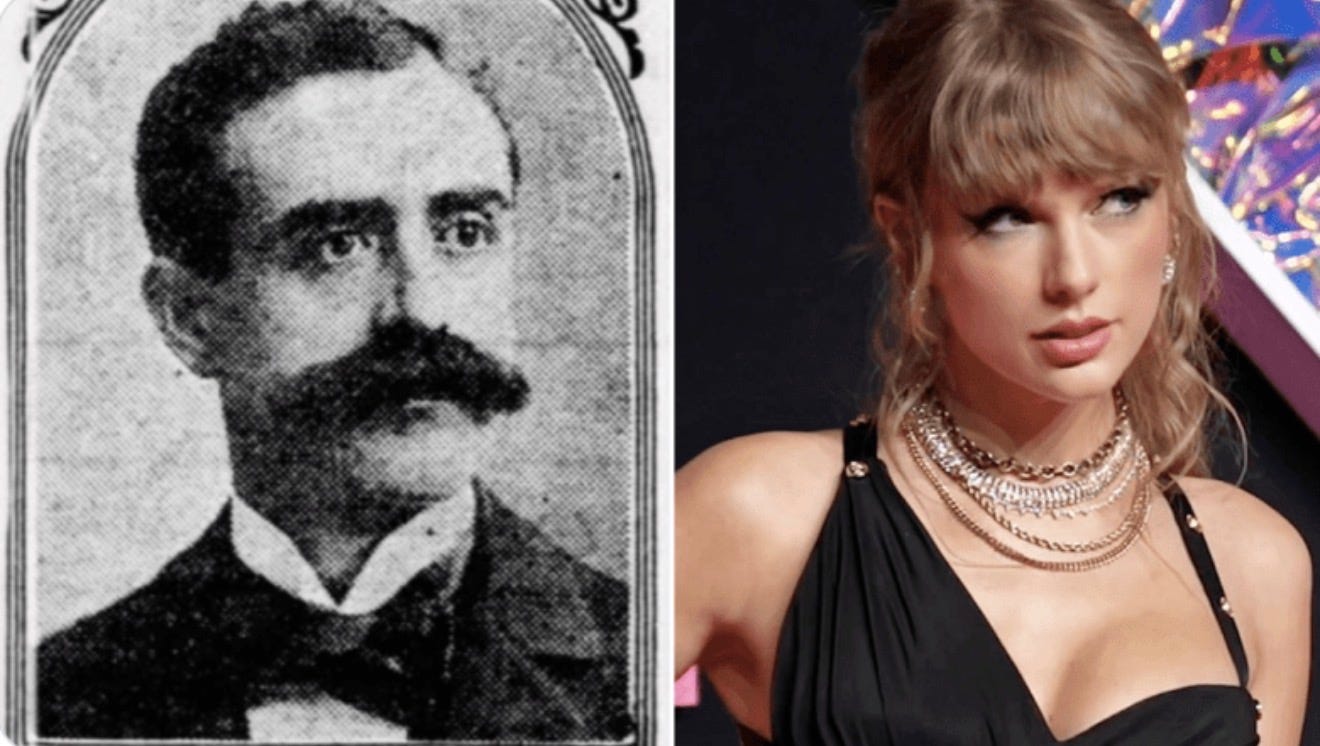
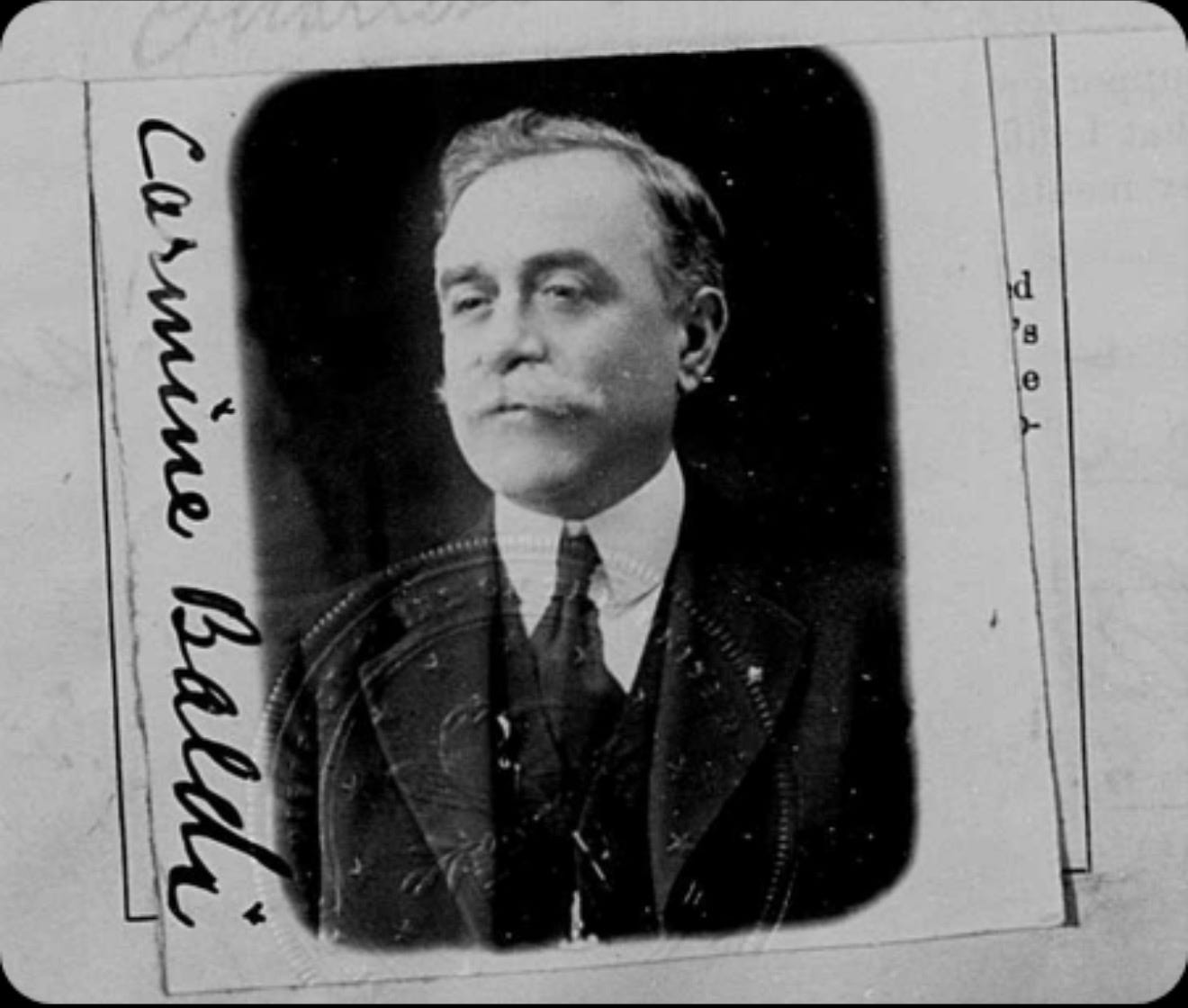
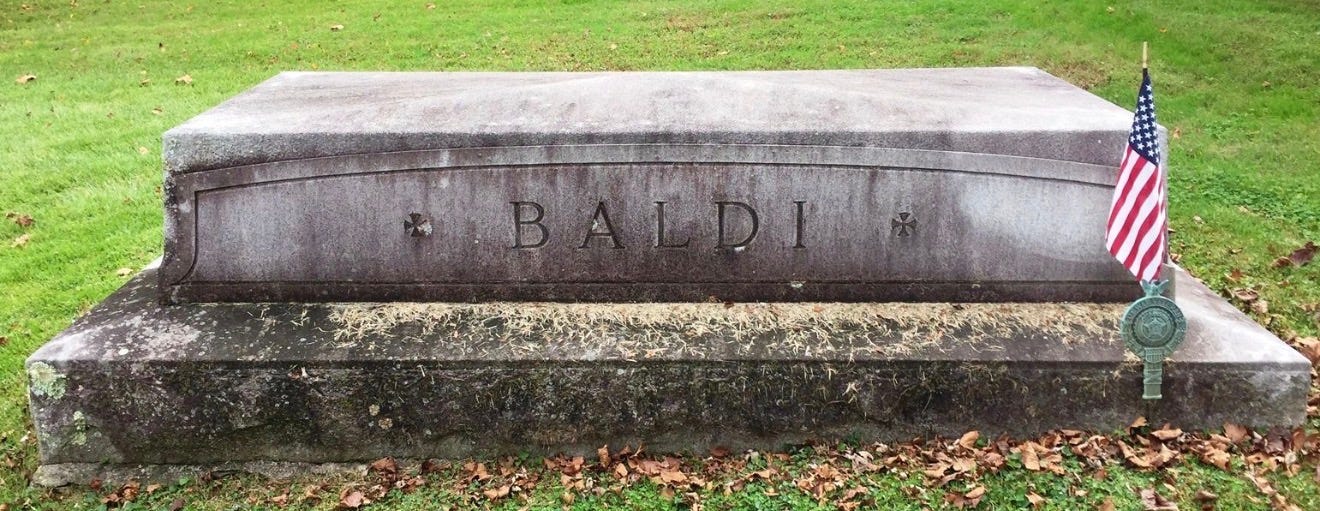
Taylor Swift — the highest-grossing solo touring artist in recorded history — is the great-great-granddaughter of a man named Charles Carmine Antonio Baldi, who died on December 28, 1930, in a South Philadelphia apartment. When Baldi died, the Italian dictator Benito Mussolini sent a personal condolence telegram to the offices of the Italian-language newspaper Baldi controlled. The two men had been, in the word of the Philadelphia Inquirer, allies and friends.[1][2]
This is not trivia. It is a thread that, when pulled, reveals something about how American power was assembled at the municipal level — through immigrant labour, private banking, ethnic media, machine politics, and the calculated management of an entire community's political loyalties. Baldi is not an anomaly. He is an archetype.
Part I: The World Baldi Left
Southern Italy After Unification
Charles Carmine Antonio Baldi was born December 2, 1862, in Castelnuovo Cilento, in the province of Salerno, in the Campania region of southern Italy — confirmed by a birth certificate located at the Museo del Cognome di Padula, Salerno, and verified in 2026. He was born into the wreckage of Italian unification.[^3]
The Risorgimento — the political unification of Italy completed in 1861 — was, from the perspective of the Mezzogiorno (southern Italy), less a liberation than a conquest. The new unified Italian state was administered from the north. Northern Italy was industrial and relatively prosperous. Southern Italy — Campania, Calabria, Sicily, Basilicata — was agricultural, impoverished, and politically abandoned. The new government imposed tariffs that effectively taxed southern produce while subsidising northern industry. Peasants who had worked the same land for generations found themselves dispossessed by a new political order that did not represent them.[^4]
The result was mass emigration. Between 1876 and the onset of World War II, roughly twenty million people left the Italian peninsula. Annual emigration averaged almost 220,000 in the period 1876 to 1900, and almost 650,000 per year from 1901 through 1915. Approximately 80 percent of the late-nineteenth and early-twentieth century immigrants to the United States came from the Mezzogiorno — the south. They were, overwhelmingly, landless agricultural labourers and subsistence farmers. Most could not read or write in any language.[5][6][7][4]
Baldi left Castelnuovo Cilento in 1876, at approximately fourteen years of age, with his younger brother. He arrived in Philadelphia with, by his own account, forty cents.[^8]
Part II: The Machine That Received Them
The Padrone System
The infrastructure that processed Italian immigrants into the American labour economy was called the padrone system. The word padrone is Italian for boss, owner, or patron. The system was not informal. It was a structured, transnational labour brokerage that operated from the villages of southern Italy to the construction sites, coal mines, and street corners of American cities.[9][10]
The mechanism worked as follows. An agent — the padrone — would travel to villages in southern Italy, often in Campania, Calabria, or Sicily, and offer families a proposition: send your son (or your husband, or yourself) to America, and I will arrange the passage, the housing, and the work. The promise of L'America — wages unimaginable at home — made the offer compelling. The reality of the arrangement was different.[4][11]
Upon arrival, workers found themselves contractually bound to the padrone. He controlled their wages, their accommodation, their food supply, and their ability to obtain other work. He took a percentage of everything they earned. He charged inflated prices for food and lodgings. He could extend their contracts unilaterally. The Library of Congress, in its primary documentation of Italian immigration, states plainly: "In practice, many padroni acted more like slave holders than managers. A padrone often controlled the wages, contracts, and food supply of the immigrants under his authority, and could keep workers on the job for weeks or months beyond their contracts."[^10]
Children were specifically targeted. Italian families in extreme poverty sent sons as young as five years old to America with padroni who promised job placement and housing in exchange for a portion of the boys' wages. Upon arrival, these children were funnelled into street labour — selling newspapers, peddling flowers, playing music on city corners — while the padrone confiscated the majority of their earnings. Those who could no longer work, or who tried to escape, were abandoned.[12][4]
The system was so pervasive that the United States Congress passed the Padrone Act of 1874 — described in contemporary commentary as America's first anti-human trafficking law — specifically to criminalize the importation of Italian and Sicilian workers under conditions of indentured servitude. The Act formally outlawed the arrangement. It did not end it. The Library of Congress records that the padrone system was not eradicated until the middle of the twentieth century. A Canadian Royal Commission on Italian Immigration, convened in 1904–1905, documented the same system operating identically in Montreal, where a padrone named Cordasco charged fees 60 to 150 percent above cost for arranging employment with the Canadian Pacific Railway — and continued demanding fees from newly arrived migrants even after he knew there was no work for them.[13][14][15][10]
The Italian State's Role
Before 1888, the Italian government exercised no formal oversight over emigration. Emigrants were, in the words of the Italian diaspora's own historical record, "in the hands of emigration agents whose job was to make money for themselves by moving emigrants". The 1888 Crispi Law attempted to bring emigration agencies under state control. It was largely ineffective.[7][16]
In 1901, Italy passed a comprehensive emigration law and created the General Commissariat of Emigration (Commissariato Generale dell'Emigrazione), operating under the Foreign Ministry. The Commissariat issued licences to carriers, regulated ticket prices, maintained health inspections at ports of embarkation, and — critically — tried to manage the remittance flows that Italian emigrants sent home. By some estimates, emigrants' remittances amounted to approximately five percent of Italian GNP by the early twentieth century.[17][18][^7]
The Italian state was not simply failing to prevent the exploitation of its citizens. It was, from 1901 forward, actively managing their export as a labour commodity and organising the financial flows that export generated. The Commissariat also negotiated with receiving countries, including attempting to suspend emigration to Brazil after reports that migrants had ended up as "quasi-slaves on large coffee plantations". The word used in the primary record is quasi-slaves.[^7]
When Mussolini came to power in 1922, the Commissariat was eventually abolished (1927) and replaced by the General Directorate of Italians Abroad — with a name change specifically designed, as the Museo dell'Emigrazione Italiana documents, "to hide the economic problems that drove Italians to leave Italy". Under fascism, emigration was redirected toward Italian colonies. And from 1938, over 500,000 Italians were sent to Nazi Germany as contracted labour — the same structural mechanism, now formalised between two fascist states.[^16]
Part III: What Baldi Built, and How
From Peddler to Power Broker
Baldi arrived in Philadelphia in 1876–1877. He began, like thousands of other southern Italian immigrants, as a street vendor selling lemons. The transition from peddler to power broker took approximately a decade, and it turned on a single moment documented in the family's own oral history and recorded by the Italian American Herald in 2024.[2][8]
In 1883, the Italian consul in Philadelphia needed an interpreter to negotiate a labour dispute involving Italian workers on the Schuylkill Valley Railroad. He sent Baldi. This was not a random selection. The consul was deploying an Italian community figure who could move between the immigrant labour force and American institutional power — in both directions. Baldi negotiated the dispute. He then did something that defined the next fifty years of his life: he identified a commercial opportunity inside the crisis.
The railroad was using expensive anthracite coal as track ballast. Baldi located a gravel bank, contracted the railroad to substitute gravel, and shipped the displaced coal back to Philadelphia. He built a coal yard at 12th Street and Washington Avenue, South Philadelphia, and later acquired a coal mine in Schuylkill County, Pennsylvania. He had converted a moment of labour crisis — in which Italian immigrant workers were the raw material — into a private supply chain. This is the structural move that defines his career.[19][8]
The Interlocking Empire
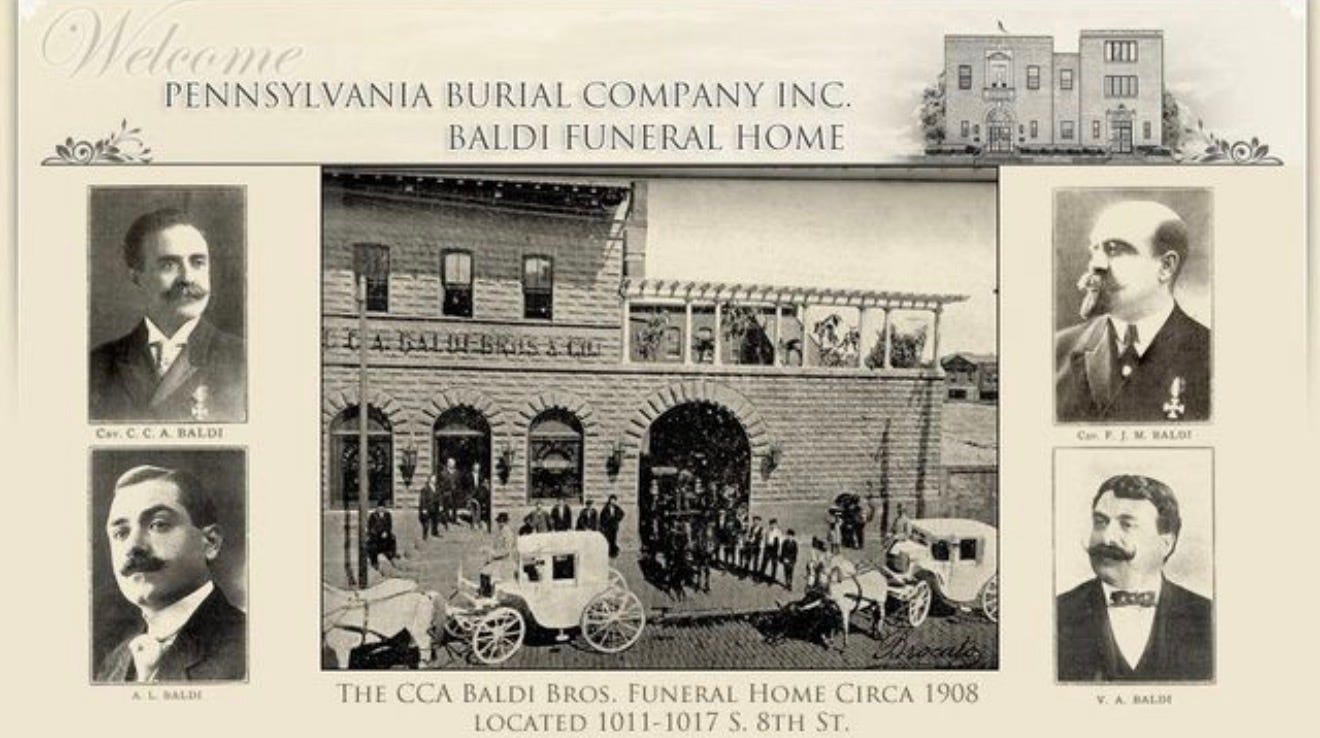
By approximately 1900, the Baldi brothers had built a cluster of enterprises centred on the 8th and Kimball Street area of South Philadelphia — confirmed by a 1908 photograph of the premises, a 2025 Philadelphia Historic Register nomination for the property, and Pennsylvania Supreme Court records:[20][19][^21]
C.C.A. Baldi Bros. Bank — a private savings and exchange bank. The Pennsylvania Supreme Court case Baldi v. Baldi et al. (325 Pa. 177, 1937) records deposits of $50,000 and $76,000 (the latter in bonds allegedly stolen from a safe deposit box at the bank) and adjudicates its legal character as a private contractual arrangement outside normal bank-depositor law.[^20]
L'Opinione — Philadelphia's only Italian-language daily newspaper. The Library of Congress Italian American Periodicals catalogue identifies C.C.A. Baldi Sr. as its editor.[^22]
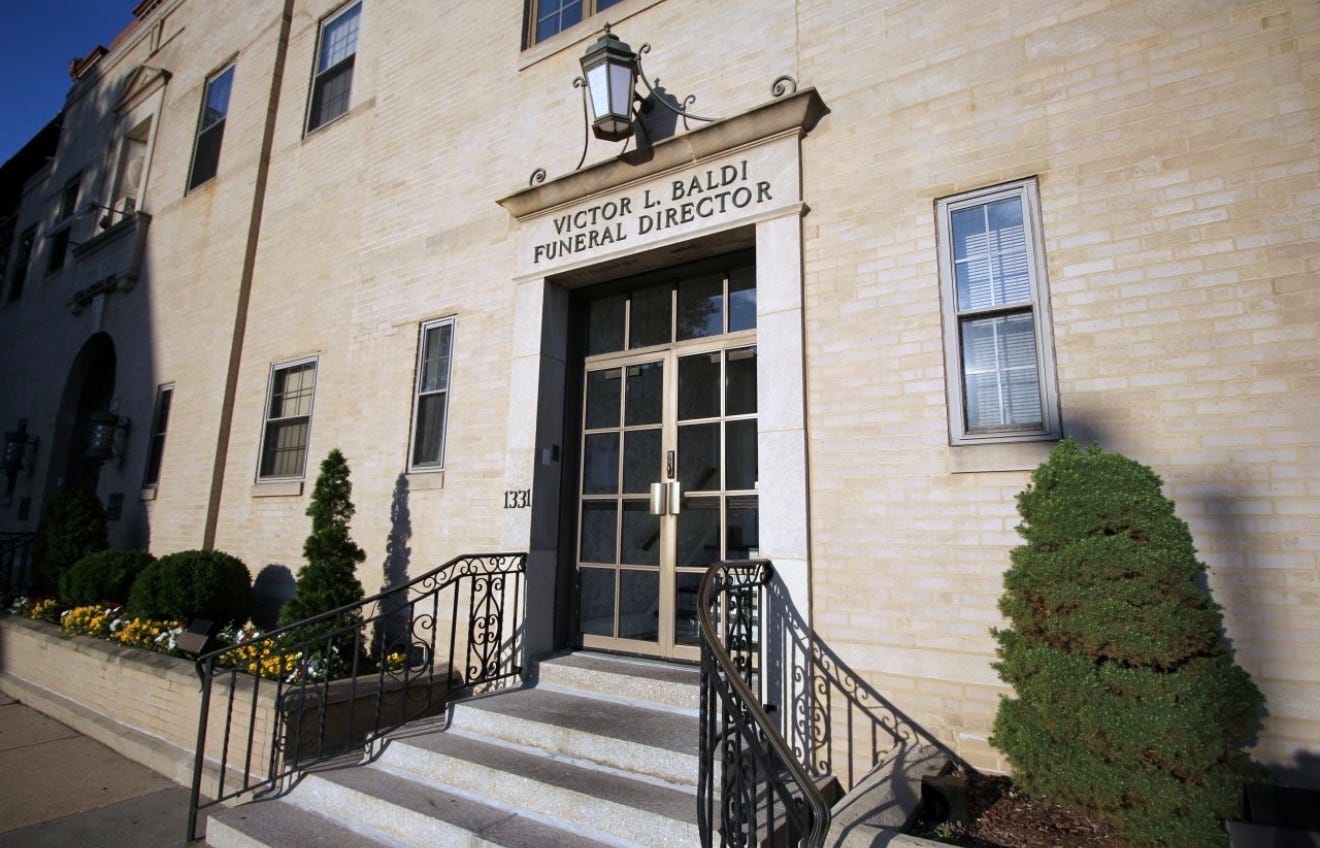
C.C.A. Baldi Bros. Funeral Home — at 1011–1017 South 8th Street, operational by approximately 1900.[23][21]
Coal yard at 12th and Washington Avenue; coal mine in Schuylkill County.[19][8]
Real estate and insurance operations.[^19]
The brothers involved were Virgilio (the plaintiff in the 1937 Supreme Court case), Alfonso (who managed the funeral home), Joseph/Giuseppi, and Fioravanti/Ferdinando.[8][23][^20]
Why a Private Bank Matters
The private bank is not incidental. For Italian immigrants in the late nineteenth and early twentieth century, the formal American banking system was effectively inaccessible — language barriers, documentation requirements, and systematic discrimination excluded recent arrivals from mainstream financial institutions. Padroni typically provided the banking function in immigrant communities: collecting wages, holding savings, arranging remittances to Italy. The Massachusetts Historical Society documents that padroni specifically offered "banking for the immigrants; providing them with a 'safe' place to save the money they earned and a way to 'send' money home to Italy".[^11]
Baldi's bank occupied exactly this role — but at scale, and with the added authority of his community standing. He was the financial intermediary for a captive community. When his brother Virgilio sued for $76,000 in bonds he claimed had been stolen from the bank's safe deposit boxes, the Pennsylvania Supreme Court found that the deposits were contractual arrangements, not standard bank accounts. The structural ambiguity — a bank that was legally not quite a bank — is characteristic of the padrone financial model.[^20]
Part IV: The Political Control System
"The Broker"
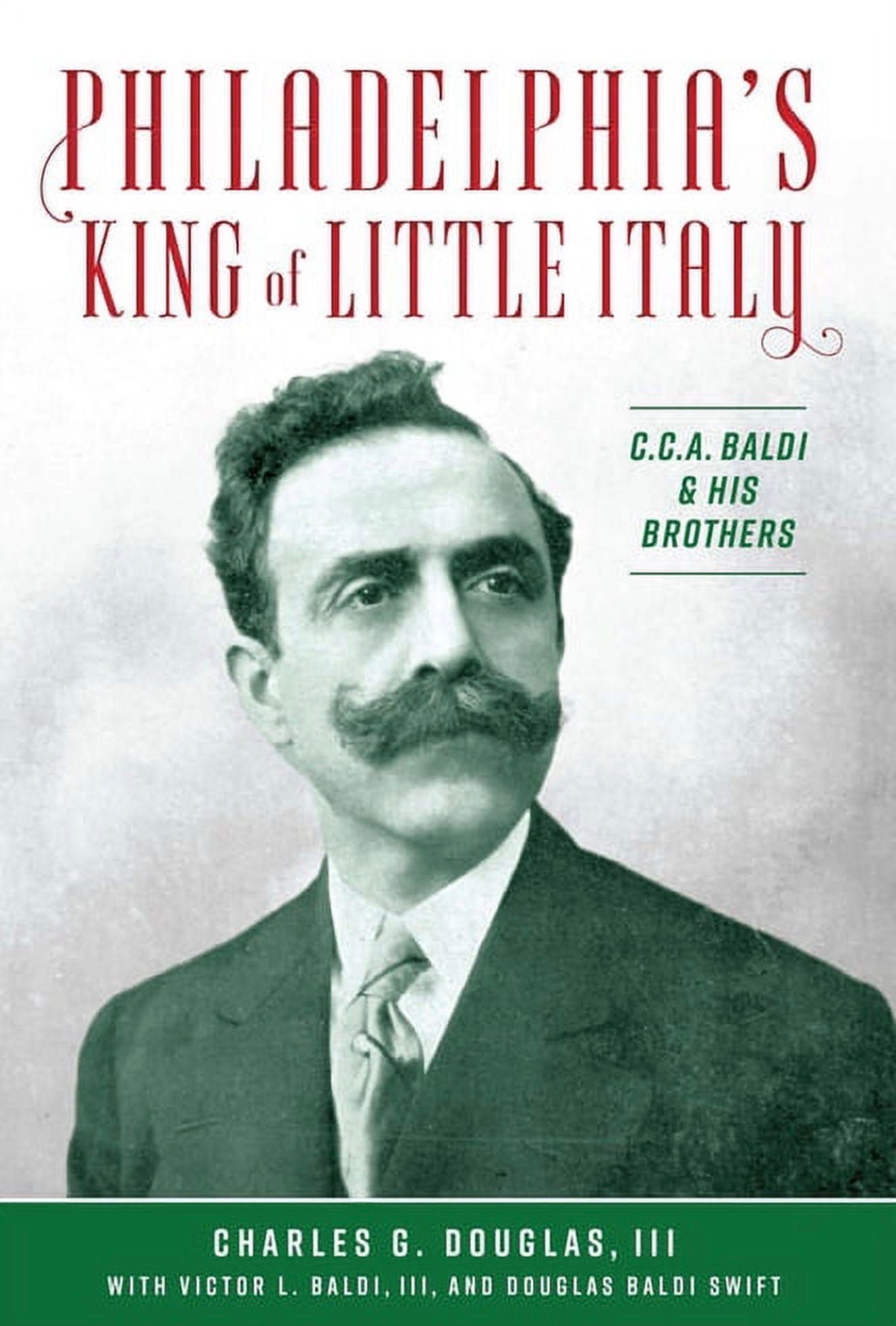
Two peer-reviewed academic papers published in JSTOR identify C.C.A. Baldi Sr. explicitly as "the broker between the GOP organisation and the Italian-American community in Philadelphia". This is the clearest formulation of what he was. He was not simply a successful businessman. He was a political infrastructure operator.[24][25]
The Republican machine that dominated Philadelphia politics from the 1860s through the 1930s required predictable bloc votes from the city's rapidly expanding immigrant wards. Italian immigrants, arriving in the tens of thousands and concentrated in South Philadelphia, represented a significant electoral asset — if they could be organised. The machine provided patronage: contracts, jobs, protection from prosecution, access to city services. The broker provided delivery: getting the votes to the machine in exchange for the patronage flowing back to the community.[26][25][^24]
Baldi's instruments for this were the bank, the newspaper, and his personal authority as the figure who had organised the community infrastructure. L'Opinione was the only daily news source for non-English-speaking Italian immigrants in Philadelphia. It told them what to think about American politics. The bank held their money. The funeral home managed their deaths. Baldi had positioned himself at every point of material dependency in immigrant life.[11][22][19][21]
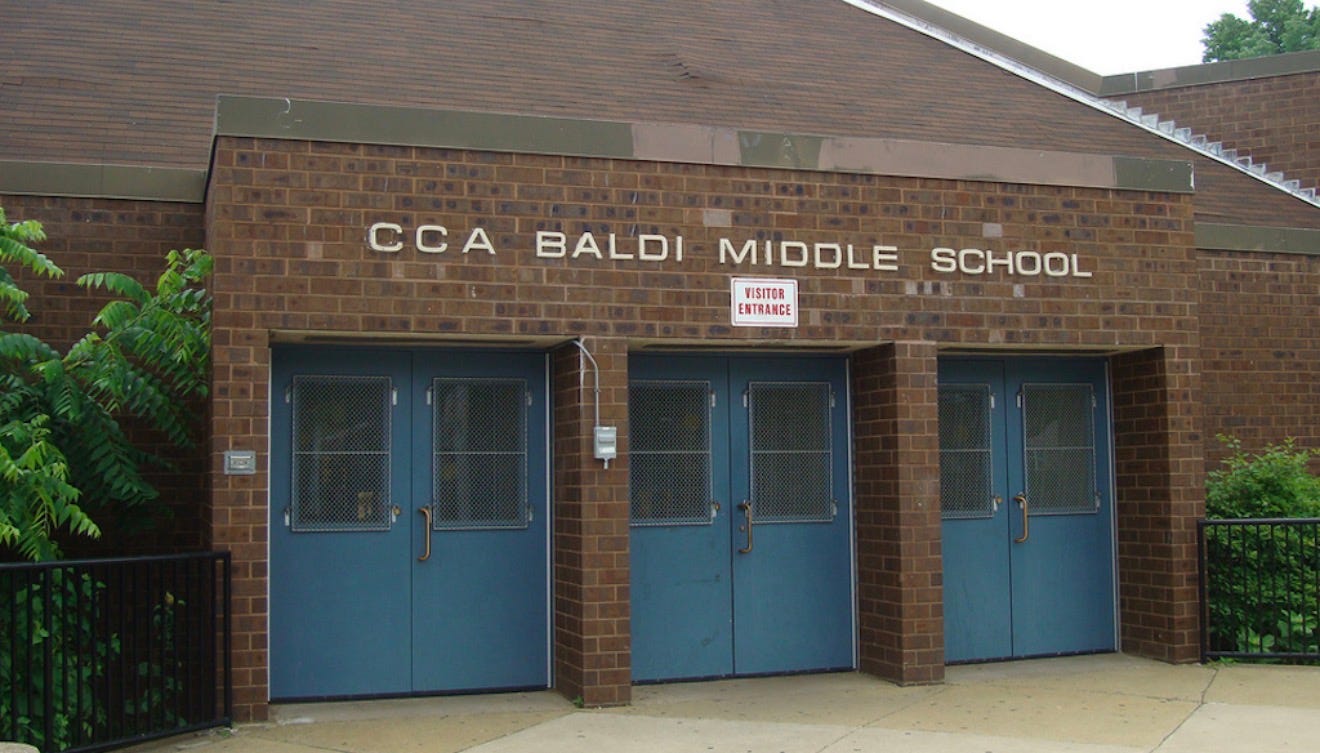
In 1915, Baldi was appointed to the Philadelphia Board of Education — the first immigrant to hold that position. He served until his death in 1930. By the time the New York Times ran his death notice on December 29, 1930, he was described as "leader of Philadelphia's Italian-American colony" — a phrase that reveals the colonial logic of the arrangement precisely.[1][2][^23]
Victor Emmanuel III and the Knighthood

In 1907 and 1911, C.C.A. Baldi and his brother Joseph were knighted by King Victor Emmanuel III of Italy — the king who would later, in 1922, invite Mussolini to form his government, and who in 1938 signed the racial laws restricting the civil rights of Jewish Italians.[8][27]
The instrument was the Order of the Crown of Italy (Ordine della Corona d'Italia), a state order founded in 1868 specifically to reward civil and military merit, including within the diaspora. By the early 1900s it had tens of thousands of recipients and was used explicitly as a soft-power instrument to maintain the Italian state's relationship with prominent emigrants abroad. The 1911 knighthood coincided with Victor Emmanuel III personally presiding over the Esposizione Internazionale di Torino — marking the 50th anniversary of Italian unification, a moment of intensive state outreach to the diaspora.[28][29][30][31]
The Italian consul had been using Baldi as an institutional intermediary since 1883. The knighthood formalised that relationship. The same king who honoured Baldi in 1911 enabled Mussolini in 1922. The lineage is continuous.[27][8]
Part V: Fascism in South Philadelphia
"A Second Napoleon"
On July 4, 1923, the Philadelphia Inquirer ran a headline: "A Second Napoleon." The quote came from Baldi, describing Benito Mussolini, whom he had just visited in Italy following Mussolini's March on Rome and seizure of power the previous year. The same article described Baldi as "leader of American supporters of the Fascisti movement".[^1]
That same year, a bomb destroyed Baldi's home in Northwest Philadelphia. Press speculation attributed it to opponents of his fascist politics, though no prosecution was documented. His alignment did not change.[32][1]
Why Italian Americans Supported Mussolini
The academic record on this is substantial. The Journal of Italian American Studies open syllabus at CUNY documents that the fascination of Italian immigrants with fascism "foreran Mussolini's rise to power" and drew on "recently developed nationalistic feelings" and "ethnic pride" stemming from the Duce's alleged achievements. For a community that had been lynched, economically exploited, racially classified as non-white, denied union membership, and told by mainstream American society that they were culturally inferior, Mussolini represented something simple: an Italian who was taken seriously on the world stage.[4][33][^34]
A University of Padua historian, Professor Stefano Luconi, documents that this sentiment was reinforced by the Catholic establishment — which encouraged Italian Americans to support the fascist regime — and persisted until Italy joined Nazi Germany in World War II and Mussolini declared war on the United States in December 1941.[33][35]
Baldi was the most prominent Philadelphia expression of this tendency. He had the newspaper to amplify it, the bank to ground it, and the political machine relationship to insulate it.[24][1][^22]
Mussolini's Telegram
When Baldi died on December 28, 1930, Mussolini sent a personal condolence telegram to the offices of L'Opinione. In the same period, after a 1933 bombing at the home of another prominent Italian-American, Giovanni di Silvestro, a message of condolence arrived from Rome signed "Mussolini" — documented in the New York Times on January 30, 1933. The Italian state was actively maintaining its diaspora influence network through exactly this kind of personal communication to community leaders and their media institutions.[1][36]
Part VI: The Family Line
How Baldi Became Swift
The genealogical record, confirmed by primary documentation including the 2026 birth certificate discovery at the Museo del Cognome di Padula, Salerno, establishes the following descent:[3][37]
Generation
Person
Notes
1st
Charles C.A. Baldi (1862–1930)
Castelnuovo Cilento, Campania
2nd
Louise Eurindine Baldi (daughter)
Born Philadelphia, married Charles Gwynn Douglas
3rd
Rose Baldi Douglas (granddaughter, b. July 30, 1920)
Born Philadelphia
4th
Scott Kingsley Swift (great-grandson)
Married Andrea Finlay; born Reading, Pennsylvania
5th
Taylor Swift (great-great-granddaughter)
Born 1989, West Reading, Pennsylvania
Rose Baldi Douglas married Archie Dean Swift Jr. on March 21, 1942, in Roxborough, Pennsylvania. Scott Swift was their son. Taylor Swift was born to Scott and Andrea Swift in 1989.[38][39][^37]
The connection is documented, not speculative. C.C.A. Baldi's great-great-granddaughter is, by any measure of American popular culture, the most famous person alive today.
Part VII: The System, Not Just the Man
What the Padrone Structure Represents
Baldi is not unusual. He is legible. He is the version of this story that has a paper trail — the New York Times death notice, the Pennsylvania Supreme Court case, the peer-reviewed academic papers, the knighthood records, the Philadelphia Inquirer headlines, the Mussolini telegram. Most padroni left none of these things.
What the system represents, when examined structurally, is a specific form of colonial extraction applied to a European immigrant population:
Poverty engineered at source — Italian unification extracted wealth from the south to subsidise northern industrialisation, creating the emigration pressure.[^4]
Recruitment at the point of desperation — padroni operated in the villages of Campania, Cilento, Calabria, and Sicily, converting family poverty into labour contracts.[10][12]
Debt-bonded transport — passage to America created an immediate debt to the padrone.[^11]
Labour capture at destination — the padrone controlled wages, accommodation, food, and financial services at the destination city, preventing any accumulation of independent capital.[10][11]
Political neutralisation — community leaders with the right machine relationships managed the political expression of the immigrant community, delivering bloc votes in exchange for patronage that benefited the leaders personally.[24][25]
Information control — ethnic-language newspapers, controlled by figures like Baldi, determined what the community knew about American politics, Italian politics, and their own situation.[40][22]
State capture at origin — from 1901, the Italian state's Commissariat formally managed the emigration pipeline and the remittance flows, treating the labour export of its own citizens as a national financial instrument.[17][7]
The Padrone Act of 1874 named this as trafficking. It did not stop it.[14][15]
Coal, Children, and Falsified Birth Certificates
The Pennsylvania coal industry's specific use of Italian immigrant child labour is documented in primary photographic and Congressional record. Lewis Hine's photographs for the Department of Labor's Children's Bureau documented Italian immigrant "breaker boys" in Pennsylvania coal operations — children as young as eight sorting slate from coal with bare hands for 80 cents a day. In 1900, the census recorded between 1.5 and 2 million children in wage labour in the United States — one in six children.[41][42][^43]
An Instagram documentation of Hine's record, drawn from archival sources, states: "The coal companies knew they were underage. So they falsified the birth certificates.".[^41]
In Philadelphia around the turn of the century, children's labour accounted for between 28 and 33 percent of household income for native-born two-parent families, and higher percentages for immigrant families. The exploitation was not incidental to the economy. It was structural.[^44]
Between 1890 and 1920, more than 60,000 Italians settled in Philadelphia. By 1890, nearly 90 percent of the labourers in New York's Department of Public Works were Italian immigrants. The political machines in both cities — Republican in Philadelphia, Tammany Hall in New York — managed this workforce through brokers. Baldi was Philadelphia's.[45][46]
Part VIII: The Violence at the Margins
Lynching
The exploitation was enforced by the threat of violence — some of it from within the Italian community (Black Hand extortion rackets, documented in Philadelphia, New York, Chicago, and the coal towns of Pennsylvania and West Virginia) and some of it from outside, in the form of lynching.[47][48][^49]
Between 1877 and 1922, Italian immigrants were lynched across the United States — in Ohio, Mississippi, Louisiana, Florida, Colorado, West Virginia, Missouri, and New York. The most famous single incident was the March 14–15, 1891 massacre in New Orleans, when eleven Italian immigrants were dragged from jail and killed by a mob after their acquittal in a murder trial. The first documented Italian-American lynching was Giovanni Chiesa in Trumbull, Ohio, on July 27, 1873 — killed because he had been brought in as a strikebreaker by the mine owners, and the existing miners' union objected. The mechanism of the violence reveals the structure: Italian immigrant labour was used as a weapon against organised labour, and then the Italian immigrants were killed for the predictable consequences.[^4]
The Racial Classification Problem
From the passage of the 1790 Naturalization Act — which restricted citizenship to "free White persons" — through the early twentieth century, Italian immigrants existed in an ambiguous racial category in American law and social practice. Southern Italians were darker in complexion than Northern European immigrants. Courts debated whether they qualified as white under the statute. They were systematically excluded from unions that organised other workers. The path to legal whiteness required assimilation — learning English, moving to the suburbs, intermarrying with Northern European groups, and making patriotic military contributions.[4][10]
By World War II, this assimilation was substantially complete. The Civil Rights era of the 1960s, with its Black-White binary, consolidated Italian-Americans' position within the expanding definition of whiteness. The historical memory of the padrone period, the lynchings, and the indentured servitude largely did not survive this transition.[^4]
References
Taylor Swift's family history includes this 19th century Philly civic ... - CCA Baldi was a major figure in Philadelphia's Italian American community. His family would go on to...
CHARLES C.A. BALDI, BANKER, FOUND DEAD - ny times - Charles C. A. Baldi, banker, merchant, newspaper publisher, philanthropist and leader of Philadelphi...
Taylor Swift's Italian Roots. A Village in Campania Has the Proof. - A birth certificate found in Italian archives confirms Taylor Swift's great-great-grandfather was bo...
The Dark and Forgotten History of Italian Immigration I bet You Didn't ... - In the case of Italians, many went through the “padrone” system. This was a labor arrangement exploi...
Italians - Global Boston - The peak period of Italian immigration to the United States occurred between 1880 and 1921, when app...
[PDF] The Italian Emigration of Modern Times: Relations Between Italy and ... - In the late 1800s, the United States was the great destination of Italian emigrants. In North Americ...
Italian diaspora - Wikipedia - During the first few emigration was not particularly controlled by the state. Emigrants were often i...
Relatives come from far and wide to celebrate remarkable Baldi family - Along with his brothers, Joseph, Alfonso and Virgilio, they established a bank, funeral home, and th...
The Italian-American padrone system and its labor brokers - Facebook - The system was a complex network of business relationships formed to meet a growing need for skilled...
Working Across the Country | Italian | Immigration and Relocation in ... - The padroni were labor brokers, sometimes immigrants themselves, who recruited Italian immigrants fo...
Immigrants Needing Protection from Themselves? The Padrone ... - The Padrone -from the Italian word for manager or boss- were labor brokers. Although largely unheard...
America's “White Slaves” Padroni system, Italian immigrants, child ... - Men called Padroni came to their villages, offering opportunity. They said they'd take the boys to A...
Royal Commission on Italian Immigration, 1904-1905 - The Royal Commission on Italian Immigration was called in 1904 to investigate the exploitation of It...
Hon. George Mentz (JD MBA CILS CWM® Int'l Lawyer Commissioner) - With the Padrone Act of 1874, it was the formal end of Italian and Sicilian indentured slavery in Ne...
Italian Emancipation Day: Congress passes Anti-Padrone Act - ... Italian Emancipation Day of 1874 and America's first anti- human trafficking law. ... of exploit...
A09 Emigration and politics | MEI - The General Emigration Commissariat was abolished and replaced by the General Directorate of Italian...
[PDF] Sending States' Transnational Interventions in Politics, Culture, and ... - The 1901 law created the Emigration Commissariat to shepherd the nation's interests in migration abr...
[PDF] Italian Emigration in the Post-Unification Period (1861-1971) - against emigrants, being recorded both in Italy and abroad. In 1901 law was passed setting up the Ge...
Taylor Swift's great-grandpa's former Philly home gets historic ... - Baldi Funeral Home on South Eighth Street – all by the turn of the century. That C.C.A. is also Read...
BALDI v. BALDI ET AL | Pa. | Judgment | Law - CaseMine - 2. Plaintiff had rented a safe deposit box from the bank. He claimed to have had $76,000 of bonds in...
A 1908 photo of the CCA Baldi Bros. Funeral Home at 1011-1017 S ... - Besides owning and operating the funeral home, Baldi and his younger brothers also organized a bank,...
Pennsylvania - Italian American Periodicals at the Library of Congress - ... Charles Carmine Antonio Baldi, Sr. (1862-1930) editor of L'Opinione, another Italian American ne...
Pennsylvania Burial Company and Baldi Funeral Home - The roots of Baldi Funeral Home run deep in the heart of Philadelphia's immigrant story. In 1876, at...
Bringing out the Italian-American Vote in Philadelphia - jstor - heavily dependent on the economic help of the machine. Charles C.A. Baldi, Sr., was the broker betwe...
The Italian-Language Press, Italian American Voters, and Political ... - Charles CA. Baldi Sr. was the broker of Philadelphia's Republican machine within the local Italian-A...
[PDF] Immigrant Group Size and Political Mobilization - NBER - There is substantial variation in the distribution of immigrants across wards with groups of Czechs,...
Italian king's reburial reopens old wounds - BBC News - The body of King Victor Emmanuel III has returned to Italy from Egypt, 70 years after he died there ...
Vittorio Emanuele III, King of Italy - Turin 1911 - Victor Emmanuel III was King of Italy from 29 July 1900 until his abdication on 9 May 1946. His reig...
Order of the Crown of Italy - Wikipedia - The Order of the Crown of Italy was founded as a national order in 1868 by King Vittorio Emanuele II...
REGARDING THE ORDER OF THE CROWN OF ITALY - The Order of the Crown of Italy counted among its ranks tens of thousands of Knights and Dames from ...
Victor Emmanuel III and the inauguration in 1911 | Vittoriano - It was Victor Emmanuel III himself who set the date of the inauguration ceremony in 1911, as a key e...
Article clipped from The Philadelphia Inquirer - Newspapers.com™ - Bomb Shock Fatal to Woman Living Near Baldi Home Continued From First Page ris, who was formerly a m...
Fascism | Italian American Studies Open Syllabus | Manifold @CUNY - The fascination of many Italian immigrants and their US-born progeny with fascism foreran Benito Mus...
Little Italy & Mussolini: From Hype to Heartbreak - YouTube - The untold story of why many Italian Americans once admired Mussolini—and how WWII changed everythin...
How Fascism Made Italian Americans Feel Special - YouTube - ... Mussolini's Italy; how Catholic identity, community leaders, and the image of an orderly, modern...
GETS IL DUCE'S SYMPATHY.; Di Silvestro Receives Message From ... - ... bomb demolished his South Philadelphia home, received today a message of condolence from Premier...
Family of Taylor Swift - Taylor Swift Wiki | Fandom - Charles Carmine Antonio Baldi Great-Great Grandfather, December 2, 1862 - December 28, 1930. He was ...
Charles C. A. Baldi - Wikipedia - Charles Carmine Antonio Baldi … lived in Philadelphia, Pennsylvania. Chuck Douglas (great-grandson) ...
Charles Carmine Antonio Baldi Family Group | Ahnentafel No: 22 - Charles Carmine Antonio Baldi View famous kin of Charles Carmine Antonio Baldi. 2nd Great-grandfathe...
The Italian-Language Press, Italian American Voters, and Political ... - On October 13, 1944, President Franklin D. Roosevelt instructed his aide, Edwin M. Watson, to send f...
Children Who Never Saw a Classroom In the coal mines ... - Instagram - In the coal mines of Pennsylvania, Italian immigrant families faced an impossible choice — and their...
Kids at Work: Congress and Child Labor | National Archives - Summary: This lesson uses primary sources to engage students in studying the Progressive Era issue o...
Child Labor | Classroom Materials at the Library of Congress - Child labor and the reform movement opposed to it documented in photographs, cartoons, audio intervi...
The Child Labor of Early Capitalism Is Making a Big Comeback in ... - Italian padrones expedited the exploitation of immigrant kids while treating them brutally. They wer...
Library of Congress Presentation; Italian Immigration… - Folkstreams - In 1890, nearly 90 percent of the laborers in New York's Department of Public Works were Italian imm...
The Italian Legacy in Philadelphia: History,… - Broad Street Review - Between 1890 and 1920, more than 60,000 Italians settled in Philadelphia, but immigration laws soon ...
Black Hand | The Godfather Wiki - Fandom - ... Godfather[src] The Black Hand, or La Mano Nera in Italian, was a type of extortion racket. It wa...
Black Hand | Italian Mafia, Sicilian Immigrants & Crime Syndicate - Black Hand, any of several extortion rackets run by immigrant Sicilian and Italian gangsters in the ...
The Black Hand | The Early History of Heilwood - Stabbings, shootings, and property damage came to be associated with a group known as the Black Hand...
Baldi Middle School Teachers File Potentially 'Precedent-Setting ... - Three teachers at Philadelphia's Baldi Middle School have just filed a federal complaint with the Un...
Comments
Nothing yet. Say the first thing.
Sign in to join the conversation.