
My dear friends, I have two pieces of great news that I want to share with you!
My latest piece in the Guardian was published last week. If you want to read a piece on how to balance hope, fear, and love in your relationship with God, then look no further:
2. I recorded a second episode with the Abbasid History Podcast. This episode focuses on Ferdowsi, the author of the Shahnameh. Please do give it a listen and share your thoughts!
And now, back to regular schedule my good sirs and madams :)
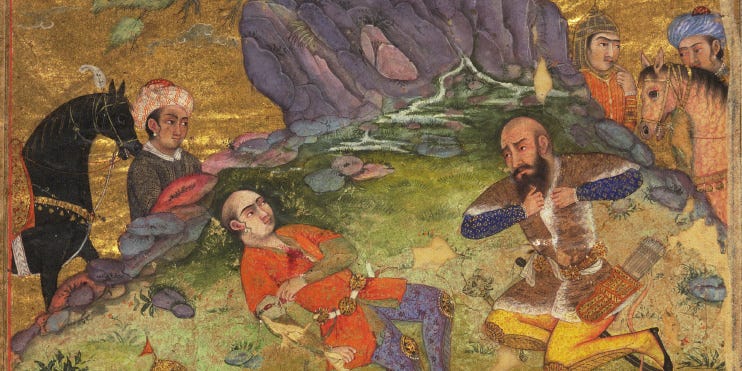
Persian literature is full of sorrow and tragedy, and no poem embodies this more than the Shahnameh; the Shahnameh is full of heroes, and there is no greater hero than Rostam; Rostam’s life is full of achievements and tragedies, and there is no greater tragedy than that of Rostam and Sohrab.
Rostam is Sohrab’s father, although the two are unaware of this when they meet in single combat. Rostam is the legendary hero of the Persians, their fiercest warrior, old in age but still a force to be reckoned with. Sohrab is the young hero of the Turanians, the mortal enemies of the Persians.
Sohrab is anxious to meet his father Rostam, whom he has heard a great deal about, but never met before. He even spies on the Persian army, trying to identify Rostam, offering wealth and riches to one soldier who would identify Rostam for him. Soldiers from both sides remark on their uncanny resemblances. When they first meet in combat the similarities between them do not pass without comment:
Then Sohrab said, "I'm going to question you.
Your answer must be honest, straight, and true:
I think that you're Rustam, and from the clan
Of warlike Sam and noble Nariman."
Rustam replied, "I'm not Rustam, I claim
No kinship with that clan or noble name:
Rostam's a champion, I'm a slave — I own
no royal wealth or crown or kingly throne."
And Sohrab's hopes were changed then to despair,
Darkening before his gaze the sunlit air.
Sohrab and Rostam then engage in long, fierce battles in which, for the most part, they are evenly matched. Sohrab eventually gains the upper hand and is on the verge of killing Rostam, before Rostam remarks that killing him in such a way would lack honour. Sohrab foolishly relents, and Rustam leaves the battlefield to rest and replenish.
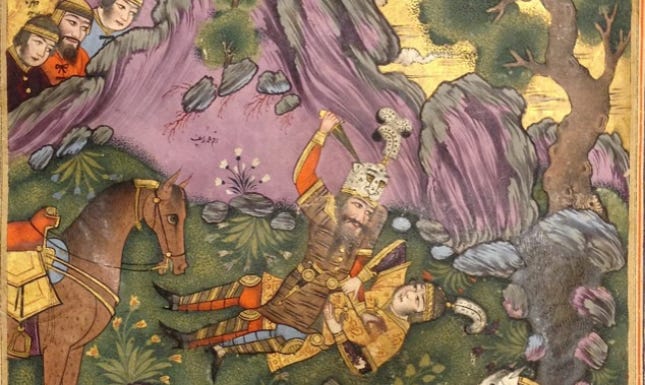
They meet again for the final battle in which Rostam overcomes Sohrab, plunging a dagger into his chest. It is here that Sohrab speaks his final words, words that have echoed for over a thousand years in Persian literature:
I brought this on myself, this is from me,
And Fate has merely handed you the key
To my brief life: not you but heaven’s vault —
Which raised me and then killed me — is at fault.
Love for my father led me here to die.
My mother gave me signs to know him by,
And you could be a fish within the sea,
Or pitch black, lost in night’s obscurity,
Or be a star in heaven’s endless space,
Or vanish from the earth and leave no trace,
But still my father, when he knows I’m dead,
Will bring down condign vengeance on your head.
One from this noble band will take this sign
To Rostam’s hands, and tell him it was mine,
And say I sought him always, far and wide,
And that, at last, in seeking him, I died.
When Rostam heard the warrior's words, his head whirled and the earth turned dark before his eyes, and when he came back to himself, he roared in an agony of anguish and asked what it was that the youth had which was a sign from Rostam, the most cursed of all heroes.
"If then you are Rostam," said the youth, "and you killed me, your wits were dimmed by an evil nature. I tried in every way to guide you, but no love of yours responded. Open the straps that bind my armor and look on my naked body. When the battle drums sounded before my door, my mother came to me, her eyes awash with tears, her soul in torment to see me leave. She bound a clasp on my arm and said, 'Take this in memory of your father, and watch for when it will be useful to you' but now it shows its power too late, and the son is laid low before his father." And when Rostam opened the boy's armor and saw the clasp he tore at his own clothes in grief, saying. "All men praised your bravery, and I have killed you with my own hands." Violently he wept and tore his hair and heaped dust on his head. Sohrab said, "By this you make things worse. You must not weep what point is there in wounding yourself like this? What happened is what had to happen."1
My dear friends, I have a further request to make of you. I am attaching here a fundraiser which I hope you guys can contribute to, with any amount possible. Your contributions will brighten the day of someone who has seen endured the worst of tragedies over the past 16 months, and help them rebuild their life.
All translated excerpts are sourced from Dick Davis’ translation of the Shahnameh.
Comments
Nothing yet. Say the first thing.
Sign in to join the conversation.