
This isn’t your usual Numinous post where I share my reflections, translations, and punny jokes. Instead I want to share two passages from two different books, both of which have given me much to think about. One has absolutely nothing to do with Persian literature, and the other has absolutely everything to do with Persian literature. Both are absolutely worth your time.
Passage/Reflection 1:
Earlier this week, as I was preparing to teach a course on Ancient Greek mythology, I came across one of the most beautiful and tragic passages I’ve ever read. John Davies, a poet and reader of this blog, restacked the passage and noted how it evoked memories of his own mother’s passing. I also hope that it stirs something within you. The passage is quoted here below, translated by Richmond Lattimore:
So she spoke, but I, pondering it in my heart, yet wished to take the soul of my dead mother in my arms. Three times I started toward her, and my heart was urgent to hold her, and three times she fluttered out of my hands like a shadow or a dream, and the sorrow sharpened at the heart within me, and so I spoke to her and addressed her in winged words, saying:
"Mother, why will you not wait for me, when I am trying to hold you, so that even in Hades' with our arms embracing we can both take the satisfaction of dismal mourning? Or are you nothing but an image that proud Persephone sent my way, to make me grieve all the more for sorrow?"
- Odyssey, Book XI.
Passage/Reflection 2
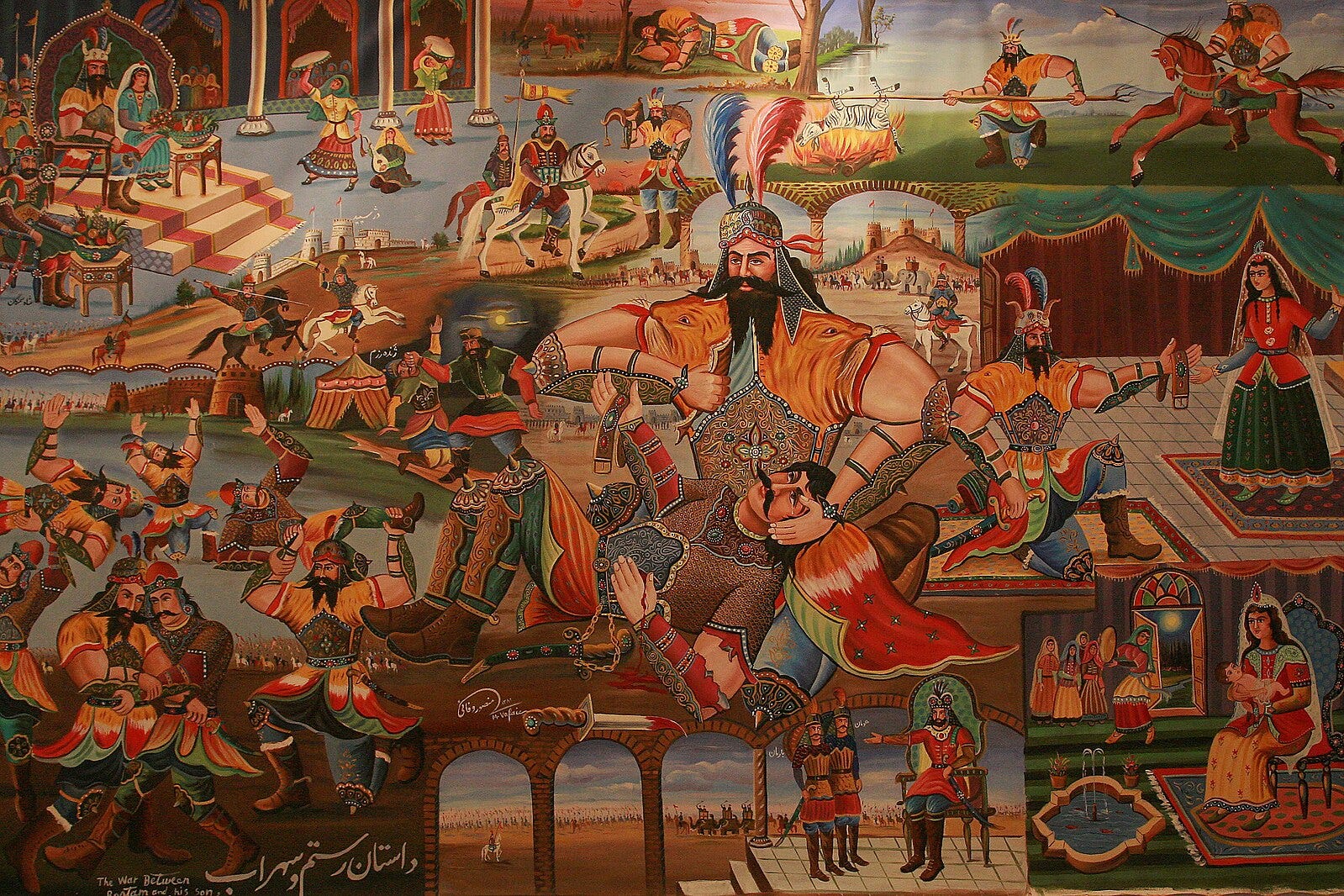
Earlier this week, I was also preparing for my next appearance on the Abbasid History Podcast (I seem to be doing a lot of preparing these days). I came across the following passage in the Foreword to the Shahnameh, or The Book of Kings. Composed by Ferdowsi, the Shahnameh is the national epic of Persian speaking peoples, and amongst the masterpieces of world literature. But Ferdowsi’s poetry isn’t what gripped me — if you are interested then check out the podcast episode next week.. Rather, it was Azar Nafisi’s Foreword wherein he described literature as a homeland. The passage is quoted here below:
My father always insisted that Persians basically did not have a home, except in their literature, especially their poetry. This country, our country, he would say, has been attacked and invaded numerous times, and each time, when Persians had lost their sense of their own history, culture and language, they found their poets as the true guardians of their true home. Citing the poet Ferdowsi and how, after the Arab invasion of Persia, he rescued and redefined his nation's identity and culture through writing the epic of Persian mythology and history in his Book of Kings, my father would say, We have no other home but this, pointing to the invisible book, this, he would repeat is our home, always, for you and your brother, and your children and your children's children.
Let’s chat in the Comments section! Please feel free to share any passages that you’ve read recently that resonated with you, particularly those passages that made you feel that they were composed solely for you.
Thanks for reading Numinous! Subscribe for free to receive new posts and support my work.
Comments
Nothing yet. Say the first thing.
Sign in to join the conversation.