

Spire: The City Must Fall is a grim, vertical fantasy-punk tabletop role-playing game built around an enormous, stratified metropolis where oppressive systems, cramped neighborhoods, and engineered scarcity shape everyday life. Its city, simply called the Spire, is both setting and antagonist: towering strata of built space where class, politics, and survival compress into narrow alleys, vertical slums, and glittering heights controlled by rival powers. The game’s mood and mechanics force players to reckon with architecture as authority and the ways built environments canalize human behavior and power.
That fiction resonates with a surprising range of real-world architectural and urban phenomena. For example: Begich Towers (Whittier, Alaska), Centro Financiero Confinanzas (the “Tower of David,” Caracas), Kowloon Walled City (Hong Kong), and the conceptual X-Seed 4000 (Tokyo proposal). They all offer distinct, instructive parallels. Each illuminates different aspects of vertical urbanism that Spire dramatizes: communal enclosure, improvised occupation, ungoverned density, and utopian/dystopian scale. Below I compare the Spire’s themes with these four examples to show how a roleplaying setting synthesizes real architectural logics into a narrative machine.
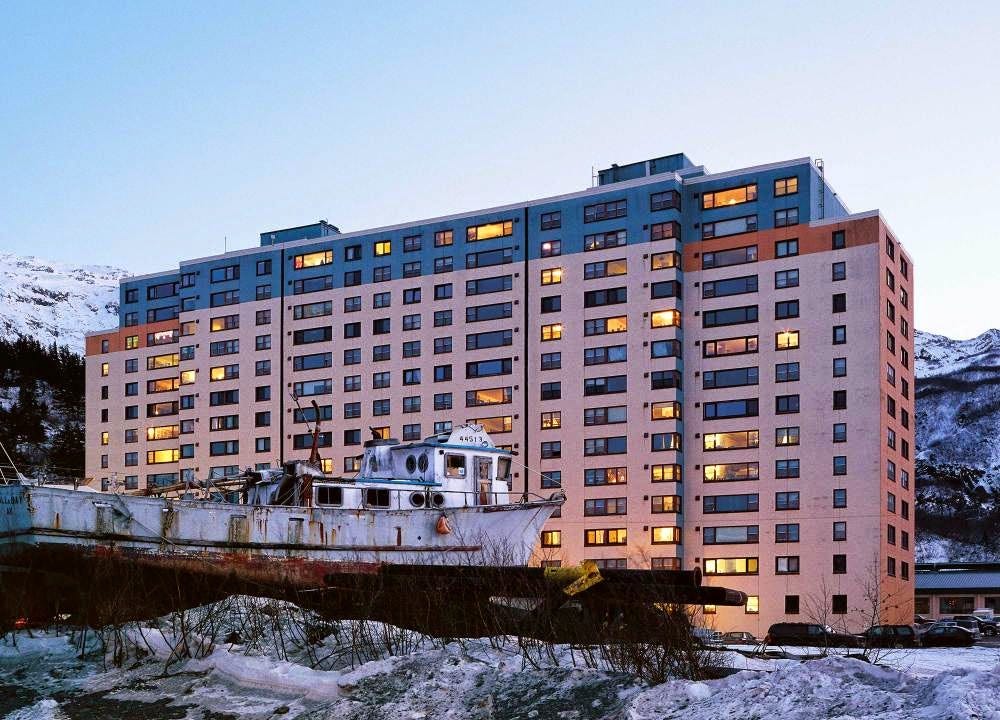
Begich Towers is a concrete, mid-century block in the Alaskan port town of Whittier where, uniquely, most of the community’s residents and services are housed under one roof (apartments, the post office, clinic, shops, church, and municipal services all packaged into a 14-story complex). The building emerged from military infrastructure and was later adapted for civilian life; its design and location make staying indoors a practical survival choice in severe weather. The result is a socially consolidated microcity, where everyday life plays out through corridors and shared spaces rather than dispersed streets.
In Spire, enclosure is political as well as practical: whole neighborhoods and social functions are contained within the spine of the city, and mobility between levels is restricted by factional power. Begich is useful as a real-world foil because it demonstrates how architecture can produce intimacy, dependency, and a community logic that is not inherently dystopian but which can become a lever, or a trap, when the wider systems around it fail. Spire takes that lever and turns it into a machine: when enclosed spaces are controlled by hostile authorities, the same physical convenience becomes a method of control.
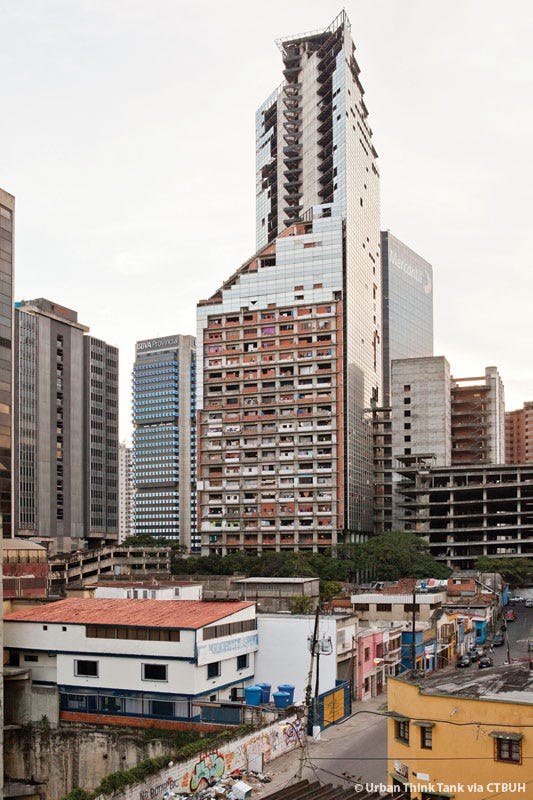
The Tower of David is a partially completed Caracas skyscraper that was never finished because of banking collapse and changing fortunes. In the 2000s, thousands of people moved into the empty concrete floors, creating a self-organized vertical community that provided housing, markets, and rules of thumb for daily life without formal municipal services. The tower became famous as perhaps the tallest “squat” in modern history: an improvised city inside a structure intended for finance, repurposed by inhabitants to meet the urgent need for shelter.
This phenomenon maps neatly onto Spire’s battered mid-levels, where accidents of development and abandonment produce zones of informal life. Torre de David shows how residents convert incomplete or neglected infrastructure into dense, lived space. They create their own economies, circulation, and safety norms. In game terms, it’s a perfect model for neighborhoods where official rule is absent, replaced by networks of patronage, barter, and localized authority. The human ingenuity and communal institutions of such places complicate a simple “lawless slum” stereotype: these are spaces of care, commerce, and creative governance, even under precarity.
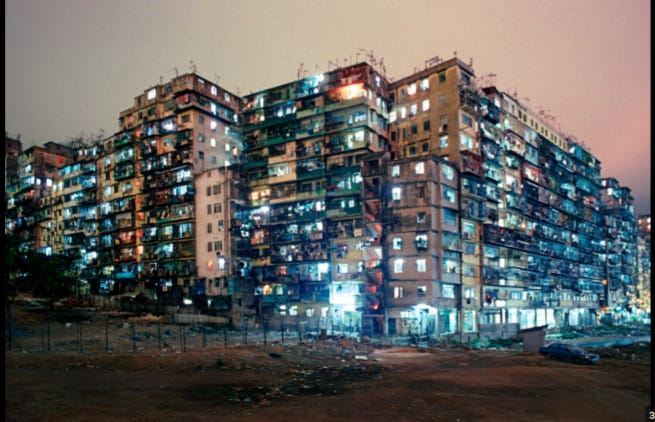
Kowloon Walled City is the classic historical example of organic, high density vertical assembly. At its peak it was an unregulated tangle of interconnected buildings, stacked without centralized planning, producing a highly efficient but unsanitary urban organism. Despite its reputation in the media as chaotic and criminal, Kowloon was also a place of industry, small manufacturing, informal services, intimate social networks, and extraordinary use of every cubic foot of space. Its vertical alleys, rooftop gardens, and labyrinthine interiors supplied livelihoods and shelter to tens of thousands until demolition in the early 1990s.
For Spire, Kowloon is the archetype of the city as organism rather than machine: walls and floors accrete by necessity into complex ecologies. The Walled City demonstrates how density can produce both resilience (compact supply chains, mutual aid) and disorder (sanitation, governance gaps). Spire synthesizes these outcomes. The mid and lower strata look and feel like Kowloon-style construction where everyday life adapts to scarcity and where vertical proximity intensifies social conflict, but also produces forms of solidarity and improvisational infrastructure.

Where Kowloon and Torre de David are about occupation, and Begich about contained community, X-Seed 4000 represents the opposite impulse: a deliberately conceived megastructure, a 4,000-meter conceptual arcology meant to house up to a million people inside a single, engineered envelope. Although never intended to be built (it was largely a visionary exercise by Taisei Corporation to showcase technical imagination) X-Seed crystallizes fantasies about scale: the promise that technology and design can produce self-contained urban systems that solve congestion, commuting, and resource distribution.
Spire borrows that rhetorical posture while inverting it. The game’s titular spire is not a technocratic utopia but a political machine: scale amplifies inequality, and technological or architectural ambition becomes a statement of power. X-Seed helps us think through Spire’s upper echelons (the architecture of aspiration) where monumental planning and spectacle hide extraction and exclusion. The comparison yields a useful double image: buildings can be seized (Torre de David), can accrete organically (Kowloon), can solidify communal life (Begich), or can be imagined as totalizing techno-utopias (X-Seed). Spire brings all these registers into conflict along a single vertical axis.
Taken together, these examples show that vertical cities are not monolithic fictions but composites of real-world phenomena. Begich provides a model of enclosed social infrastructure; Torre de David shows improvised occupation and bottom-up governance; Kowloon offers lessons about density, informal economies, and accidental order; X-Seed warns about the political symbolism of mega-projects. Spire’s strength as a setting is that it compresses these different logics into playable tension: levels of the city become social classes, architectural types correspond to governance regimes, and movement through built space becomes movement through systems of power.
For game designers and players, the lesson is practical. If you want a Spire that feels lived-in and believable, borrow not only the dramatic images of squalor and danger from media but also the more subtle social infrastructures from real examples: the way residents of the Tower of David organized services and security; the way Kowloon’s dense markets and family networks functioned; the pragmatic reasons Whittier’s residents prefer indoor life; the rhetorical allure of megaprojects like X-Seed. These are the human logics that make vertical cities feel plausible and morally complex rather than merely theatrical.

Spire: The City Must Fall is a narrative distillation of architectural politics. It dramatizes how buildings and city forms shape human possibilities. How they are shaped for care, solidarity, exploitation, and resistance. By comparing Spire to Begich Towers, Torre de David, Kowloon Walled City, and X-Seed 4000, we see that vertical cities are not just visual set pieces but assemblages of social practices, improvisations, and ambitions. Real world precedents complicate Spire’s dystopia with evidence of resilience, ingenuity, and the contradictory human life that emerges when people make homes inside the cracks of planning and power.
No posts
Comments
Nothing yet. Say the first thing.
Sign in to join the conversation.