
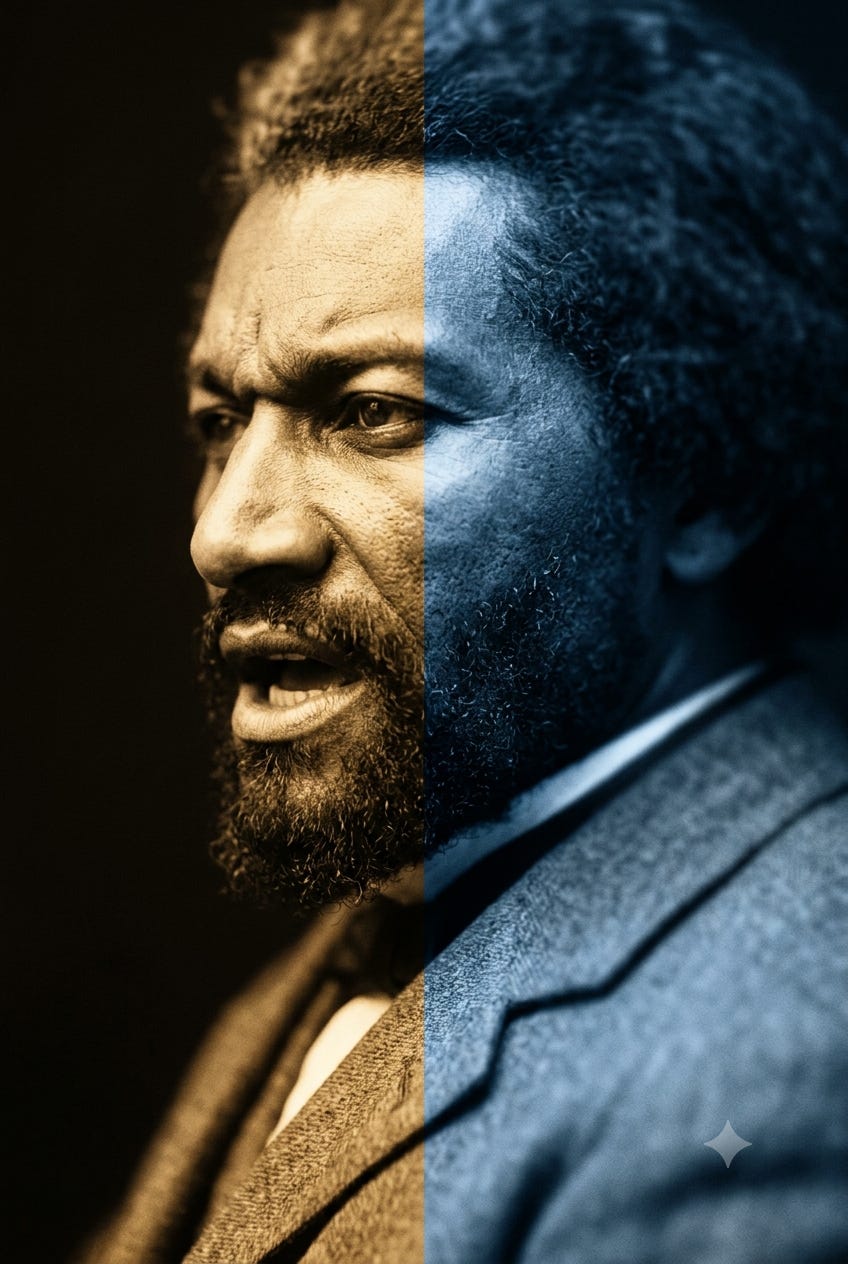
Rochester, New York, July 5, 1852: Douglass rises to a platform built for celebration, and everything in his opening words announces that he has not come to supply one. The Fourth fell on a Sunday that year. The Rochester Ladies’ Anti-Slavery Society moved the occasion to Monday, and Douglass takes the platform the day after independence, not the day of it.
What his audience receives is an indictment delivered in the cadence of celebration, a jeremiad structured like a toast.
He turns to scripture before he turns to politics. The nation calls itself Christian. Its churches bless its commerce, its courts, its Constitution. Douglass does not attack Christianity itself.
He attacks the specific theology built to sanctify bondage, the pulpits reading Paul’s letters as scriptural mandate for the whip and the chain.
A nation’s “religious parade, and solemnity,” he tells the hall, amounts, to the enslaved, to nothing but “bombast, fraud, deception, impiety, and hypocrisy, a thin veil to cover up crimes which would disgrace a nation of savages.”
Then the closing line, the one that outlives the speech:
“This Fourth July is yours, not mine. You may rejoice, I must mourn.”
From Ledger to Platform
That theology did not end with emancipation; it changed instruments, moving from the pulpit into the ledger and eventually into the platform.
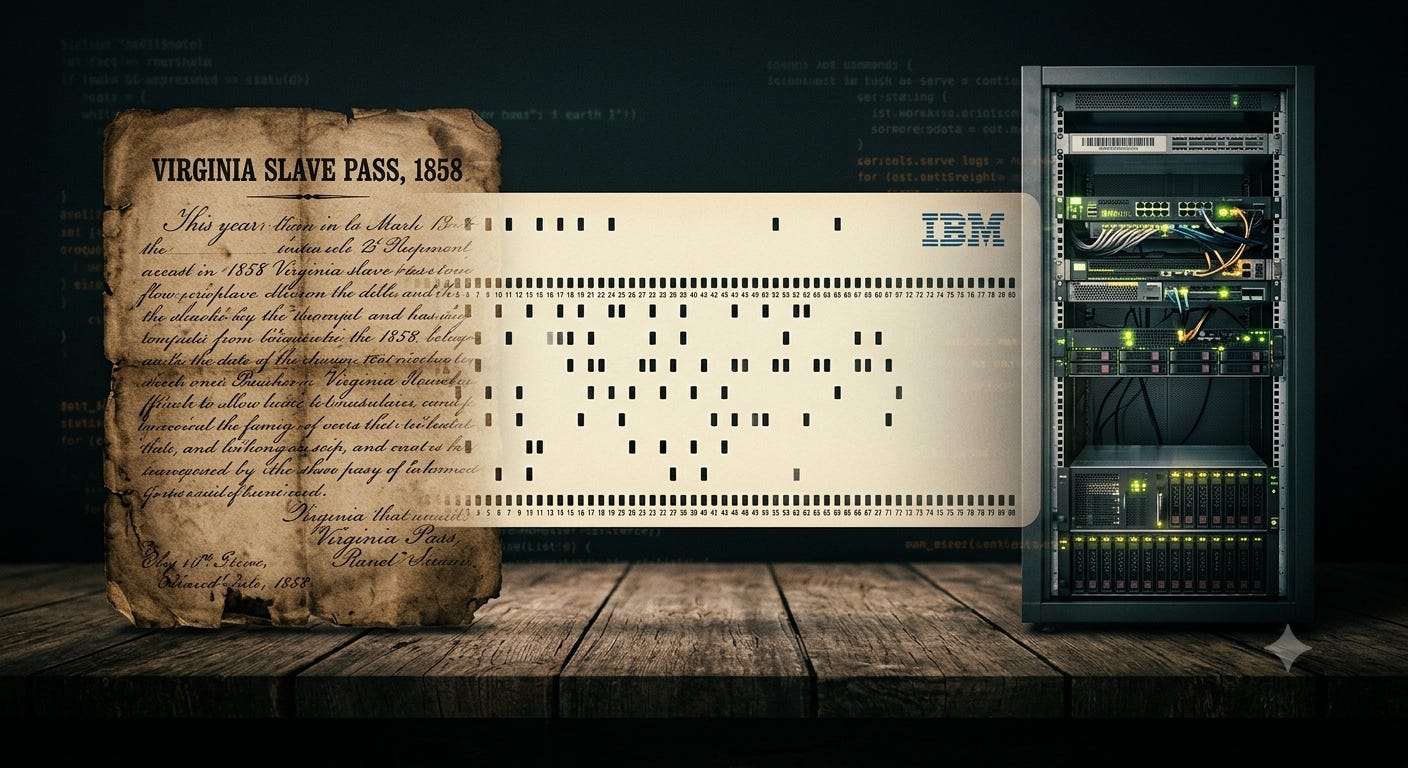
Before the algorithm, the American slaveholding system built its own data apparatus. The slave pass functioned as a mobility permit, requiring written authorization for any enslaved person moving beyond plantation boundaries, enforced by patrol militias empowered to seize, whip, or return anyone lacking documentation.
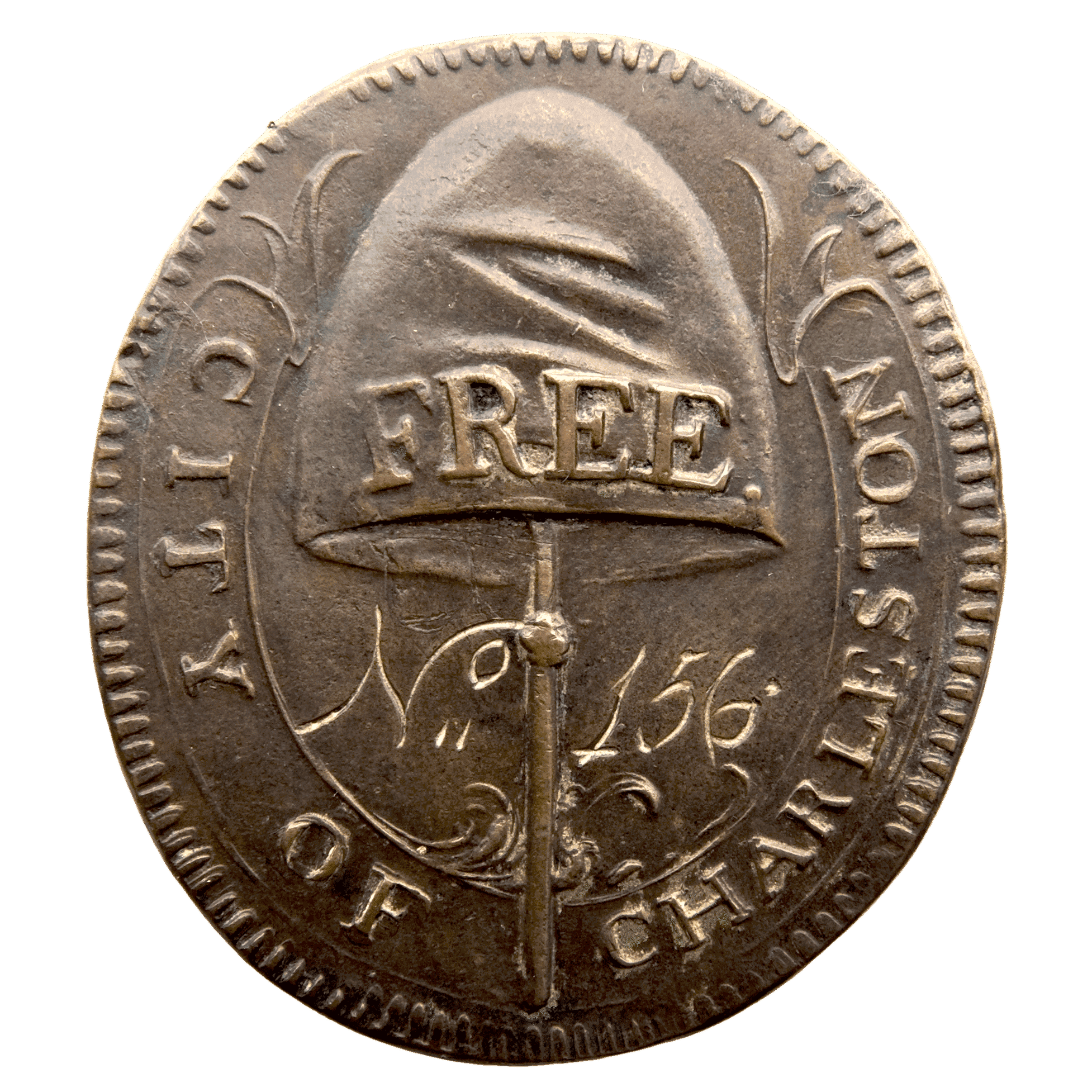
The slave badge, most extensively documented in Charleston, converted enslaved laborers into numbered, trackable units of hired labor, cross-referenced in municipal registries decades before any government built a database to do the same work with different tools. The bill of sale converted a person into an appraised line item. The runaway advertisement deputized an entire reading public into a distributed surveillance network.
Each instrument required theological sanction to operate without moral friction, and ministers like Thornton Stringfellow supplied it, publishing full theological defenses arguing that slavery carried divine sanction.
These instruments did not survive emancipation, but the function did.
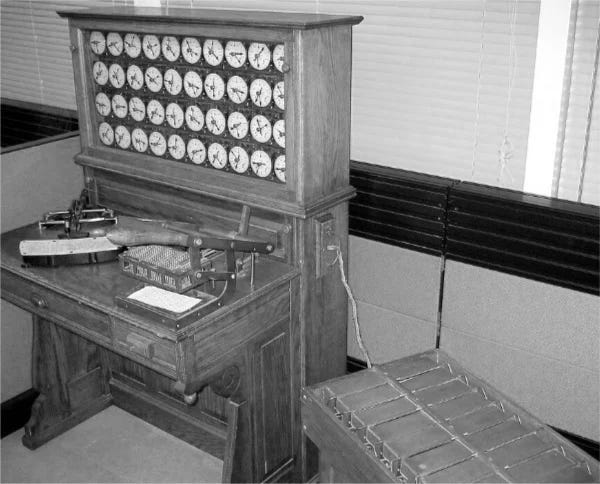
Herman Hollerith’s punch card tabulator, built for the 1890 census, industrialized the sort that enumerators had already performed by hand for a century.
IBM inherited that infrastructure and licensed the same machinery, documented by Edwin Black, to the Nazi census apparatus decades later
Domestically, the Federal Housing Administration’s underwriting manuals directed appraisers from 1934 through the 1960s to grade neighborhoods by racial composition, assigning the lowest grade and the color red to any neighborhood with Black residents. This practice, redlining, produced exactly the structured dataset that the FICO score, introduced in 1989, would inherit and formalize into a number that claims neutrality because a formula has no stated intent.
Douglass had already named the pattern: “You boast of your love of liberty, your superior civilization, and your pure Christianity, while the whole political power of the nation... is solemnly pledged” to the opposite.
The theology that once required a minister now requires only an engineer willing to certify a model as objective.
Immigration and Customs Enforcement contracted Palantir Technologies in April 2025 to build ImmigrationOS, a platform integrating IRS filings, Social Security records, DMV registrations, passport data, and license plate reader feeds into a single searchable system, a contract that has grown past one hundred forty-five million dollars.
More here…ImmigrationOS
A second Palantir tool named ELITE draws on Medicaid enrollment data to generate deportation leads, including a confidence score estimating an individual’s current address, data every enrollee understood as walled off for medical care alone.
The Department of Agriculture pursued the identical pattern through SNAP, demanding states transmit recipient data including Social Security numbers and household composition, then running that data through DHS’s SAVE system, originally built to verify immigration status, recently overhauled to verify citizenship for people born in this country. Twenty-one states sued. A federal judge blocked the penalty provision. USDA responded by sending a second demand letter its own officials called a distinct action, uncovered by the injunction.
There is not a nation on earth guilty of practices more shocking and bloody, Douglass told his audience in 1852, than the people of these United States, at this very hour.
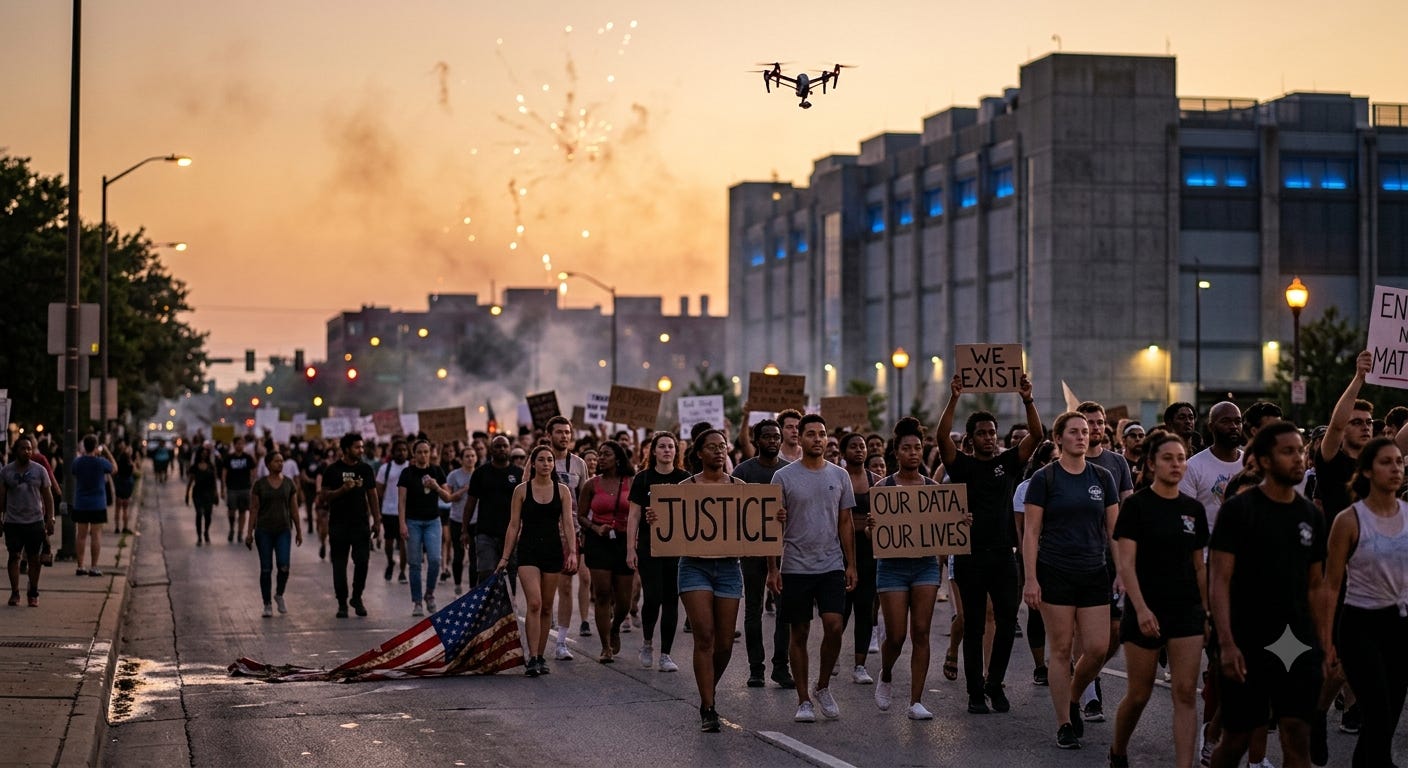
The Hour Has Not Closed
Minneapolis, January 2026: federal officers under Operation Metro Surge kill two residents inside three weeks.
An ICE agent kills Renee Good on January 7. Border Patrol agent Jesus Ochoa and CBP officer Raymundo Gutierrez shoot and kill Alex Pretti, a thirty-seven-year-old intensive care nurse with a Minnesota permit to possess a firearm and no criminal record, on January 24, after he approaches officers to assist a woman the agents have pepper sprayed.
The Wall Street Journal, the New York Times, the Washington Post, and CNN each independently analyze the video, and each contradicts the administration’s account that Pretti brandished a weapon.
Deputy White House chief of staff Stephen Miller calls him an assassin before revising the claim days later. President Trump calls him an agitator and possible insurrectionist. Border Patrol commander Gregory Bovino tells reporters the agents are the victims.
Minneapolis Mayor Jacob Frey asks how many more residents need to die before the operation ends. The operation does not end; it relocates, redeployed under new command a state away.
ImmigrationOS does not kill anyone directly. It builds the target list, assigns the confidence score, and hands the file to agents operating under an administration that treats accountability as optional. The platform and the trigger belong to the same system.
The same administration strips local governments of authority over their own land.
Nashville’s mayor files eminent domain legislation in June 2026 to block a fifty-megawatt AI data center campus near the city zoo.
In Fayette County, Georgia, a homeowner negotiates for months with Georgia Power over an easement for transmission lines feeding a data center project, uncertain whether her family can stay safely in a home now bordered by construction and high-voltage infrastructure.
In Coweta County, transmission lines built for an eight-hundred-twenty-nine-acre hyperscale campus cross the path of more than three hundred thirty private properties. Pennsylvania’s proposed legislation would let a state board bypass local zoning entirely for data center energy infrastructure.
These families are not, by the documentation available, the same population targeted by ImmigrationOS. But they face the same governance failure: a federal and state apparatus treating local democratic control, whether a zoning board or a family’s front yard, as an obstacle to engineer past rather than a right to respect.
Where the acceleration turns specifically anti-Black is in the convergence. Black Americans are represented in federal benefit programs at rates exceeding their share of the general population, a direct consequence of the redlining documented above, and that same population’s enrollment records now feed the identical pipeline built to generate deportation leads.
The chain runs unbroken from the FHA’s red line on a map to the SNAP household file USDA and DHS now query for immigration enforcement, regardless of the family’s actual citizenship status.
Douglass told his Rochester audience that their independence was not his. "I am not included within the pale of this glorious anniversary," he said. "Your high independence only reveals the immeasurable distance between us."
That distance has not closed. It has been re-instrumented, run through a pipeline spanning USDA, HHS, and DHS, defended by officials who occupy their offices now, under an administration that has shown, through conduct rather than press releases, that the constraint of law is negotiable when the target is deemed disposable.
The Fourth of July does not mean less because Douglass's argument weakened with age. It means less because the nation he indicted built the infrastructure to execute that indictment's logic at a scale his audience in Corinthian Hall could not have imagined, and placed that infrastructure in the hands of people who have already shown, on a sidewalk in Minneapolis, what they are willing to do with it.
This is the first of three parts.
Part Two follows, tracing this same seizure into facial recognition, predictive policing, and the data center land disputes spreading across the country right now.
Yusuf Jones is a reader-supported publication. To receive new posts and support my work, consider becoming a free or paid subscriber.
Comments
Nothing yet. Say the first thing.
Sign in to join the conversation.