
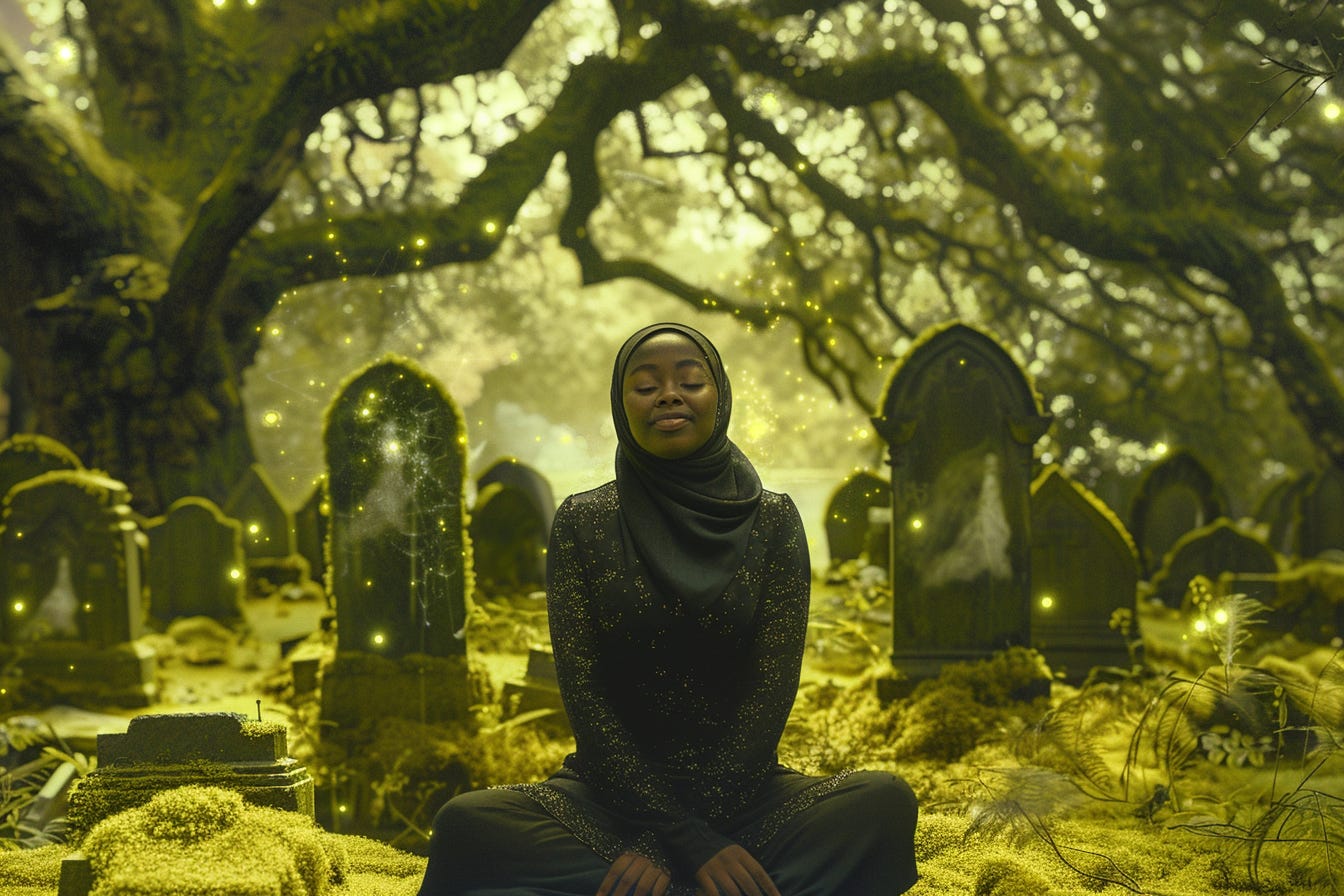
There is a question the modern Muslim often carries quietly, not because the Qurʼan and the sunnah are silent on it, but because modernity has made the silence seem safer. Do the righteous dead know us? Do they hear? When we stand at a grave and speak, or when we perform a good act and feel something ancestrally witnessed about it, are we feeling something real, or are we projecting grief into empty space?
The Qurʼan and the sunnah together refuse the second option. Not tentatively, and not with the hedged language of scholars who have made their peace with secular epistemology and offer the living half-answers to take home. The classical scholars of Islam, drawing on the Qurʼan and the hadith corpus, affirm with consistency and clarity that the righteous dead maintain a living awareness of those they left behind. They receive reports of the deeds of their descendants. They rejoice at obedience. They feel distress at disobedience. They intercede with duʾāʾ. The barzakh, the intermediate realm between death and resurrection, is not a sealed chamber but a place of continued relationship.
The first report comes through al-Ḥakīm al-Tirmidhī in the Nawadir al-Usul:
“Actions are presented to God on Mondays and Thursdays, and presented to Prophets, fathers, and mothers on Fridays. They rejoice at the good works, and their faces increase in whiteness and brightness. So fear God and do not hurt your dead.”
The presentation of deeds to God on Mondays and Thursdays is well-established in the hadith literature, and the Prophet, ﷺ, himself fasted on those days for precisely this reason, as recorded in Ṣahīḥ Muslim (1162) and Sunan al-Tirmidhī (747). What this narration adds is a distinct Friday presentation to Prophets, parents, and extended clan. The dead are recipients of active transmission rather than passive remnants. The presentation produces a perceptible and embodied response, brightness, radiance, the visible mark of joy. The Prophet’s injunction, “do not hurt your dead,” presupposes that the living can affect the condition of the dead through their actions, and hurt implies susceptibility, which implies ongoing life.
The second report appears in the Musnad of Imam Aḥmad (ibn Masʻud, no. 3666) and is corroborated by al-Ḥakīm al-Tirmidhī in the Nawadir al-Usul and by Ibn Mandah in Kitab al-Ruḥ:
“Your actions are presented to your dead relatives and clans. If they see goodness in it, they rejoice. If they see other than that, they say: O God, do not let them die until You guide them as You guided us.”
The presentation reaches clans, lineages, the full relational network of the deceased. When the dead encounter disobedience, they do not simply register distress and fall silent. They pray, asking God to grant their descendants guidance before death reaches them, making them active participants in the spiritual welfare of the living through the only instrument available in the barzakh, supplication directed to God.
These two reports carry a complete picture. The dead receive. They respond emotionally. They intercede. The link between the living and the righteous dead is not a metaphor for memory or a theological sentiment, but a described reality carried in the attributed speech of the Prophet, ﷺ.
Sūrat Āl ʻImrān, 3:169, states that those killed in the way of God are not to be counted among the dead. They live with their Lord, they are given provision, they rejoice in what God has granted them, they receive tidings of those who follow after them, and they feel no fear and no grief over those who remain.
Al-Qurṭubī, al-Ṭabarī, and Ibn Kathīr treat the life of the martyrs in the barzakh as a real, qualitatively conscious existence rather than a metaphor for divine favor at the moment of death. They are “with their Lord” as a description of their ongoing state, not a statement confined to a single instant of transition. They receive news and they rejoice. The emotional and cognitive capacities that defined them in this world persist, now operating under the conditions of the next. If the martyrs, who occupy a station of excellence, maintain this awareness, that awareness is not sealed off from those who occupy lesser stations of righteousness.
Sūrat al-Aʻrāf, 7:172, is the verse of the primordial covenant, the Mīthāq. God gathers all of humanity from the loins of Adam and takes their testimony, “Am I not your Lord?” and they affirm it. The soul is not constituted by its bodily container, and its relational identity, who it belongs to, who it came from, who follows it, persists across the transitions of existence. Classical scholars who invoke this verse in discussions of ancestral connection draw on this implication directly: the covenant was made before the body, and the relationship continues after it.
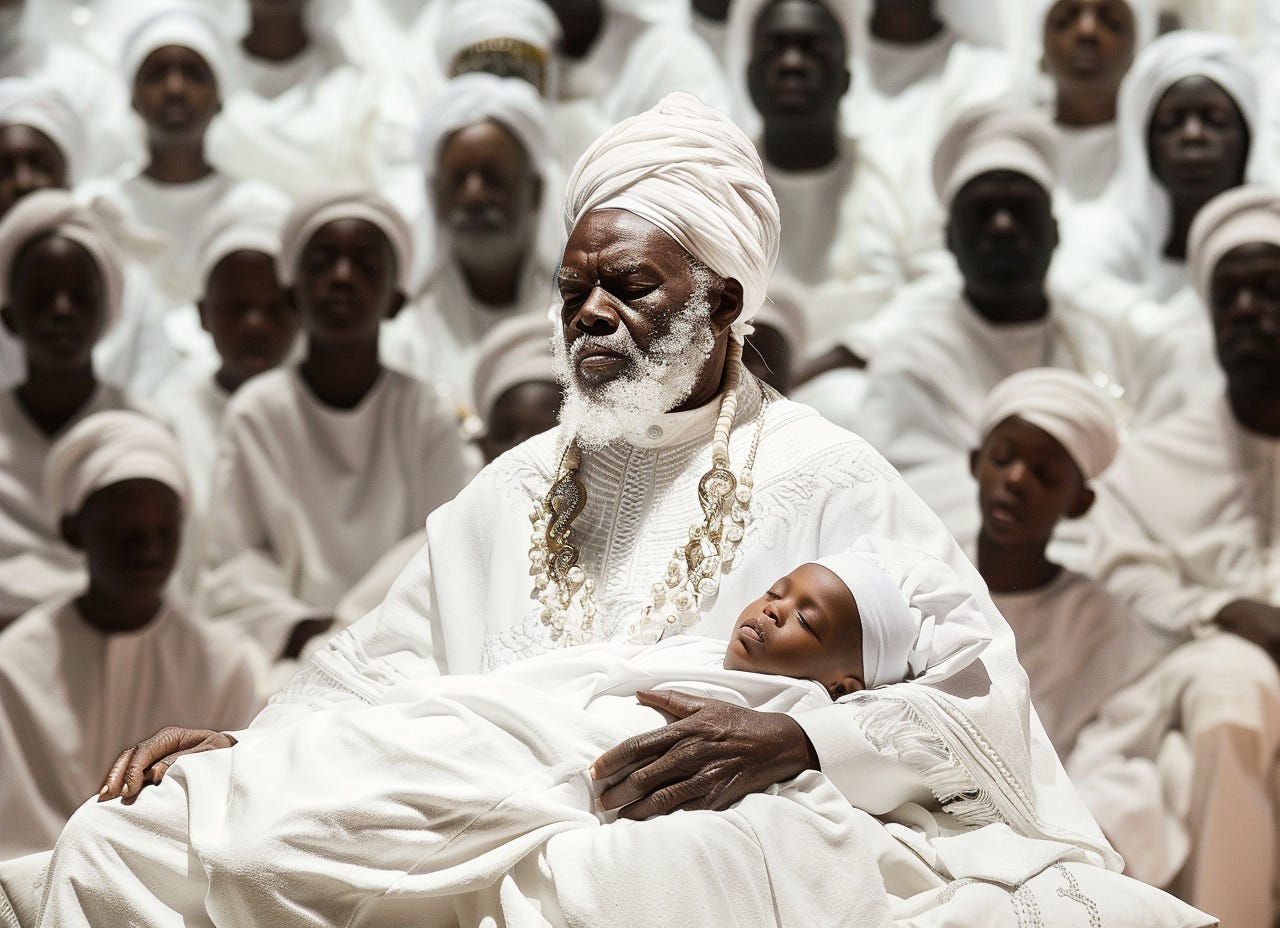
After the Battle of Badr, the Prophet, ﷺ, addressed the slain leaders of Quraysh by name as they lay in a pit. ʻUmar ibn al-Khaṭṭāb, who was present, expressed disbelief: “O Messenger of God, you are speaking to bodies that have no souls?” The Prophet replied: “By the One in whose hand is my soul, you do not hear my words more than they do.” The report is in Ṣahīḥ al-Bukhārī (3980). The Prophet makes a direct comparative statement: the living man standing at the pit does not exceed the dead men inside it in their capacity to receive his words.
In Ṣahīḥ Muslim (2870), the Prophet states that when a person is buried and those who attended the burial turn to leave, the deceased hears the sound of their sandals on the ground. Awareness does not require speech or proximity. The dead perceive the physical world in ways the living do not fully comprehend, and that perception is not confined to extraordinary moments of prophetic address but accompanies the ordinary departures of ordinary mourners.
In Sunan Abī Dāwūd (2041), God returns the soul of the Prophet, ﷺ, in whatever manner befits his station, so that he may answer those who send ṣalawāt upon him. The one who sends greetings is heard, and the greeting is returned. Relationship is not dissolved by death.
In Ṣahīḥ Muslim (2827), God raises the rank of righteous parents on account of the good deeds their children perform after their death. The parents ask God how they came to receive this elevation, and they are informed of their child’s actions.
The dead know. God tells them. They understand what they are told.
Ibn al-Qayyim al-Jawziyya, not a figure associated with laxity in matters of evidence, affirms in Kitab al-Ruḥ that the dead recognize those who visit and greet them, and that this recognition is active, specific, and emotionally present. He draws that conclusion from the narrations examined across these sections, and his treatment of the barzakh as a realm of ongoing relational life represents not a marginal mystical position but a careful synthesis of the primary hadith evidence read without the prior commitment to minimizing what it says.
The righteous dead know us. They receive reports of our deeds. They rejoice when we do good. They feel distress when we disobey. They ask God to guide us before we die. They hear us at their graves. They perceive our departures. They receive elevations in rank because of what we do after they leave. They answer our greetings. They pray for us by name.
Classical jurisprudence is precise about what is enjoined and what is prohibited in relationship with the dead, and those distinctions rest on a prior reality: the dead are not absent, the connection is real, and the question the living Muslim carries, do they know us, has a documented, transmitted, theologically grounded answer in the primary sources of the faith.
They do. They have always known.

The charge of ancestor worship does not fall evenly across the Muslim world, and the pattern of where it lands is not theologically generated. It follows older lines.
When West African Muslim communities honor the memory of their saints, when Indonesian or Malaysian Muslims maintain practices of visitation and relational prayer at graves, when Senegalese Tijaniyya or Malian Sufi communities speak of their deceased shaykhs as spiritually present and accessible, the accusation arrives with speed and force. These communities, the argument goes, have allowed pre-Islamic custom to contaminate their practice. They are susceptible. They require correction. The specter of ancestor worship is invoked as a diagnostic category, and the communities flagged by it are, with a consistency that should give any serious scholar pause, African and Asian.
The same lens does not turn towards Yemen, to the Levant, to the Arabian Peninsula with the same regularity or the same urgency. Yemeni shrine culture, Palestinian grave visitation practices, Syrian traditions of seeking blessing at the tombs of the awliyāʾh are discussed within Islamic scholarship, sometimes critically, but rarely with the categorical alarm that attaches to practices in communities further from the imagined center of Islamic authenticity. The question of who is presumed capable of holding orthodoxy and who is presumed to need policing is never only a theological question.
This selective application of suspicion has a history. European colonial administrators and missionaries spent considerable energy distinguishing between what they called real Islam and Islam corrupted by local animist or ancestral custom. The communities they targeted were African and Asian. Their scholarly successors, some of them, absorbed this framework without examining its genealogy. What presented itself as rigorous theological caution carried, and in some quarters continues to carry, the architecture of a racial epistemology. The criteria for what counts as dangerous proximity to ancestor worship are not applied uniformly because they were never designed to be applied uniformly.
None of this dissolves the jurisprudential questions Islamic scholarship genuinely debates. Real distinctions exist between duʾāʾ directed to God on behalf of one’s relationship to a deceased person, seeking intercession through a recognized walī, and practices that attribute independent divine agency to the dead.
Those distinctions matter and Islamic scholarship takes them seriously. But the application of those distinctions has been distorted by a suspicious geography that clusters around certain communities and exempts others, and that distortion is not innocent. It shapes which communities are trusted to hold their own tradition and which are presumed to be drifting from it, which practices are read as living sunnah and which are read as residual paganism, and which scholars are granted the authority to correct and which communities are positioned as perpetually in need of correction.
What the framework of suspicion consistently fails to reckon with is the specific intercessory standing the Prophet ﷺ described for the shuhadāʾ. In Sunan Ibn Mājah (2799) and Sunan al-Tirmidhī (1663), the martyr is granted, among six distinctions, permission to intercede for seventy of his relatives. This is not passive awareness. It is active, consequential, divinely granted intercession on behalf of specific kin, extending into the living fabric of families and lineages across generations. The communities whose grave visitation practices draw the heaviest scrutiny are very often communities organized around precisely those who died as shuhadāʾ, whether in armed resistance to colonial violence, in defense of their people and their faith, or through the prolonged martyrdom of dispossession, forced displacement, and the systematic destruction of their way of life. The classical jurisprudential literature, cataloged extensively by Ibn Ḥajar al-ʻAsqalānī in Fatḥ al-Bārī, recognizes martyrdom beyond the battlefield. Those who die by drowning, by plague, by oppression, by the violence of unjust power, carry the jurisprudential weight of shuhadāʾ.
The West African shaykh killed resisting French colonial forces, the Indonesian scholar who died under Dutch administration, the Malaysian community leader who gave his life defending his people, these are not figures whose intercessory standing is theologically ambiguous. The ambiguity has been manufactured and selectively applied.
Perhaps nowhere is that manufactured ambiguity more consequential, or more deliberately sustained, than in the treatment of the millions of African Muslims who endured the Atlantic slave trade, the Middle Passage, and generations of chattel enslavement across the Americas and the broader African diaspora. Sylviane Diouf’s Servants of Allah and Michael Gomez’s Black Crescent document with precision what the historical record makes unmistakable: a substantial portion of the Africans taken into the slave trade were Muslim.
Many of them were not recent converts or nominal adherents. They were educated men and women, scholars, jurists, teachers, ḥuffāẓ of the Qurʼān, leaders of their communities, people who carried Islamic knowledge in their bodies and transmitted it under conditions designed to make transmission impossible. They arrived not as strangers to the faith but as its bearers. And they died, in numbers that resist full comprehension, under conditions that meet classical jurisprudential criteria for martyrdom across multiple categories simultaneously.
They died in the holds of ships. They died under the systematic violence of enslavement. They died resisting. They died refusing. They died of the slow, grinding destruction of bodies and spirits that bondage inflicts across decades. They died separated from their children, their lineages deliberately severed as a matter of colonial policy.
They died in uprisings that have been recorded in the history of every slaveholding society in the Americas, from the Malê Revolt in Bahia in 1835, led by Muslim scholars who went to their execution with Qurʼānic verses on their lips, to the sustained resistance of Muslim enslaved people documented across the American South, the Caribbean, and throughout Brazil. Ibn Ḥajar’s catalog of martyrdom categories does not require adjudication to reach a conclusion about what their deaths were. The conclusion is available to anyone who reads it without the prior commitment to denying it.
If those millions of African Muslims who died under enslavement hold the standing of shuhadāʾ under classical criteria, then the implications for their descendants are not marginal or speculative.
Their descendants who maintain practices of ancestral veneration, who feel the weight of those dead, who seek connection with them by Allah permission through appropriate visitation, prayer, and remembrance, who build their spiritual lives around a sense of ancestral presence and ancestral intercession, are not practicing a corrupted folk Islam contaminated by West African animism.
They are doing what the sunnah permits, and in some cases commends, toward people who may hold the specific intercessory capacity the Prophet ﷺ described.
The seventy relatives for whom a martyr may intercede do not stop being relatives because they were born into enslavement in South Carolina or Louisiana or Jamaica. The covenant does not recognize the legal fictions of slaveholders.
The suppression or sidelining of this theological possibility has not been entirely purposeful or accidental. Acknowledging the martyrdom of the enslaved African Muslim would require acknowledging their intercessory standing. Acknowledging their intercessory standing would require acknowledging the theological legitimacy of the practices of their descendants. Acknowledging that legitimacy would dismantle the entire framework of suspicion that has been used to police, subordinate, and condescend to African and African American Muslim communities within the broader ummah, to position them as perpetually in need of correction from communities and scholars who do not apply the same scrutiny to themselves.
It is not coincidental that Islamic scholarship has given so little sustained attention to the martyrdom of the millions of African Muslims who died under enslavement. The question has not been neglected because the evidence is insufficient. The evidence is abundant, and the jurisprudential framework for reaching a conclusion is fully developed and widely available. The question has been neglected because answering it honestly collapses too many hierarchies at once. It would require the scholars and institutions that have spent generations positioning African and African American Muslim communities as theologically suspect to reckon with the possibility that those communities have been living in the spiritual orbit of an enormous company of shuhadāʾ, and that the practices being dismissed as ancestor worship are in fact a community’s long, faithful, theologically grounded attempt to remain in relationship with its martyred dead.
The silence has become structural. It protects a hierarchy that has never been willing to name itself honestly. African Muslims did not arrive in the Americas as pagans who needed Islam. They arrived as Muslims who needed, and in many cases found ways to sustain, what they already carried. Their dead are not the dead of people who died outside the fold. Their dead are the dead of shuhadāʾ, and the living communities that grew from them have been doing, in ways that colonial frameworks trained even Muslim scholars to misread, exactly what the faith they already held permits.
The hadith literature that runs through this piece does not belong to one ethnic expression of Islam. It is the shared inheritance of every community that recites the shahādah and prays toward the Qiblah. When that literature is accepted in principle but the practices of African and African American Muslim communities that emerge organically from its affirmations are treated as evidence of corruption, the problem is not with the communities. The problem is with the framework doing the accusing, and with the long silence of those who knew better and said nothing.
No posts
Comments
Nothing yet. Say the first thing.
Sign in to join the conversation.