
What a “Portfolio” Actually Means in Systematic Trading
Ask ten traders what a portfolio is and nine will say “a bunch of strategies running at the same time.” That’s not wrong, but it’s incomplete.
In systematic trading, a portfolio isn’t a collection.
It’s a construction.
A collection is passive: you add strategies as you find them, you run them in parallel and you hope the good ones outweigh the bad ones.
A construction is deliberate: each strategy earns its place based on what it contributes to the whole, not just how it performs in isolation, but how it behaves relative to everything else already in the portfolio.
That shift, from “more strategies” to “better combinations” is what this series is about.
The Goal: What This Portfolio Is Actually For
Before building anything, you need to be honest about what you're trying to achieve. Not in abstract terms, but specifically what the portfolio is supposed to accomplish.
Here’s the goal for the portfolio we’re building throughout this series:
Sustain drawdowns without blowing up and compound returns over time with a MAR ratio worth defending.
That sounds obvious. But most traders optimise for return, treat drawdown as an acceptable side effect and end up with a portfolio that makes huge gains in certain regimes and falls apart in others. The goal here inverts that priority: drawdown control comes first, returns are a byproduct of it.
The portfolio should be able to:
Survive a period where any single strategy stops working
Portfolio maximum drawdown stays below 50% of the sum of individual strategy historical maximum drawdowns. If it does, diversification is doing real work.
Produce a long-term MAR ratio (annualised return ÷ max drawdown) that justifies live capital allocation. For me, this means a target of 1.0+ MAR for the portfolio.
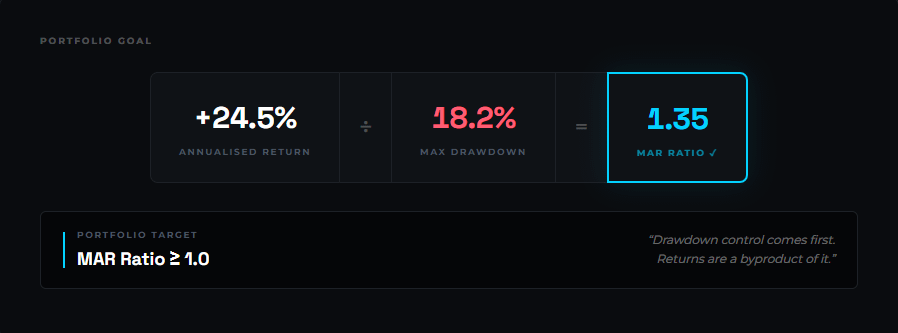
This isn’t just a performance target, it’s a design constraint. Every decision, which instruments to trade, how many strategies to run and how to size positions should be evaluated against it.
There’s also a second goal that sits alongside performance: establishing a verifiable track record. That’s where Darwinex Zero comes in (more on that below).
The Single-Strategy Trap
If you’ve traded a single systematic strategy for any length of time, you’ve felt it.
The strategy has a drawdown, not catastrophic, well within what the backtest suggested but it keeps going. Two weeks. A month. Six weeks. You start wondering whether the market regime has shifted, whether the edge has been arbitraged away, whether you made a coding error you haven’t found yet.
This is the single-strategy trap. Not the drawdown itself, but what the drawdown does to your decision-making.
The math of single-strategy trading creates a specific kind of psychological pressure. Every drawdown forces the same question: is this normal variance or is the edge gone? There’s no offset, no diversification and no second source of returns to anchor your confidence. Your entire portfolio rises and falls with a single idea.
That’s why one strategy is rarely enough. Not because it can’t make money, but because every trading strategy eventually experiences periods of underperformance. If all your capital depends on one edge, every drawdown becomes a test of your conviction.
A portfolio changes that dynamic. When multiple uncorrelated strategies are running, one can struggle while another performs well. The question shifts from “Is my system broken?” to “Is this strategy behaving within its historical expectations?” That’s a far more manageable question, both mathematically and psychologically. If the worst case scenario is true and the edge is gone in one strategy you can remove it and still keep your trading business running. In a single-strategy scenario, you would have been out of business.
The Live Example: Darwinex Zero Futures Portfolio
Throughout this 3-part series, the strategies I have been sharing for years are being incorporated into a Darwinex Zero futures portfolio, starting from scratch, in public, with you watching.
Darwinex Zero is a funded account programme built specifically for serious traders. You start with $1,000,000 in virtual capital, trade futures under real risk constraints and if your performance holds up, Darwinex wraps your track record into a DARWIN, a tradeable instrument that external investors can allocate to. That last part is what makes it interesting to me.
Most funded account programmes end at the payout. You hit your targets, you take your cut, you reset. Darwinex has a second part, if your DARWIN attracts investor capital, you earn performance fees on that too. This structure rewards exactly what should be rewarded, consistent, risk-adjusted returns over time, not just passing an evaluation.
That's why I chose it over the normal prop firm models. My goal is to build a track record in public and the DARWIN investor model is the only structure that rewards that directly. A live DARWIN is something you can point to. A backtest isn't.
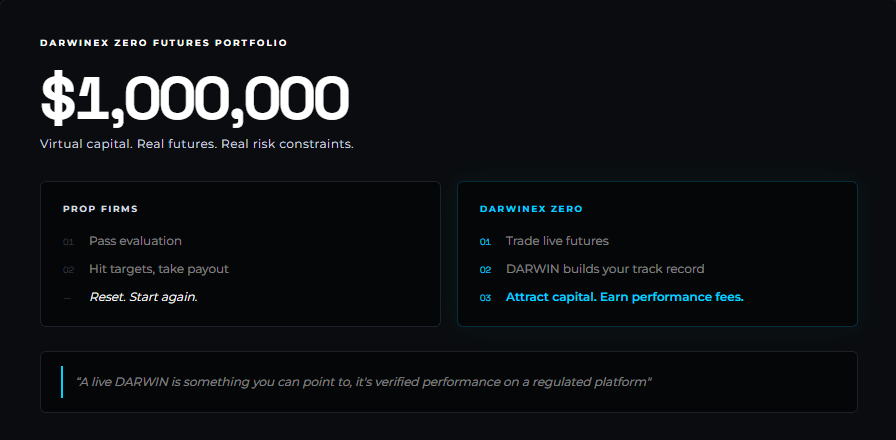
I’m starting from zero here. No existing track record on the platform, no live trades yet, just the portfolio framework I’m about to walk you through and the strategies I’ve been developing, publishing and trading on Algomatic Trading. This series documents the build as it happens. I don’t know how it ends. That’s the point.
Note: Since my MT5 announcement last week, most of the discounted Premium Annual spots have now been claimed. There are 5 spots remaining at €299 before the price permanently increases to €399.
Premium members receive the complete strategy database and starting in August, my strategies will include both the original ProRealTime code and a ready-to-run MT5 Expert Advisor.
Get Premium Annual Access — €299 → (Only 5 spots left)
What We’re Building Toward
By the end of this series, the goal is a small, diversified portfolio of uncorrelated strategies across instruments and timeframes, designed to perform across different market conditions rather than optimised for any single one.
Small is intentional. Five to ten strategies should be enough to capture meaningful diversification without diluting position sizing to irrelevance. The aim is the minimum number of strategies needed to achieve genuine uncorrelation, not the maximum number possible.
The three pillars we’ll work through in this series are:
Correlation (Part 2): measuring how strategies move relative to each other and using that to make decisions about what belongs in the portfolio and what doesn’t.
Diversification (Part 2): across instruments (energy, metals, indices), across timeframes and across strategy logic, so no single market regime can take down the whole system simultaneously.
Performance measurement (Part 3): beyond return, beyond Sharpe ratio, toward metrics that reflect what actually matters in live trading: drawdown behaviour, recovery time and MAR.
Disclaimer: I am not a financial advisor and I don’t recommend you to trade my strategies. This article is for informational and educational purposes only. Trading involves risk, and you can lose money. Always do your own research.
No posts
Comments
Nothing yet. Say the first thing.
Sign in to join the conversation.