
The strategies that work often feel wrong.
The ones that feel natural tend to underperform.
This is not a coincidence.
Human beings evolved to avoid uncertainty.
We seek confirmation, consensus and safety, and the markets reward none of these things consistently.
A strategy that feels comfortable usually feels comfortable because most people already agree with it. And when everyone is acting on the same belief, there is usually little edge left.
Trend following is one of the oldest and most proven concepts in markets.
Imagine a stock that has already risen 30%. Most traders look at that chart and think:
I missed it, but the trend follower thinks: what if this is only the beginning?
Buying strength feels wrong because it looks expensive. We naturally prefer bargains.
Yet some of the largest market moves in history started after prices had already made new highs. The Donchian Channel Breakout is a simple example of this logic in practice.
Trend following works because it aligns itself with persistence rather than prediction. But in real time, it feels wrong. You are buying what already went up and personally I would never be able to do that without rules and automation.
Now consider the opposite.
A market drops 5% in a single session. It doesn’t happen often, but it does happen in bear markets, during crises and during moments like March 2020 when the world felt like it was ending. The news is negative, fear is spiking and everyone is selling.
Your mean reversion strategy enters long.
Emotionally, this feels absurd. The market looks broken. Every instinct says wait for confirmation.
The strategy buys anyway.
Why? Because most short-term selloffs are driven by temporary emotional imbalances, not permanent changes in value. This imbalance is exactly what mean-reversion strategies aim to profit from.
The edge exists because most participants are too uncomfortable to buy into weakness. If you want a framework for building these kinds of systems, this guide covers the key components you need to create your own mean-reversion strategy.
The discomfort is the reason the opportunity exists in the first place.
Diversification feels inefficient and at any given time, part of a diversified portfolio will underperform and it is supposed to. Some strategies look brilliant in trending environments and others look broken. The portfolio rarely feels optimal.
Here is the thing though.
If everything is working well at the same time, you are probably not diversified.
A portfolio that is never fully satisfying is often the one doing its job correctly. Pairing trend following with mean reversion is one of the most reliable ways to achieve this and the two approaches tend to fail in opposite environments. I wrote about this combination in depth here.
No strategy escapes drawdowns, that’s a fact.
Every drawdown creates the same psychological trap. You always start asking:
Has the edge disappeared? Is the market different now? Should I stop trading?
The temptation to quit is strongest precisely when the strategy feels worst.
Many traders abandon systems during normal periods of statistical pain and miss the eventual recovery. As I documented in my trading journey post, the hardest part of systematic trading is not finding the edge, the hardest part is executing it through doubt and losing streaks long enough for the math to play out.
Every drawdown feels different. That is why they are hard.
Imagine a strategy that always felt comfortable, made a lot of money and never had drawdowns.
How many people would trade it?
Everyone.
And if everyone traded it, the edge would be gone.
Profitable strategies survive precisely because they contain some element of discomfort. That discomfort acts as a barrier. It prevents most traders from participating long enough to capture the returns.
A single trade tells us very little about the quality of a strategy. A robust system can experience losses, drawdowns and periods of underperformance while remaining completely healthy. Likewise, a poor strategy can look brilliant over a small sample of trades.
The challenge is that we experience trading one outcome at a time, while edges only reveal themselves over dozens or even hundreds of observations. This creates a constant temptation to abandon good strategies during normal periods of discomfort.
The traders who survive long enough to capture an edge are often the ones who learn to focus on process rather than outcomes, probabilities rather than predictions, and portfolios rather than individual trades.
I explored this idea further in How to think in probabilities, where I discuss why probabilistic thinking is one of the most important mindset shifts a systematic trader can make.
In many cases, the discomfort is not evidence that something is wrong.
It is simply the price paid for accessing an edge that most market participants are unwilling or unable to capture consistently.
The discomfort is the edge.
The goal is not to find a strategy that feels good.
The goal is to find a strategy that is robust.
A robust strategy might buy when you want to sell. It might underperform for months and it might look foolish at times.
But if the logic is sound, the testing is honest and the portfolio is well-constructed, emotional comfort becomes almost irrelevant.
One way to avoid building strategies that only look good on paper is to test for robustness from the start, and this curve-fitting guide covers 8 ways to do that.
The lesson most systematic traders eventually learn:
The market rarely pays people for doing what feels comfortable.
More often, it pays them for doing what feels reasonable despite being uncomfortable.
The discomfort is the edge.
A quick note before I wrap this up.
I’ve updated the Strategy Performance Tracker on the Algomatic Trading website.
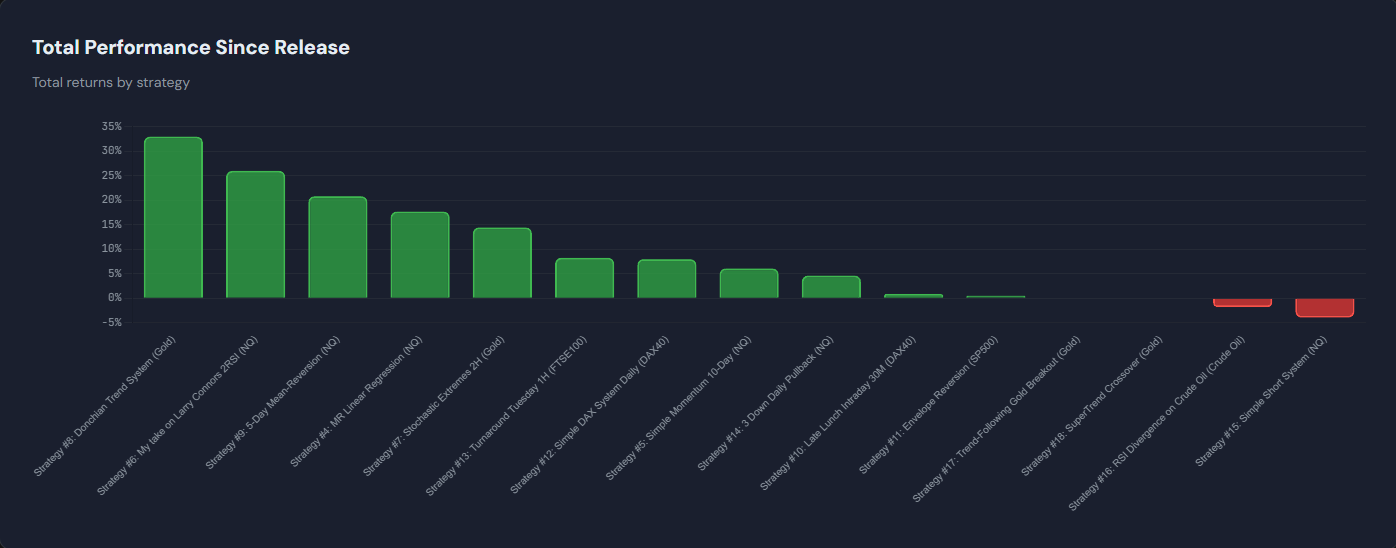
The tracker allows you to follow the performance of all published strategies from their release date onward.
You can explore the tracker here:
https://www.algomatictrading.com/strategies
I'll continue updating the tracker as new systems are published. You can access all these strategies by becoming a premium member.
Thank you for reading!
- Algomatic Trading
Disclaimer: I am not a financial advisor and I don’t recommend that you trade my strategies. This article is for informational and educational purposes only. Trading involves risk, and you can lose money. Always do your own research.
No posts
Comments
Nothing yet. Say the first thing.
Sign in to join the conversation.