
WTF is happening with our agreement to negotiate an agreement with Iran? Good question! The answer might have changed while you read that last sentence. The entire episode represents a major strategic failure for the US. And because the universe has a sense of humor, the Memorandum of Understanding that has the US lifting sanctions on Iran, paying them war reparations, and getting nothing in return was signed at Versailles, the same place Germany signed a treaty to end World War I and accepted a humiliating defeat.
To understand why this agreement with Iran is a major strategic defeat for the US, I’ll point you to this excellent piece by . And for some lighthearted historical context to explain how we got here, this is a good time to read my essay on Iran👇
Also, I spoke with about the damage the Trump administration is doing to the US intelligence community by continuously putting unqualified people in charge of our intelligence agencies. You can see clips here and here. The full interview is here (paywalled).
A friendly reminder that Rant! is a reader-supported publication. Thank you for making this newsletter possible!
ALEX’S WEEKLY RANT!
The Russian frigate Admiral Grigorovich has been vibing in the English Channel and North Sea lately to watch over all the shadow fleet vessels passing through on their way to and from Russia. The crew might have been feeling a wee bit on edge as of late since both the United Kingdom and France detained two of their shadow vessels in the last few days. Sweden and Belgium have also taken vessels in the last few weeks.
It was in this environment of already heightened tension that retired British couple Jane and Alan Kelvey set sail on their 39-foot sailboat, called Bright Future, to cross the Channel from England to France. Around 11 am last Tuesday, they noticed a vessel in the distance. The vessel did not show on AIS, the Automatic Identification System that broadcasts a ship’s identity and location to help avoid collisions. As they got closer to the vessel, they saw Cyrillic writing and realized they were about 400 meters away from a Russian warship.
This is too close. The proper distance to keep from a Russian warship is very fucking far. The Russians also thought this was too close. The Russian warship decided Bright Future was a major threat, so it let out five loud horn blasts to deter it. According to the Kelveys, Bright Future changed course to let the warship know they had seen it and were maneuvering away. According to Moscow, however, the threatening sailboat continued on its dangerous course. About a minute later, the warship let out another five horn blasts followed by four or five shots of small arms fire. Yes, a Russian warship fired warning shots at a British sailing yacht in the English Channel.
The UK Ministry of Defense said it believes the Russian vessel fired the shots to avoid a collision. The Kelveys say there was no chance of a collision and have accused the UK government of trying to shut them up for fear of upsetting Russia and escalating the situation.
Moscow said it fired the shots because the yacht made a “dangerous approach.” I’m not sure how a sailboat sailing by sail, as Bright Future was, can pose a major threat to a warship. Yes, mini speedboats caused enormous damage to the USS Cole. But that ship was fueling at a dock in Yemen, not cruising in the English Channel. Furthermore, a sailboat sailing by sail is totally reliant on the wind. I’m imagining how many times it might have to tack before it could sneak up on the warship and attack it. I’ve been on a sailboat and seen our destination and thought, “Oh, hey! That’s like ten minutes away!” and then four hours later we still haven’t reached it. Using a sailboat to strike a warship is not a likely scenario!
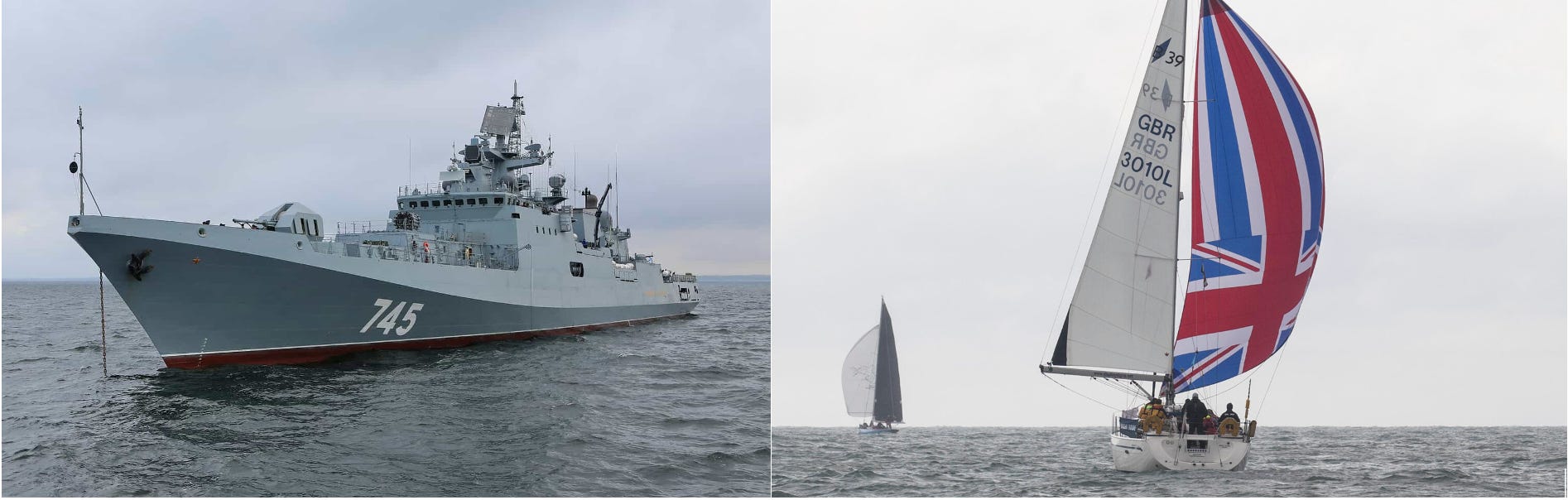
A source from the British Ministry of Defense told the AFP the Admiral Grigorovich was “drifting rather than being maneuvered under power, which may have made her feel more vulnerable.”
Possible. Russian warships have a tendency to be vulnerable. In April 2022, Russia’s warship Moskva was sunk by Ukraine, which doesn’t have a navy. Last December, Ukraine used a marine drone to put a Russian submarine in a Black Sea port out of commission. Russia’s aircraft carrier, the Admiral Kuznetsov, used to travel with its own tugboats because it was always breaking down. It also traveled with a giant cloud of smoke because it belches exhaust and is often on fire. It was brought into Murmansk for repairs in 2017. In 2018, a drydock in the marina sank, causing a 70-ton crane to fall on the flight deck of the Kuznetsov, creating g a 200-square-foot hole. I was never good at physics but I think a giant gaping hole is a bad thing to have on a boat. When the Russian navy finally moved the aircraft carrier to another dry dock, it caught fire again.

So it’s no wonder a 39-foot sailboat seemed like a monstrous threat to the mighty Russian navy.
While it’s possible this incident was an unfortunate misunderstanding, it demonstrates the real threat an ever more frightened and stressed Russia poses. The more vulnerable it feels, the more it will lash out, and the more likely a miscalculation or miscommunication will lead to much more serious consequences. Given the number of Russian vessels that have been detained recently, Russia certainly feels the pressure is being ratcheted up.
The UK’s response to the warning shots—fear of escalation—is the exact wrong one, particularly considering that this week it was revealed that Russia was behind a series of arson attacks that targeted the prime minister!
Which is why I’ve ended several of my Rants! with the kicker that the best way to stop Russian aggression against NATO is to give Ukraine everything it needs to win.
What exactly does that mean? Because it is about more than pushing Russia out of Ukraine and returning Ukraine to its sovereign borders.
Estonian Member of Parliament Marko Mihkelson put it rather elegantly in a recent piece:
It is not how to negotiate with the Kremlin or deter a future attack, but how to ensure Moscow is defeated in its war against Ukraine so that aggression no longer appears to be a viable strategy.
As Mihkelson writes, skillful diplomacy and somehow putting the onus on others to make sure Russia feels secure is counterproductive.
Russia operates according to the opposite logic. It prepares for opportunities, not threats. Its military planning rests on the assumption that weakness and hesitation among its adversaries create openings for further conquest. Its strategic objectives have not changed: Ukraine must fall and NATO must fracture.
As such, we must define what prerequisites are necessary to secure a lasting peace. Appeasement in any form won’t cut it.
Peace without justice is not peace at all. It is merely a ceasefire before the next war. If the aggressor is left convinced that borders can be redrawn by force and that democratic societies will lose patience before it does, then the next conflict becomes only a matter of time.
Mihkelson goes on:
So what does Russia’s defeat actually mean?
It does not necessarily mean the collapse of the Russian state or all-encompassing chaos. Russia’s defeat means, above all, that the Kremlin fails to achieve its military and political objectives in Ukraine. It means recognizing that aggression does not pay. It means that Ukraine preserves its sovereignty and its right to determine its own future. It means that Russia’s political elite must acknowledge that this war was a strategic mistake. It means that those responsible for war crimes are held accountable. It means that the damage caused by aggression is compensated. …We must be willing to speak openly about Russia's defeat. More importantly, we must act to bring it about.
The first step, as I wrote last week, is clearly defining Russia as the enemy and stating out loud our objective to defeat it.
As with so many of the other challenges we face today, we cannot be afraid of accountability. When aggressors believe they cannot lose, they will continue their aggression against us.
Perhaps the Brits on Bright Future were too polite to yell at the crew of the Admiral Grigorovich the famous words of the Ukrainian hero on Snake Island as the crew of the then-floating Moskva demanded his surrender, but we can do it for them, toward the crew of the Grigorovich and to all of Russia: “Russian warship, go fuck yourself!”
THE WEEK’S LINKS
A roundup of things you should be reading
RUSSIA’S WAR ON NATO
Russia was behind arson attacks targeting Prime Minister (BBC)
US USING AID TO AFRICA TO MAKE AMERICA RICHER
US Demands to Access Africans’ Data Raise Privacy, Sovereignty Concerns (ProPublica)
RUSSIA USING AFRICA TO RECRUIT FOR WAR
Russia plans to open eight new cultural centers in Africa to court a loyal generation, HUR says (Euromaidan Press) Good to be read with:
Class 21: Why are the French Stealing African Penises? (part of my Foreign Influence Operations Course)
EXCELLENT RESOURCES!
Just Security has launched WHAT JUST HAPPENED? as well as a litigation tracker to help readers keep up with the chaos
Alex Finley is a former officer of the CIA’s Directorate of Operations, where she served in West Africa and Europe. She writes and teaches about terrorism, disinformation / covert influence, and oligarch yachts. Her writing has appeared in Slate, Reductress, Funny or Die, POLITICO, The Center for Public Integrity, and other publications. She has spoken to the BBC, MSNBC, CNN, C-SPAN’s Washington Journal, France24, and numerous other media outlets. She was also invited once to speak at Harvard, which she now tells everyone within the first ten seconds of meeting them. She is the author of the Victor Caro series, satirical novels about the CIA. Before joining the CIA, Alex was a journalist, covering Capitol Hill, the Pentagon, and the Department of Energy. She reported on issues related to national security, intelligence, and homeland security. Did she mention she was invited to speak at Harvard?

Comments
Nothing yet. Say the first thing.
Sign in to join the conversation.