
Parts 1 and 2 of this series documented the Finch Paper closure and the financial chain connecting Vermont’s own pension fund to the company that made that decision.
This piece is about what happened inside the boardroom of the only surviving large-scale pulp buyer in the Northeast - while the company that owns Finch Paper held a seat at the table.
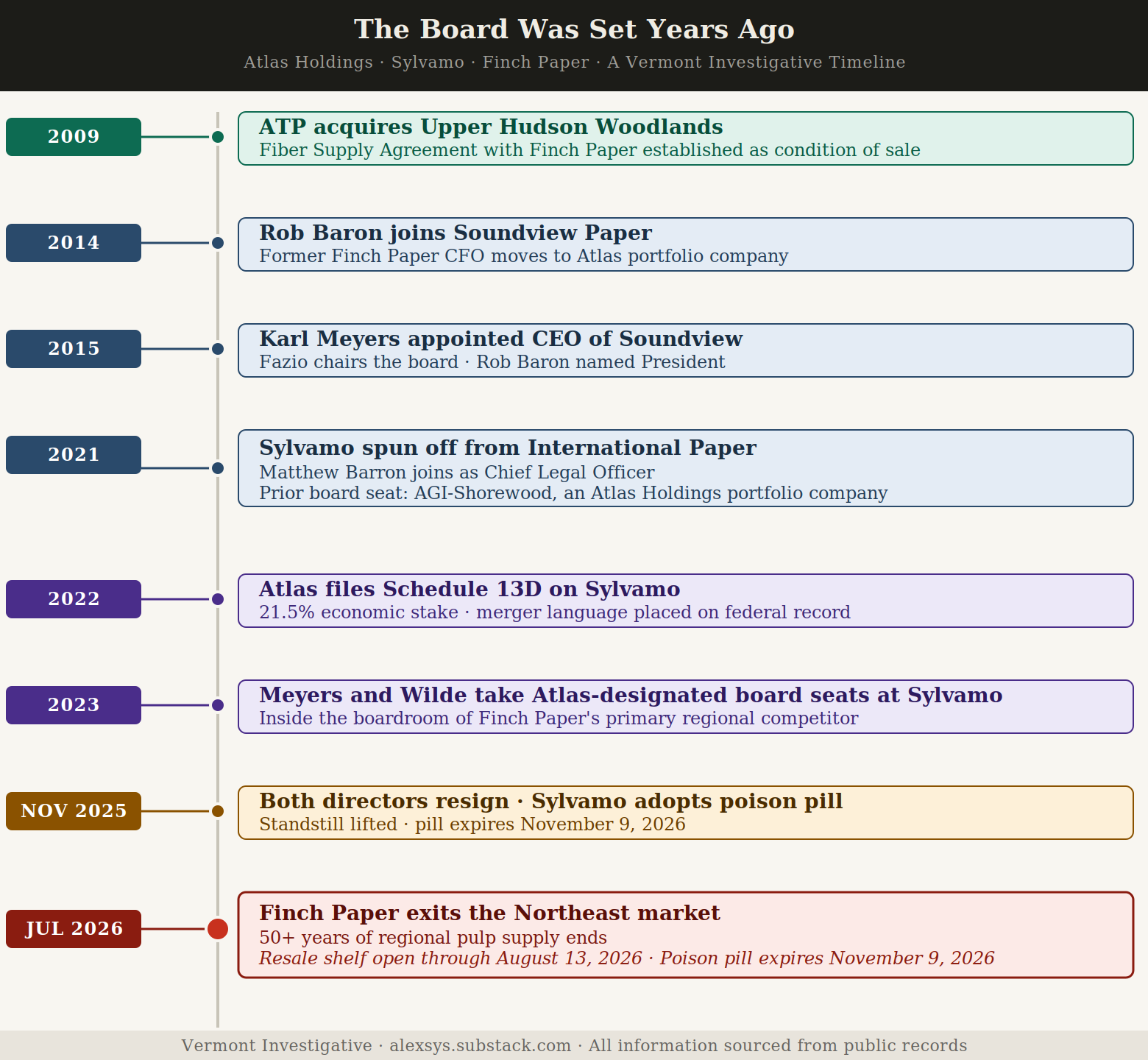
When International Paper spun off Sylvamo Corporation in 2021, it created an independent company built around uncoated freesheet paper - the kind used in offices, copy machines, and commercial printing. Sylvamo’s mills include operations in Brazil, Poland, and the United States. Its American anchor is the Ticonderoga mill in upstate New York - the last remaining large-scale regional pulp buyer in the Northeast after Finch Paper’s exit from the market.
Atlas Holdings noticed.
In April 2022, Atlas filed a Schedule 13D with the Securities and Exchange Commission, signed personally by co-founders Andrew Bursky and Timothy Fazio. The filing disclosed that Atlas held approximately 21.5 percent of Sylvamo’s economic interest. The filing also stated, on the record, that a merger or acquisition of Sylvamo was among the possible outcomes Atlas was considering.
Atlas owned Finch Paper. It now held a significant stake in the company that owned Finch’s primary regional competitor. And it had put its intentions toward that competitor into a federal securities filing.
On February 14, 2023, Sylvamo and Atlas entered into a Cooperation Agreement, executed through an Atlas affiliate entity called Atlas FRM LLC. Under the terms of that agreement, Atlas was entitled to designate two individuals to serve on Sylvamo’s board of directors.
Atlas designated Karl L. Meyers and Mark W. Wilde.
Both took their seats in March 2023. Both resigned on November 5, 2025 - together, at Atlas’s direction, ending what the agreement called the Cooperation Period and removing a standstill restriction that had limited Atlas’s ability to take further action on its Sylvamo position.
For thirty-two months, Atlas held two seats inside the boardroom of the company that owned Ticonderoga - Finch Paper’s only remaining large-scale regional competition for Northeast pulpwood.
Karl L. Meyers is a paper industry executive from New Jersey whose career spans Fort Howard Paper, Fort James Corporation, and twelve years as a senior executive at Georgia Pacific.
In 2015, he became CEO of Soundview Paper Company - an Atlas Holdings portfolio company in Orangeburg, New Jersey. He was appointed to that role by Tim Fazio, who personally chaired the Soundview Board of Managers. The announcement was documented in a June 1, 2015 BusinessWire press release, with Fazio quoted directly. Simultaneously, Rob Baron - the former Chief Financial Officer of Finch Paper - had joined Soundview in 2014 as Senior Vice President of Strategy and was promoted to President in 2015. An Atlas executive running one company. A Finch Paper veteran running another. Both inside the same Atlas portfolio.
Soundview was later renamed Marcal. It remained an Atlas portfolio company.
Meyers carried that history onto Sylvamo’s board in March 2023. He spent nearly three years as an Atlas-designated director at the company whose Ticonderoga mill was the primary remaining buyer of Northeast pulpwood - the same regional market on which Vermont and New York loggers depended, and on which Finch Paper’s suppliers had historically competed with Ticonderoga for fiber.
He resigned November 5, 2025.
Mark W. Wilde’s professional identity in the paper industry is specific enough to have a nickname. He is known as “Dr. Paper.”
Wilde grew up in Northern Michigan - timber country. He earned a BA in History and Accounting summa cum laude from Alma College and a PhD in Economic History from the University of Delaware, where he was a Hagley Fellow. He spent thirty years as a Wall Street analyst covering global paper, packaging, and forest products - first at Bankers Trust, then as Managing Director at Deutsche Bank, then as Managing Director at Bank of Montreal Capital Markets.
Thirty years of watching this industry from the analyst’s seat. Tracking which mills were viable, which companies were positioned for consolidation, which fiber markets were stressed, which management teams were executing.
In November 2024, LinkedIn shows him joining McKinsey & Company as a Senior Advisor in global packaging - a role he continues to hold. On November 5, 2025, he resigned from Sylvamo’s board.
During his thirty-two months as an Atlas-designated director, LinkedIn shows Wilde served on Sylvamo’s Audit Committee and Management Development/Compensation Committee. He also served on an ad hoc committee charged with the selection of Sylvamo’s new CEO.
In February 2026 - three months after his Sylvamo resignation - his LinkedIn profile shows him joining Atlas Holdings LLC as an Operating Partner, part-time, based in Greenwich, Connecticut. His listed focus: paper, packaging, and building products initiatives.
Mark Wilde - who spent thirty years as one of Wall Street’s most respected paper sector analysts, who sat on Sylvamo’s board for thirty-two months as an Atlas-designated director, who served on the committee that selected Sylvamo’s new CEO, and who had direct visibility into Sylvamo’s operations, financials, and Ticonderoga mill competitive position - is now an Operating Partner at the company that owns Finch Paper.
The Cooperation Agreement gave Atlas’s designated directors access to the information that flows to all board members of a public company. Board members of a publicly traded corporation receive financial reporting, operational updates, strategic planning discussions, and competitive intelligence as a matter of standard governance.
Sylvamo’s Ticonderoga mill is the only remaining large-scale regional pulp buyer after Finch’s exit. Its procurement strategy, its pricing, its capacity, its own fiber sourcing decisions - those are among the things a Sylvamo board member would have visibility into.
Atlas held two seats on that board from March 2023 to November 2025. One occupied by a paper industry operator with direct Atlas portfolio company experience. One occupied by a thirty-year Wall Street analyst who now works for Atlas directly.
The Finch Paper announcement - ending log purchases from Northeast suppliers - came on July 17, 2026. Drew Gardner, installed as Finch Paper CEO in February 2025 after coming from Iconex, another Atlas portfolio company, delivered the news.
Vermont Investigative is not alleging that anything that occurred in Sylvamo’s boardroom was improper. Directors of public companies have fiduciary duties to the companies on whose boards they serve. Cooperation Agreements of this kind are a standard private equity governance tool, disclosed to regulators and the public.
What is documented, entirely from public records, is the sequence: Atlas placed two directors inside the boardroom of Finch’s primary regional competitor. Those directors had access to the information that flows to all board members. They resigned in November 2025, lifting the standstill restriction. Sylvamo adopted a poison pill the same month - expiring November 9, 2026. Eight months later, Finch Paper exited the Northeast market.
There is a fifth connection inside Sylvamo that does not run through the Cooperation Agreement.
Matthew Barron is Sylvamo’s Senior Vice President, Chief Administrative and Legal Officer - the company’s top legal and administrative executive, in place since Sylvamo’s inception at the International Paper spinoff in 2021.
Barron’s biography, published on Sylvamo’s own investor relations website, lists his prior board service. Among his board positions: ASG Worldwide - also known as AGI-Shorewood - an Atlas Holdings portfolio company.
Sylvamo’s own Chief Administrative and Legal Officer held a board seat at an Atlas portfolio company before Sylvamo existed as a standalone entity.
The people who move through this story do not move at random. They move along documented lines.
Drew Gardner came to Finch Paper from Iconex, an Atlas portfolio company, via Atlas Holdings itself - installed as CEO seventeen months before the closure announcement.
Rob Baron served as Finch Paper’s CFO before joining Soundview Paper - an Atlas portfolio company - in 2014, rising to President in 2015, the same year Karl Meyers was appointed Soundview CEO by Tim Fazio.
Karl Meyers ran Atlas’s Soundview portfolio company, appointed personally by Fazio, before taking the Atlas-designated board seat at Sylvamo.
Mark Wilde served as an Atlas-designated Sylvamo director for thirty-two months before joining Atlas Holdings directly.
Matthew Barron sat on the board of an Atlas portfolio company before becoming Sylvamo’s top legal officer at the IP spinoff.
Five individuals. Five documented connections between Atlas Holdings and the people positioned inside or adjacent to Finch Paper and its primary regional competitor. All from public records. No single connection proves a coordinated strategy. The pattern is what the documents show.
Atlas’s stake in Sylvamo is not a simple stock position. It is a two-part structure that gives Atlas more economic exposure than its share count alone would suggest.
The direct piece: Atlas holds approximately 16 percent of Sylvamo’s outstanding common stock in direct beneficial ownership. The indirect piece: an additional 5.5 percent comes through derivatives, financial instruments that track Sylvamo’s stock price without requiring Atlas to hold the underlying shares. Combined, Atlas carries approximately 21.5 percent economic exposure to Sylvamo.
That derivatives layer matters. Think of it this way: Atlas has placed a financial bet on Sylvamo’s stock price that behaves like ownership, it gains and loses value as the stock moves, without triggering the same disclosure requirements as direct share ownership. Activist investors commonly use this structure to build economic exposure quietly before converting to direct ownership. Sylvamo’s board noted that Atlas “rapidly acquired a large position in the company’s common stock in 2022.” The derivatives layer suggests that accumulation was more layered than the share count alone reveals.
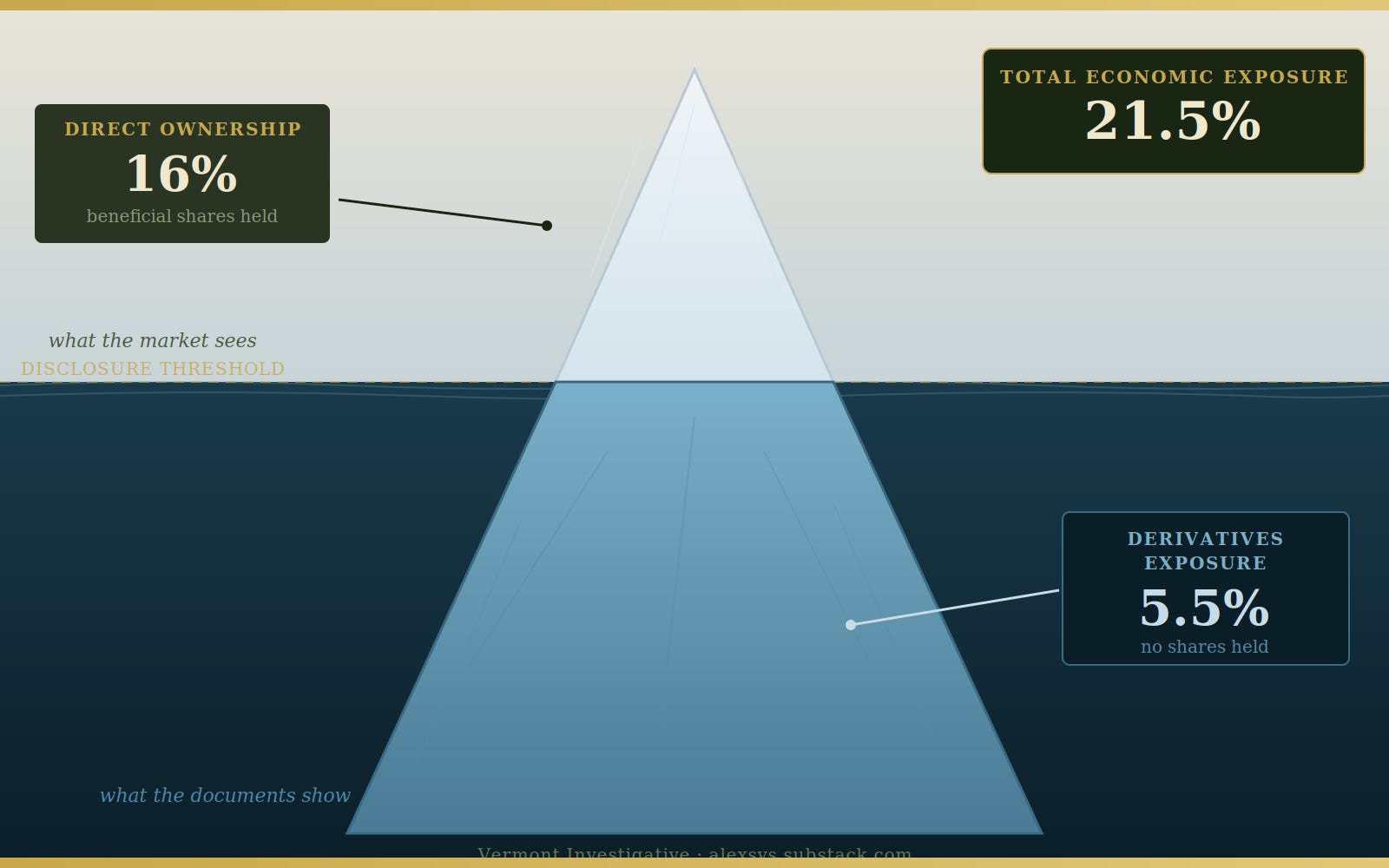
When the board adopted the poison pill in November 2025, it disclosed this position structure publicly for the first time, which is how the breakdown became a matter of public record.
There is a second piece to Atlas’s legal position. As part of the Cooperation Agreement, Sylvamo was required to register 6,312,454 Atlas shares for public resale. That shelf registration became effective March 6, 2026, and remains open through August 13, 2026. Atlas can sell those shares into the open market at any time before that date without additional SEC process.
Between March 2025 and March 2026, Sylvamo’s share price fell approximately 41.7 percent, from $66.29 to $38.64 per share, meaning Atlas’s position has lost substantial paper value over that period.
That decline has a direct cause. When the Trump administration announced sweeping tariffs on Canadian and Mexican imports in early 2025, including uncoated freesheet, the paper Sylvamo produces, importers flooded North American markets ahead of the restrictions, depressing domestic pricing and squeezing Sylvamo’s margins. The U.S. imports approximately 400,000 tons of uncoated freesheet from Canada annually, roughly 7 percent of domestic supply. Canada responded with retaliatory tariffs on U.S. goods including pulp and paper products. Sylvamo’s revenue fell more than 11 percent in 2025 and earnings fell 56 percent over the same period. The policy that reshaped the regional paper market did not spare the companies, or the investors, positioned inside it.
A shareholder rights plan, commonly called a poison pill, is a corporate defense mechanism that allows existing shareholders to purchase additional shares at a discount if any single investor crosses a specified ownership threshold, diluting that investor’s stake and making a hostile takeover prohibitively expensive. Companies adopt them to slow or block unwanted acquisition attempts.
The shareholder rights plan Sylvamo adopted in November 2025 is set to trigger if any person or group crosses 15 percent ownership, or 20 percent for passive investors. It expires November 9, 2026.
Atlas is already above the 15 percent threshold in direct beneficial ownership. The pill was structured specifically around Atlas’s existing position - grandfathering what Atlas already holds while blocking further accumulation. The moment the pill expires, that ceiling lifts.
Atlas still holds approximately 21.5 percent of Sylvamo’s economic interest, with merger language on the federal record since April 2022. The directors it placed inside Sylvamo’s boardroom for thirty-two months have resigned - one to join Atlas directly. The standstill is gone. The resale shelf is open through August. The pill expires in November.
“All has been controlled behind the boardroom doors. Our wood fiber supply and flow was and is controlled by those corporations and their large group of investors.”- William Sargent, Vermont forester, fifty years in the field, public post, Rural Vermont Rising, July 2026
He was writing about what happened to the loggers and truckers. He was also, without knowing it, describing exactly what the documents show.
What happens at Sylvamo after November 9 is not yet written. What is written - in federal securities filings, in press releases, in board rosters, and in LinkedIn profiles - is the story of how Atlas positioned itself before that date.
Principal has a way of losing to premium. The question Sylvamo’s shareholders may soon have to answer is whether, this time, principle will win out over premium.
Vermont Investigative is continuing to report on this story. Right-of-reply correspondence is outstanding with multiple parties named in this series. Responses received will be incorporated into subsequent reporting.
This is part of a continuing series. Part 4 will examine what happened to the land itself - the timberlands ATP sold, the carbon project built on top of them, and who benefits when the working forest stops working.
SEC Schedule 13D, Atlas Holdings / Sylvamo Corporation, April 2022 - Bursky and Fazio personally signed, merger language on record
SEC Schedule 13D Cooperation Agreement - Atlas FRM LLC named as specific Atlas affiliate entity
Sylvamo / Atlas Holdings press release, February 15, 2023 - Cooperation Agreement, Meyers and Wilde named as designated directors
TipRanks, November 6, 2025 - Meyers and Wilde resignation from Sylvamo board confirmed
BusinessWire, June 1, 2015 - Fazio quoted as Soundview Board Chairman, Meyers appointed CEO
NJBIZ, June 2, 2015 - Rob Baron confirmed as former Finch Paper CFO, promoted to Soundview President
Sylvamo investor relations website - Matthew Barron executive biography, AGI-Shorewood (Atlas portfolio company) board service confirmed
LinkedIn, Mark Wilde profile (accessed July 2026) - Operating Partner, Atlas Holdings LLC, Part-time, February 2026–present; Senior Advisor McKinsey & Company, November 2024–present; Sylvamo Member Board of Directors March 2023–November 2025, Audit Committee, Management Development/Compensation Committee, ad hoc CEO succession committee confirmed
Albany Business Review, January 3, 2026 - Drew Gardner installed as Finch Paper CEO February 2025, Iconex/Atlas background
Glens Falls Chronicle, July 17, 2026 - Finch Paper announcement, Drew Gardner quote
Sylvamo BoardWire / BusinessWire, November 10, 2025 - poison pill adopted, Atlas position breakdown confirmed (16% beneficial ownership + 5.5% derivatives = 21.5% economic exposure)
Sylvamo S-3ASR shelf registration, March 6, 2026 - 6,312,454 Atlas shares registered for resale, effective through August 13, 2026
Fintel institutional ownership data - Sylvamo share price $66.29 (March 24, 2025) → $38.64 (March 23, 2026), 41.7% decline
SEC filings November 2025 - Sylvamo poison pill adopted, expires November 9, 2026; triggers at 15% ownership (20% passive)
William Sargent, public Facebook post, Rural Vermont Rising group, July 2026 - quoted on record
If you find yourself reading, learning, or citing this work please consider supporting it with a Substack subscription or Ko-fi.
alexsys.substack.com
Comments
Nothing yet. Say the first thing.
Sign in to join the conversation.