
Previous pieces in this series documented the Finch Paper closure and the boardroom of the only surviving large-scale pulp buyer in the Northeast - the Atlas Holdings directors who held seats at that table for thirty-two months before the mill went quiet.
Here we explore what was already in place before any of that happened - and what it means now that the mill is gone.
The Land
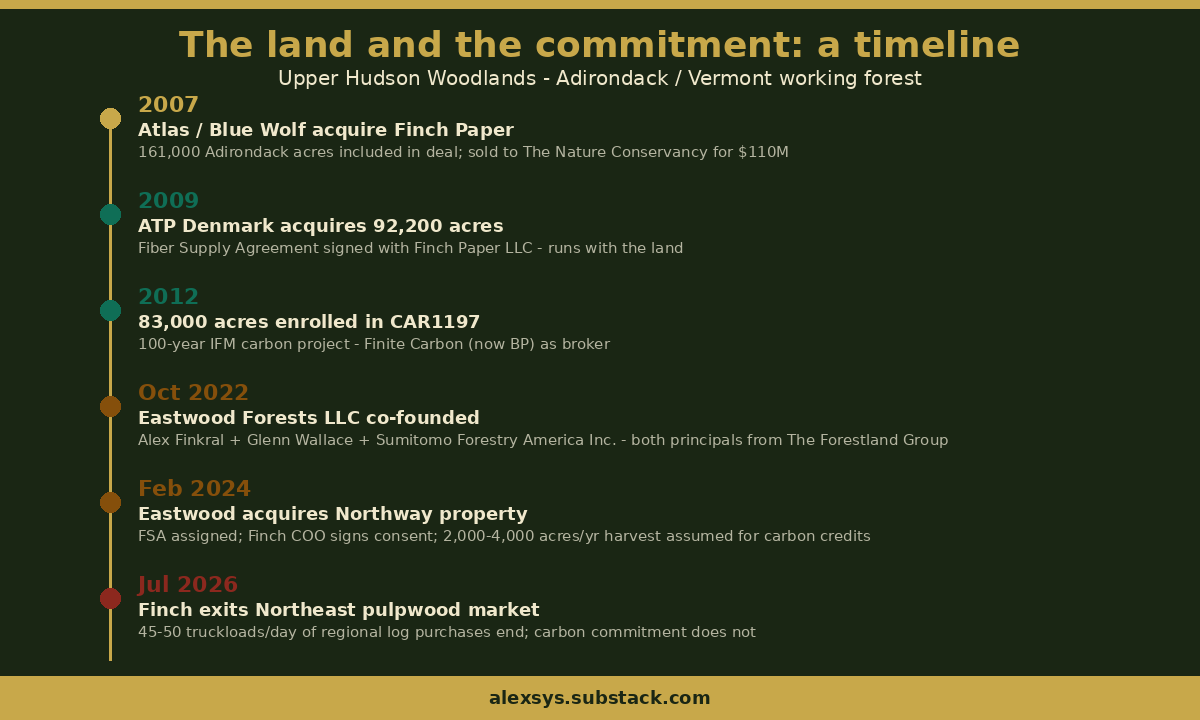
When Atlas Holdings and Blue Wolf Capital acquired Finch Paper in 2007, the deal included something most paper mill acquisitions don’t come with: 161,000 acres of Adirondack timberlands that Finch had owned for generations.
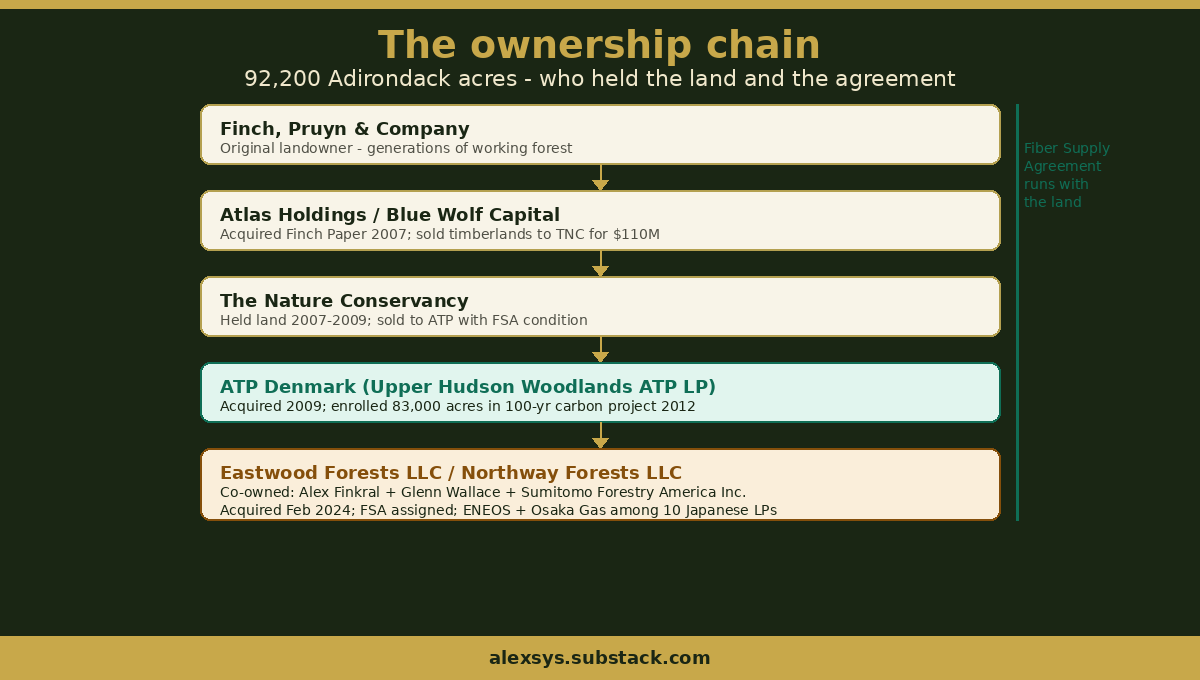
Atlas and Blue Wolf sold those acres to The Nature Conservancy for $110 million. Two years later, on March 27, 2009, a Danish pension fund called ATP - Arbejdsmarkedets Tillægspension, which manages retirement savings for approximately five million Danish workers - acquired the property from The Nature Conservancy. The acreage is reported at 92,200 by Eastwood’s own records today and at 92,035 in NYS DEC’s own Recreation Management Plan for the property - a small variance likely reflecting different survey dates or minor boundary adjustments over seventeen years of ownership, not a substantive discrepancy. (A separate, overlapping interest in this land - an 88,763-acre conservation easement - was purchased by New York State’s DEC in December 2010; that easement encumbers part of the fee acreage but is a distinct legal interest from ATP’s, and later Eastwood’s, ownership of the land itself.)
The sale came with a condition. A Fiber Supply Agreement between Finch Paper and the new landowner was written into the transaction. The working forest would remain a working forest, supplying fiber to the mill whose owners had just sold the land.
That agreement is now a question mark. Finch Paper has said it will stop purchasing “large quantities of logs from wood suppliers in the Northeast and New England” - roughly 45 to 50 truckloads of pulpwood daily, according to industry press coverage. The company says it will continue purchasing wood for its biomass cogeneration facility, but that facility runs on 600 tons per day of bark, sawdust, and rejected wood chips generated inside the mill itself - not the roundwood independent loggers cut and haul from the forest. The mill that was the economic anchor of the Fiber Supply Agreement is exiting the market that agreement was built around. Atlas Holdings, Finch’s parent company, also owns Millar Western, an Alberta pulp producer - raising the possibility that Finch’s future pulp purchases move north to a sister company rather than staying in the regional market at all.
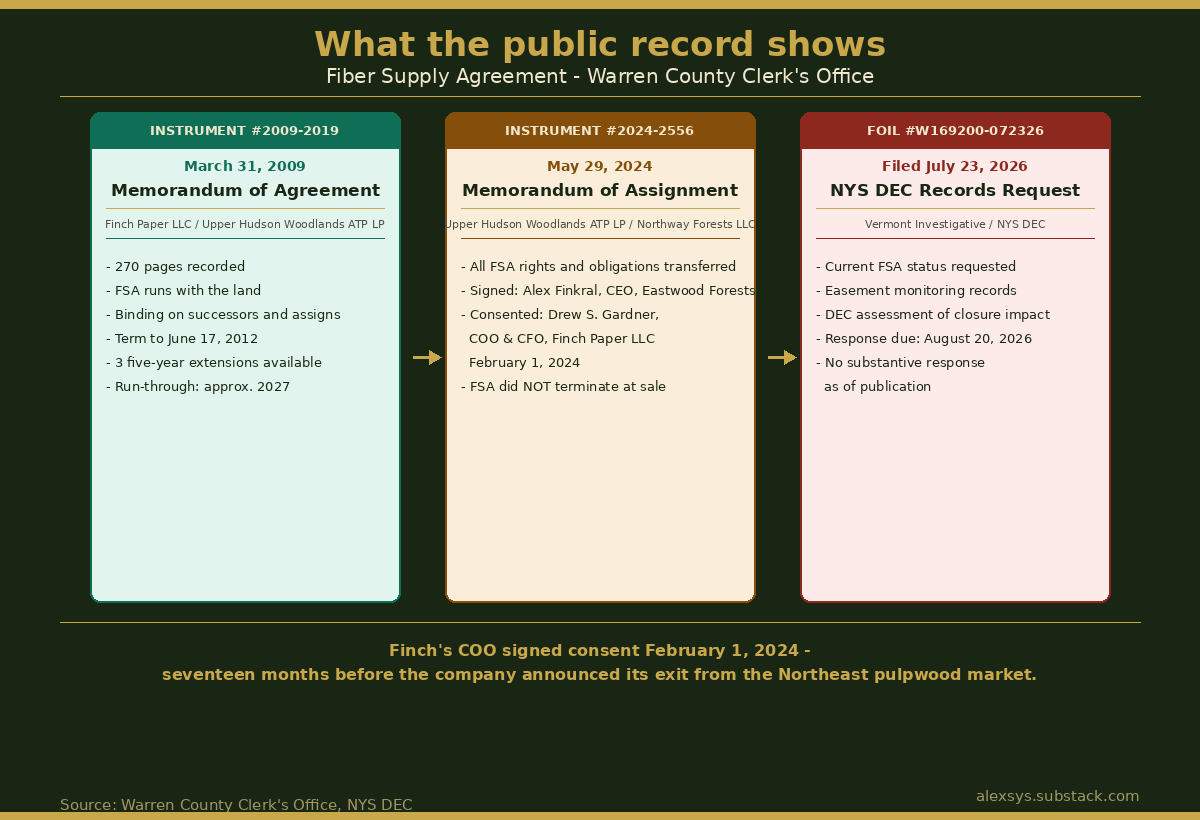
What public land records show is this: the Fiber Supply Agreement was recorded on March 31, 2009 in the Warren County Clerk’s Office as Instrument #2009-2019 - a 270-page document establishing that the FSA ran with the land and was binding on successors and assigns. The Memorandum of Agreement confirmed Finch had options to extend the agreement’s term for three additional five-year periods beyond its initial expiration of June 17, 2012 - meaning the agreement could run through approximately 2027. When Eastwood Forests acquired the property in early 2024, the FSA did not terminate. A Memorandum of Assignment of Fiber Supply Agreement, recorded May 29, 2024 in Warren County as Instrument #2024-2556, transferred all of ATP’s rights and obligations under the FSA to Northway Forests LLC, Eastwood’s holding entity. The document was signed by Eastwood’s CEO Alex Finkral. Finch Paper’s own COO and CFO, Drew S. Gardner, signed the consent page acknowledging and agreeing to the assignment - on February 1, 2024, seventeen months before Finch announced it was exiting the Northeast pulpwood market.
Whether Finch’s announced exit implicates the agreement’s terms depends on what the private contract requires of Finch as buyer - minimum purchase volumes, force majeure provisions, termination rights. The full contract is not publicly recorded. Vermont Investigative filed a Freedom of Information Law request with the New York State Department of Environmental Conservation on July 23, 2026 (Reference #W169200-072326), seeking the current status of the Fiber Supply Agreement, DEC’s easement monitoring records, and any internal DEC assessment of the July 2026 closure’s implications for the conservation easement’s working-forest terms. DEC acknowledged receipt and set an expected response date of no later than August 20, 2026. No substantive response has been received as of publication.
What is known - documented from public records - is what happened to those 92,200 acres in the years that followed.
The Commitment
In 2012, ATP enrolled 83,000 of its Adirondack acres in a carbon credit project registered with the Climate Action Reserve. Project ID: CAR1197. Upper Hudson Woodlands ATP Improved Forest Management.
The broker was Finite Carbon - now a subsidiary of BP.
Finite Carbon is not new to the Vermont/Adirondack landscape. A second active IFM carbon project - ACR0558, covering Park Forestry NY LLC’s holdings spanning Vermont and New York’s Adirondack Park - was registered in March 2022 with a crediting period running through 2040. Park Forestry states on its own website that carbon and ecosystem markets are part of their long-term planning. Finite Carbon is the carbon developer on that project as well. Conservation and recreational easements on Park Forestry’s Vermont holdings are held by the Vermont Land Trust and the Trust for Public Land - including 1,700 acres in Sharon and 930 acres abutting Groton State Forest. Those easements are part of the legal architecture that makes the 20-year carbon commitment enforceable on those acres. The Vermont Land Trust holds easements on land enrolled in that same carbon project, which has 406,263 credits issued but not yet retired - still available in the market for purchase by industrial emitters.
The commitment period: 100 years.
Under California’s cap-and-trade program - the compliance mechanism that governs this project - enrolled forests generate carbon credits by storing more carbon than a baseline projection assumes they would under conventional management. Those credits are sold to industrial emitters who need to offset their emissions. The landowner receives revenue. The carbon stays in the trees, in theory, for a century.
In exchange, the landowner commits to managing the forest to the carbon project’s standards for the full 100-year term. A portion of the credits generated - the “buffer pool” contribution - is set aside as insurance against the risk that the stored carbon is lost to fire, disease, or other disturbance. The buffer pool is supposed to make the system whole if a project fails.
A May 2026 study published in the journal Nature found that the buffer pools across the California compliance system are significantly undersized for the level of climate-driven risk - fire, drought, insect infestation - now affecting North American forests. The insurance mechanism was designed for a different climate than the one these forests are operating in.
The Finch Paper closure did not trigger a carbon project default. But the economic model that made working forest management viable just lost its anchor buyer. The carbon commitment assumed a working forest. The market that made the working forest work is no longer there.
The Fund
Eastwood Forests LLC was co-founded in October 2022 by Alex Finkral, Glenn Wallace, and Sumitomo Forestry America Inc., a wholly owned subsidiary of Sumitomo Forestry Co., Ltd. of Japan. Sumitomo Forestry describes Eastwood as a Sumitomo Forestry Group company - not a portfolio investment but a co-owned management entity. Finkral holds a doctorate in forestry from Yale and spent twelve years as Chief Forester and Vice President of Conservation at The Forestland Group, a Chapel Hill-based timberland investment organization with its own history of Adirondack carbon credit work. Glenn Wallace, CFO and Managing Partner, spent twelve of his twenty-three years in the venture capital and private equity industry at The Forestland Group as well. Both the CEO and CFO of the company now managing the Northway property came out of the same organization, in the same region, doing the same work.
Eastwood acquired the Northway property - the 92,200 ATP Adirondack acres - in February 2024 as the first asset in Eastwood Climate Smart Forestry Fund I. The fund raised ¥60 billion - reported at the time as approximately $415 million to $427 million depending on the yen conversion used. It is domiciled in Japan and carries a 15-year investment period.
Its limited partner investors are public record, confirmed in a press release from Sumitomo Mitsui Trust Bank dated July 10, 2023. All ten are Japanese institutional entities:
Sumitomo Forestry Group. Tokyo Century Corporation. Japan Post Holdings. NYK (Nippon Yusen). Fuyo General Lease. Sumitomo Mitsui Banking Corporation. Sumitomo Mitsui Trust Bank. Unicharm Corporation.
And two others: ENEOS Corporation - Japan’s largest oil refiner. And Osaka Gas Co. Ltd. - a major natural gas utility.
The Eastwood Climate Smart Forestry Fund I, which finances the 100-year carbon commitment on 83,000 Adirondack acres, counts Japan’s largest oil company and a major gas utility among its investors. The carbon broker for that same project is Finite Carbon - a subsidiary of BP, one of the world’s largest fossil fuel companies. Fossil fuel industry capital on both ends of a climate commitment on a working forest whose regional market just collapsed.
An Eastwood spokesperson confirmed to the Adirondack Explorer in October 2024 that producing carbon credits on the Northway property requires managing between 2,000 and 4,000 acres of active harvest annually. That harvest assumption is baked into the carbon project’s math. The pulpwood market that made harvesting those acres economically viable just lost its anchor buyer.
The Blueprint That Didn’t Plan for This
Vermont did not enter the Finch closure without a framework. It had one.
In 2022, the Vermont Legislature passed Act 183, which included a statutory mandate directing the Commissioner of Forests, Parks and Recreation to create the Vermont Forest Future Strategic Roadmap. The Legislature’s findings were explicit: the forest products sector provides nearly 14,000 jobs for Vermonters, generates $2.1 billion in annual sales, and that “addressing the economic and social needs of the forest products sector is paramount to keeping forests intact, viable, and healthy.”
Commissioner Danielle Fitzko delivered that Roadmap in February 2024 - more than two years before Finch Paper announced it was exiting the Northeast pulpwood market
The Roadmap’s five pillars address forest management, the business environment, research and innovation, industry reputation, and forest economy and communities. Pillar 3 explicitly flags carbon sequestration and storage markets as an emerging area to “monitor and study.” The framework assumed viable markets for the full range of forest products, including pulpwood. It has no contingency for losing an anchor buyer.
Vermont Investigative submitted a right-of-reply request to the Vermont Department of Forests, Parks and Recreation in July 2026. Kate Eberle, Vermont Department of Forests, Parks and Recreation, responded on the record. Her response confirmed that Finch Paper was responsible for 40 percent of the state’s hardwood pulp and almost all of its hemlock. FPR, she stated, is actively surveying parties affected by Finch’s market withdrawal. The Forest Future Strategic Roadmap, she said, is guiding FPR’s response.
The Legislature mandated a strategic framework to keep Vermont’s working forests intact. The Roadmap was the answer. The Finch closure is the stress test the Roadmap was not built to absorb.
Some Perspective
A 100-year commitment is not a contract. It is a declaration about the future made by people who will not live to see it kept or broken.
The carbon project enrolled on these 83,000 Adirondack acres in 2012 runs until 2112. Everyone alive who negotiated it, brokered it, signed it, and consented to it will be gone before it expires. The ATP executives in Denmark. The Finite Carbon brokers who structured it. The DEC officials who accepted the conservation easement. The Finch Paper executives whose mill anchored the working forest economics the whole arrangement assumed. Gone.
The United States has existed for 250 years. Vermont has been a state for 235. This commitment is nearly half the age of the republic - made by private entities that did not exist a century ago and carry no guarantee of existing a century from now.
A tree standing on these acres today was a seedling when this agreement was signed. It will be harvested - or left standing, or lost to climate stress, or flagged by a carbon verifier whose company doesn’t yet exist - under terms set before it reached its first decade of growth. The forest will cycle through multiple generations before this commitment expires.
What does not cycle is the obligation. It runs with the land. It transferred from ATP to Eastwood in February 2024 without pause. It will transfer again, to whoever comes next, under whatever conditions the working forest presents in 2050, in 2075, in 2100.
The mill that anchored the economics of this commitment closed in 2026. The commitment did not.
What a 100-Year Commitment Means
Carbon commitments of this duration are not unusual in the compliance market. They are, by design, longer than most human planning horizons. They are longer than most institutional investment cycles. They are longer than the careers of every professional currently managing the land or the fund connected to it.
The land enrolled in CAR1197 is obligated to store carbon at the levels the project baseline assumes for one hundred years — through ownership changes, market collapses, climate shifts, and ten presidential administrations. The commitment does not care what happens to the mill, the fund, or the fiber market. It runs until 2112.
Eastwood Forests, which now manages the property, acquired it knowing that commitment was in place. Alex Finkral, whose background is in working forest management and carbon markets, has stated publicly that “neglecting carbon would mean you are probably doing your investors a disservice.” The Eastwood model treats carbon revenue as a core component of the working forest’s financial viability, not an add-on.
What the Finch Paper closure does to that model is a question Vermont Investigative put to Eastwood Forests on July 22, 2026. Eastwood acknowledged receipt and stated it could not respond at this time. The response reframed the question as being about the “pulp mill closure” - not about the carbon project, not about the Fiber Supply Agreement, not about the working forest’s long-term economic model.
Finite Carbon, the BP subsidiary that brokered the carbon project, did not respond to a request for comment by publication deadline.
ATP Denmark responded to Vermont Investigative’s right-of-reply request. Jørgen Rudbeck, ATP’s Head of External Communications, confirmed ATP sold the Upper Hudson Woodlands property to Eastwood Forests in early 2024 and said ATP “is not in a position to comment on matters relating to the current operation of the property” - including the Finch Paper closure, wood supply arrangements, or the carbon project - and referred further questions to Eastwood as current owner and operator.
Who’s Watching
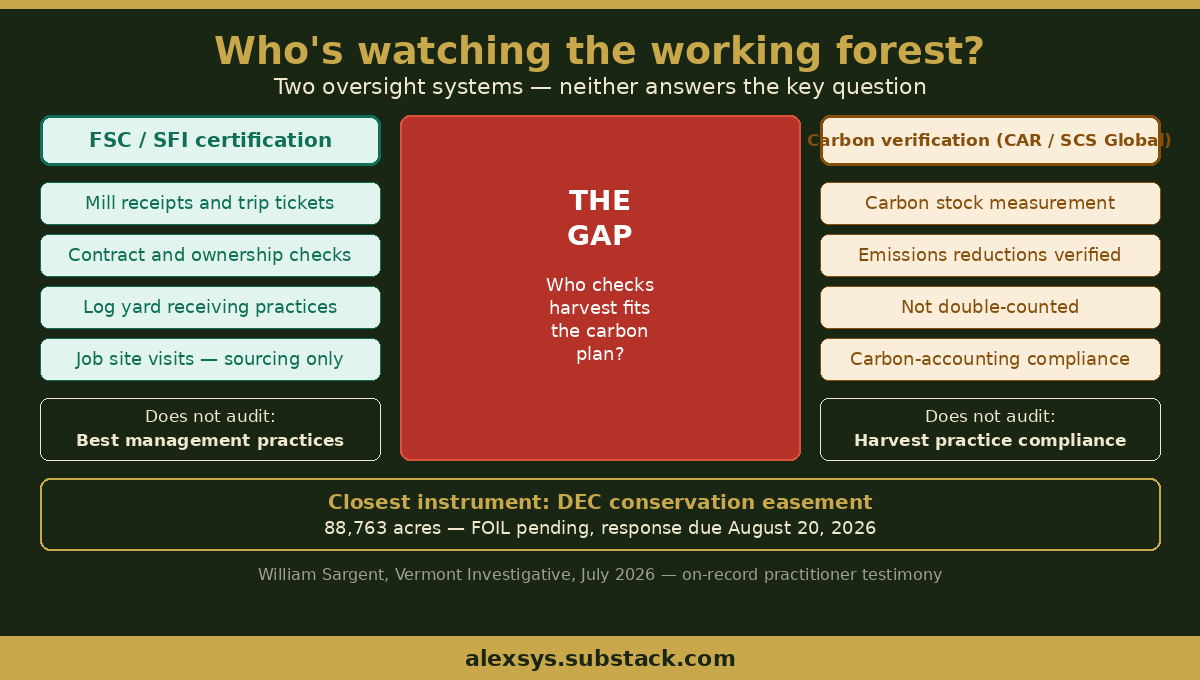
Two oversight systems exist for the Upper Hudson Woodlands. Neither was designed for the question the Finch closure is now asking.
The first is carbon verification. The Climate Action Reserve requires periodic third-party verification by an accredited body - SCS Global in this case. That process includes a desk review and a project site visit. What it checks is whether the carbon math holds: are the trees storing what the model says, are the emissions reductions real and not double-counted. Carbon-accounting compliance. Not harvest-practice compliance.
The second is sustainable forestry certification. Eastwood carries both Forest Stewardship Council and Sustainable Forestry Initiative certification on the property. William Sargent, a co-author of this series and a veteran of the Vermont and regional logging industry with direct FSC experience, described those audits from practice: extensive review of mill receipts, trip tickets, contracts, log yard receiving practices, and job site visits to confirm where wood is coming from. The focus, Sargent said, was chain of custody and ownership verification - confirming that contracts matched ownership and that the wood was not stolen. He personally signed ownership verification statements as part of the process. Best management practices were not where the audit’s attention was directed. “Our FSC certification was never audited for good forestry management practices that I’m aware of,” Sargent said. “The focus was on chain of custody and ownership.” As for carbon verification site visits specifically: “I wouldn’t even be able to speak as to carbon credit inspection. It should happen.”
The two systems don’t formally speak to each other. Neither is specifically designed to answer whether this forest is being harvested in the way the carbon project’s management plan assumed - now that the pulpwood market has collapsed.
On the question of what happens to the forest if harvest levels drop significantly, Sargent was direct: less harvesting on most stands is manageable in the short term - perhaps five years. After that it becomes a problem. He noted that Vermont’s Commissioner of Forests, Parks and Recreation, Danielle Fitzko, is already wrestling with Current Use plans that have inspection and work mandated that can no longer be done because the market to do that work no longer exists.
In New York, a parallel program called 480a provides tax incentives for managed forestland, similar in structure to Vermont’s Current Use. Sargent said he has never heard much about actual inspection under the 480a program.
The DEC conservation easement - 88,763 acres of it, purchased by New York State in December 2010 - is the closest instrument to on-the-ground enforcement of working-forest terms on this land. Vermont Investigative’s pending FOIL request seeks DEC’s assessment of what the Finch closure means for those terms. DEC’s response is due no later than August 20, 2026.
The Chessboard
Each piece on this board was placed by a different hand.
Atlas Holdings and Blue Wolf Capital sold the Adirondack timberlands in 2007 to close the Finch Paper acquisition. The Nature Conservancy acquired them, then sold to ATP Denmark in 2009. ATP enrolled the acres in a carbon project brokered by Finite Carbon, now BP. Eastwood Forests - backed by Sumitomo Forestry and a fund that counts ENEOS and Osaka Gas among its LPs - acquired the property in 2024.
No single player controls the board. No single decision explains the outcome. The pieces were placed over seventeen years by professionals doing their jobs - acquiring assets, enrolling acres, raising capital, managing portfolios.
The result is a working forest enrolled in a 100-year climate commitment, managed by a fund whose investors include fossil fuel companies, brokered by a BP subsidiary, connected through the mill’s former supply chain to the company that just eliminated the regional market that made the working forest economy function.
The board was set before anyone in Vermont knew to look at it. The people who live and work in these woods are only now seeing what was placed around them.
Vermont Investigative is continuing to report on this story. Public records requests and right-of-reply correspondence are outstanding with multiple parties named in this series. Responses received will be incorporated into subsequent reporting.
This is Part 4 of a continuing series.
Primary Sources
Glens Falls Chronicle, “Finch Paper will stop making its own pulp,” July 2026 - Finch’s own statement on ending log purchases; continuing biomass cogeneration purchasing
New York Almanack, “Finch Paper Closing Glens Falls Pulp Mill; Logging Affected,” July 2026 - 45-50 truckloads of pulpwood daily prior to closure; Atlas Holdings’ ownership of Millar Western as likely future pulp source
PaperAdvance, “Finch Paper to End Pulp Production at Glens Falls,” July 2026 - discontinuation of independent logging contractor purchases confirmed
Atlas Holdings LLC, “ESG Spotlight: Finch Paper,” atlasholdingsllc.com, February 2025 - cogeneration facility converts 600 tons/day of bark, sawdust, and rejected wood chips into steam
Finch Paper LLC, “Finch’s Environmental Sustainability,” finchpaper.com - cogeneration facility technical detail
Open Space Institute press release, June 18, 2007 - TNC acquisition of 161,000 acres from Finch Pruyn for $110 million
NYS DEC, Upper Hudson Woodlands Recreation Management Plan - confirms ATP acquisition of 92,035 acres on March 27, 2009
Warren County Clerk’s Office, Instrument #2009-2019, recorded March 31, 2009 - Memorandum of Agreement, Finch Paper LLC to Upper Hudson Woodlands ATP LP; FSA runs with land; term to June 17, 2012 with three five-year extension options; Book/Page 3740/1
Warren County Clerk’s Office, Instrument #2024-2556, recorded May 29, 2024 - Memorandum of Assignment of Fiber Supply Agreement; signed by Alex Finkral, Eastwood Forests LLC; consented to by Drew S. Gardner, COO & CFO, Finch Paper LLC, February 1, 2024; Book/Page 6931/289
NYS DEC, Public Records Request acknowledgment, Reference #W169200-072326, received July 23, 2026 - FOIL request re: FSA status, easement monitoring, closure impact; response expected by August 20, 2026
PitchBook, Sumitomo Forestry Co. company profile - trailing 12-month revenue $15.1 billion as of December 31, 2025
Wu, C., Anderegg, W. et al., “Forest carbon protocols underestimate climate-driven carbon loss risks,” Nature, May 20, 2026 - buffer pools undersized for climate-driven reversal risk; sixfold increase in buffer pool size estimated as necessary
Sumitomo Mitsui Trust Bank press release, July 10, 2023 - Eastwood Climate Smart Forestry Fund I LP list confirmed; fund size ¥60 billion
Sumitomo Forestry Co., Ltd. press release, May 11, 2023 - Establishment of Eastwood Climate Smart Forestry Fund I
Global AgInvesting, February 3, 2025 - ¥60 billion fund size reported as US$427 million
Finite Carbon project page, finitecarbon.com/projects/atp-upper-hudson-woodlands - 83,000 acres, 100-year CARB commitment, CAR1197
SCS Global registry - Upper Hudson Woodlands ATP IFM confirmed
Upper Hudson Woodlands Forest Management Plan Summary - Fiber Supply Agreement as condition of 2009 acquisition confirmed
AgriInvestor, February 19, 2024 - Alex Finkral quote on carbon and investor obligation
Park Forestry NY LLC website, parkforestry.com, accessed July 28, 2026 - Vermont holdings documented; carbon markets as long-term planning; easements held by Vermont Land Trust, Trust for Public Land, NYS DEC
American Carbon Registry, Project ID ACR0558 - Finite Carbon / Park Forestry IFM; active; registered March 27, 2022; 427,701 credits issued, 21,438 retired, 406,263 unretired
William Sargent, co-author, Vermont Investigative Finch Paper series, email response July 29, 2026 - on-record practitioner testimony on FSC audit scope, carbon verification, harvest impact, NY 480a program
Kate Eberle, Vermont Department of Forests, Parks and Recreation, email response to Vermont Investigative right-of-reply request, received July 2026 - Finch responsible for 40% of state hardwood pulp and almost all hemlock; FPR survey underway; Forest Future Strategic Roadmap cited as guiding framework
Vermont Forest Future Strategic Roadmap, Final Report, January 2024 - Commissioner Danielle Fitzko; five-pillar strategic framework; carbon markets flagged as emerging area to monitor and study (Pillar 3)
Vermont Act 183 (2022), Secs. 42-44, codified at 10 V.S.A. Chapter 82 - statutory creation of Vermont Forest Future Strategic Roadmap; legislative findings: ~14,000 jobs, $2.1B annual sales
Jørgen Rudbeck, Head of External Communications, ATP Denmark, email response to Vermont Investigative right-of-reply request, received July 2026 - ATP sold property to Eastwood in early 2024; declined to comment on current operations; referred to Eastwood
Eastwood Forests, email response to Vermont Investigative right-of-reply request, July 22, 2026 - acknowledged receipt; could not respond at this time
NYS DEC Environmental Notice Bulletin, March 2, 2022 - 88,763-acre Upper Hudson Woodlands ATP conservation easement purchased from TNC, December 29, 2010
Finite Carbon, California AB 1305 Voluntary Carbon Market Disclosures, updated December 22, 2025 - no entry for CAR1197 or ACR0558 among projects currently marketed to California buyers
Adirondack Explorer, “Global investors bet big on Adirondack forests for carbon credits,” October 7, 2024 — Eastwood spokesperson confirms 2,000-4,000 acres annual harvest assumption required for carbon credit production on Northway property; Finite Carbon confirmed as broker on at least 5 Adirondack projects totaling 370,000+ acres
Global AgInvesting, “Sumitomo Forestry, Eastwood Forests Launch Forestry Fund I in North America,” February 3, 2025 — Eastwood Forests LLC confirmed co-founded by Alex Finkral, Glenn Wallace, and Sumitomo Forestry America Inc.; fund target 322,000 acres by 2027; 15-year investment period
If you find yourself reading, learning, or citing this work please consider supporting it with a Substack subscription or Ko-fi.
Comments
Nothing yet. Say the first thing.
Sign in to join the conversation.