
Vermont Investigative transmitted a written questionnaire to Hannah Sessions on June 1, 2026 — twelve master questions asked of all five declared candidates for Vermont Senate Addison District (ADD-1), plus candidate-specific addendum questions drawn from her documented record. The questionnaire was transmitted under identical conditions to all five declared candidates.
No written response to the questionnaire was received.
On June 20, 2026, Vermont Investigative transmitted a right-of-reply communication to Sessions documenting four simultaneous roles identified in the public record and their relationship to Vermont’s Act 59 conservation policy infrastructure. Sessions responded in writing on June 20, 2026:
“Yes, we conserved our farm with VLT in 2004. I served on the VHCB Board from September 2015 to January 31, 2019 (appointed by the Governor). I have served on the Vermont Land Trust Board from October 6, 2019 to the present (voted by VLT’s membership). I conserved my land prior to these affiliations, and I never served on these boards at the same time. I have no financial relationship with VLT other than through the terms of our conservation easement. My easement provides no financial benefit other than the payment we received in 2004 and I have no financial interest in VLT’s decisions. As a VLT Board member I follow VLT’s conflict of interest policy. I believe that working and farming with the land for twenty-five years has given me the experience and perspective to be a strong advocate for farming and conservation in Vermont. I think bringing a farmer’s perspective to the VLT Board serves farmers’ interests and the Vermont landscape well.”
Her response addressed the timeline of her board affiliations and her conflict of interest practice at VLT. She did not address how she would manage Senate committee jurisdiction overlapping with her current VLT trusteeship if elected.
Of five declared candidates for ADD-1, one responded to the questionnaire: Andrea Treadway. Vermont Investigative will note that fact in every candidate profile in this series.
In the absence of written questionnaire responses, Vermont Investigative reviewed Sessions’ public record: campaign finance filings with the Vermont Secretary of State, Vermont Land Trust governance documents, VHCB board records, Vermont Conservation Plan TAC membership documentation, and Sessions’ public statements. What follows is what those documents show. Where the public record addresses a question, it is cited. Where it does not, that absence is noted.
Hannah Doton Sessions is a first-generation farmer and cheesemaker. She and her husband Greg Bernhardt have owned and operated Blue Ledge Farm in Leicester, Vermont since 2000 — a 150-acre goat dairy producing artisanal cheeses sold nationally. Blue Ledge Farm is located in Addison-2, the district her family has farmed for generations.
Her community leadership record, as listed on her campaign website hannahsessionsforvt.com:
Owner/Operator, Blue Ledge Farm, 2000–present
Board member, Addison County Community Trust for Affordable Housing, 2000
Local and district school boards, 2006–2016
Act 46 Committee — first successful joint school district merger, 2016
Vermont Housing and Conservation Board, 2015–2019, appointed by the Governor
Board of Trustees, Vermont Land Trust, October 6, 2019–present
Technical Advisory Committee, Vermont Conservation Plan (Act 59/30x30), current
State Delegate, Addison County Democratic Committee, 2025
She is running as part of a two-candidate Democratic team with incumbent Senator Ruth Hardy, announced March 22, 2026. Their campaign describes the partnership as “the first Two Woman Team to represent you, the people of the Addison District, in the Vermont Senate.” The political pipeline through which Hardy recruited and mentored Sessions is documented in By Design: Vermont’s Democratic Pipeline.
She is the daughter of Senior U.S. District Court Judge William Sessions.
(Source: hannahsessionsforvt.com, accessed July 13, 2026 · ruthforvermont.com, March 22, 2026)
Vermont Investigative’s right-of-reply communication, transmitted June 20, 2026, documented Sessions in four simultaneous roles with connections to Vermont’s Act 59 conservation policy infrastructure:
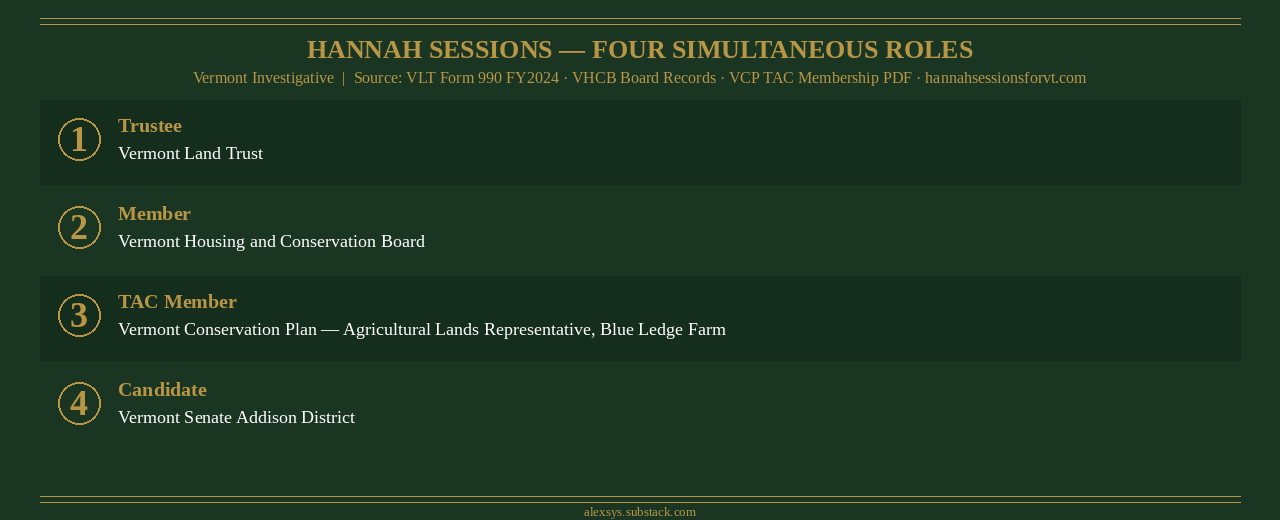
The right-of-reply communication also noted, sourced to blueledgefarm.com, that Blue Ledge Farm sold its development rights to Vermont Land Trust in 2004 — making Sessions simultaneously an easement holder under VLT and a trustee of the organization that holds her farm’s easement.
No claim is made about Sessions’ intent or the appropriateness of her judgment in any of these roles. The documented structure — easement holder, trustee, former VHCB board member, TAC member, and Senate candidate — is factual. Vermont Investigative documents structure. Voters assess meaning.
Vermont Investigative reviewed Sessions’ 2026 campaign finance disclosure filed with the Vermont Secretary of State.
Contributors of note from the itemized record:
Neil Mickenberg — $500.00
Mickenberg is current Vice-Chair of the VHCB board, documented in VHCB board minutes from June 2025. The 2018 VHCB Annual Report confirms Sessions and Mickenberg served on the VHCB board at the same time — both are named in the board photo caption from that year. His contribution is not from a former colleague but from a documented contemporaneous board peer. (Source: VHCB Board Minutes, June 24, 2025; VHCB Annual Report 2018, legislature.vermont.gov)
Charles Grigg — $1,000.00
Grigg is president of the S&C Harvest Foundation. Vermont Investigative identified a $5,000 grant from the S&C Harvest Foundation to Vermont Land Trust in the same fiscal year as Grigg’s personal contribution to Sessions’ campaign. Sessions is a current VLT trustee.
Out-of-state contributions:
Vermont Investigative’s review of Sessions’ campaign finance filing identified $6,470.00 in out-of-state contributions against $52,811.00 in total monetary contributions campaign to date — 12.3 percent of total funds raised. Sessions stated publicly on Facebook that contributions came from the “vast majority from local, in-state donors.” The filing is a public document. Vermont Investigative reports what it contains.
(Source: Vermont Secretary of State campaign finance disclosure, Hannah Sessions 2026)
Q1 asked candidates to cite the primary source for Vermont’s documented housing demand and describe the demographic assumptions behind the state’s 40,000-unit projection.
Sessions did not respond to the questionnaire. No documented public statement from Sessions specifically addressing the demographic assumptions behind Vermont’s housing demand projections was located in the public record as of publication.
Q2 asked candidates to describe the education fund revenue risk posed by Vermont’s projected demographic decline and identify which funding mechanism is most vulnerable.
Sessions did not respond. No documented public statement specifically addressing the education fund’s demographic revenue exposure was located in the record.
Q3 asked candidates to state their position on whether noncitizens should be permitted to vote in school budget elections.
Sessions did not respond. No documented public statement specifically on noncitizen voting in school budget elections was located in the record as of publication.
Q4 asked candidates to describe Act 59’s mechanism for generating carbon credits from conserved land, identify who captures the value, and state whether current law adequately protects landowner interests.
Sessions did not respond to the questionnaire. Sessions currently serves on the Act 59 Technical Advisory Committee as the Agricultural Lands representative, with Blue Ledge Farm listed as her affiliation. (Source: Vermont Conservation Plan TAC membership PDF, October 2025)
No documented public statement specifically describing the carbon credit mechanism under Act 59 or addressing landowner value capture was located in Sessions’ public record as of publication.
Q5 asked candidates to describe how they would value Vermont’s natural capital — forests, wetlands, agricultural soils, groundwater — in land use and fiscal policy, and whether that valuation should be monetized.
Sessions did not respond. No documented public statement specifically addressing natural capital valuation methodology was located in the record.
Q6 asked candidates whether Vermont should require public disclosure of beneficial ownership for entities holding land above a specified threshold, and what that threshold should be.
Sessions did not respond. No documented public statement specifically on beneficial ownership disclosure for land-holding entities was located in the record.
Q7 asked candidates to describe the appropriate relationship between federal conservation priorities and Vermont’s authority over its own land use decisions.
Sessions did not respond. No documented public statement specifically framing Vermont’s land use sovereignty in relation to federal conservation programs was located in the record.
Q8 asked candidates to describe their framework for rural Vermont — specifically, how they balance the interests of working landowners, conservation goals, and new residential development.
Sessions did not respond. Sessions operates Blue Ledge Farm under a VLT conservation easement and serves as a VLT trustee. No documented public statement specifically describing her framework for balancing working landowner interests against conservation goals was located in the record as of publication.
Q9 asked candidates to describe their position on large-scale data center development in Vermont, including the energy demand implications and what regulatory standards should govern siting.
Sessions did not respond. No documented public statement specifically on data center siting standards or energy demand policy was located in the record as of publication.
Q10 asked candidates to describe the relationship they see between Vermont’s per-pupil education spending and measurable student outcomes, and what specific changes they would support.
Sessions did not respond. Sessions served on local and district school boards from 2006 to 2016 and was a member of the Act 46 committee that produced the first successful joint school district merger in Addison County. No documented public statement specifically addressing per-pupil spending relative to outcome data was located in the record.
Q11 asked candidates to describe the mechanism they believe drives Vermont’s housing price-to-income mismatch and identify the one regulatory change most likely to move the ratio.
Sessions did not respond. Sessions served on the board of Addison County Community Trust for Affordable Housing in 2000 and on the Vermont Housing and Conservation Board from 2015 to 2019. No documented public statement specifically naming a single regulatory lever for the price-to-income mismatch was located in the record.
If elected to the Vermont Senate, Sessions would vote on legislation governing conservation easements, Act 59 implementation, ANR rulemaking, and VHCB — all areas in which Vermont Land Trust and VHCB have direct institutional interests.
Sessions’ right-of-reply response addressed her conflict of interest practice at the VLT board level. It did not address how she would manage the overlap between her VLT trusteeship and potential Senate committee assignments with jurisdiction over conservation policy.
The following positions from Sessions are not in the public record in sufficient specificity to report as documented: her framework for the carbon credit mechanism under Act 59, her position on beneficial ownership disclosure, her description of the demographic assumptions behind Vermont’s housing demand projections, her specific regulatory recommendation for Vermont’s housing price-to-income mismatch, and how she would manage Senate committee jurisdiction that overlaps with her VLT trusteeship.
Vermont Investigative will update this profile if Sessions provides written responses after publication.
Five candidates are on the ballot. One provided written answers. The public record for the four who did not is what it is. Voters in Addison District will decide in August what the absence of a written questionnaire response means — and what four simultaneous roles in Vermont’s conservation policy infrastructure mean for the candidate asking for a fifth.
hannahsessionsforvt.com, candidate biography and community leadership record, accessed July 13, 2026
ruthforvermont.com, campaign announcement March 22, 2026
blueledgefarm.com, Blue Ledge Farm development rights sale, 2004
Vermont Land Trust, Board of Trustees, VLT Form 990 Part VII FY2024, EIN 03-0264836, vlt.org/about/our-board/
Vermont Housing and Conservation Board, board page and board minutes, December 2025 and June 24, 2025, vhcb.org
VHCB Annual Report 2018, legislature.vermont.gov — confirms Sessions and Mickenberg served concurrently on VHCB board
Vermont Conservation Plan Technical Advisory Committee, Agricultural Lands membership, VCP TAC membership PDF, October 2025
Vermont Secretary of State, Campaign Finance Disclosure, Hannah Sessions 2026, campaignfinance.vermont.gov
S&C Harvest Foundation, grant records — $5,000 grant to Vermont Land Trust, same fiscal year as Grigg contribution
Hannah Sessions, written right-of-reply response to Vermont Investigative, June 20, 2026 (on record)
Vermont Investigative, By Design: Vermont’s Democratic Pipeline, alexsys.substack.com/p/by-design-vermonts-democratic-pipeline
If you find yourself reading, learning, or citing this work please consider supporting it with a Substack subscription (https://alexsys.substack.com/subscribe) or Ko-fi (https://ko-fi.com/alexsysthompson)
Comments
Nothing yet. Say the first thing.
Sign in to join the conversation.