
For those of you who prefer to read on paper (or e-reader) rather than in your Substack or email app, I have converted this essay into an easily printable PDF
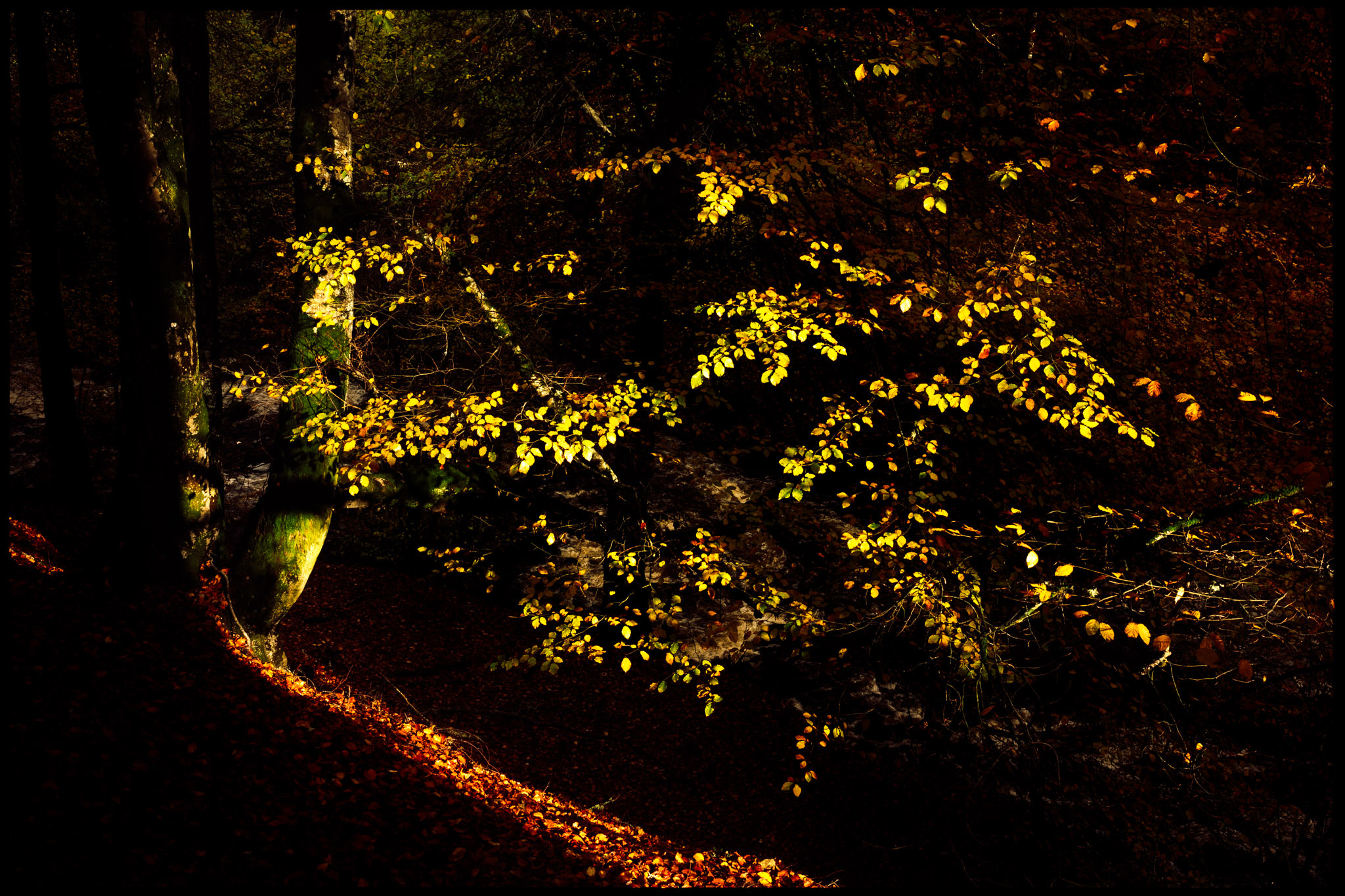
No big intro this week, because it’s a long newsletter! Hope you enjoy the goodies I’ve curated for you this time. The photograph above is from a recent walk with my old friend and mountaineering partner Isi, who has moved back to Scotland with her family – future adventures await.

From my desk
Working on right now
Like the Wind issue #48.
Sidetracked Volume 35, plus a few other Sidetracked bits and bobs behind the scenes.
Plans for Kendal next week are occupying a fair bit of my time. More on this below.
Recent stuff
🧭 How to break bad navigation habits
Pleased to see this piece of work I did for the Austrian Alpine Club (UK) and TGO magazine now available to read online. I’ve mentioned it before, but this was a great project for me, and I’m glad to be able to spread what I consider an important and positive message:
Smartphone-based navigation is safe when used correctly. However, a growing body of evidence demonstrates that learned skills are degraded by automation – and that includes nav apps, no matter how intentionally we use them. We like to think we can remain on top of the tech, but that isn’t backed up by the science. How could I fight the skill fade, break bad navigation habits, and put myself back in the driving seat?
✍🏻 Analogue Renaissance
My talk about the analogue renaissance of the 2020s was very well received! An engaged and well-informed audience made for some lively chat about film photography, print magazines, music on vinyl, and all the other good stuff. My dodgy Star Wars jokes even went down well. Quote of the night: ‘How come your 70-year-old cameras in regular heavy use look pristine, while my modern mirrorless is knackered after two years?’
I’d love to take this talk elsewhere, so if anyone has any ideas for possible venues, please do give me a shout.
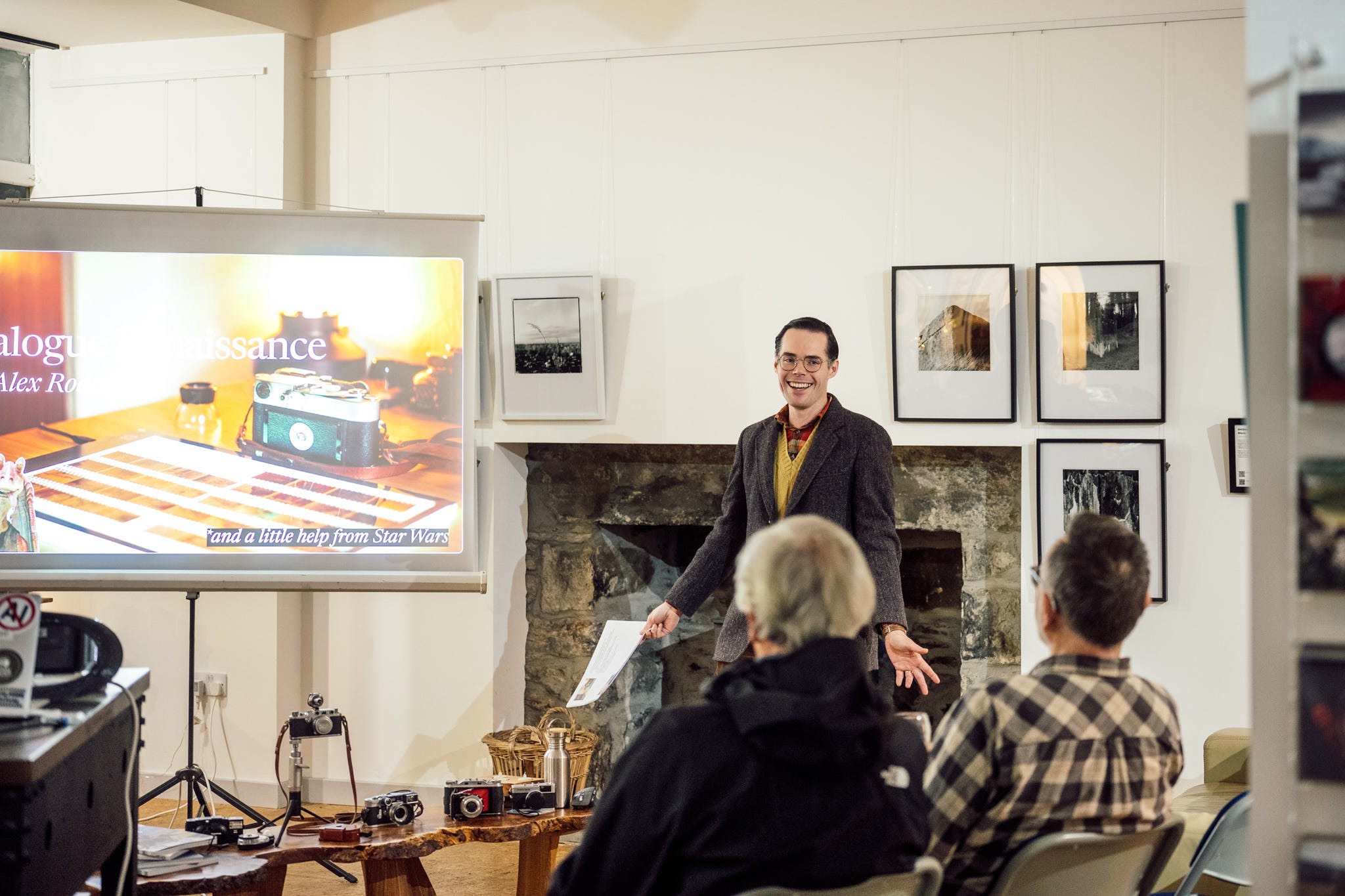
Photo by my wife Hannah Roddie.
Upcoming
Yep, it’s all about the Kendal Mountain Festival next week!
🥾 Outdoor Connections industry summit, Kendal, November 20th, 2025
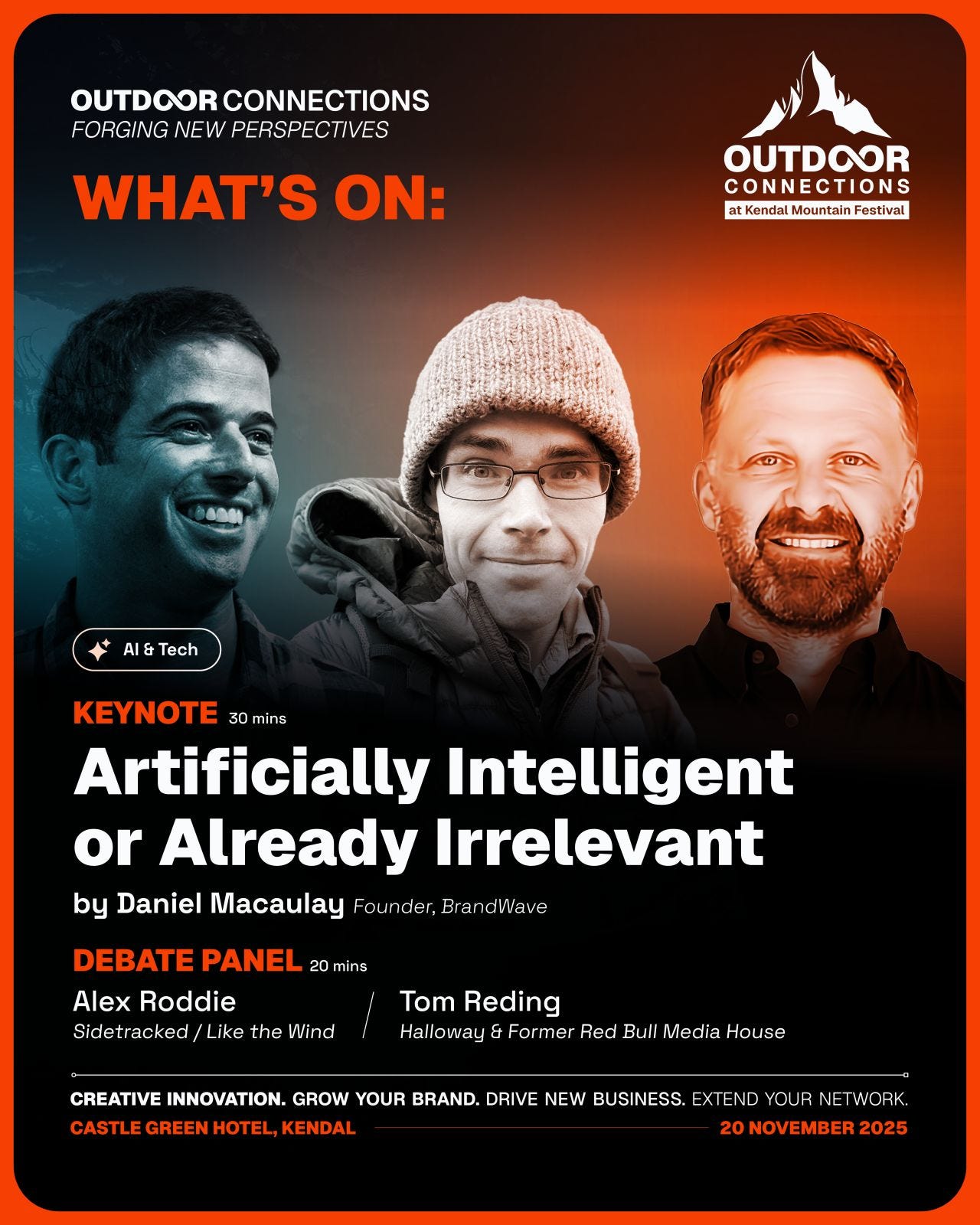
A final reminder that I’ll be participating in the ‘Artificially Intelligent or Already Irrelevant’ debate on AI at the Outdoor Connections summit just before the Kendal Mountain Festival. It’s only a short debate, but my hope is that it opens up space for a more involved conversation at some point.
Here’s how to sign up to the industry summit:
🍻 ALINE: Open Ground, Kendal, 2pm November 21st, 2025
I’m really looking forward to this gathering of like-minded creative folk. I’ll be speaking a bit about how I’ve been taking my photography and artwork into new dimensions over the last few months. Tickets are selling quickly, so grab yours – it’d be lovely to see you there.
Recently processed film images
It’s taken weeks, but I have finally finished scanning my negatives from the Aosta Alta Via. Just need to file, keyword and archive now. The result is a body of work I’m pleased with – and perhaps the most tangible expression of the aesthetic all my visual work has been moving towards for more than a year. Perhaps a philosophy more than an aesthetic? I guess I’m a student of the chiaroscuro school now.
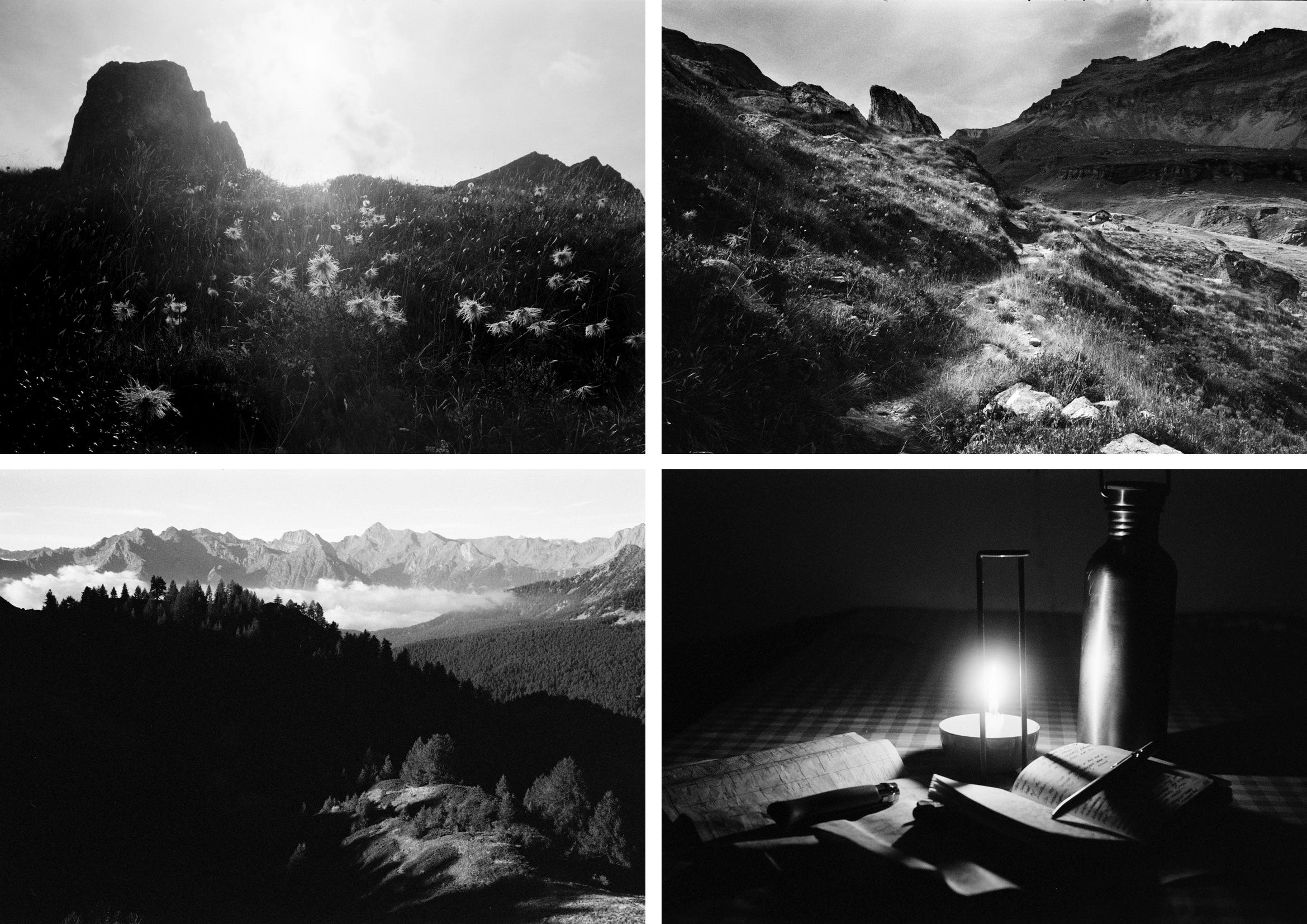
Shooting nothing but Kodak Double-X, and metering by eye, was a leap of faith for me – especially on a long-distance mountain journey – but my faith has been more than justified. It felt like both a steep learning curve and a vindication of the skills I’ve been building for the last decade and more. Being able to look at a scene in changing light and intuitively set exposure without reference, trusting my brain instead of a meter reading, feels like some new and deeply satisfying kind of witchcraft.
I see now the value in studying a single camera, single lens, single film stock for a long period and truly becoming a master. I am not that master yet, not by a long shot.
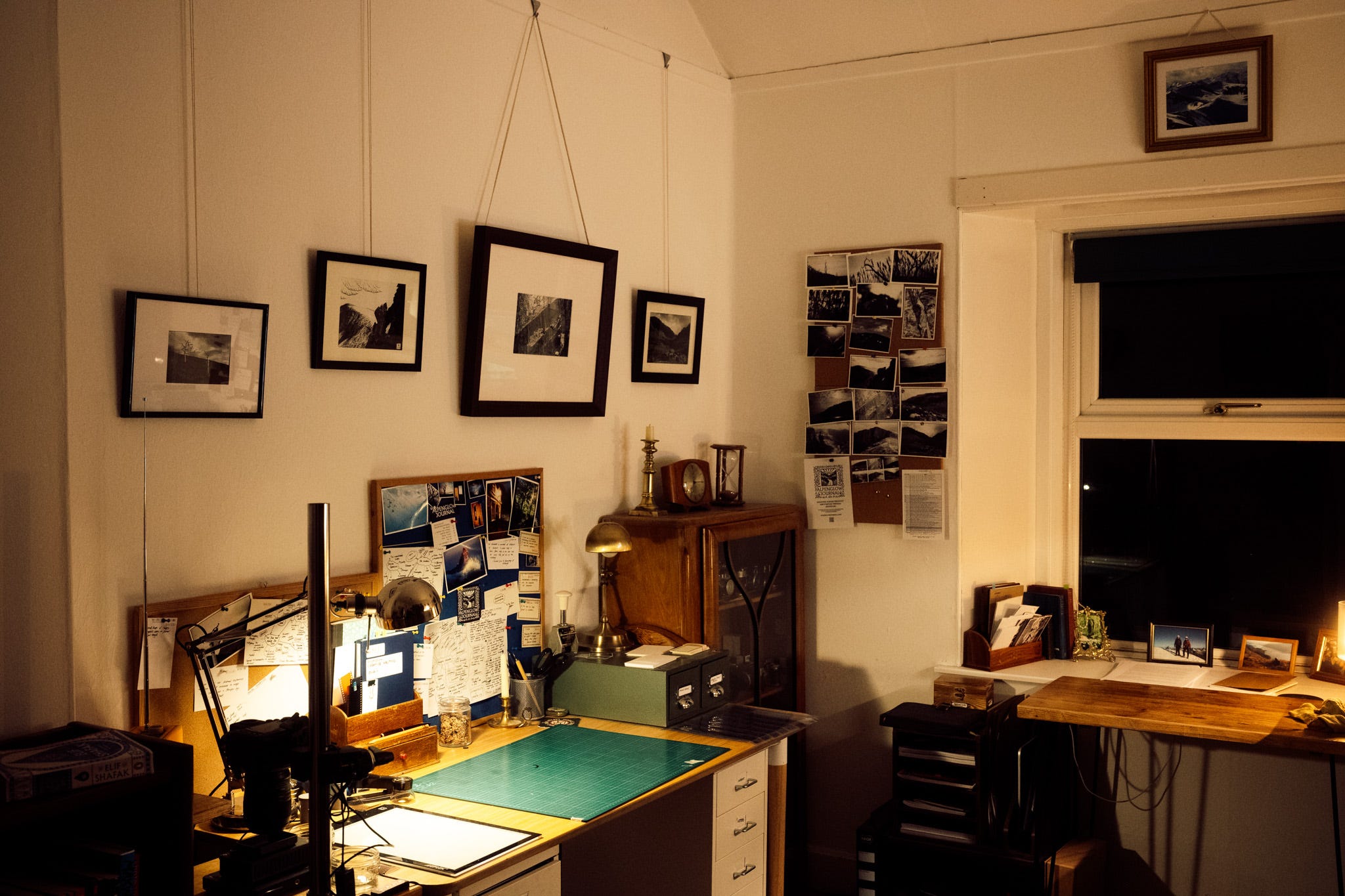
I’ve actually shot and processed a ton more photography over the last few weeks, including my first few home-developed rolls. A subject for a future post. Oh, and I’ve been hanging some photographs in my study:
Art
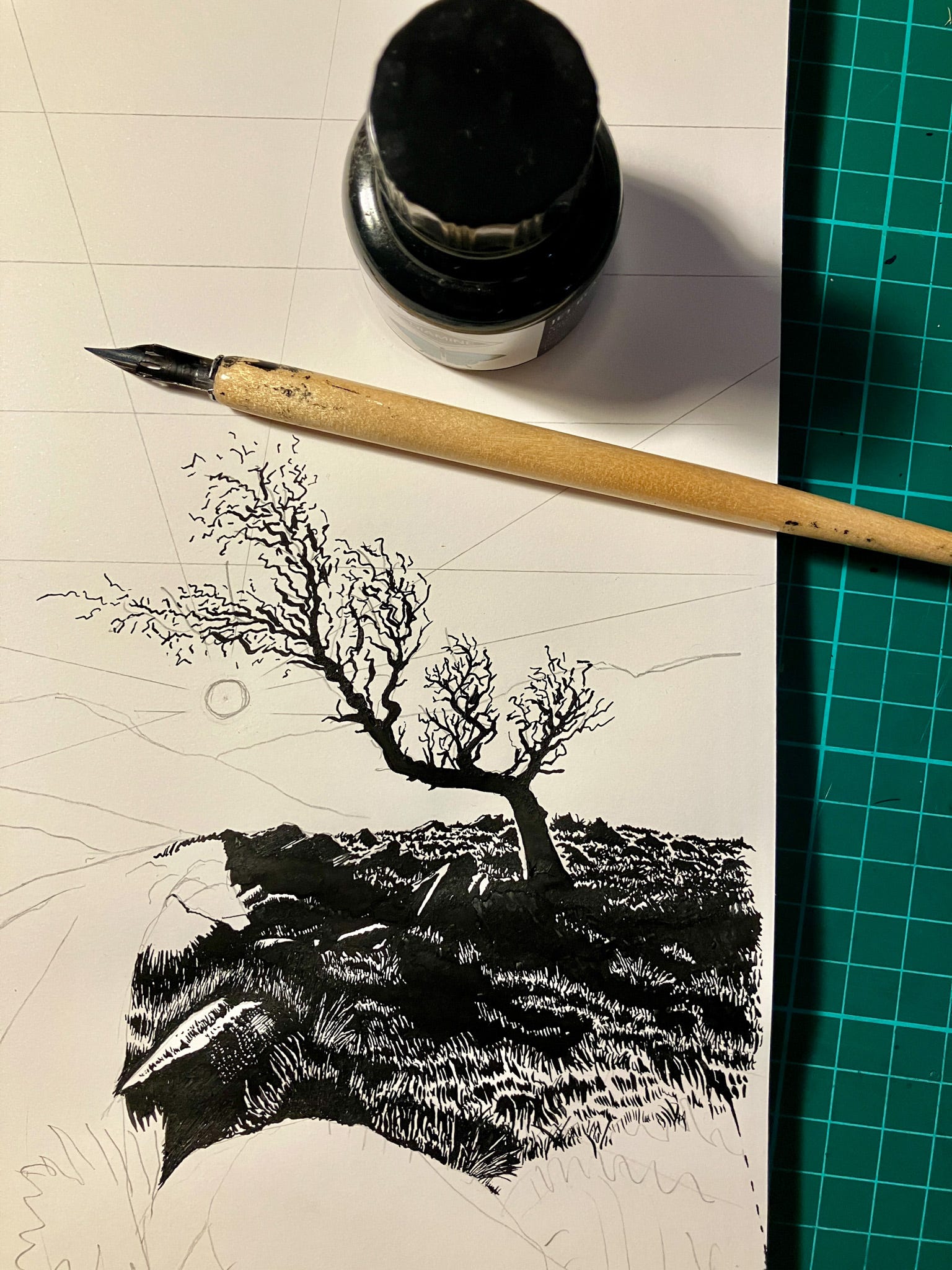
We needed a piece of artwork for a Like the Wind story at short notice, and the subject matter felt very me – gothic and high-contrast – so I commissioned myself to draw one! I won’t share the finished piece here, but here’s a photo of the work in progress. Dip pen and ink on cartridge paper.

What I’ve been reading
Books
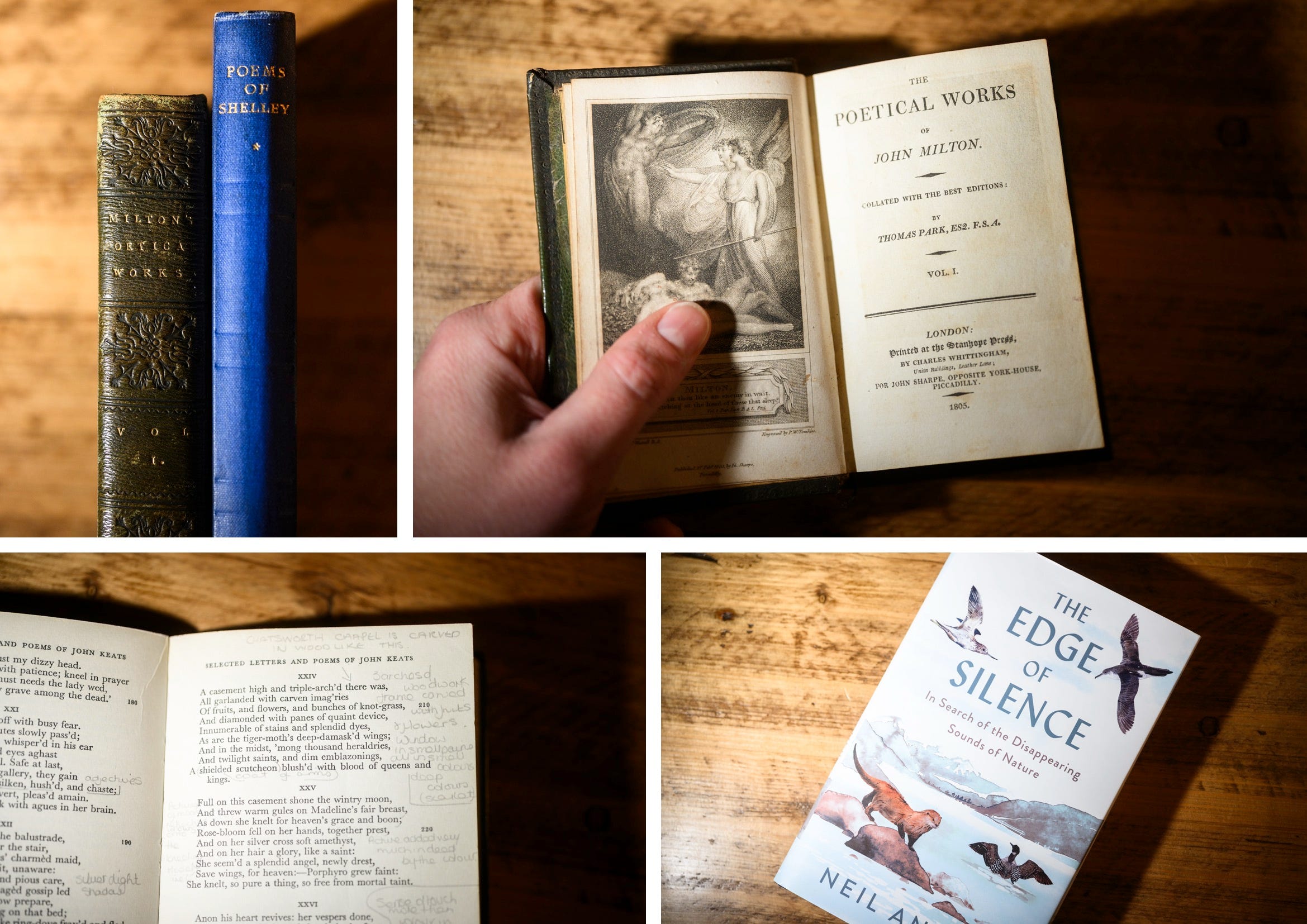
A few books I’ve picked up lately: an 1805 copy of Paradise Lost and other poetical works by Milton (which I’ve been meaning to read forever), books of poetry by Shelley and Keats (for reference, and because I like the annotations from previous readers), and The Edge of Silence by Neil Ansell, one of my favourite nature writers.
I’m still reading Gormenghast by Mervyn Peake. I’ve just about got to Irma Prunesquallor’s ball. What a delicious treat this book is.
From the web
📚 Bauer closes Modern Gardens magazine and ends Trail in print
End of an era for Trail magazine, which is closing in print form after 35 years, and shifting to a 100% digital model. Lots of buzz about this in various group chats across the UK outdoor media industry this week.
It’s not my place to throw any mud at Trail, because I have the greatest of respect for the people who work there – people I’ve shared chat (and a few beers) with, people who really care about what they do. Some of them are now being made redundant just before Christmas, despite noises from Bauer about redeploying staff. However, I will post these remarks from industry threads I’ve been privy to:
For me, the future for print lies in depth and distinctiveness, magazines that feel crafted and collectible rather than disposable.
The mag section in my Smiths is tiny and buried at the back behind 427 types of pencils.
If Trail can make a successful move online, more power to them.
One thing’s for sure: this is going to be a subject of much debate next week at Kendal.
🌿 Birdwatching Is Having a Moment - And We Need to Talk About It
Setting aside the clickbaity title for a moment, not to mention the conclusion that I’m not sure will move the needle for anyone, this piece does make some valid points that I’d never considered in this way. Worth a read!
The reason birdwatching is stereotyped as “for old people” is because our culture is so dysfunctional it takes most people 50 years or more to figure out what makes for a meaningful life. The answer is genuine connection to other people and nature. Birds are how most people can get there fastest. Birdwatching is not a hobby for old people. It’s one of the most important things anyone can do at any age to improve the quality of their life.
Training our attention on nature allows us to approach the end goal of birdwatching, which is to be fully present in each moment and to appreciate the birds as they are—to close the distance between you and the bird so that you experience the reality of two lives becoming one.
🤖 Why AI is not “just another tool”
grapples with the existential threat of AI to creative work, and strikes to the heart of something key here:
I often hear the argument that, by automating some of the “mundane” or “procedural” parts of the creative process, we can open our minds to the greater creative puzzles. To me that is bullshit. For me, becoming an expert in your craft – be that branding, writing, design, whatever – you’ve made some shit stuff, either it was shit to start or you made something shit.
Those bullish on AI often claim that the future is a single creative director (the human in the loop) managing AI tools and agents, eliminating the human creative layers that once existed.
Setting aside this dismal future for most creative jobs, and the disengaged future of babysitting machines for the humans left in the field, and the flattening of culture that all this will lead to, how do we think anyone gets to this level of creative taste and judgement? By – yep – doing the hard, boring, or mundane work for years and years.
It is right that this is hard. Taste is born through friction and discrimination, not ease and abundance. Nobody is born a master, and the future we are sprinting towards is one in which nobody ever gets to become a master, because the talent pipeline is being guillotined at its source. So that’s a future in which creative directors – the ones telling us we must adopt AI or die, anyway – make themselves obsolete.
Who is winning here? What are we doing, and why? Are we ok with deskilling ourselves and allowing machines to do our work, live our lives, and order our every decision and thought? Are we ok with a future in which nobody can ever again feel the satisfaction of a job well done, only the dull appeasement of anxiety that you have successfully negotiated with the demon… for now?
See also: this thoughtful comment by .
Thanks to David for sending me this. Sooner or later, we are all going to wake up to the fragility of the digital world we’ve built. I just hope the wake-up call isn’t too violent.
Sorry for the doom, but it’s a really important piece. If you read only one link I’ve posted in today’s newsletter, please make it this one.
I want to stress one overwhelming point – after two working days with communication cut off, you could feel the normal operation of our community breaking down.
Resilience isn’t AI, it’s walkie talkies. Old-school solutions are reliable in the face of external duress. Allowing Facebook to be our primary means of public communication for communities is outright reckless. Assuming it will always be there and always be working for us is stupidity.
The means of our survival are privatised for the profit of the rich. They cut corners to boost the bottom line. It is a threat to the life of every single one of us.
✍🏻 The Curious Case of Cursive
I’m interested in how the methods we use to express ourselves change our thinking, and handwriting has got to be the ultimate form of this. I find it hard to comprehend what kind of person I’d be without my handwriting. Writing is embodied thinking, literally part of my mind, so the prospect of never even learning cursive is frightening to me.
Great to see the start of a pushback against the Modernism doom loop we’ve been in for so long, too. My personal opinion: sans-serif everything, sterile grids and white space everywhere, is dreary and unimaginative and has had its day. Can we have some personality in design again, please? Even some (whisper it) decoration?
Garnham agrees, “I’m also completely depressed by the kind of sans-serif of digital modernism of the state we’re in. We’re not seeing any bravery in brand design at all right now. There’s an obsession that you can just take any sans-serif and apply some quirky character or some subtle shift on it and put the same color palettes in. We’re missing emotive design. That’s why cursive is so appealing to me at the moment. There’s a great opportunity. [Cursive] is almost like a gateway to uncovering new ideas and new potential.”
📸 Lomography releases new LOMO MC-A 35mm autofocus compact camera
Another new 35mm film camera release – and unlike this looks like a serious camera, with a 32mm f/2.8 autofocus lens, 35mm coverage, and either aperture-priority or manual shooting modes. Should be capable of great image quality, although I’m not crazy about the zone-based autofocus system. But £449 is very reasonable for a camera like this. The automation makes it accessible to beginners. Although it’s not a camera for me, it’s encouraging for the future of 35mm film photography. I think it’ll sell well.
🌿 The stag’s bellow, the slaughter and the foreshortening
I really enjoyed this from on language and place.
It is a landscape steeped in my own memories and that one that genuinely feels like returning home, though I have never lived there. Can colours, smells and contours be home?
I think that’s why I like learning languages so much. It helps us see, these words. It ties us to our history, and the commonality of humans and our connection to earth.

That’s all, folks
If you like what you’ve read, please subscribe to receive updates in your inbox and Substack app. Thanks for your support. And if you’ve enjoyed what you have read, please tell someone else about it!
Images and words © Alex Roddie. No AI has been used in the creation of any work on this page. All Rights Reserved. Please don’t reproduce this material without permission.
Comments
Nothing yet. Say the first thing.
Sign in to join the conversation.