
You feel off. You can’t say exactly why. Work is fine, your health is fine, nothing is wrong on paper. So you call it a funk and you wait for it to pass.
Most funks are not funks. They are missed turns. You are running a mode that the moment stopped asking for, and the longer you run it, the worse you feel. The fix is not to push harder. The fix is to turn the corner.
This piece is a framework for taking that corner on purpose instead of by accident.
There are, at least for me, two basic ways of moving through a stretch of life.
Expansion: you are out in the world. Meeting people, opening doors, saying yes, widening the aperture, collecting inputs.
Introspection: you pull in. Narrow, deep, quiet. You spend your time with the few people and ideas that actually move you, and you process everything the expansion brought in.
Before you sort yourself into one of these camps, stop. This is not introvert versus extrovert. Those are identities, answers to the question “what am I?” Modes are positions, answers to the question “where am I right now?” The most extroverted person you know needs introspective stretches, and the deepest introvert you know has seasons where the only right move is to go wide. Nobody lives in one mode. Nobody should.
Here is the constraint that makes all of this matter: you cannot run both modes at once. I have tried. When I am in full expansion and I try to also do the deep inner work, both come out thin. When I am deep in introspection and I force myself to go network, I come home drained and I have not actually connected with anyone. The two modes use the same part of you, and that part does not split cleanly.
So at any moment you are on one road or the other. The question is never which road is better. The question is when to turn.
Picture the shape of a good stretch of life as terrain. Expansion is the climb. Introspection is the descent. And here is the thing most people get wrong about it: the slopes are the easy part.
When you are mid-climb, you know the job. Say yes, take the meeting, open the door, collect. When you are mid-descent, you know that job too. Go deep, process, write, sit with the few people who matter. On the slopes you are running at full speed, and the experience is basically linear. More effort in, more progress out. The slopes take fitness. You already have fitness.
The corners take skill.
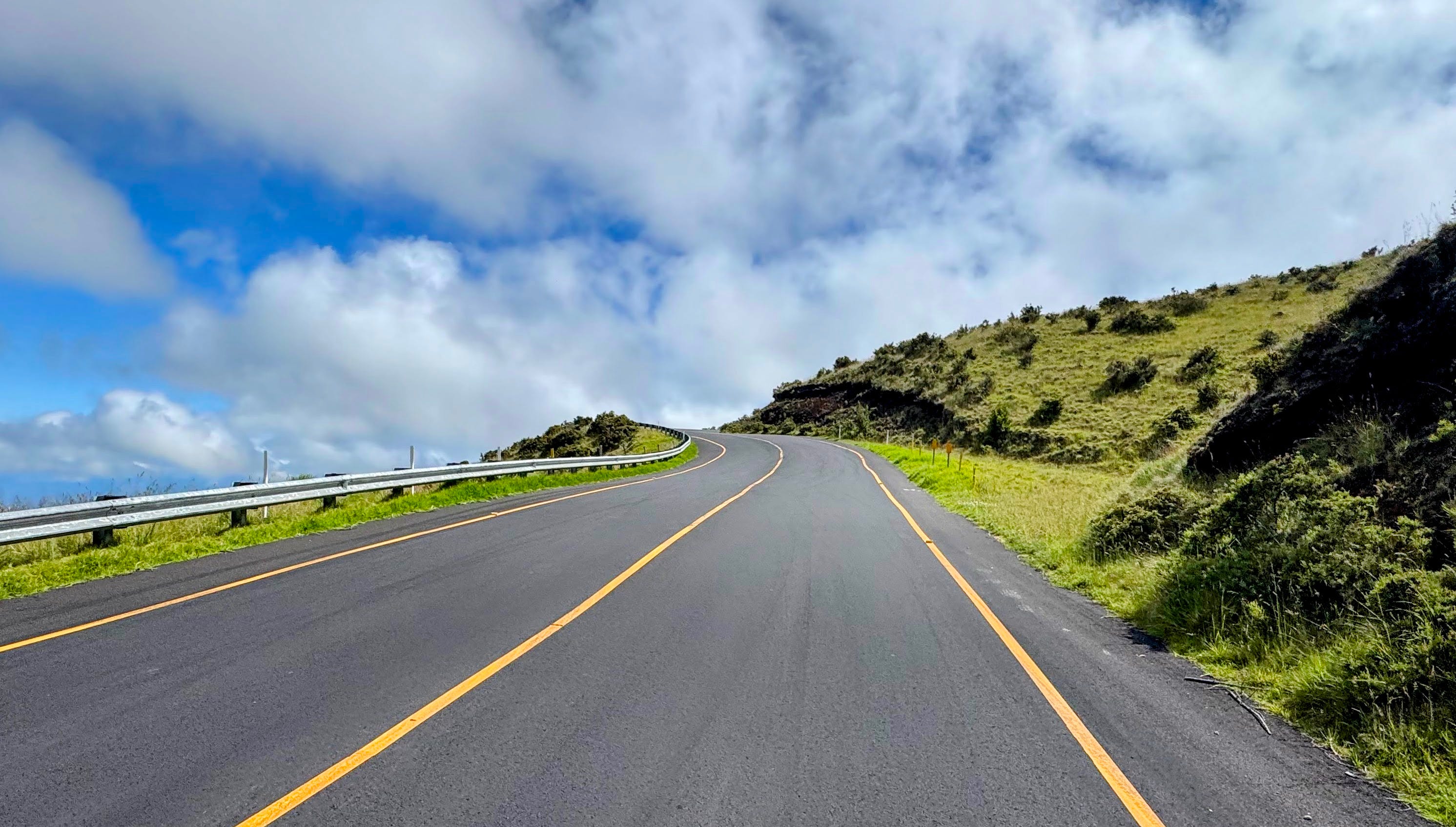
Anyone who has ridden a switchback knows the difference. The straightaway asks for legs. The corner asks for judgment: when to brake, the right line, how much speed to carry, when to get back on the pedals. And the road turns whether you are ready or not. Turn with it and you carry your momentum straight into the next stretch. Miss it and you are off in the shoulder gravel, still pointed the old direction, on a road that has already turned.
That shoulder gravel is the funk. Staleness is not a mood and it is not a mode. It is a corner you refused to take.
Stay in expansion past the top and every new meeting returns less than the one before it: conversations become performances, inputs pile up unprocessed.
Stay in the descent past the bottom and every new thought returns less than the last: the journal circles, ideas go unpressure-tested, your inner voice stops surprising you.
Nothing has gone wrong in either case. The road turned and you didn’t.
There are two corners in every cycle, and they are different skills. The top of the climb, where expansion hands off to introspection, is the harder one for most ambitious people, because it feels like slowing down while you’re winning despite feeling the marginal gains start to slip away. The bottom of the descent, where you have to point yourself back out at the world, is often the scary part, because the deep and quiet is comfortable and the world is critical.
And here is where the identity trap comes back around. Your weak corner is not random. It is almost always the turn that points away from who you think you are. Anyone who has met me knows I am an extrovert. Expansion genuinely gives me energy, most of the time. Which is exactly why the top of the climb is my weak corner: when the moment calls for turning inward, there is a voice that says, “but I’m an extrovert, this is what fuels me.” That voice is not lying. It is answering the wrong question. It knows what I am. It does not know where I am. The introvert runs the mirror image of this at the bottom of the descent, staying in the quiet past the turn, because the quiet is who they are.
Know which corner is your weak one. You will not have to think hard. It is the one that turns you away from your identity.
So how do you know a corner is coming? The tells are surprisingly consistent, and they show up before the gravel does.
Nearing the top of a climb: you come home from things drained instead of energized. Emptiness after contact, which is a very different thing from tiredness after contact. You notice you are collecting names and ideas and opportunities and processing none of them. Throwing things into the CRM and leaning into pseudo-productivity while holding the cognitive dissonance that your motion is losing its direction.
Nearing the bottom of a descent: restlessness with your own company. You can predict your own next thought. You have refined ideas for weeks that no one has pushed back on, and you are starting to suspect that some of them only survive because of it. You have gotten so comfortable with the quiet that laziness starts to creep into your daily schedule and habits that used to be automatic start to become irregular.
And there is one alarm that works at both corners: you reach for easy distraction more than usual. The endless scroll, the busywork that is pretending to be progress. That reaching is rarely the problem itself. It is smoke. It is the signal to look up and check where the road goes next.
I learned to read these the expensive way. I used to keep score by activity. Full calendar, packed trips, motion as proof of momentum. And there were whole stretches where I would look up and realize the last month had been all motion and no movement. The drained feeling had been there the entire time. I just had not understood what it was telling me. It was not saying the meetings were bad. It was saying the top of the climb was behind me and I was still standing on the pedals instead of leaning into the corner.
Here is the good news: You do not take the corner with willpower. You take it with a lever, and you already know yours. You have just never written them down.
The assignment: think back to the last three times you got unstuck. Not what you were stuck on. What actually moved you. A trip. Sitting with a specific person. A brutal workout. A weekend of writing. A stretch of therapy that finally clicked. That list is your lever set. Mark each one: did it turn you outward or inward?
The beauty of these levers is that they often work both ways. With one slight change, they send you in opposite directions. And feeling your visceral reaction to two versions of the same activity will tell you everything you need to know about which direction to turn. For example: a 4 day trip across the world can mean two very different things if it is a business trip packed with meetings vs. a hiking trip. An intense workout in your home gym vs. a group class or a team sport. Jamming on music by yourself vs. with a band. A solo ride with occasional stops just to take in the scenery vs. pounding a fast-paced group ride or a social coffee ride.
These levers are often misinterpreted as moments of re-inspiration - accelerations rather than inflections. And that’s probably because you’re letting your identity do too much work as your guide. The introvert’s list is all journals and long walks. The extrovert’s is concerts and conferences. Your levers cluster on the side where you are most comfortable, but life isn’t a NASCAR race, and the corner you most need help with is the one you have no equipment for. There are two corners in every cycle and you need levers for both, but very often the same activity with one small change sends you in the refreshing direction that will keep you on the road as it curves through life.
Learning the timing and picking your line early is the take-home skill here. A lever pulled right at the corner has enormous torque, because the turn is already there and all you are doing is steering into it. The same lever pulled after weeks in the gravel is a rescue operation. It still works. It just costs far more, because first it has to get you back on the road.
I ran this deliberately last month: I had blown past a top-of-climb corner. So I needed ten days on the road, a massive (mostly solo) bike ride, only seventeen meetings, and one rule for the whole trip: no new friends. No coffees with people I probably should meet. Everyone I spoke to had known me for over ten years. On paper it looked like an expansion trip, flights and meetings and new miles on the bike. Every piece of it was configured to turn me inward. It worked precisely because I knew which corner I was in before I booked anything. And the return is the tell: I came back ready for the next slope, the elevated and refined one. It’s not more of the same as the last climb, it’s the better version of it that I was looking for.
The first time a lever works, it is usually an accident, and it usually takes months. You stumble into the trip or the conversation and come out the other side feeling like yourself, without fully knowing why. The meta-skill is understanding the mechanism well enough to run it on purpose, and faster. Months to weeks. Weeks to days. Eventually, on the corners you have taken a few times, you feel the road bending before it bends, and you take it clean. And at the far end of the skill, the whole turn fits inside a single day: a morning where you feel the climb stop paying, an afternoon already pointed the other way. Same turn. The difference is when you noticed, and how many times you have taken it before. Sometimes the introspection phase is a week and expansion is two years, and sometimes it’s the opposite. That’s the opportunity, but it’s also the challenge.
One trap here for the type A crowd: the skill is feeling the turn coming, not turning too early. Braking before the corner is its own mistake. You scrub speed, you get unstable, and you kneecap both phases before either one gets interesting. Read the road. Then turn when the road turns.
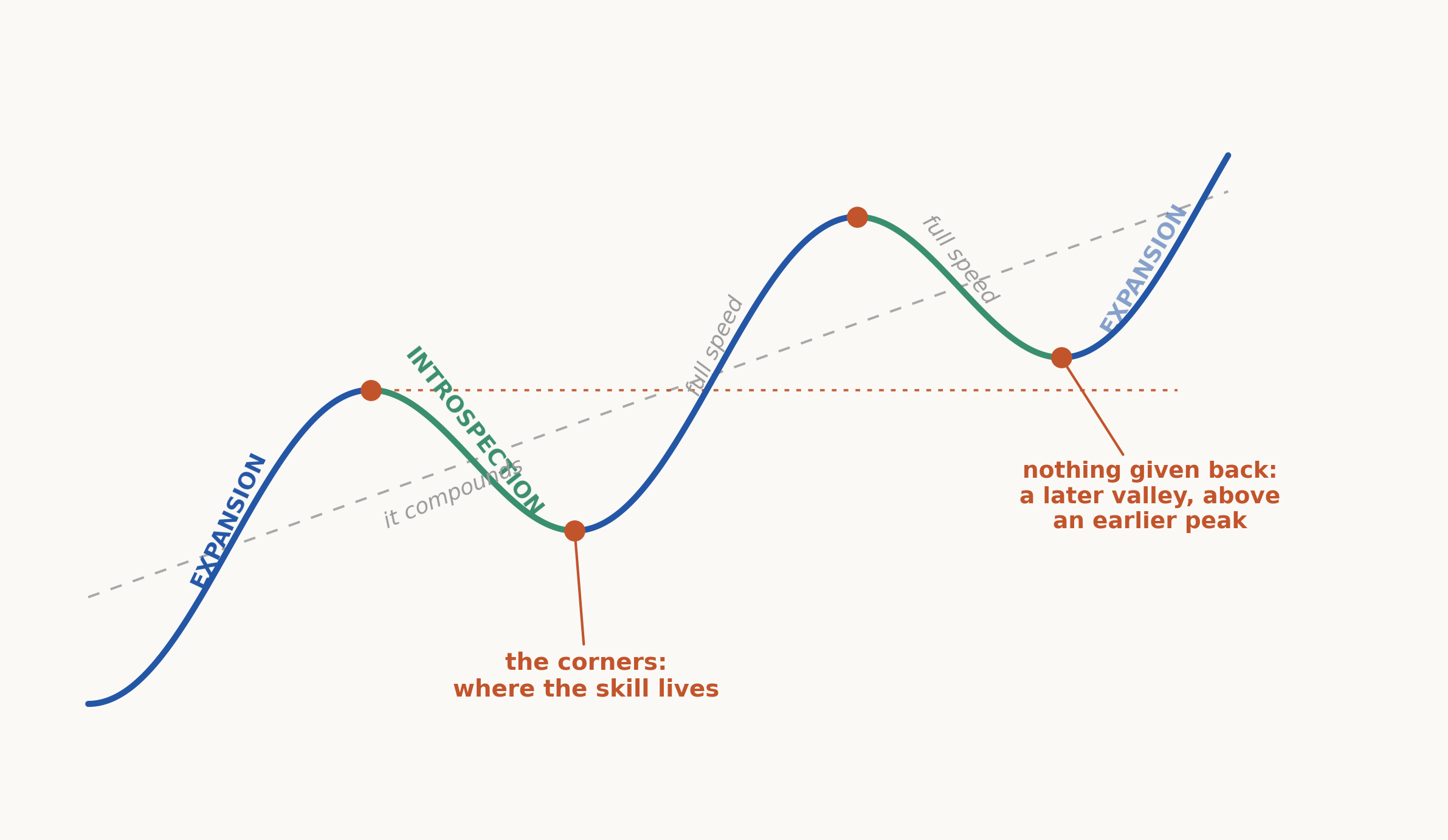
One last picture, because it changes what the whole cycle is for.
If every corner is taken well, something compounds. You start each stretch where the last one left you. Nothing gets given back. The introspection processes what the expansion collected, the next expansion is built on what the introspection produced, and you start covering ground faster. Run it long enough and a quietly remarkable thing becomes true: your valleys start landing above your old peaks. You’re not only accomplishing more, but you feel that it’s the right things at the right time - in both expansion and introspection modes.
You will keep coming back to the same kinds of corners. That is the nature of the thing. But you never come back to the same place. Each time around, one turn higher. A helix seen from the side.
And notice what makes the tilt possible. It is not bigger climbs or deeper descents. Those come as a consequence. If you want the expansion phases to be big and the introspection phases to be deep, the corners are where you earn it, because the corners decide how much speed you carry from one into the other. Blow the corners and every phase starts from a standstill. Take them cleanly and each phase inherits the last one’s momentum.
So, the framework, in the order you will actually use it:
Know which slope you are on.
Watch for the tells that the corner is coming.
Keep a lever list that points both directions.
Hit a lever at the corner, while the turn still has torque, not from the gravel.
Your identity trains you for one corner and the road has two.
You do not need a ten day trip to do any of this. You need ten minutes and the last three times you got unstuck. Write the list. You already know what is on it.
No posts
Comments
Nothing yet. Say the first thing.
Sign in to join the conversation.