
Most founders think pricing is how they collect money. It is. But that’s the smaller half of the job. Pricing is an engagement mechanism. It teaches your customers how to behave, and they learn the lesson whether or not you meant to teach it.
AI is still operating mostly as a raw technology, and customers have not figured out (or been guided properly towards) how to engage with it at scale. My hypothesis is that if we can clarify the business model, the use cases will become less hand-wavy and more value-driven.
Every pricing model trains a behavior. And underneath every model is the same trade: you can have explosive growth, or you can have stability. Never both. There is no free lunch. There’s only the choice of what you pay with, made honestly or made by accident. Time the market right, and you may only see one side of the volatility curve, but at some point, you’ll have to pay the piper one way or another.
Here’s the ladder:
You buy the thing, it works, the story ends. Think jewelry, or an old-school computer. No recurring revenue, so no volatility, no upside, no downside. Amplitude zero. The baseline everything else departs from.
Behavior: just deliver.
Close to the best business ever designed, once you’re locked in. Thin margin on the box, near-total margin on the renewal, boringly reliable revenue.
Behavior it teaches: stay. The catch is the cost of getting there. Winning that lock-in is slow and expensive.
Sold on growth through less friction, and the friction it removed was the fear of commitment. The pitch, spoken or implied: if you don’t like it, you can churn. A prenup with your customer. It gets people in the door faster because leaving is easy, and you bet they stay. Churn isn’t a bug, it’s the deal. And it costs you: because they can leave, you have to keep earning them, which is why SaaS runs at lower margins than the license business it replaced.
Behavior: try it. We hope you’ll stay.
Here’s where it turns. Every model above was at worst neutral about usage. This one is against it. Pay for what you use, and you go looking for ROI on every unit, which is a polite way of saying you look for reasons to stop. The minibar: the water is an arm’s reach away, but the meter’s running, so you walk to the shop across the street. I do it with tools I pay for, rationing them, pushing everything I can to the free version, getting good at not using the thing I’m paying for. People value what they pay for, but they don’t pay for what they value. The meter makes you value the rationing.
Behavior: use less. Which is the one thing your business can’t afford them to learn.
The purest-sounding alignment: charge for results, win only when they win. Beautiful when it works, and it captures value you could never charge for up front. But you’re no longer betting on your product. You’re betting on your customer’s ability to use it, and most of that is out of your hands and even unknowable. You let the dog off the leash. It might do wonderful things, it might destroy your house.
Behavior: hope.
Stay. Try it. Use less. Hope.
That’s the surface. Underneath is one variable: volatility, and it grows at every rung.
Volatility cuts both ways. Usage climbs faster than a subscription ever could, and falls faster too, because nothing holds it up. If the economy tightens, a subscription customer waits until the term ends to leave. A usage customer just stops, same day. An outcome customer just lost their customer for reasons unbeknownst to you.
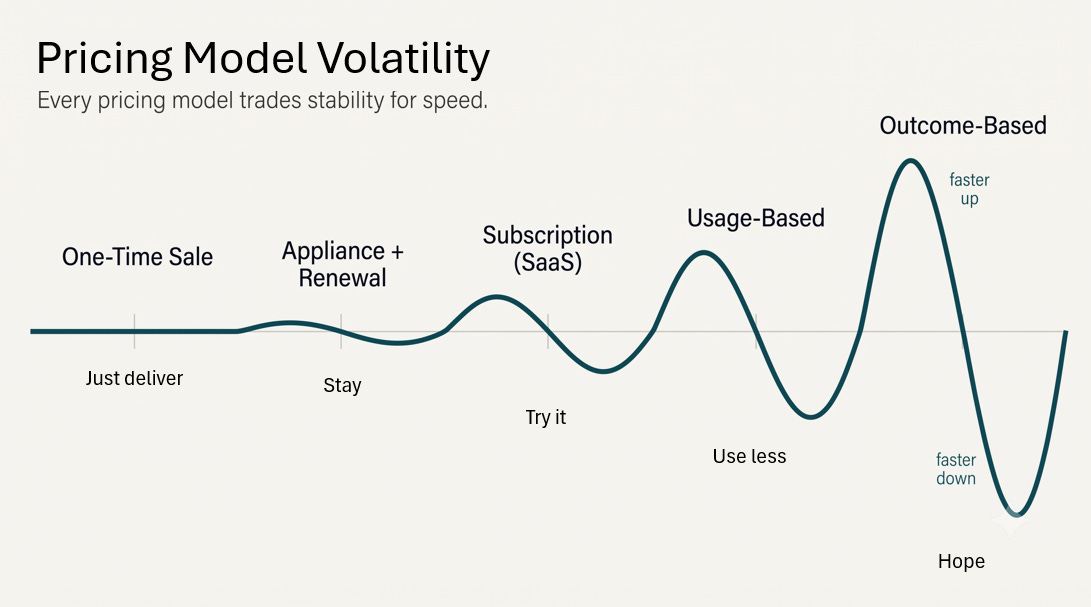
The rigorous name for this is the discount rate - it’s how we finance nerds price risk. Revenue quality lives in the contract. Multi-year prepaid is the most durable, so it’s worth the most. Subscription next. Usage less. Outcome-based, dependent on a dozen things you don’t control, is worth the least. Same dollar today, wildly different values, depending on the behavior your contract trained. Between each level, there is a trade-off point, but don’t pretend a dollar of usage-based revenue is worth as much as a dollar of appliance revenue.
So the takeaway isn’t really about pricing. Your customers behave according to the alignment you write into your contracts. Not the alignment you were hoping for. The one you actually wrote down. Want them using the product? Don’t put a meter on it. Want them to stay? Give them a reason the contract makes real. You know the value of your products and what it costs you to deliver better than anyone else - use that to your advantage.
Which is why the best example looks like it broke the rule.
Shopify reads as SaaS plus usage-based. Look again. People build their businesses on top of it, which is lock-in as total as bolting an appliance to the floor, and it was earned, not metered. Then the usage part is tied to payment volume, which is to say tied to the customer’s own success. The meter only runs when the customer is winning. Nobody rations that.
That’s not SaaS plus Usage. It’s a leased Appliance plus Success fees. The most modern-looking model on the ladder is really the oldest one, rebuilt on aligned incentives instead of switching costs. That’s business model logic at work.
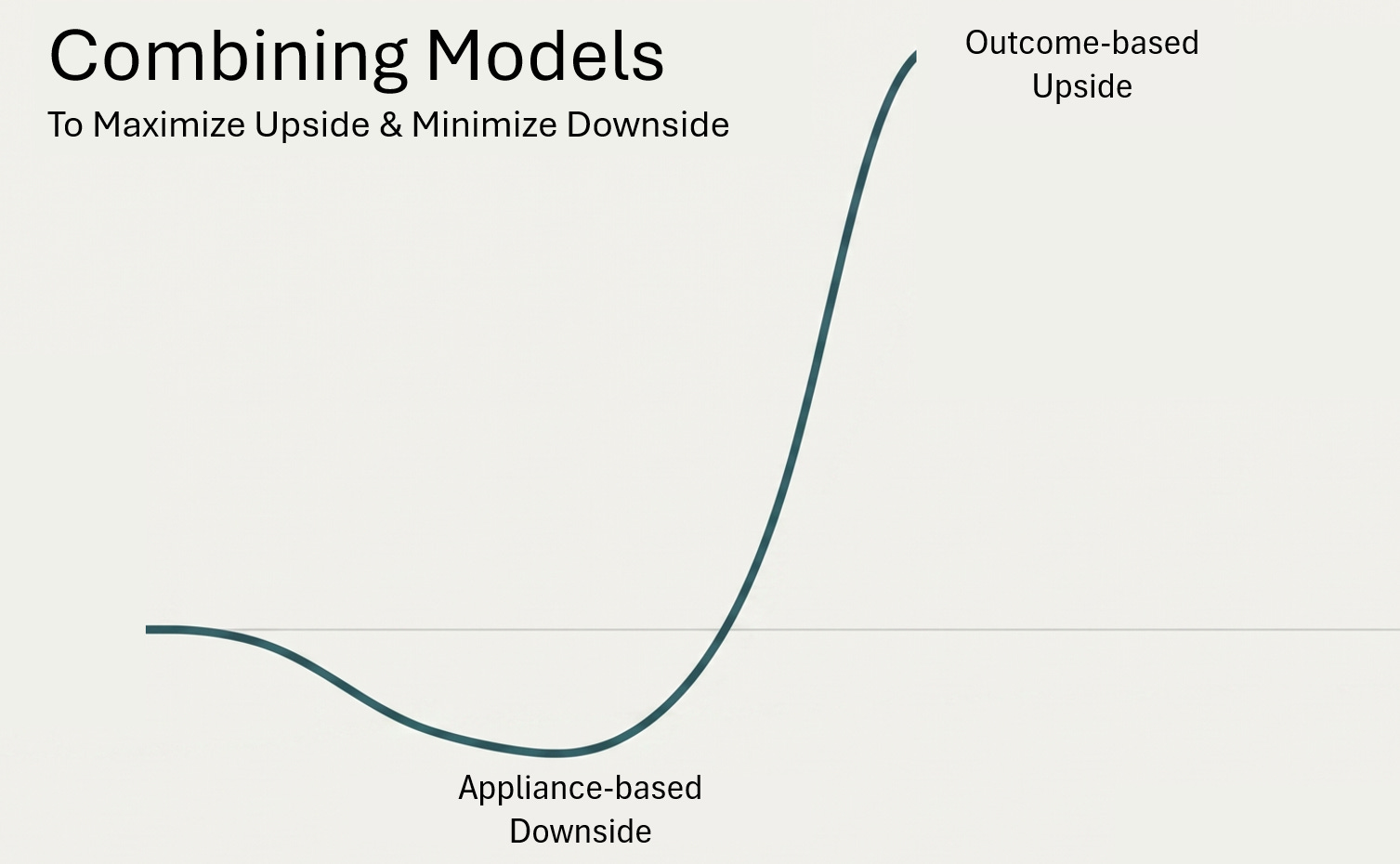
And it points at something bigger than “pick your rung carefully.” The rungs aren’t a menu you choose from. They’re a design space. The real move isn’t climbing to the right for growth or hugging the left for safety, it’s combining them so you get the upside of the right priced at the discount rate of the left. Maximize growth, minimize discount rate. Shopify didn’t pick a better rung. They engineered a wave with a tall crest and a shallow valley, which is not something the ladder offers you off the shelf. You have to build it.
So the question isn’t which pricing model is best. There isn’t one. The question is what combination, what permutation of lock-in and alignment and metering works best for your product in your market: minimize the downside and maximize the upside. Find that, and the behavior your contract teaches and the growth your business needs finally point the same direction.
The meter always teaches something. The best businesses design it to teach the one behavior that makes everyone richer at once.
When it comes to AI, there's more opportunity than ever, and the companies simply metering raw capacity are teaching customers to ration a technology they haven't learned to use yet. That's product, finance, and marketing's problem to solve, together.
What’s the right combination for your business?
No posts
Comments
Nothing yet. Say the first thing.
Sign in to join the conversation.