
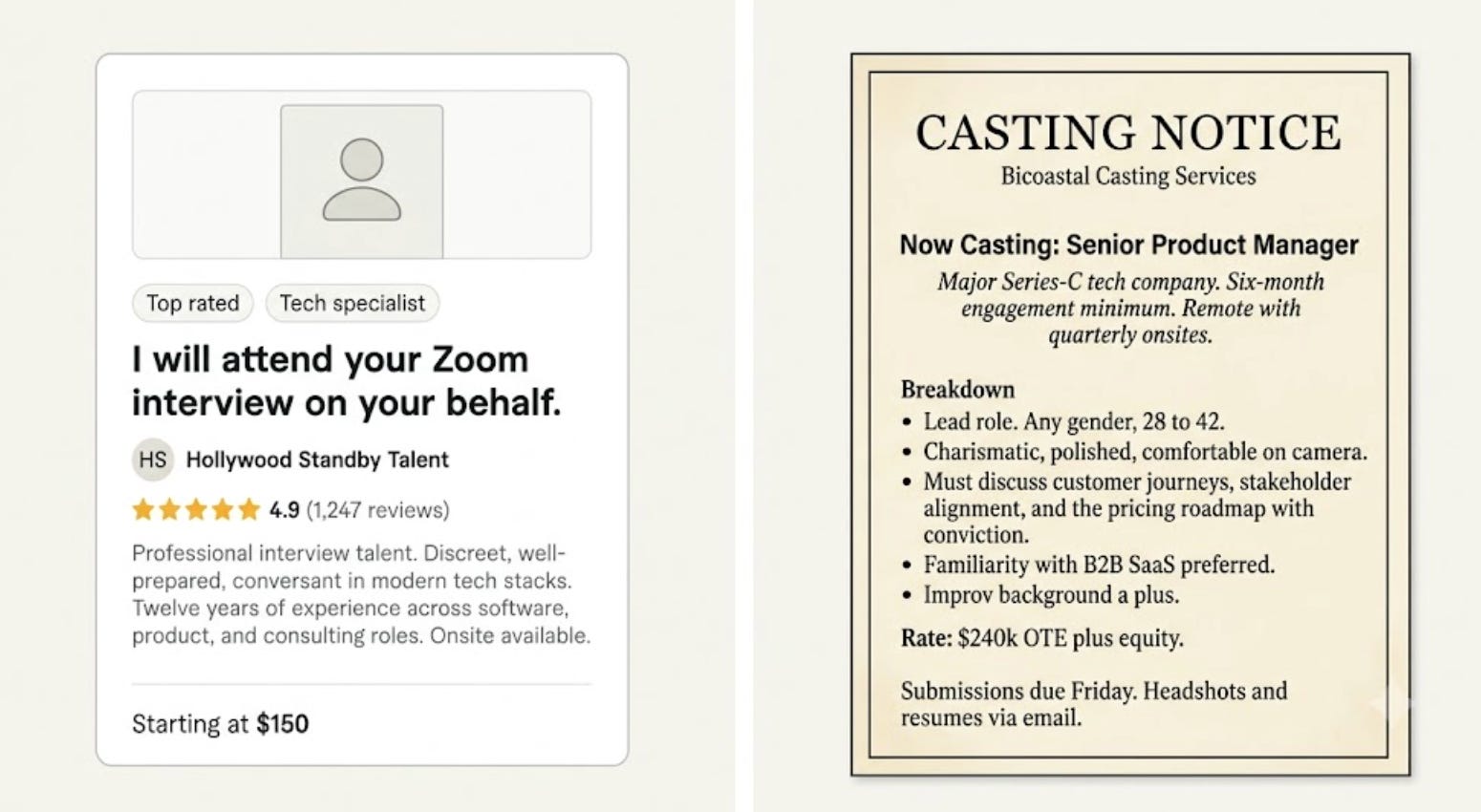
Someone told me a story recently. A remote company ran a candidate through multiple rounds of Zoom interviews, made an offer, and scheduled onboarding. When the person showed up, it was a different guy. He had paid someone else to interview on his behalf, then shown up to collect the job hoping nobody would notice, or simply that onboarding and hiring were handled by different people.
My first reaction was that this was insane. My second reaction was that it was completely logical.
Hiring has always been a weak signal dressed up as a rigorous process. The case study interview tests preparation, not performance. The behavioral question tests storytelling, not behavior. The technical screen tests a narrow, artificial version of a skill that rarely maps to actual on-the-job demands. We built elaborate rituals around a simple problem we never actually solved: how do you know if someone can do the work?
For a long time, the gaps in the system were small enough to ignore. Candidates couldn’t realistically fabricate years of experience. Prep was at least a good proxy for motivation. References, however scripted, at least required real relationships. Work samples took real effort to produce. The friction in the system created a kind of accidental verification.
AI and remote work didn’t break hiring. They just dissolved the friction that was hiding how broken it already was.
Work samples can now be generated in minutes. Reference calls can be coached to a script. Technical screens can be cleared with a model running in the background. And as the story above illustrates, even the interview itself (the supposed heart of the process) can be outsourced entirely. The deception that used to require a criminal operation now requires a group chat and a Venmo payment. What better proof that interviews are theater than the very fact that people are hiring actors to perform them in their stead?
There’s also a version of this that isn’t even fraud, and it’s scarier. Governments with adversarial interests have run organized programs placing workers into remote roles at Western companies, sometimes to extract intellectual property, sometimes for reasons less obvious. The individual hiring manager running a Zoom screen has no real way to know.
Here’s the part that doesn’t get said enough to people who are living the struggle of job hunting: the hiring manager is dealing with all the same issues. They’re flying blind.
When you apply cold to a role with a resume and a cover letter, you aren’t just an unknown quantity. You’re a risk. Your credentials could be inflated. Your work samples could be AI-generated. Your references are people you selected and prepped. Every signal you can send through a formal application process is a signal that is now either easy to fake or impossible to verify.
The warm introduction doesn’t exist because hiring managers are lazy, or because the system is rigged by insiders (though it sometimes is). It exists because it’s the only information channel that is genuinely hard to fake. When someone you trust says “I’ve worked alongside this person and they are excellent,” or “I have known this person since they were a kid and I can speak to their character and their work ethic,” those sentences carry information that no resume can replicate. It’s a compressed version of months or years of direct observation, filtered through someone whose judgment you’ve already validated. It’s not a reference from an unknown source. It’s based on shared values and shared history. That’s what a human relationship actually represents. And the transitive property applies.
This is why the trickle-down of trust-based hiring isn’t going to reverse. It was always how partners got hired at law firms and executives got placed at companies. Now it’s how mid-level roles get filled too. The pool of candidates who come in warm has gotten smaller relative to the pool of cold applicants, and the gap between the two groups has gotten wider.
If you’re early in your career, the credential and the brand are still the ticket that gets you into the room. But the room is the point. Your goal in the first several years is not to accumulate certifications or optimize your LinkedIn headline. It’s to be somewhere that lets people watch you work. Small companies where you’re visible. Teams where you’re proximate to senior people. Projects where your output is legible to someone who might one day say your name in a room you’re not in. The degree signals capacity. The network that forms around your actual work signals character and execution. One of those is hard to fake.
This may seem unfair to those brought up in less well-connected circles, and I won’t pretend it isn’t. Access has always been uneven. But the ball has moved more than it has narrowed. It used to be grades and credentials, gates you could only walk through if you got the right start. Now it’s human relationships, and relationships form in far more places than a brand-name dorm.
For some, the ball actually moved closer. When AI does the functional work, completing every prerequisite matters a lot less. The expensive master’s degree matters less than it ever has. What’s left is the soft stuff, and the soft stuff can be the whole game. That’s a big win for a lot of people who never had the credentials. It also leaves a lot of privileged candidates out in the cold, holding a diploma the market just repriced.
The person who vouches for you doesn’t have to be someone you were assigned at birth. It can be the manager at the restaurant where you waited tables. The first customer who paid for the thing you built. The senior person on a small team who watched you show up early and stay late. It can even be a stranger you stood next to in line for coffee.
That last one isn’t a throwaway. On a recent Huberman Lab episode, Nick Epley, who studies social connection at the University of Chicago, has spent years showing that we badly misjudge these small moments. We assume the stranger doesn’t want to talk, that we’ll be a bother, that it’ll be awkward. The data says the opposite. People want those interactions more than we think. Most of them slip away as easily as they arrived. But some don’t. Some are the start of something real.
I’m not telling you to ambush managing directors outside the coffee shop near 200 West. I’m telling you that the scene from the movies, where a busboy takes abuse from a rude waiter and handles it with grace, and the customer at the table quietly slides over a business card, is not a fantasy. It happens. Successful people pay attention to small things, because small things are the only signal that’s hard to fake.
So create the opportunity. Be the person successful people want around (and therefore want to hire). That’s as democratic as it gets.
From 2011 to 2013 I was a key player on the Stanford undergrad recruiting team at Morgan Stanley. One conversation with a managing director still stands out. As we reviewed resumes and looked students up on Facebook, he told me he watched for two red flags: inappropriate photos or posts, and no presence at all. The second one surprised me. He wasn’t worried those students were hiding something. He was worried they were boring. It gave me a lot of perspective. The job isn’t that hard to do technically. Surviving it is about attitude and motivation more than anything else. Perfect grades tell less of that story than other signals do. And most important: people hire people they think they’ll like.
Internships matter, a lot. Get experience. Start to build relationships. Then spend the rest of the summer getting people to like you. Be reliable, available, humble, and tactful. That’s all anyone expects from an intern. Trying to do more is usually a gamble that isn’t worth taking. If you can’t get an internship, or can’t afford to work for free, you still have two good options. One, get a job (an old-school job). If you work at a restaurant and your manager glows about you, that tells someone at a software company more than you can possibly imagine about how you’ll be as a customer success manager. Two, start a project. Use free tools. Use school credits. Build something and get people to pay for it. Learn to sell. Service customers. Those references matter a lot too.
If you’re deep in your career, you already have a network. The question is what kind. The people who are fine right now are the ones who stayed in genuine contact, showed up for others, and built relationships that weren’t purely transactional. The ones who are exposed are the ones who treated their network as a contact list to activate when they needed a job. A network you only reach out to when you want something isn’t a network. It’s a list of people who recognize your number. The social aspect of work matters. A lot. More than it should. But learn to live with that reality. The middle school lunch table vibe never goes away.
After my first year at NEA, I had worked on 10 new investments and gotten snippets of glowing feedback from my two main partners. When it came time for my official one-year review, I awaited deep and meaningful feedback, validation, recognition. What did I get instead? “The assistants would really appreciate it if you smiled more when you walk around the office.”
This knocked me back. I had been thinking that analysis, diligence, and investment theses mattered most. It turned out that was table stakes. I was missing the real way to win.
Work product is a commodity. It might sound superficial, but it’s not: be well-liked. Work hard at it if it doesn’t come naturally.
If you came here for advice, here’s the whole thing in a few lines. Get into rooms where people can watch you actually work. Be reliable, available, humble, and tactful, because that’s the entire job when you’re starting out. Make real impressions on real people (the manager, the customer, the stranger in line), because those are the references that can’t be faked. Stay in genuine contact with people when you need nothing from them. And be well-liked. Work at it if it doesn’t come naturally, because work product is table stakes and likability is the multiplier. None of that requires the right last name or the right zip code. All of it requires showing up as someone people are glad to have around.
The guy who sent a stand-in to his interview got one thing right: the formal process was theater. He just drew the wrong lesson. The system worth optimizing for isn't the one with the Zoom screen. It's the one where someone who's seen you up close, professionally or socially or just in passing, says your name in a room you're not in. That one has no shortcut.
No posts
Comments
Nothing yet. Say the first thing.
Sign in to join the conversation.