

I trained for one of the toughest mountain races in the world called the Dragon’s Back Race and I didn’t get injured. It’s 380 km with 16,500 meters of elevation.
Six brutal days across the spine of Wales and I trained for it… in London.
You know, It’s flat, there are no mountains, no real vert.
So the question becomes:
How do you prepare for extreme terrain when your environment gives you nothing?
I realised that I hadn’t been injured for 4 years and it make me think.

During the race on Day 3 I got the injury, my tibialis started screaming, the bogs, the terrain and me not training in bogs made it harder to run and finish the race. But in the end I finished the race “strong”.
Before that, I stayed injury-free not because of luck or genetics, but because I followed a simple formula:
If you are a man over 35 injuries start creeping in if we don’t take care of them. Something I learned from my skydiving coach Jose: the best way to avoid malfunctions when you jump is to triple check everything on the ground. I applied the same philosophy in the running coaching and training.
1. Why do most trail runners get injured?
So most common injuries in trail running are:
Ankle Sprains
Knee Pain (Patellofemoral Syndrome/Runner’s Knee).
IT Band Syndrome
Achilles Tendinopathy
Plantar Fasciitis
Shin Splints (Medial Tibial Stress Syndrome)
Acute Injuries from Falls
You look at most common injuries in general and you work on strengthening what needs to be strengthened.
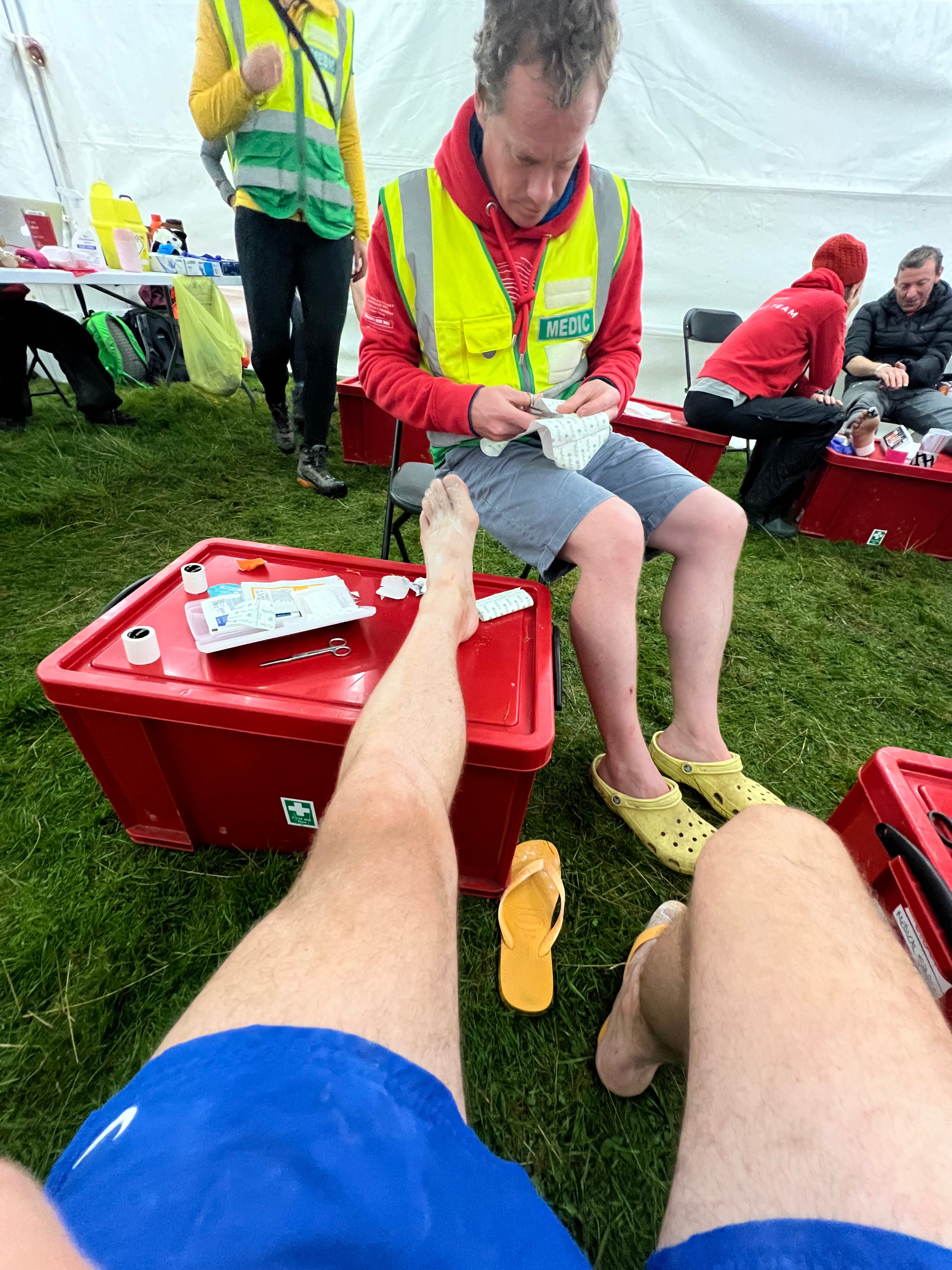
2. What are the main reasons runners DNF in X race?
We will use Dragon’s Back Race as an example:
The Dragon's Back Race is renowned as one of the world's toughest multi-day mountain trail races, with DNF (Did Not Finish) rates often exceeding 50%. The most common reasons for runners DNFing are a combination of extreme physical, technical, and mental factors that accumulate over the six-day event.
Key Reasons for DNF (Did Not Finish)
Foot Issues and Blisters
Missing Cut-off Times
Musculoskeletal Injuries: Common injuries include anterior tibialis tendonitis (shin pain) from excessive ankle rotation, knee problems, and joint fatigue.
Poorly Judged Pace: Starting too fast on Day 1 is a frequent error.
Insufficient Training on Technical Terrain: Lack of preparation for long, steep, and technical descents.
Inadequate Nutrition/Hydration: Failing to manage calorie intake or developing stomach issues.
Extreme Weather and Hypothermia/Hyperthermia
Accumulated Fatigue and Mental Breakdown
Navigation Issues
So looking at the above issues you work on them one by one. Foot issues and blisters for example: you go to do a recce weekend and you make sure you run in bogs, you make sure your feet are wet. You actively seek bad conditions and train in them.
Navigation errors are preventable. I removed that risk by upgrading to the COROS Vertix 2 for better battery life and reliability and then practiced using it during long runs.
3. Train With Intention
During my training blocks I don’t just do long runs every weekend for the sake of it, I do long runs with intentions. So you need to understand what are your strengths, weaknesses and what you need to work on.
Every long run serves it’s purpose. One long run is focusing purely on pacing strategy so maybe start super slow and second half of the run you push harder.

Maybe during one long run you focus on climbing one hill with poles and the other hill without poles. Maybe you focus on downhill long run. So you find a loop that you make sure you prioritize on going downhills x10 times (depending on what you need to work on)
The further away you are from the race, the more broader the work is, the closer you get to the race, the more specific you need your training to be.
4. Periodization Plan - but adjust
Before any training starts you need to create a periodization plan for your running, strength and nutrition. So for example if you are going to be peaking in running you can’t be doing progressive overload in your strength training and going into a calorie deficit in the same week.
Think of it as a dance: you need to balance things out; so maybe when you are peaking in your running you reduce strength training and do more mobility strength and increase your daily calories slightly.
For me, when I was training for Dragon’s Back race one of my goals was to become leaner and lose body fat, so I was in calorie deficit. But I always had a high day(s) for my long runs and during the week I knew what macros goals to hit.
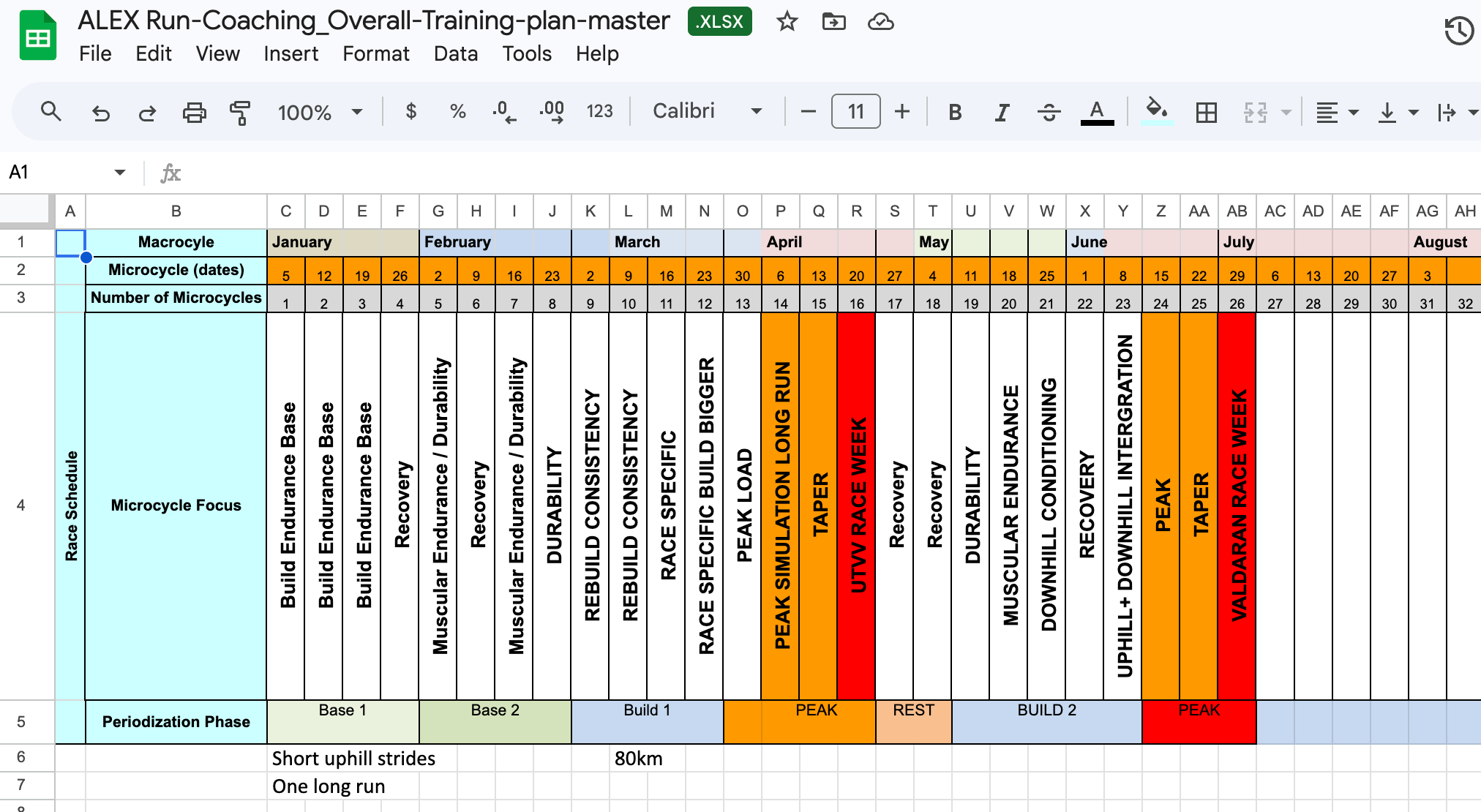
So create a periodization plan for strength; running and nutrition.
5. Functional Strength Training
This is what will keep you injury free if done right. This is not about lifting weights just for the sake of lifting or for the sake of the race. This is for longevity. This is a must if you want to be able to be a functional human being after you are 40, 50, 60 years old.
It depends where you are right now as well, so if you’ve done strength training before you need to focus on functional strength training, so not one dimensional movements but in all directions - focus on your core, the deep core muscles, your rotational movements and of course your legs. Add weights, challenge yourself when you are doing progressive overload.
6. Mindset Work
Most trail runners think that mindset work is some sort of ‘soft’ stuff that they don’t need. But actually what seems easy on the outside is hard. This is where you develop your character. But not in a way that you keep pushing if your leg is falling apart.

This is not about going crazy with your pace just for the sake of it. No, this is being in control and knowing where your optimal challenge is.
In order to work on your mindset you need to prepare yourself for the worst: how are you going to react when you are going to be in pain, how are you going to react when you will feel you want to quit? You can practice this during your long runs, during your short runs.
Listen to inspiring books, podcasts and have a ‘repeat’ playlist on your phone ready to go. Have a small number of songs on that playlist available to you when you will need some motivation and inspiration.
7. Imagine the finish line
Last but not least, during your runs imagine you running through that finish line, imagine the feeling of you crossing that finish line. Imagine how that finish line will make you feel.
Every race changes you. You don’t finish as the same person who started.
Visualization during your training helps, you are working on your subconscious mind. This is deep work.

8. Ignore The 10% Rule
Ignore the 10% increase in distance rule that a lot of coaches and runners suggest. If you look it up and see what the source of 10% rule is… well you won’t find anything. I actually thought for years that you need to increase your distance by 10% every week because coaches suggested and it made sense. It wasn’t until I did my UESCA endurance running coaching qualifications I learned that it’s a myth.
The goal is not to increase 10% every single week, the goal is to go based on your training history and based on how you adapt. Some weeks you will need to increase by 5% some weeks you will need to increase it by 0%. It depends how you recover.
Zone 2 training is often misunderstood and overused. You don’t need to train in Z2 all the time. You need to include variety in your training based on your fitness levels.
I’ve stayed injury free for the past 4 years because I’ve been applying the principles shared above.
If you want to stay injury-free while training for your next ultra, start applying these principles now or you can go deeper:
I’ve put everything into a free guide—How to Finish Your Big Ultra Strong, Not Destroyed.
If you would like to have a chat about your training, you can always get in touch with me here.
Comments
Nothing yet. Say the first thing.
Sign in to join the conversation.