
This week I pointed the strongest AI model that’s ever existed at a folder of markdown files, and it caught me arguing with myself in public.
Two of my published pieces, opposite sides of the same rule. A page still claiming I’d “never tried” a workflow I’d taught a whole course on. Six moves I make in my writing on pure instinct that I’d never once written down. It found all of it in one morning, and then it wrote the position that reconciles the contradiction, in my voice, better than I would have.
That folder is my second brain. It’s the highest-leverage thing in my entire operation, and you can build the starter version of it in an afternoon.
Here’s the whole thing.
🧠 What a second brain actually is: your thinking and your work, written down where your AI can read it. Plain markdown files in folders you own.
Notion and Obsidian people have preached this for years; the difference now is that a model like Fable 5 can sit down and read the whole thing at once.
And this is not a writer thing. Mine is built from published pieces because publishing is a big part of my business, but the same build works on any body of work: research and reports, client deliverables, sales call notes, coaching sessions, project post-mortems, a founder’s decision log. If your work produces documents, you have the raw material.
One fork before we start.
If you already have a second brain in some form, skip straight to Step 5 and point Fable 5 at it today; the prompts are the payoff. If you don’t, the next four steps build the starter version by hand this afternoon. And if you’d rather not build it by hand at all, there’s a done-for-you route at the bottom of this piece.
Step 1 — Create the skeleton
Open Claude Code (the desktop app works fine, you don’t need a terminal), point it at an empty folder, and paste this:
Create a second-brain skeleton in this folder:
wiki/
├── raw/            ← my original pieces go here, untouched
└── pages/
    ├── index.md    ← a catalog of every page, updated on every change
    ├── log.md      ← a dated log of everything ingested
    ├── sources/    ← one summary page per piece I've published
    ├── topics/     ← one page per position I hold, tracking how it evolves
    └── patterns/   ← the moves that repeat across my work
Create index.md and log.md now with empty scaffolding and a one-line
explanation at the top of each. Ask me nothing; just build it.
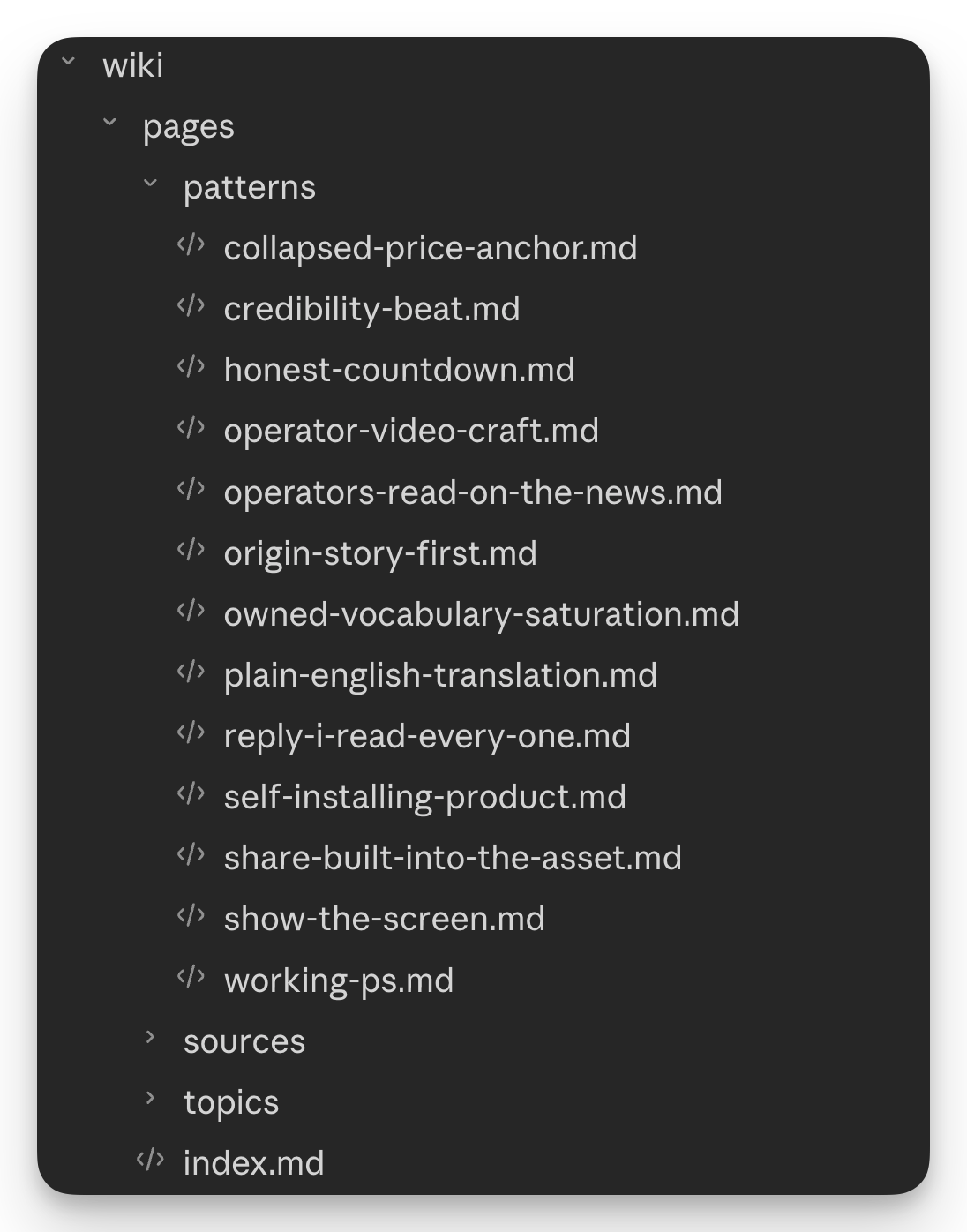
That’s the entire architecture. Three kinds of pages: what I’ve published, what I believe, what repeats. Everything else is just feeding it.
Step 2 — Feed it your real thinking
Drop 5 to 10 pieces of your actual work into raw/. Newsletters, essays, research summaries, client reports, call notes, a strategy doc, that half-finished manifesto. Markdown or plain text is ideal; exports from Substack, Google Docs, or Notion all work.
Two rules. First, use your best thinking, not your most recent. You’re seeding the brain with positions, and your strongest pieces carry the most of them. Second, don’t clean anything up. The model handles messy input fine, and the friction of “let me reformat everything first” is where most second brains die before they’re born.
Step 3 — Run the first ingest
This is the step that turns a pile of files into a brain. Paste this:
Read every file in wiki/raw/, one at a time. For each one:
1. Create a source page in pages/sources/ — what this piece argued,
   its strongest claims, and any position it stakes out.
2. Update or create the relevant pages in pages/topics/ — one page
   per position I hold. If a piece shifts a position, record the
   evolution with dates. Never flatten my old view; track the change.
3. Update pages/patterns/ with any move that now appears in two or
   more pieces — structural habits, recurring frames, signature moves.
4. Add a line to log.md and keep index.md current.
Work through all of them before reporting back.
Then go get a coffee. When you come back, your thinking has a table of contents.
This is what mine looks like.
Step 4 — Read what it wrote about you
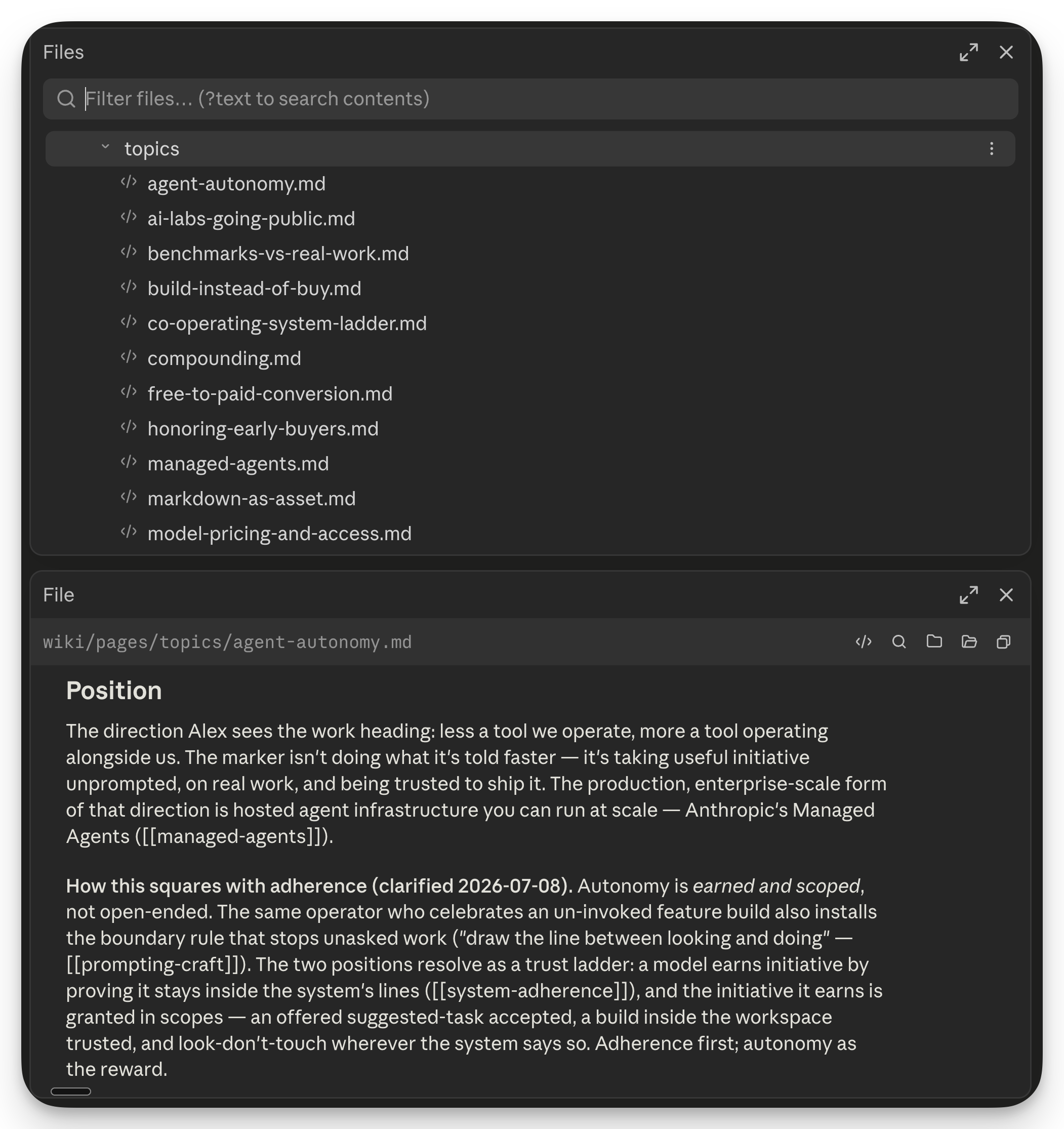
Don’t skip this. Open pages/topics/ and read the position pages. Open patterns/ and read what it says keeps repeating in your work.
This is the moment this stops being a filing exercise. Somewhere in those pages there will be a sentence about your own thinking that’s more precise than anything you’ve said about yourself, and that’s when you understand what you just built. Fix anything it got wrong (they’re your files; edit them), because every correction makes the next job smarter.
If this is useful so far, it’s useful to someone else you know!
Step 5 — Point Fable 5 at it (4 PROMPTS)
Now the payoff. Once you have a wiki built (this can be a few days or weeks), switch the model to Fable 5 and run my audit.
Steal it whole; the only things to adapt are "video ideas" (make it whatever your work produces) and the bracketed topic pick:
Hey there,
I want to do a full audit of my wiki.
Carry out these tasks and put together a package at the end for me
to review, with each task getting its own dedicated page.
1. The contradiction hunt. "Read every topic page. Where do my
   positions contradict each other, or where has a position quietly
   changed without me noticing?"
2. The pattern mine. "Read the patterns and sources pages. What
   patterns exist in my published work that I have never explicitly
   written down?"
3. The idea engine. "From my own positions only, write my next 10
   video ideas — each must extend something I already believe, not
   repeat it."
4. The unwritten-position job. "Based on everything here, what do I
   clearly believe that I've never actually published?"
5. The synthesis draft. "Write the opening 200 words of a piece on
   [pick a topic page] using only my established positions and my
   voice."
6. The full audit. "Audit this wiki like a consultant: what's stale,
   what's thin, what's missing given where my work is heading?"
Don't make any changes to the actual wiki without my green light.
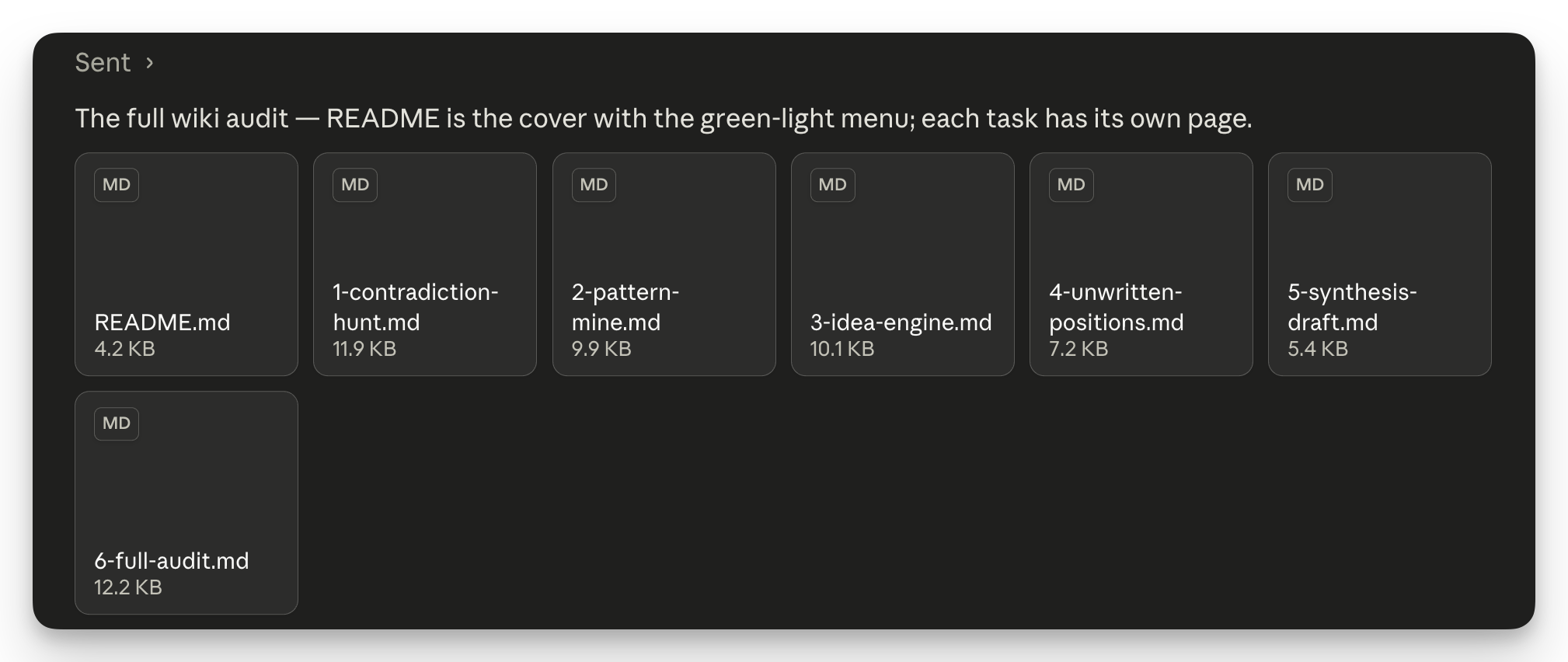
Two details in there that matter. The dedicated-page-per-task instruction is what turns the output from a wall of chat into a review package you can actually work through. And the last line makes the whole run read-only: the model reports, you decide what changes. Keep that line; a second brain you can’t trust is worthless.
Task 4 is the eeriest output you’ll get from an AI this year. Mine answered the hardest question I get about my own business, and it built the answer entirely from pages I’d written without seeing it.
Why Fable 5 for this specifically: it’s the most powerful model Anthropic has ever shipped, and this is the job that actually shows it. Synthesis across months of your own thinking is exactly where the gap between it and every other model stops being a benchmark and starts being visible on your screen. It’s included in paid Claude plans right now. And if you’re reading this later and the lineup has shuffled again, the play doesn’t change: point the strongest model you have at the brain. The build outlives every model cycle.
Step 6 — Keep it alive
The whole system compounds on one habit: every time you finish something worth keeping (a published piece, a report, a big client call), drop it in raw/ and say “ingest this.” Thirty seconds. The source page gets written, the topic pages evolve, the patterns sharpen.
Do that for a month and something shifts. Your AI stops sounding like a smart stranger and starts arguing from your actual positions, catching you when you drift from them, and pitching ideas that extend what you believe instead of what’s trending. Mine is a few months old and it’s already the first thing every new model gets pointed at.
That’s the principle the whole thing runs on: the models keep getting better, and every one of them walks into a brain that already knows you.
Everything in this piece is the by-hand build, and it’s genuinely enough to start. The done-for-you route I mentioned at the top: paid subscribers get my full plugin library, and the annual plan adds my mini courses — including Your Second Brain, which goes deep on this exact system and ships with the wiki plugin that builds, ingests, and maintains the whole thing for you, plus a browsable snapshot of my real wiki so you can see what a mature one looks like inside.
Build the skeleton today. Feed it five pieces. Run the contradiction hunt and see what it catches.
The model is rented. The brain is yours.
—Alex
P.S. The first thing my second brain ever caught was a page confidently describing a workflow I’d already abandoned. It was right, I was stale, and I’d have kept teaching the old version for weeks. Build yours before it has to catch something bigger.
Comments
Nothing yet. Say the first thing.
Sign in to join the conversation.