
Fable 5 came back this morning.
If you missed it: Anthropic released the most powerful model we’ve ever had access to on June 9. I got three days with it. Long enough to switch my operation over and film my reaction the same day. Then the government pulled it under export controls on June 12, everyone fell back to Opus 4.8, and people were desperate enough for its return that they built literal status-tracker sites to count the days.
The controls were withdrawn yesterday. Today it’s live again for everybody.
Now the part you actually need to know. Fable 5 is included on paid Claude plans right now, Pro, Max, Team, and select Enterprise. You can put up to half of your weekly usage into it at no extra cost. That window closes July 7. After that it moves to usage credits, and Fable 5 is priced at double Opus: on the API it runs $10 per million tokens in, $50 per million out. Real money.
So you’ve got six days, and a holiday weekend is going to eat two of them.
Here’s what I’d do with those six days, because Anthropic did something genuinely useful alongside this release: they published an official guide on how to prompt this model. It’s called “Prompting Claude Fable 5” and it’s sitting in their docs right now, written by the people who built the thing. Most people will never open it. And the guide itself is written for developers, so even the people who do open it have to squint past the API talk.
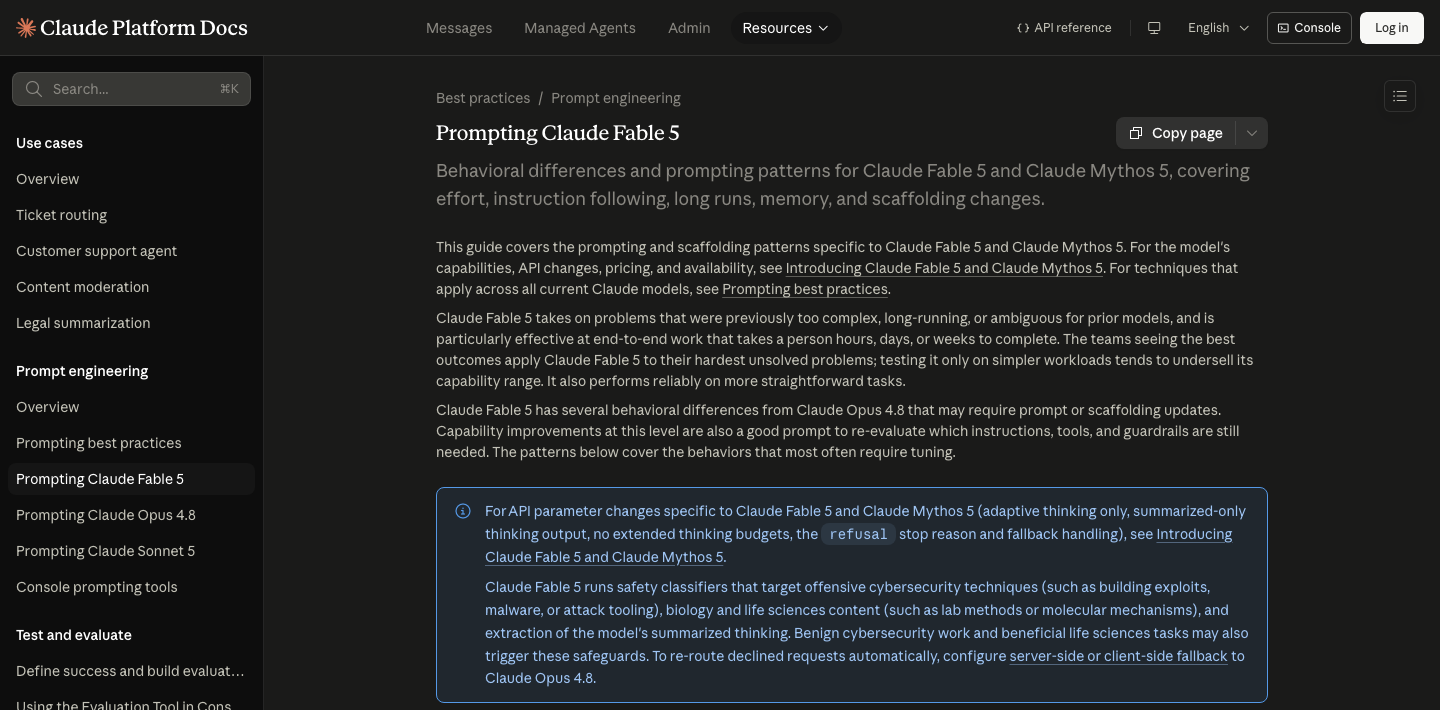
I read the whole thing and translated it for us normal people.
The ones running a newsletter, serving clients, producing content, operating a business, stuff like that.
Seven rules.
1. Give it the reason, not just the request
Fable 5 performs better when it knows why you’re asking. That’s not a vibe, it’s in the doc: context lets it connect the task to the relevant information instead of inferring your intent on its own.
So instead of “write the welcome email,” say: “I’m building the welcome sequence for new free subscribers. Most of them just came from a YouTube video. They need one quick win in their first five minutes. With that in mind, draft the first email.”
And if you run a real workspace with context files, the why does double duty. It tells Claude which of your files to go read before it writes a word.
2. Tell it to act
Fable 5 thinks longer and plans harder than any model before it. On a hard task that’s exactly what you want. On an ambiguous ask, it can overplan: re-researching things it already knows, laying out options it’ll never pursue.
Anthropic’s fix is one line, straight from the guide: “When you have enough information to act, act.” I’d add the second half from the same page. If it’s weighing a choice, it should hand you a recommendation, not a survey.
Kill the ritual where every task starts with a research phase and a plan for you to approve. Describe what done looks like and get out of the way.
3. Make it prove it
The oldest trust problem with any model: it tells you something’s done and it isn’t.
Anthropic tested a fix and reported it nearly eliminated made-up status reports, even on tasks designed to bait them. The move is simple. Every claim of progress has to point at evidence.
The line to put in your setup, adapted straight from their guide: “Before you report progress, check every claim against an actual result. Only report work you can point to evidence for. If something isn’t verified yet, say so explicitly.”
4. Draw the line between looking and doing
Fable 5 runs further on its own than any model before it, and Anthropic admits it will occasionally do adjacent things you didn’t ask for. Their own example: drafting an email when nobody asked for one.
Their guide has a line for this too. Flip it into first person and it reads: “When I’m describing a problem or thinking out loud rather than asking for a change, the deliverable is your assessment. Report your findings and stop. Don’t apply a fix until I ask for one.”
One line, and you stop finding drafts of emails nobody asked for.
If this is useful so far, it’s useful to someone else you know!
5. Say less
This is the counterintuitive one, and it might sting.
All those long prompts you tuned for older models, the fifteen numbered rules, the step-by-step choreography? Anthropic says instructions written for prior models are often too prescriptive for Fable 5 and can actively degrade its output. The model is smart enough now that one plain sentence does the work a page of numbered rules used to do, especially inside a workspace with real context.
State the goal. State the constraints. Cut the babysitting. This is the best news on the list: you finally get to delete prompt scaffolding instead of adding more.
6. Never ask it to show its reasoning
Almost nobody knows this one, and it’s Fable-specific.
Fable 5 ships with safety classifiers, and one of the things they screen for is attempts to extract the model’s internal reasoning. If a prompt or skill you saved months ago tells Claude to “explain your reasoning” or “show your thinking,” the classifiers can read that as exactly that kind of attempt and decline the request. And here’s the kicker: on the Claude apps, a declined request quietly gets picked up by Opus 4.8 instead. You asked for the strongest model available and got the second-best one, without ever being told.
Go check your old prompts and skills for those lines tonight and delete them. Anthropic explicitly recommends auditing for exactly this.
7. Give it a place to write things down
The rule everyone skips, and the one I care about most.
Anthropic says Fable 5 performs particularly well when it can record lessons from previous runs and read them later. Their suggested starting point is humble: a plain markdown file. Their suggested format: one lesson per note, record corrections and confirmed approaches alike, update old notes instead of duplicating them, delete the ones that turn out wrong.
If you already run context files, this is one more file in the folder. Tell Claude where it lives and to check it at the start of every session. Every mistake becomes a note. Every note makes the next session smarter. That’s the whole game.
Save this one.
Where these rules live
Not in your chats. In your system.
Rules 2, 3, and 4 go in your CLAUDE.MD once, and every session after that starts with the habits pre-installed. Rules 1 and 5 are how you write from now on. Rule 6 is a ten-minute audit of what you’ve already built. Rule 7 is a new file.
Everything in this piece is stuff you can build yourself, tonight, for free. But if you’d rather start from working parts: paid subscribers get a full library of Claude Code plugins I run this business on, 10 plugins and 24 skills at last count, plus every new one the day it drops. That’s $20 a month (prices rising soon).
The $200 annual plan adds mini courses as they release, each one shipping with the tool it teaches. The first course, Establish Your AI Voice, is already out. And the next one coming is rule 7 taken to its logical end: a full wiki your Claude reads, writes, and gets smarter from.

One last thing from the guide, and it’s the first thing I’d act on. Anthropic says the teams getting the most out of Fable 5 are the ones pointing it at their hardest unsolved problems, and that testing it on easy work undersells it.
With a 50% cap on your weekly usage — and Fable 5 burns through that quota faster than Opus does — that’s also just good math. Don’t spend it on routine production. Aim it at the thing you’ve been circling for a month.
You have until July 7. Go.
—Alex
P.S. If you know another operator who should read this before the window closes, send it to them. That’s the best way to pay me back.
Comments
Nothing yet. Say the first thing.
Sign in to join the conversation.