
If you want to know what PitchCraft is really about, don’t start with the bio. Start with the bruises.
Start with the room.
The fake warmth.
The soft language.
The meeting that felt good and meant nothing.
The buyer nodding while already thinking about risk, timing, and how not to get fired.
That was the original engine here: helping filmmakers understand what’s actually happening when the system says one thing and does another.
But the room is no longer the whole story.
The path is thinner now. Buyers are slower. The old institutions are more frightened, less useful, and far less interested in real risk than they’d like to pretend. So PitchCraft had to widen.
It’s still about pitching. Still about leverage. Still about how projects move. But it’s also about audience, proof, timing, collapse, strategy, and what filmmakers can build when waiting stops being a plan.
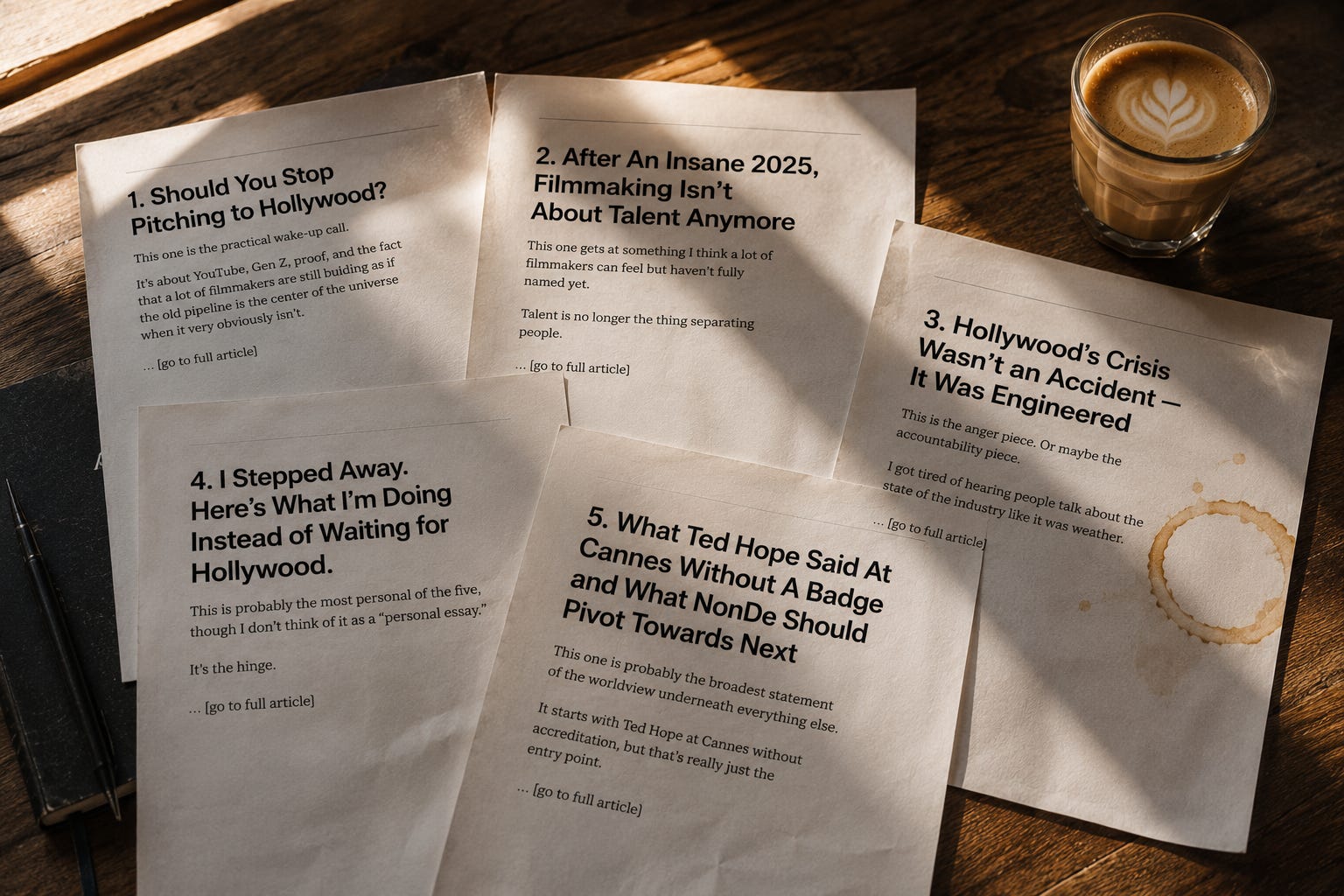
So if you’re new here, start with these five.
They’re the clearest map of how filmmakers got here, what to do about it and the playbook for your next move.
This one is the practical wake-up call.
It’s about YouTube, Gen Z, proof, and the fact that a lot of filmmakers are still building as if the old pipeline is the center of the universe when it very obviously isn’t. I wrote it because too many people are still pitching like it’s 2012 while audience attention has already moved somewhere else.
The point is not that Hollywood is dead. The point is that if your entire strategy still assumes Hollywood is the only serious door, you may be standing in the wrong hallway. The article then delves into the five-step plan around platform-first thinking and proof-of-concept. Click here for the full article.
This one gets at something I think a lot of filmmakers can feel but haven’t fully named yet.
Talent is no longer the thing separating people.
There are too many talented people. Too many smart people. Too many people with taste and pain and beautiful projects and no real understanding of the market their work is stepping into.
The divide now is literacy. Knowing how a thing moves. Where the money comes from. How the audience finds it. What leverage actually looks like now.
That one probably comes closest to the larger thesis running under a lot of this feed: less illusion, more literacy. Click here for the full article.
This is the anger piece. Or maybe the accountability piece.
I got tired of hearing people talk about the state of the industry like it was weather. Like collapse just drifted in on the breeze. It didn’t. It was built. Choice by choice. Debt. Consolidation. Fear. Bad leadership. Spreadsheet thinking. Treating filmmakers like replaceable parts in a machine they didn’t even understand anymore.
That piece is me saying: enough with the passive voice. Name the thing. Name the decisions. Name the logic that got us here.
And then, more importantly, ask what that means for filmmakers now. Because buried inside that wreckage is a brief little window where creators may have more leverage than they’ve had in a long time. Click here for the full article.
This is probably the most personal of the five, though I don’t think of it as a “personal essay.”
It’s the hinge.
It’s the piece where I stop pretending I can keep advising from the sidelines while not fully stepping into the arena myself under the new rules of the game.
That one came out of treatment, stillness, Ukraine, recovery, and the uncomfortable realization that while I believed in leverage, independence, and building outside the old gates, I hadn’t yet pushed myself far enough into modeling it.
If you want to understand why the publication itself started changing shape, this is a big part of the answer. Click here for the full article.
This one is probably the broadest statement of the worldview underneath everything else.
It starts with Ted Hope at Cannes without accreditation, but that’s really just the entry point. The bigger question is how we build anything genuinely new if we keep using the old system as the reference point for the new one.
That piece pulls together Ted, Cannes, CES, AI compliance, recovery language, NonDe, Ferran Adrià, El Bulli, and the basic truth that the system that got us here can’t be the system that gets us out.
That one matters to me because it’s about more than surviving the old model. It’s about whether we have the nerve to build something that doesn’t carry its DNA. Click here for the full article.
So that’s probably the cleanest way I can say what PitchCraft is.
It’s still about the room.
Still about pitching.
Still about leverage.
Still about how projects move.
But it’s also about what happens after the fantasy burns off.
How filmmakers build proof.
How they understand audience without flattening the work.
How they stop waiting for systems that no longer know what to do with them.
How they make better moves with fewer illusions.
That’s the feed I want this to be.
Useful.
Sharp.
Actually relevant.
A place that helps filmmakers think a little straighter and move a little sooner.
If you’re new here, start with those five.
If one of them hits, subscribe.
And if you’ve been here a while, I’d genuinely love to know which one did the most work for you.
Alex LeMay is a filmmaker, journalist, and founder of Shadowfile.Press by The Shadow Gang, an AI-powered investigation engine for journalists, documentarians, podcasters, and researchers. Creative Force is streaming at Cannes International Film Week through May 31 at cannesfilmweek.com. PitchCraft publishes at the intersection of storytelling, strategy, and building things that matter.
No posts
Comments
Nothing yet. Say the first thing.
Sign in to join the conversation.