
For weeks, my social media feed has relentlessly shown Nomio ads. Constant stacks of frozen broccoli! Trying to influence me to drink this tiny $7 “performance-enhancing vegetable” shot before hard workouts.
So I got curious about the science behind the claims, and down the research rabbit hole I went.
This Substack is reader-supported. To receive new posts and support my work, consider becoming a subscriber.
What is actually in the shot?
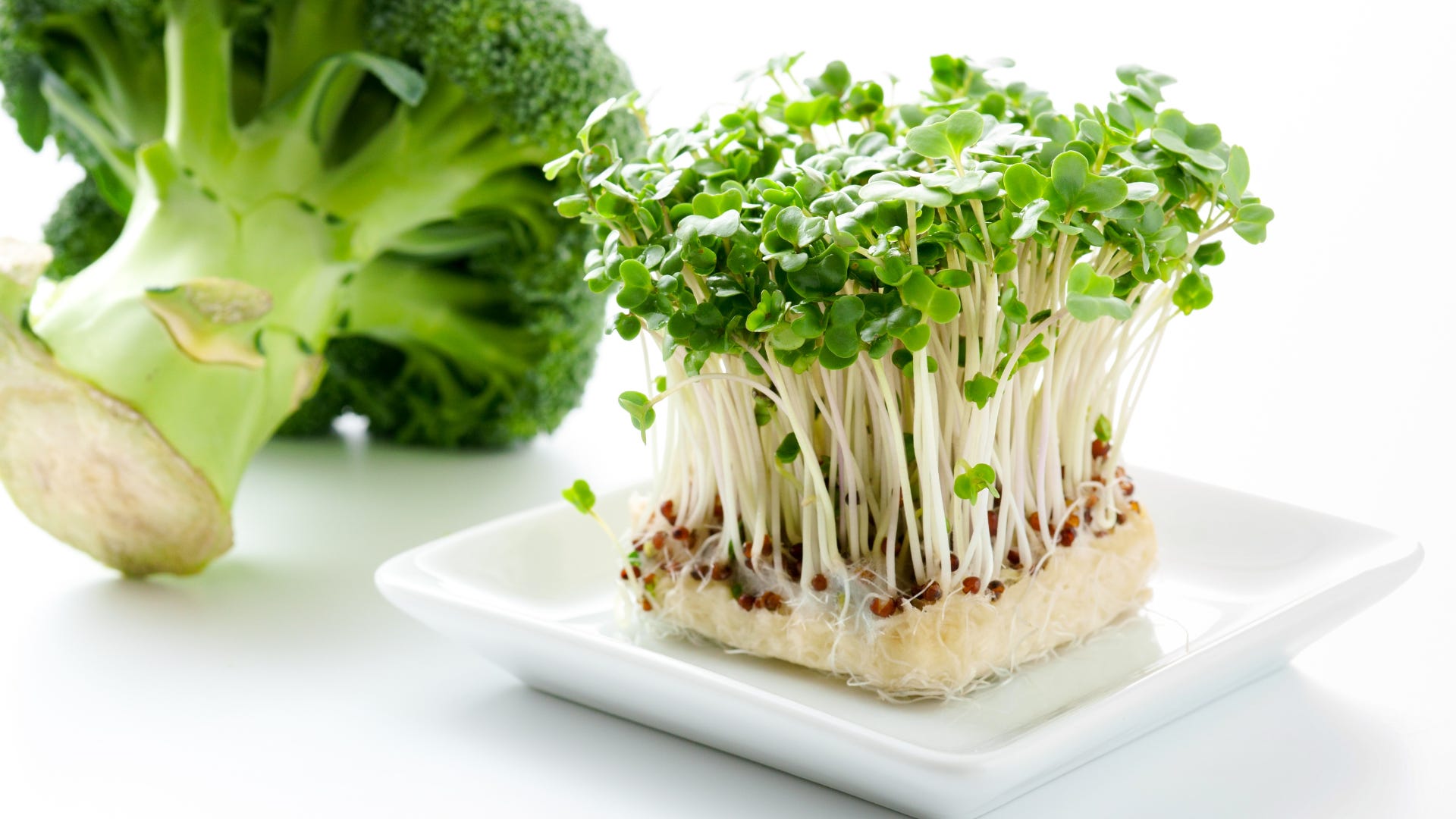
Broccoli sprout juice, lemon, and sugar. Why broccoli sprout juice?
Broccoli, kale, cabbage, and mustard all contain a group of plant compounds called glucosinolates. When you chew or crush these vegetables, an enzyme in the plant turns those glucosinolates into a different compound called an isothiocyanate, or ITC for short.
The most studied ITC is called sulforaphane. Almost every study I mentioned in this article is measuring sulforaphane, even when the product in question is marketed as an ITC product.
Isothiocyanates work differently than antioxidants. At first, they act like a small irritant inside your cells. They use up a bit of your glutathione, which is one of the body’s own antioxidants, and this creates a small burst of stress. That stress flips on a pathway called Nrf2. Nrf2’s job is to tell your cells to build more of their own antioxidant defenses.
So instead of adding outside antioxidants like vitamin C, isothiocyanates may nudge your body into making more of its own. It is a genuinely interesting idea. It is also, so far, still just an idea. Nobody has shown yet that this actually makes people perform better in real exercise.
The Research Behind the Lactate Claim
The Nomio ads claim that in clinical studies, ITCs showed a 12% reduction in blood lactate during submaximal training tests.
Let’s dive into the claim.
The first human study is from Flockhart and colleagues in 2023, published in the journal Redox Biology. Nine healthy people trained hard for seven days. Half the time they drank a broccoli sprout beverage 2x/day, and half the time they drank a placebo, in random order.
On the broccoli sprout days, their lactate was lower during exercise, they showed less oxidative stress, they could exercise longer before hitting exhaustion, and they had fewer overnight blood sugar crashes. Interestingly, their VO2max and their mitochondria did not change. So whatever caused the lower lactate, it was not simply that people got fitter or grew more mitochondria.
The researchers could not explain why it happened.
Limitations: This was also a very small study, just nine people. And the article was transparent in sharing that two of the authors, Filip Larsen and Michaela Sundqvist, are co-founders and owners of the company that would go on to sell this exact product. They also hold a patent on using ITCs compounds to improve exercise performance.
The 12% reduction in blood lactate claim most likely comes from a 2025 study, published by Vinge and colleagues.
This one is only posted online as a preprint, which means it has not yet been peer reviewed, the process where other scientists check a study before it gets published in a journal.
Fifteen people drank a single dose of kale sprout extract, either a smaller amount or a larger amount, or a placebo, then rode a stationary bike three hours later.
With the smaller dose, their lactate was about 0.4 mmol per liter lower than on placebo, at a work rate close to their lactate threshold. That is a small, but real difference. Their blood sugar was also a bit higher after the sprout drink than after the placebo.
There was no difference in how hard the effort felt, their blood pressure, or their heart rate. And again, nobody knows why the lactate went down.
Limitations: This study was single-blind, meaning only the participants did not know which drink they were getting, not the full double blind gold standard. The two senior researchers here are again Larsen and Sundqvist, the same two who own a stake in the product.
This does not mean the studies are fake, or that the results are wrong. However, a small pile of evidence, entirely from people with a financial stake in the outcome, topped off with a headline number that is still not peer reviewed, is exactly the situation where you want someone else to check the work before you believe it.
What About Muscle Soreness and Recovery?
The other Nomio claim is a recovery benefit. That ITCs protect muscles during intense exercise through activating the Nfr2 system.
There’s not a lot of evidence, but let’s dig into what we have to go off of:
The one human study here with no financial conflict of interest at all comes from Komine and colleagues in 2021. Sixteen young men took a sulforaphane supplement for two weeks around a bout of arm exercise designed to make their muscles sore.
The group taking sulforaphane had less soreness, better range of motion, and lower markers of cell stress than the control group. This is a small study without its own placebo group, but it is genuinely independent, and it points in a positive direction.
The animal research is more consistent than the human research. A 2025 mouse study by Ruhee and colleagues found that a single dose of sulforaphane, given before an exhausting treadmill run, reduced inflammation and protected muscle function.
The Cesanelli and colleagues 2026 study is one that did not support the recovery story at all.
This was a double-blind placebo study. They gave 15 people two weeks of high-dose broccoli powder before a muscle-damaging arm workout.
There was no difference between the groups in strength, muscle damage markers in the blood, range of motion, or muscle appearance on ultrasound.
So they found that broccoli supplementation did not help people recover faster.
This Substack is reader-supported. To receive new posts and support my work, consider becoming a free or paid subscriber.
Should you spend your money on a broccoli shot?
When it comes to supplements, it’s all about weighing the benefits and the risks.
I don’t see any health risks to taking it, as the ingredients of broccoli sprout juice, lemon, and sugar seem harmless for healthy adults. Assuming you don’t have an allergy to any of these ingredients.
Broccoli sprout extracts, particularly in higher doses, have been known to cause mild GI side effects (bloating and gas). Individual tolerance may vary.
The product does say it’s not suitable for children, pregnant or breastfeeding women, and the recommended maximum intake is 2 shots per day and not to exceed 150 shots per year.
Spending your money on this product, based on where the evidence stands to date, that’s completely up to you. My goal for this article is not to influence you. It’s to help you make a more informed decision.
I’d love to hear your thoughts on this product, especially if you’ve tried it! What does it taste like?
References
Cesanelli, L., Thomas, R., Mickevičius, M., Sniečkus, A., Mickevičienė, D., Venckūnas, T., Stasiulis, A., & Kamandulis, S. (2026). Short-term effects of broccoli-derived glucoraphanin on recovery from eccentric muscle damage: A double blind randomized crossover study. Nutrients, 18(4), 710. https://doi.org/10.3390/nu18040710
Fahey, J. W., Moreno, D. A., Licciardi, P., Grassi, F., Karagiannis, T. C., & Mazarakis, N. (2025). Editorial: Sulforaphane and isothiocyanates in health. Frontiers in Nutrition, 12, 1558025. https://doi.org/10.3389/fnut.2025.1558025
Flockhart, M., Nilsson, L. C., Tillqvist, E. N., Vinge, F., Millbert, F., Lännerström, J., Nilsson, P. H., Samyn, D., Apró, W., Sundqvist, M. L., & Larsen, F. J. (2023). Glucosinolate-rich broccoli sprouts protect against oxidative stress and improve adaptations to intense exercise training. Redox Biology, 67, 102873. https://doi.org/10.1016/j.redox.2023.102873
Gonzalez, D. E., Dickerson, B. L., Roberts, B. M., Kurtz, J. A., Waldman, H. S., Gonzalez, A. M., McAllister, M. J., Heileson, J. L., Bloomer, R. J., Arent, S. M., Candow, D. G., Stout, J. R., Hecht, K. A., Campbell, B., Kerksick, C. M., Kalman, D., Antonio, J., & Kreider, R. B. (2026). International Society of Sports Nutrition position stand: Effects of dietary antioxidants on exercise and sports performance. Journal of the International Society of Sports Nutrition, 23(1), 2629828. https://doi.org/10.1080/15502783.2026.2629828
Komine, S., Miura, I., Miyashita, N., Oh, S., Tokinoya, K., Shoda, J., & Ohmori, H. (2021). Effect of a sulforaphane supplement on muscle soreness and damage induced by eccentric exercise in young adults: A pilot study. Physiological Reports, 9(24), e15130. https://doi.org/10.14814/phy2.15130
Ruhee, R. T., & Suzuki, K. (2024). The immunomodulatory effects of sulforaphane in exercise-induced inflammation and oxidative stress: A prospective nutraceutical. International Journal of Molecular Sciences, 25(3), 1790. https://doi.org/10.3390/ijms25031790
Ruhee, R. T., Ma, S., & Suzuki, K. (2025). Effects of sulforaphane treatment on skeletal muscle from exhaustive exercise-induced inflammation and oxidative stress through the Nrf2/HO-1 signaling pathway. Antioxidants, 14(2), 210. https://doi.org/10.3390/antiox14020210
Vinge, F., Tillqvist, E., Horwath, O., Apró, W., Larsen, F. J., & Sundqvist, M. L. (2025). A glucosinolate-rich beverage lowers blood lactate concentrations during submaximal exercise [Preprint]. bioRxiv. https://doi.org/10.1101/2025.04.15.648889
Comments
Nothing yet. Say the first thing.
Sign in to join the conversation.