
Welcome to Fueling Field Notes, where I’m documenting my journey to preparing for the CSSD (Certified Specialist in Sports Dietetics) exam. These posts are equal parts study notes, science breakdowns, and practical takeaways from the field.
This Field Note is a big one. It’s long, and we’re in the weeds. But it also provides fascinating context for how our bodies fuel performance. I actually really enjoyed writing this so much more than I did in my 2007 biochemistry class.
The body needs a continuous supply of energy to function, move, and perform. But it doesn’t run directly on the food you eat. It runs on a molecule called adenosine triphosphate, or ATP.
Think of ATP as the body’s universal energy currency.
Every cell in your body uses it, from your brain to your heart to your skeletal muscle.
For today’s study notes, we’re going to focus on how skeletal muscle uses ATP to produce force and power during exercise.

ATP releases energy through a rapid chemical reaction. When the body needs energy, ATP is broken down into adenosine diphosphate (ADP) and an inorganic phosphate (Pi), releasing energy in the process.
ATP → ADP + Pi + energy
That chemical reaction produces about 7 calories of free energy, and it happens fast. During exercise, especially high-intensity exercise, ATP breaks down at a very rapid rate.
Here’s the catch: your muscles can only store a small amount of ATP at any given time. Enough for roughly 1-2 seconds of maximal effort. So the body must continuously rebuild ATP from ADP at essentially the same rate it’s being used.
ADP + Pi + energy → ATP
If ATP cannot be replenished fast enough, muscle function deteriorates. This is one of the underlying mechanisms behind fatigue.
The body has three mechanisms for resynthesizing ATP. Each has its own advantages depending on the intensity and duration of the activity.
All 3 energy mechanisms are “on” all the time. They work in parallel with each other. But, in certain situations, one of the mechanisms may be “turned up” more than the other two because each has its own advantages.
We will cover each in detail, but here is a quick overview:
Creatine phosphate hydrolysis is ideal for very short, very intense, anaerobic efforts lasting roughly 5-10 seconds.
Anaerobic glycolysis uses carbohydrate stored in the muscle or circulating in the bloodstream to produce ATP without oxygen. Also used in more intense, higher-effort efforts.
Oxidative phosphorylation is the aerobic system, using carbohydrates, fat, and protein to produce large amounts of ATP over longer durations.
ATP is not the only high-energy phosphate stored in muscle.
Creatine phosphate (CrP), also called phosphocreatine (PCr), is stored in muscle fibers at concentrations 3-4x greater than ATP. Like ATP, it does not require oxygen to produce energy.
When the body needs to rapidly rebuild ATP, CrP donates its phosphate group to ADP, instantly regenerating ATP. The enzyme creatine kinase facilitates this reaction.
ADP + CrP → ATP + creatine
This system can produce ATP faster than any other mechanism, which is why it powers the most explosive, high-intensity efforts.
The tradeoff is that it is very short-lived. CrP stores are depleted within approximately 5 to 10 seconds of maximal effort and require several minutes of recovery to be fully restored.
How do our creatine phosphate stores recover?
CrP recovery depends on aerobic metabolism. Creatine molecules use energy from ATP produced aerobically in the mitochondria to convert back to creatine phosphate.
This is why after a short-duration, high-intensity effort, athletes are out of breath. The body must temporarily increase oxygen intake and aerobic metabolism to meet the high need to restore creatine phosphate.
(*Geeking out over here with how cool the body is).
Dietitian note: This is exactly why creatine supplementation is relevant for endurance athletes, not just strength athletes. Topping off muscle creatine stores supports those explosive high-intensity moments that show up in endurance racing and training, like sprinting to the finish line, powering over a steep climb, or surging away from the pack.
The major food sources of creatine are beef and fish.
The body can also synthesize some creatine on its own when adequate amounts of the amino acids arginine, glycine, and methionine are available, which is one more reason solid overall protein intake matters.
I have numerous creatine articles written here on Substack. Make sure to check them out!
Glycolysis is the breakdown of carbohydrates for energy. The “anaerobic” part means it happens without oxygen.
All forms of carbohydrates consumed are converted to and used as glucose or stored as glycogen for future use. (For an overview on carb basics, read here)
For clarification:
Glycolysis involves the breakdown of glucose through a series of chemical steps to reform ADP into ATP.
Glycogenolysis involves the breakdown of glycogen.
Here is what happens in simple terms:
Glucose is broken down through a series of many chemical reactions in the sarcoplasm, producing a small but rapid yield of ATP.
The end product of this process is pyruvate.
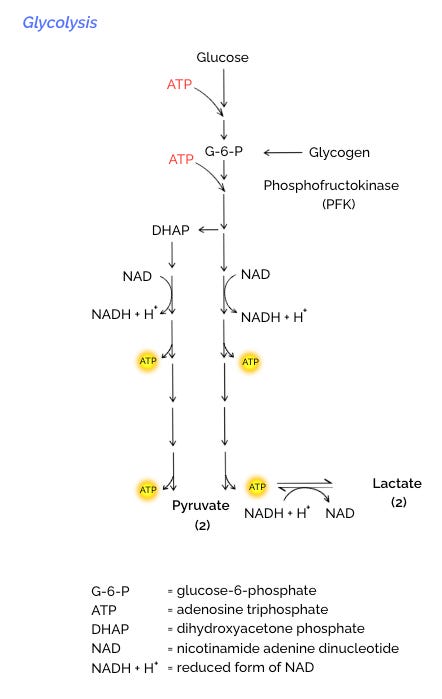
At lower intensities, pyruvate moves into the mitochondria and enters the aerobic energy system, where it can be used to produce much larger amounts of ATP.
At higher intensities, when the aerobic system cannot keep up with the energy demand, pyruvate is converted into lactate. Lactate often gets a bad reputation, but it is not the villain it has been made out to be.
Lactate is actually a useful fuel that can be shuttled to other tissues and used for energy.
The problem is not lactate itself but the accumulation of hydrogen ions that occurs alongside it, which contributes to the burning sensation and fatigue associated with high-intensity efforts.
Anaerobic glycolysis is the next fastest option for energy behind the creatine phosphate system. It can usually sustain high-intensity efforts for about 30 seconds to 2 minutes.
This is why carbohydrate availability matters so much for high-intensity endurance efforts. When muscle glycogen stores are low, the anaerobic glycolysis system loses its primary fuel source, and performance at higher intensities suffers quickly.
This is one of the foundational reasons why carbohydrate intake before, during, and after hard training sessions is not optional for endurance athletes pushing intensity.
Check out my podcast, Endurance Eats episode #43 with Dr. Jeff Stout, where we talk about how supplements like beta-alanine and sodium bicarb can help buffer those hydrogen ions.
Comments
Nothing yet. Say the first thing.
Sign in to join the conversation.