
Welcome to Fueling Field Notes, where I’m documenting my journey to preparing for the CSSD (Certified Specialist in Sports Dietetics) exam. These posts are equal parts study notes, science breakdowns, and practical takeaways from the field.
Before we get into how muscles use fuel, let’s take a quick look at the structure of the muscle itself. This context will make reviewing energy systems much easier to understand when we get there.
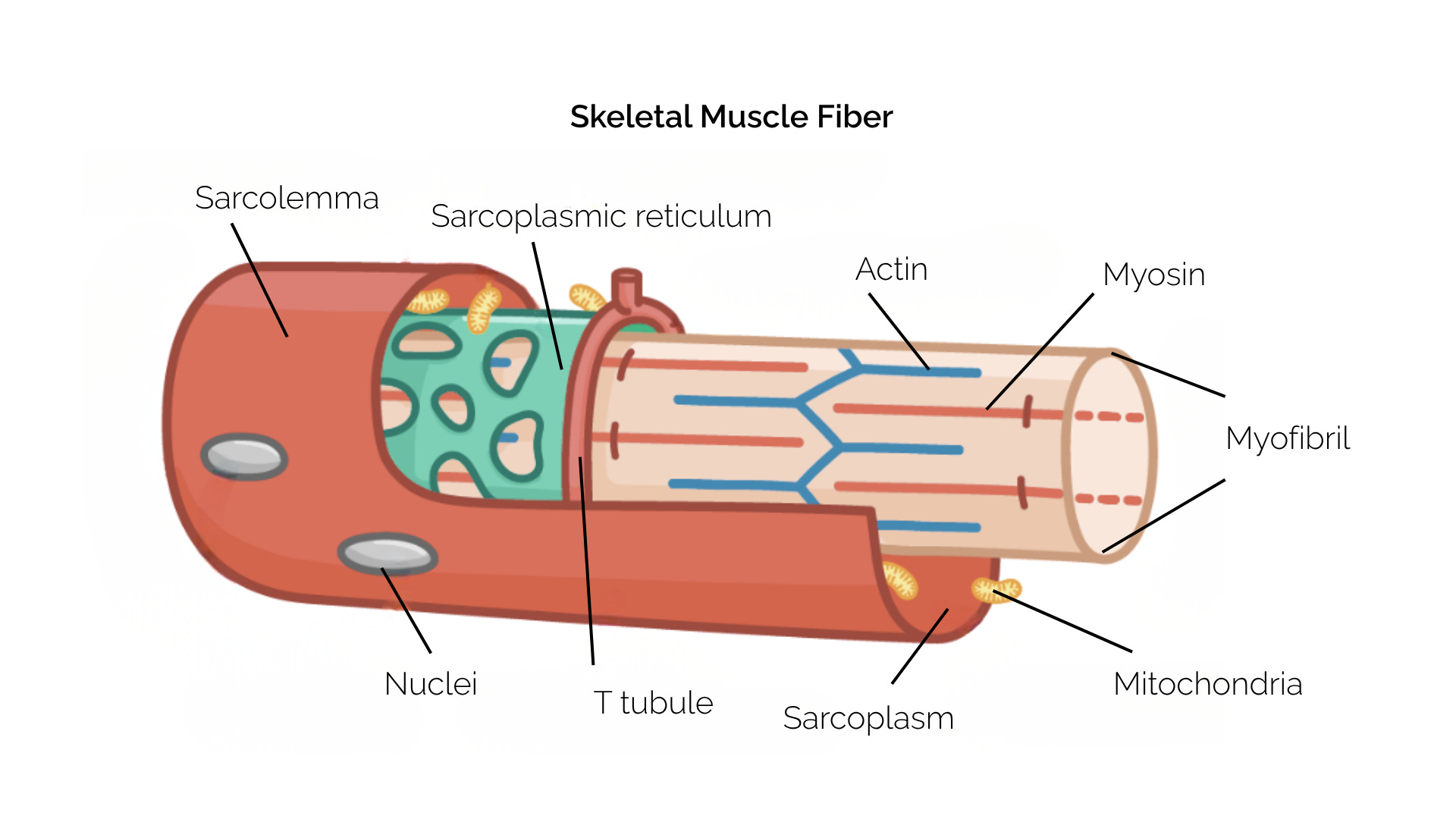
Muscles are made up of long, cylindrical cells called muscle fibers. Each fiber is essentially one very long muscle cell, and a single muscle contains thousands of them bundled together.
Surrounding each muscle fiber is the sarcolemma, which acts as the outer boundary of the muscle cell. It controls what enters and exits, and plays a key role in conducting the electrical signals that trigger contraction.
Inside each muscle fiber is a thick, gel-like fluid called sarcoplasm. Think of it as the working environment inside the cell. It contains everything the muscle needs to function, including:
Nuclei, which control cell activity and protein synthesis.
Mitochondria, the energy-producing organelles responsible for generating ATP. You may have heard them called the powerhouse of the cell, and in muscle tissue, that description is especially fitting given how much energy muscles demand during exercise.
Myoglobin, a protein that stores oxygen inside the muscle cell and gives the muscle its characteristic red color. It works similarly to hemoglobin in the blood, but its job is to hold oxygen in reserve within the muscle itself.
Myofibrils, the contractile units of the muscle fiber. Each fiber contains approximately 500 myofibrils, and these are what actually move when a muscle contracts.
Dietitian note: The mitochondria are exactly why aerobic capacity matters so much for endurance athletes. More mitochondria and better functioning mitochondria mean a greater ability to produce ATP efficiently using oxygen. One of the key adaptations we want from endurance training is an increase in mitochondrial density within muscle fibers.

The sarcoplasm also serves as a storage site for the muscle’s fuel supply:
Glycogen is the stored form of carbohydrate and a primary fuel source during exercise.
Triglycerides, the stored form of fat, serve as a fuel source, particularly during lower-intensity and longer-duration activity.
Phosphocreatine (PCr), a rapidly available energy source used to regenerate ATP during short, high-intensity efforts.
ATP (adenosine triphosphate) is the body’s direct energy currency. Every energy-requiring process in the cell runs on ATP.
Free amino acids. The sarcoplasm also contains a small pool of free amino acids. While amino acids are not a primary fuel source, they can contribute to energy production during prolonged exercise when carbohydrate stores are running low.
Next week’s article is going to walk through how these fuel sources power muscle for performance.
Each myofibril is made up of overlapping thin protein filaments (called actin) and thick protein filaments (called myosin) arranged in a repeating pattern. These filaments interacting is what allows muscles to contract and generate force.
The sarcomere is the basic functional unit of the myofibril and the actual site where muscle contraction happens.
Within each sarcomere, myosin binds to actin and pulls, shortening the sarcomere and producing force.
When thousands of sarcomeres fire simultaneously, you get visible muscle movement. Every contraction requires ATP (aka: energy), which is why energy availability is so directly tied to how well your muscles perform.
Wrapped around the myofibrils is a network of connecting, bag-like, membranous tubules called sarcoplasmic reticulum. They store calcium and release it when the muscle needs to contract. When the contraction signal stops, the calcium gets pumped back in, and the muscle relaxes.
T-tubules are narrow channels that carry the contraction signal from the surface of the muscle fiber deep into its interior, making sure the entire fiber contracts at once rather than just the outer edges.
There are different types of muscle fibers based on their contraction speed and metabolic characteristics.
Muscle fibers are extremely adaptable. However, the distribution of muscle fiber types is genetically determined and not easily altered. The training program will impact the metabolic potential of the muscle, regardless of the proportion of fiber types.
Comments
Nothing yet. Say the first thing.
Sign in to join the conversation.