
I want to start this one differently than I usually do. Instead of a story from the therapy room or the keynote stage, I want to start with a number, because I think this particular number might genuinely calm some nervous systems today.
Fifty one percent. That is roughly how much of a person’s desire to quit their job can be explained by one single thing, according to a brand new study published this year by researchers Cuppello et al. The thing is not salary. It is not job title. It is not even burnout on its own. The thing is connection, plainly and simply measured as how supported, valued, included, and trusted a person feels in their working life.
I know that might sound obvious to say out loud. Of course feeling connected matters. But here is why I find this particular study so quietly reassuring rather than just interesting. For years, so many of us in this field have talked about connection as something soft, something nice to have, something you address after the real business metrics are handled. This research took over three hundred working adults, built a thirty six item measure across three separate studies, and tested it against real outcomes like performance and turnover. And what they found is that connection was not a soft afterthought at all. It behaved like one of the most powerful, well behaved variables you could ask for in a study like this, with strong statistical reliability and a clean, coherent structure that held up again and again.
If you are someone who lies awake wondering whether you are just too sensitive, too needy, too much for wanting to feel like you belong somewhere at work, I want you to actually sit with that fifty one percent for a second. Your nervous system has been tracking something completely real this whole time. It was never a character flaw. It was data collection, and the data was accurate.
Here is where the real relief really lives for me, though. The researchers did not just find one big blob called connection and stop there. They found six distinct, measurable pieces underneath it, and each one behaves a little differently depending on what outcome you care about.
The first is Appreciation, which is simply whether your effort gets noticed and celebrated.
The second is Cohesion, which is whether the people around you actually pull in the same direction and support each other.
The third is Contribution, which is whether you have the resources, clarity, and autonomy to actually do your job well.
The fourth is Belonging, which is that deeper sense of pride and alignment with your team and its purpose.
The fifth is Trust, which is whether you believe the promises made to you and feel safe enough to speak honestly.
And the sixth is Wellbeing, which is whether your work allows you an actual, sustainable life outside of it.
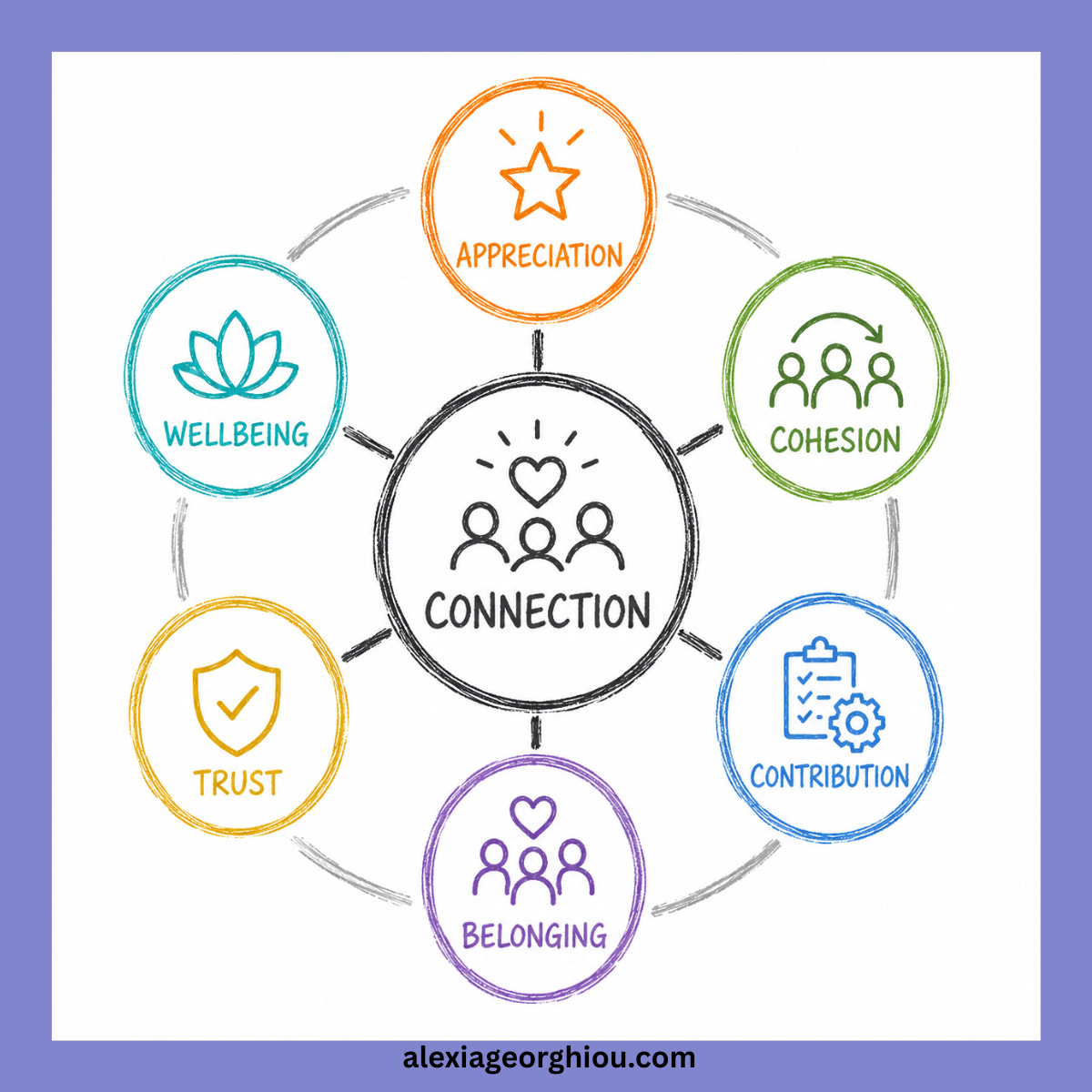
Why does breaking it apart like this matter for your anxiety specifically? Because global, undifferentiated dread is so much harder to sit with than a specific, nameable thing. When everything about work feels bad, it feels enormous and unsolvable. But this research found that these six pieces, while related, each pull their own weight.
Belonging was the strongest predictor of whether someone wanted to leave their job entirely.
Wellbeing was the strongest predictor of whether someone had the energy and focus to actually perform well day to day.
Contribution, having what you need and the room to use your own judgment, was the strongest predictor of whether people went above and beyond rather than just going through the motions.
What this tells me, both as a therapist and as someone who has spent years helping leaders build better cultures, is that you do not have to fix everything at once. If you are the one feeling off at work right now, you can actually ask yourself a much smaller, kinder question than usual. Not, is my whole job wrong for me. But, which of these six specific things feels thin right now.
Is it that nobody is noticing your effort?
Is it that you feel isolated from your team?
Is it that you do not have what you need to do the work well?
Is it that you have stopped feeling proud of where you belong?
Is it that trust has eroded somewhere?
Or is it that your life outside of work has quietly disappeared?
Naming the actual gap tends to shrink the anxiety around it, because a specific problem always feels more solvable than a vague, looming sense that something is wrong with you.
There is one more finding in this paper that I think deserves to be said slowly, because I know how many people carry both burnout and self doubt at the same time, wondering which one is real. In a related study referenced in this paper, the researchers tested burnout and connection together, side by side, to see if connection was just burnout wearing a different name. It was not. Even after accounting for burnout fully, connection still explained a meaningful, separate piece of whether someone wanted to leave their job.
In plain language, that means you can be exhausted and disconnected as two different, layered experiences, and addressing one does not automatically fix the other. If you have ever rested, taken the vacation, tried to recover from burnout, and still felt something missing underneath it, this finding is your evidence that you were not doing recovery wrong. You were simply naming an incomplete list.
I will admit, as someone who has stood in front of hundreds of leaders talking about happiness at work, that research like this makes my job easier in the best way. It gives me language that is not just warm and well intentioned but actually measurable, which means it can be advocated for in rooms where warmth alone sometimes struggles to get a seat at the table. When a leader asks me to prove that culture work matters, I can now point to a specific, credible study and say that connection alone explained about half the variance in whether people intend to stay.
But more than anything, if you are the person reading this on a hard week, wondering whether your discomfort at work is legitimate, I want you to take this with you. Researchers spent three separate studies and hundreds of working people’s honest answers proving that what you feel when you feel disconnected at work is real, structured, and predictable. It is not a personal weakness showing up in you. It is a well documented human pattern showing up in the data, the same way it shows up in your body on a Sunday night before a Monday you are dreading.
You are allowed to name the specific thing that is missing!
You are allowed to ask for it!
And you are allowed to trust that your discomfort was never irrational to begin with!
It was, this whole time, remarkably good data.
~Alexia
If you lead a team, a department, or an organization and this research is landing for you the way it landed for me, I would love to bring this conversation into your room. I speak on the future of work, human centered leadership, and the real, measurable science of connection at work, and I build every keynote around research like this so your people leave with more than a good feeling. They leave with a framework. If you are planning a conference, leadership offsite, or internal summit and want a speaker who blends peer reviewed research with lived experience, reach out and let us talk about what your audience needs.
alexia@knoxvillehappinesscoalition.com
1-865-283-3605

Comments
Nothing yet. Say the first thing.
Sign in to join the conversation.