
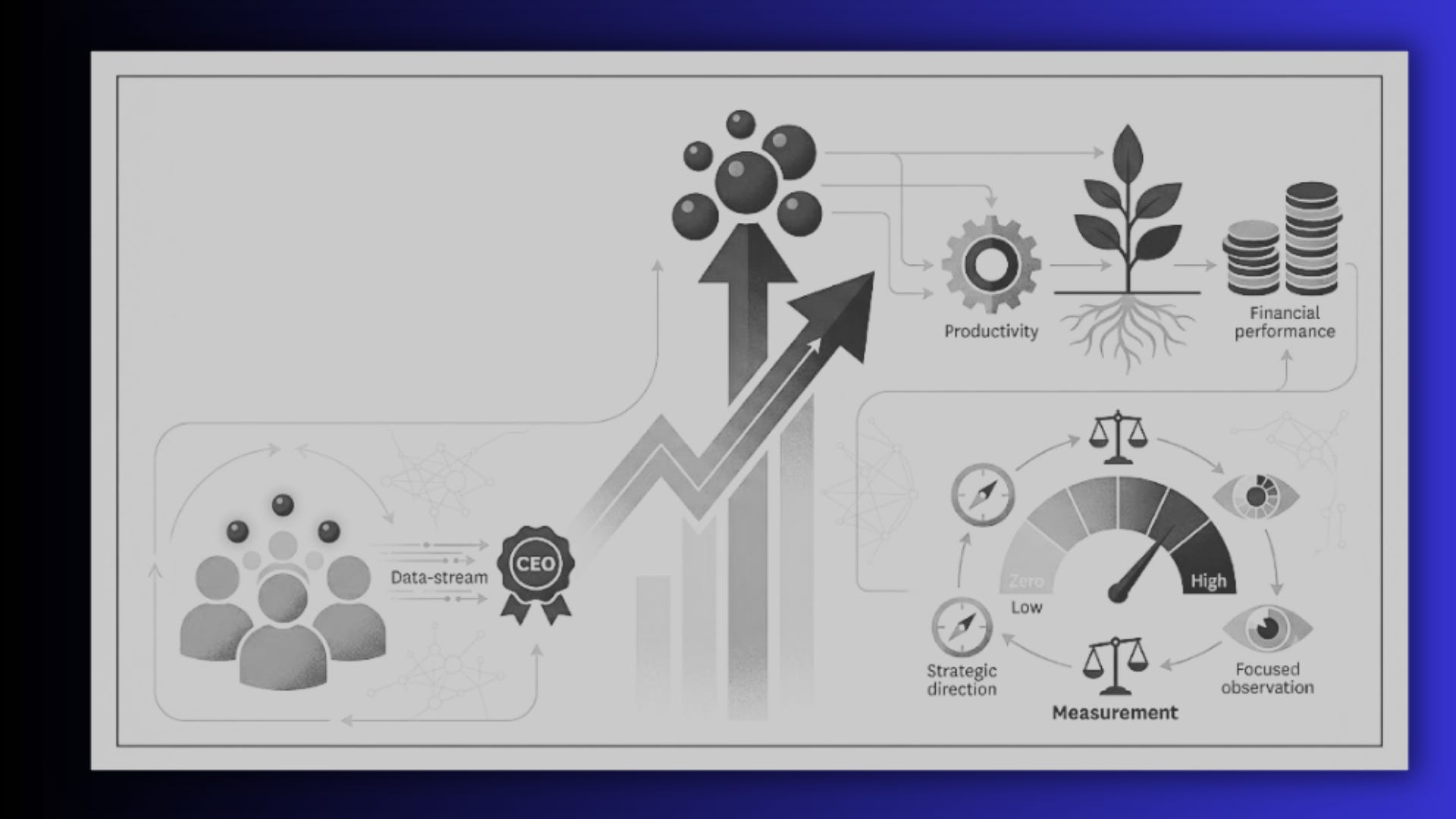
Happiness at work has an image problem. For too long it has been filed under “nice to have,” sandwiched between free snacks and casual Fridays, treated as a cultural amenity rather than a business driver. That framing has cost companies enormously. A growing body of research from Oxford, Gallup, and the OECD now confirms what the best leaders have always sensed intuitively: how people feel at work is not separate from how well the business performs. It is the same thing, measured from a different angle. If you are a CEO and you are not measuring the happiness of your workforce; you have revenue dashboards, customer satisfaction scores, and supply chain analytics, but you are blind to the single variable that touches every one of those outcomes.
Most organizations already run engagement surveys. That is a start, but engagement is only one slice of the picture. Researchers Jan-Emmanuel De Neve and George Ward at the University of Oxford Wellbeing Research Centre propose a definition of workplace wellbeing that is grounded in decades of subjective wellbeing science. They argue that workplace wellbeing is how we feel at work and about our work, and it has three distinct dimensions.
The first is evaluative job satisfaction, the cognitive, all things considered judgment a person makes about their job.
The second is the affective or emotional experience of work, the actual feelings people carry through their days, both positive emotions like happiness and energy and negative emotions like stress and anxiety.
The third is eudaimonia, the sense that work is purposeful, meaningful, and worth doing.
These three dimensions are not interchangeable. A person can be satisfied with their job on paper yet feel chronically stressed. Someone can find deep meaning in their work yet be emotionally exhausted. Measuring only one dimension and calling it “wellbeing” is like checking only blood pressure and calling it a full physical. You need all three to see the real picture.
Every initiative in a business should connect to productivity, innovation, customer value, growth, retention, and profitability. If we cannot explain that connection, we are speaking the language of HR instead of the language of the CEO. So let me make that connection explicit, domain by domain.
Growth. Happy workers do not just do their current jobs well. They go looking for what is next. Research published in Management Science by Bellet, De Neve, and Ward found that employee happiness has a causal impact on productivity. When people feel good at work, they sell more, serve more, build more. That is organic growth generated not by a new market strategy but by unlocking the discretionary effort that already exists inside your workforce. When you scale that effect across thousands of employees, the revenue implications are substantial.
Innovation. Creativity does not come from pressure. It comes from psychological safety, positive affect, and a sense of purpose. Amabile and colleagues demonstrated that positive emotions at work are closely linked to creative output. When people feel stressed, anxious, or disconnected from meaning, they default to safe, incremental thinking. When they feel happy, supported, and purposeful, they experiment, challenge assumptions, and generate the novel ideas that differentiate a company in the marketplace. If your innovation pipeline is stalling, your happiness data may tell you why before your R&D budget ever will.
Engaging People. The talent market has fundamentally shifted. Candidates now have access to crowdsourced wellbeing data on platforms like Indeed, which has collected over 15 million survey responses measuring workplace happiness across tens of thousands of firms. Job seekers are making decisions based on how it actually feels to work at your company, not just what you pay. Field experiments show that candidates change their application behavior based on this information. If your people are unhappy, you are not just losing productivity. You are losing the ability to attract the next generation of talent, and the people you do have are already looking at the door. Job satisfaction is one of the strongest predictors of voluntary turnover in longitudinal data.
Customer Value. There is no firewall between how your employees feel and how your customers are treated. Unhappy, stressed, disengaged employees deliver inconsistent, indifferent service. Happy employees bring energy, attentiveness, and genuine care to every customer interaction. The firms that consistently lead in customer satisfaction are not running better scripts or tighter quality controls. They have people who actually want to be there, people who find their work meaningful and feel good doing it. That emotional state transmits directly to the customer experience, and your NPS scores will reflect it.
Profitability. Firm-level measures of employee wellbeing have been shown to positively correlate with financial performance. Edmans demonstrated a link between employee satisfaction and long-term stock market returns. Krekel, Ward, and De Neve conducted a meta-analysis showing that employee wellbeing is associated with higher productivity and profitability at the business unit level. These are not soft findings. They represent hard financial outcomes measured over years and across industries. When you invest in the conditions that make people happy at work, you are not spending on a benefit. You are investing in a driver of margin.
Performance. Gartner’s emerging performance-first management research is pushing managers to move beyond simply supporting employees and toward enabling performance by improving how work gets done. Happiness data gives you the diagnostic layer underneath performance data. When a team’s output drops, an engagement score alone will not tell you whether the problem is emotional burnout, a lack of purpose, or dissatisfaction with how work is structured. The three-dimensional model of workplace wellbeing can. You can pinpoint whether the issue is evaluative, affective, or eudaimonic, and intervene accordingly rather than guessing.
Resilience. Organizations face constant disruption, from AI transformation to economic volatility to leadership transitions. The companies that weather those storms are not the ones with the best contingency plans. They are the ones whose people have deep reserves of hope, purpose, and emotional wellbeing. Dr. Alphonsus Obayuwana’s research on the relationship between hope, hunger, and happiness offers a powerful lens here. His Triple-H Equation demonstrates that happiness rises when hope increases and unmet desire decreases. In a workforce context, that means resilience is built when people feel hopeful about their future at the company, when their core needs are being met, and when they see their work as meaningful. Resilient organizations do not just survive disruption. They adapt faster because their people have the emotional capacity to absorb change and keep moving forward.
The Oxford Wellbeing Research Centre has proposed a prototype survey module that is elegant in its simplicity. It consists of four questions, each answered on a 0 to 10 scale where 0 means “not at all” and 10 means “completely.”
Overall, how satisfied are you with your job?
Overall, how purposeful and meaningful do you find your work?
How happy did you feel while at work during the past week?
How stressed did you feel while at work during the past week?
That is it. Four questions. They take less than two minutes to answer. They cover all three dimensions of workplace wellbeing: evaluative, eudaimonic, and affective (both positive and negative). They are grounded in the same science that governments use to measure national wellbeing and that the OECD recommends for international comparison. And they are already being deployed at scale by platforms like Indeed across tens of thousands of companies.
The beauty of this approach is that it separates outcomes from drivers. These four questions tell you how your people feel. They do not tell you why. That is a feature, not a flaw. Once you know the scores, you can investigate the drivers, whether they are compensation, management quality, workload, flexibility, or something else entirely, and you can do so without conflating the symptom with the cause.
If you run a company, you already measure things that are harder to quantify than happiness. You measure brand equity. You measure customer lifetime value. You measure culture fit in hiring. None of those have a single clean number, yet you track them because they predict outcomes that matter.
Workplace happiness is no different, except that it may be more predictive than any of them. It touches growth, innovation, talent, customer experience, profitability, performance, and resilience simultaneously. No other single variable sits at the intersection of that many business outcomes.
The research is clear. The measurement tools exist. The companies that act on this will outperform those that do not. The only question is whether you will be one of them.
If this article resonates with you, I want to invite you to experience what measuring happiness actually looks like in practice.
On March 20, 2027, the World Happiness Fellowship returns to Knoxville, Tennessee for our annual International Day of Happiness Leadership Breakfast Seminar. This year’s theme is Wellness as the Driving Force of Leadership in the Age of AI.
Dr. Alphonsus Obayuwana, the physician-scientist whose Triple-H Equation I referenced in this article, will join us in person. Dr. Obayuwana developed the Edo Questionnaire, a twelve-item self-assessment tool that makes it possible to calculate an individual’s Personal Happiness Index, a validated numerical score that can accurately identify who in any group is happy, unhappy, flourishing, or languishing. His hope measurement scale was funded by the National Institutes of Health and has been utilized by Fortune 500 companies. His latest book, The Happiness Formula, was named one of the five must-read books by Forbes.
During the seminar, we will measure our happiness together. Every participant will have the opportunity to discover their own Personal Happiness Index and leave with a concrete understanding of where they stand and what they can do about it.
The World Happiness Fellowship is not another conference. It is a retreat-style experience where titles come off and humanity comes first. A CEO may sit beside a teacher. A nurse beside an engineer. Everyone enters the room the same way. No hierarchy. Just people learning together how humans actually thrive.
Join us March 20, 2027 in Knoxville. Learn more at worldhappinessfellowship.com. For sponsorship, speaking, or partnership inquiries, reach me directly at alexia@knoxvillehappinesscoalition.com or 865-283-3605.
Because the next competitive advantage may not be technology. It may not even be strategy. It may simply be this: understanding how humans actually thrive.
Sources referenced:
De Neve, J-E., Ward, G. (2023). Measuring Workplace Wellbeing. University of Oxford Wellbeing Research Centre Working Paper 2303.
Obayuwana, A. (2024). The Happiness Formula.
Bellet, C., De Neve, J-E., Ward, G. (2023). Does Employee Happiness Have an Impact on Productivity? Management Science.
Krekel, C., Ward, G., De Neve, J-E. (2019). Employee Wellbeing, Productivity, and Firm Performance.
Edmans, A. (2012). The Link Between Job Satisfaction and Firm Value.
OECD (2013). Guidelines on Measuring Subjective Wellbeing.
Comments
Nothing yet. Say the first thing.
Sign in to join the conversation.