
Here are three absolutely essential questions that will help crystallize your story:
- What does your protagonist WANT?
- What is their PLAN to get it?
- Who and what is standing in their way? (FORCES OF ANTAGONISM)
You'd be surprised how many writers come to my workshops (some with half-completed books!) who can't answer those simple questions.
And while most of these writers are usually (eventually) able to identify what their protagonist wants, and who is standing in their way— a lot of these writers have never heard of the idea that the Protagonist needs to have a specific Plan.
So let's talk about the PLAN.
In most cases, understanding your hero/ine's PLAN will quickly focus what might be a very amorphous idea and save you endless rewriting (or giving up completely). The Plan really is the key to the drive of your story.
You always hear that “Drama is conflict,” but when you think about it – what the hell does that mean, practically?
It’s actually much more true, and specific, to say that;
In the first act of a story, the hero/ine is introduced, and that hero/ine either has or quickly develops a DESIRE (usually triggered by the INCITING INCIDENT). They might have a PROBLEM that needs to be solved, or someone or something they WANT, or a bad situation that they need to get out of, pronto.
Their reaction to that problem or situation is to formulate a PLAN, even if that plan is vague or even completely subconscious. But somewhere in there, there is a plan, and storytelling is usually easier if you have the protagonist or someone else (maybe you, the author!) state that plan clearly, so the audience or reader knows exactly what the expectation is.
The protagonist’s plan (and the corresponding plan of the antagonist’s) actually drives the entire action of the second act. Stating the plan tells us what the MAIN ACTION of the story will be—and starts a key question working in your reader or audience’s mind: Will the Plan succeed?
So it’s critical to set up the Plan by the end of Act One, or at the very beginning of Act Two, at the latest.
Let’s look at some examples of how plans work.
In Raiders of the Lost Ark, the first sequence (the first 15 minutes of a movie, corresponding to the first 50 pages of a book) is arguably two sequences, first the action sequence in the cave in South America, then the university sequence back in the US, all in a lightning fast 15 minutes.
At the end of this long sequence, Indy has just finished teaching his archeology class when his MENTOR, Marcus, comes to meet him with a couple of government agents who have a job for INDY (the INCITING INCIDENT or CALL TO ADVENTURE). The agents explain that Hitler has become obsessed with collecting occult artifacts from all over the world, and is currently trying to find the legendary Lost Ark of the Covenant, which is rumored to make any army in possession of it invincible in battle.
So there’s the MACGUFFIN*, the object that everyone wants, and the STAKES: if Hitler’s minions (THE ANTAGONISTS) get this Ark before Indy does, the Nazi army will be invincible (STAKES). Those are some stakes!
*MACGUFFIN is a word that Alfred Hitchcock coined to mean “the object that everyone wants.” Not every story has a MacGuffin!
And then Indy explains his PLAN to find the Ark: he’s going to seek out his old mentor, Abner Ravenwood, who was an expert on the Ark and had an ancient Egyptian medallion on which was inscribed the instructions for using the medallion to find the hidden location of the Ark.
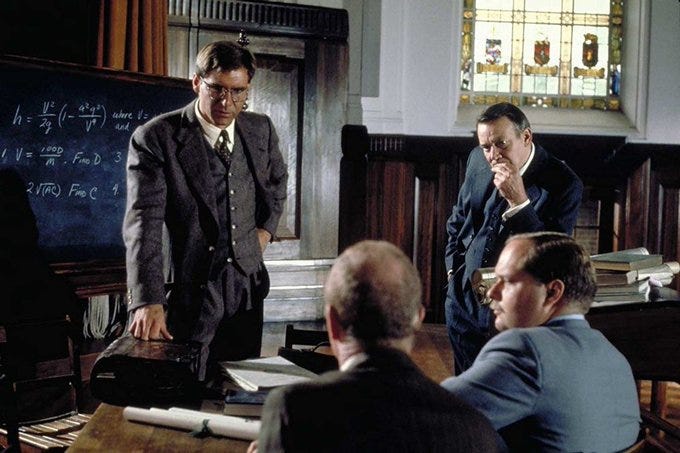
So after hearing the Plan, we understand what the main ACTION of the story is going to be:
Indy is going to find Abner to get the medallion, then use the medallion to find the Ark before Hitler’s minions can get it.
And even though there are lots of twists along the way (the first being that Abner is dead!), that’s really it: the basic action of the story.
In this video, I discuss the Plans of Raiders, The Hunger Games and Jaws.
.
Full story breakdown of Raiders of the Lost Ark
Full story breakdown of The Hunger Games
I started this post with the PLAN because it’s the one authors (and screenwriters!) most often leave out.
But I promised THREE essential things about your protagonist! So here are the other two:
This is a more complex question than it seems. Because in drama, a protagonist has two distinct WANTS - and in good stories, these wants are in direct opposition to each other!
I’m talking about INNER DESIRE and OUTER DESIRE.
We’re all - usually - pretty clear about who the Villain is in our story. But in most books, movies, TV, etc. there is not just one antagonist but several, and some of them are not necessarily an actual person:
If you can answer all three of these questions about your own book or script, you are well on your way to A Book by the End of the Year.
- What does your protagonist WANT?
- What is their PLAN to get it?
- What are the FORCES OF ANTAGONISM: Who and what is standing in their way?
Ask these questions while you’re brainstorming and before you start writing. Bash out a short synopsis based on those three elements. Make sure they’ve all been introduced in your Act I. As you write the first, draft, ask them again, periodically and make sure you’re clear on these elements - because sometimes you’ll forget, and sometimes they change!
So how is that book going?
—Alex
All material © Alexandra Sokoloff, Screenwriting Tricks for Authors
Next weekend is the Bute Noir Crime Writing Festival - a yearly party for our author and reader community. I’m always encouraging you writers to dream on paper about what you want your author life to look like and feel like, because there’s much more to it than writing and selling books:
Running a book festival might not be on your list of author goals, but it wasn’t on mine or Craig’s either! And yet it’s become one of the most magical (if fraught) elements of our author lives.
Read more about how we were tricked into it by a canny group of Scottish islanders:
for fifteen minute doses of craft to elevate your writing right now!
Likes, Comments and Shares are really helpful and much appreciated.
Share Screenwriting Tricks for Authors

Get the workbooks:
Stealing Hollywood ebook, $3.99, also available as print workbook
Writing Love ebook, $2.99
Need more help? The Screenwriting Tricks for Authors workshop is available online, as a self-paced course with all the videos, assignments, movie breakdowns and personalized feedback you need to get that book written next year. In three parts, and you only pay for what you use.
Comments
Nothing yet. Say the first thing.
Sign in to join the conversation.