
The results of last week’s poll shows a good half of you (who responded!) are writing in the first half of your books. Which is excellent! You’re already well on your way to A Book by the End of the Year.
(I myself am wiped out by the last edits pass on Lost Highway Book 2 and will have to do about a year’s worth of admin next week before I go back to my own Book By the End of the Year. But I will be so ready by then…)
So if you’re looking for more on Act I today, go to this post to make sure that you are very clear on your INCITING INCIDENT. It may be the most important thing to get right in those first chapters!
For the rest of this letter I’m going to tackle an issue I was asked about this week - that writers grapple with all the time as part of a professional writing career.
Along with writing a book, you are going to be making some serious decisions about getting that book out into the world. This is of course an awesome situation to be in because —you’re written a book! And it is simultaneously a terrifying situation to be in —because now you have to DO something with it.
After living inside the book for six months, nine months, a year, years - you now have to start looking at it from the outside in.
You have to define your book for other people. Like agents, editors, librarians, book club organizers, website designers, reviewers, conference organizers - and so many others.
But most importantly - for READERS.
Hopefully you have being working on that from the beginning, and periodically through the writing or the book. And I’m here to make sure you do.
This is where a Master List becomes really, really useful - whatever stage of your writing process you’re in.
If you’re new here, the Master List is a writing tool and teaching technique I developed a (frighteningly!) long time ago, when I first started these workshops. Even in a weekend or week-long workshop I didn’t have all that much time with the writers, and this was a way I could instantly get a writer at any level to define what it was they were writing or wanted to write, and to articulate it to other people, including me, their teacher, and the rest of the class! Once they’d done a Master List, I could pinpoint the structures that they were working with and give them instant examples of how to get there.
In the beginning of your writing process, a Master List will help you hone in on the book you want to write. It will help you figure out what story structure and story patterns to use to bring the most thrilling story out of your ideas. Throughout your writing process, making a Master List is an invaluable way to flesh out characters, brainstorm SETPIECES, and inspire solutions to just about any tricky story problems. One of the writers here just found a Master List incredibly helpful for honing in on her VILLAIN.
(I break down how to do this in workbooks, Stealing Hollywood : Chapters 10-11, Writing Love : Chapters 12-13, and throughout the books.)
A Master List also a terrific tool when you need to define your finished book— to readers, agents, editors, booksellers, librarians, conference organizers, and did I mention readers?
And a Master List is a great way to hone in on your brand, which will help your publishers sell your book, help you write and design all the promotional material you are going to have to endlessly write and design — including your website, your Substack when you’re setting up Facebook Ads, Amazon Ads, and other ads, if you’re doing that for yourself….
Because Craig and I have a new series, we are having all kinds of talks with our publishing team about marketing, including as I mentioned a while ago, filling out the dreaded author/book questionnaire. What we sent in for Book 1 was 26 pages long, and that didn’t including the pages and pages of separate author information that Craig had to send in on top of what we jointly answered. The one we just did for Book 2 was not as extensive but still took days.
The questionnaire is always grueling. But it is so incredibly focusing — about marketing, about brand— and about what really matters to you THEMATICALLY.
When you start working with your marketing team, and I’m very much including you indie authors, you need to speak in COMPS. That is, you need to define your book (and series if it’s a series) and yourself as an author by comparing your book to other books (and also movies and TV shows), and you need to compare yourself to other authors.
There is no such thing as starting this too soon! So let’s take a look at how that works, in action.
For your Comp Master List you most likely will need a very different Master List than the one that has been so helpful to you while you were writing your book. Your story structure Master List might include Shirley Jackson, Stephen King and Thomas Harris. Or maybe a whole lot of 90’s romantic comedies.
But your COMP LIST needs to have:
Present-day bestselling authors
Some very recently published books
It also helps to have books on there that have been adapted for TV or film, and/or some comparable TV shows and movies.
And that list can be a lot trickier to make than you think!
I see so many first-time authors agonizing over comps and categories.
So let’s just do it.
You’re probably pretty aware of your GENRE, and your SUBGENRE(s). But let’s face it, there are hundreds of thousands of authors and books in your genre and subgenera. Millions.
So you also have to be familiar with BOOK CATEGORIES, which will help you hone in on authors who write books that are more truly similar to your own.
By this I mean the advertising categories that Amazon and other platforms use to help readers find your books.
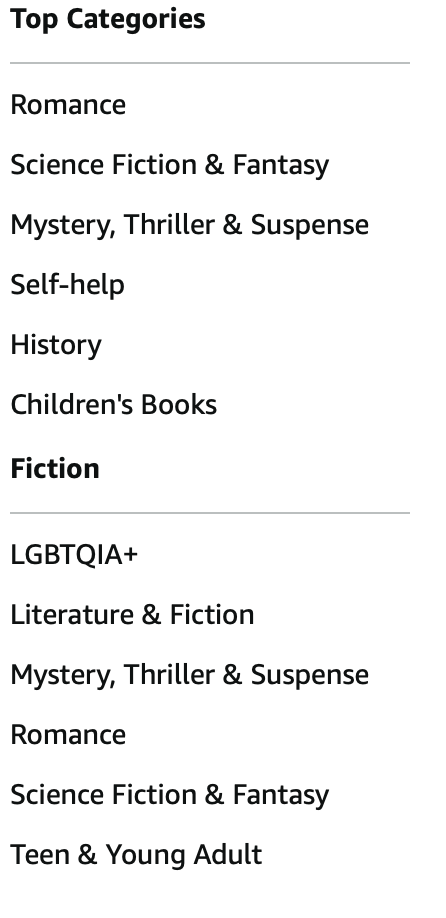
Now, each one of those more general categories can and should be broken down into subcategories (more granular categories).
Even if you’re boycotting Amazon you can still use the hell out of the platform for free to figure out the categories that will help sell your book! For example -
Heist
Kidnapping
Murder
Noir
Organized Crime
Serial Killers
Vigilante Justice
There are other separate categories for Mysteries, Thrillers & Suspense - which all gives you quite a lot to play with in the crime genre and helps you get more specific about what your book really is.
Action & Adventure, Adaptations, Alpha Male, Amish, Billionaires & Millionaires, Black & African American, Clean & Wholesome, Collections & Anthologies, Contemporary, Enemies to Lovers, Fantasy, Firefighters, Gothic, Historical Romance, Holidays, Later in Life, LGBTQ+, Love Triangle, Mafia Romance, Medical, Military, Multicultural & Interracial, New Adult & College Romance, Paranormal, Police, Polyamory, Rockstar Romance, Romantic Comedy, Romantic Suspense, Science Fiction, Small Town Romance, Sports, Time Travel, Western & Frontier, Workplace Romance
I hope you actually read that list and that it has occurred to you that you might find categories for your own book in a different genre entirely! It’s useful to periodically browse the granular categories to get ideas.
If you want to know more about how to use categories to sell your books, or even just how to find those lists of categories - let me know. We can do that! But you’re probably getting the picture.
So let’s walk this process through so you can do it with your books. (That might be just one book right now, but you’re going to include your books to come!)
What’s your GENRE?
I write crime-mystery-suspense-thrillers. That’s GENRE.
What are your book CATEGORIES and SUBCATEGORIES?
For the Huntress Moon series the subcategories of the general genre category Mystery, Thriller & Suspense would include: vigilante thriller, FBI, police procedural, hard boiled, serial killer, mystery series, and for some of the books: kidnapping thrillers, female sleuth, women detective, dystopian, and political.
I’ve also sometimes categorized some of the Huntress books as supernatural thrillers (because there is an element of synchronicity that can feel mystic, and the female main character has a sense perception so finely honed it can seem psychic); and as California mysteries; and always as feminist thrillers.
Because if a woman taking it on herself to eliminate male predators isn’t feminist, I don’t know what is.
The Lost Highway series is not FBI or police procedural. It’s amateur sleuth, female sleuth, woman detective. It’s California mysteries, and it’s a mystery series. It’s not cozy, but it has appeal for a cross section of that audience because of the female protagonist’s off-the-wall humor and over-the-top approach, and because of the van life/nomad life backdrop. But the crimes involved are very dark, as in the Huntress series, hitting the categories of serial killers, murder mysteries, and kidnapping thrillers. It could be categorized as a vigilante mystery/thriller, too.
These are all subcategories that your publisher, or you if you’re indie publishing, can choose to give your book a better chance of reaching readers who are looking for exactly the kind of book you write.
It will also help YOU as an author define your books to buyers - agents, publishers, and readers.
So —
Making a really inclusive list of your book categories and subcategories is a huge part of defining your BRAND.
And once you have those subcategories, you can :
Find COMPS (similar books and authors) just by clicking on those subcategories and looking at some of the top sellers in that category! It is a great, quick way to remind you of authors and books that should be on your comp list.
But now, to get really specific, we need to express what makes your books unique within those categories.
You need to articulate your personal THEMES that tie your books together and also make them stand out from other books in your genre.
Lost Highway is a very different series than my Huntress Moon series, in characters, tone and subgenre. But again, there are plenty of similarities that I know will attract crossover readers and that make up my unique BRAND.
They’re both road trip stories, set primarily in California — but more on the highways, small towns, and wilderness areas than in the cities. Social issues are prominent: violence against women; moral characters fighting against the sexual abuse of children and women and having to circumvent legal systems which don’t always help and sometimes do more damage; and social/political issues of homelessness, the environmental crisis, the damage that patriarchy does to everyone.
These days female rage is a popular trope, for every obvious reason, and both of my series have it in spades.
Once you do what I’ve just done above —start to identify and list those underlying themes that go beyond category — it will be much easier for you to find genuinely comparable authors and books for the benefit of you, your publishing team, your ads, and again, always, your potential readers.
Find visual images to illustrate your brand:
An image can convey what your book is about faster than any words ever could. So it’s important for you to be constantly collecting visual images, not just for your own inspiration. but for your book covers, your website, your social media posts.
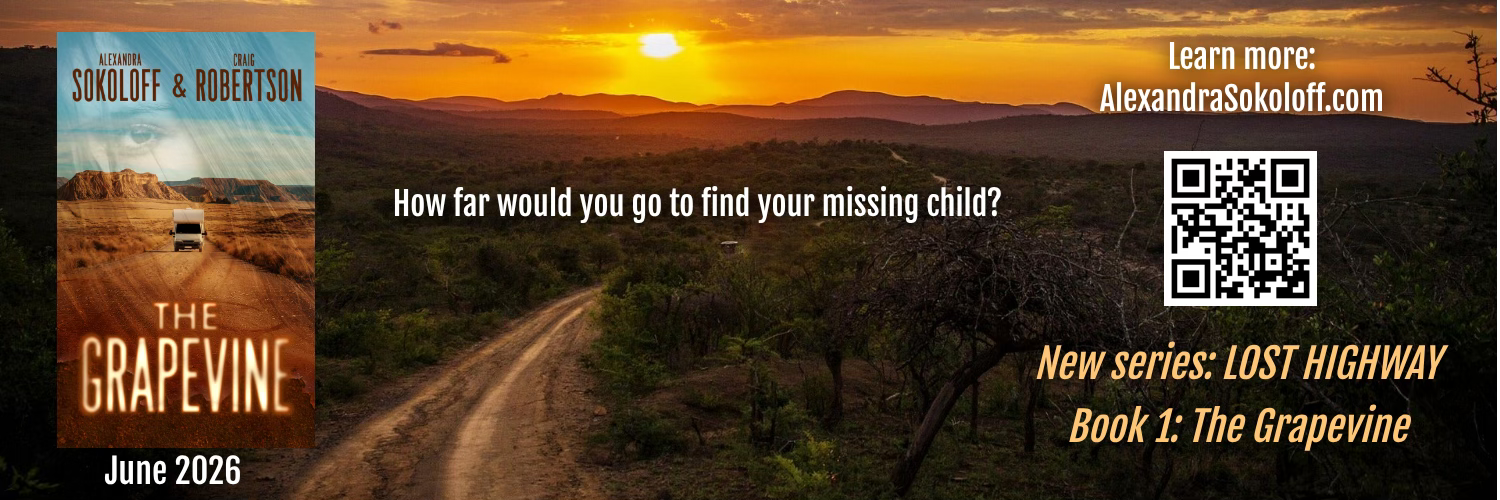
This image has been the basis for a lot of our advertising material for The Grapevine. (Lost Highway Book 1):

The back road and the eerie beauty (very Californian) is relevant to the Huntress Moon series, too - but the color scheme is completely different. The Huntress series is all moon and night and darkness and shadow. The Grapevine is more about the desert sun. But both are very much on brand for me, inviting readers to move between the series.
Here is where a Pinterest board for each of your books can be incredibly useful. But because I’m all about kinesthetic creativity, I also recommend keeping a COLLAGE BOOK.
Branding is a huge conversation and I have a lot more to say, but I’’m going to stop here, and invite you to identify your own categories and start brainstorming your own lists.
If I get enough interest I will go further in another post and we can look at those comp lists together!
—Alex
Also this week on my other newsletter - it’s book festival season! I’m writing about some of them:
Screenwriting Tricks for Authors is a reader-supported publication. Please consider contributing to this work by becoming a free or paid subscriber!
Likes, Comments and Shares are really helpful and much appreciated.
Share Screenwriting Tricks for Authors

Get the workbooks:
Stealing Hollywood ebook, $3.99, also available as print workbook
Writing Love ebook, $2.99
Need more help? The Screenwriting Tricks for Authors workshop is available online, as a self-paced course with all the videos, assignments, movie breakdowns and personalized feedback you need to get that book written next year. In three parts, and you only pay for what you use.
One-on-one coaching also available in The Writers’ Room.
Subscribe to the Screenwriting Tricks for Authors YouTube channel for fifteen minute doses of craft to elevate your writing right now!
All material © Alexandra Sokoloff, Screenwriting Tricks for Authors
Comments
Nothing yet. Say the first thing.
Sign in to join the conversation.