
*KG Note
I’m in Paris this week and will be stopping by Raise, then headed to the Amsterdam for the weekend. If you’re in either city or will be going to the conference and would like to try and grab a coffee/meal or go for a walk, please reach out (email; twitter).
Intro
More on this newsletter here.
Two months ago, I wrote a memo titled The Structural Case for Open-Source AI that argued open-source AI is overdetermined.
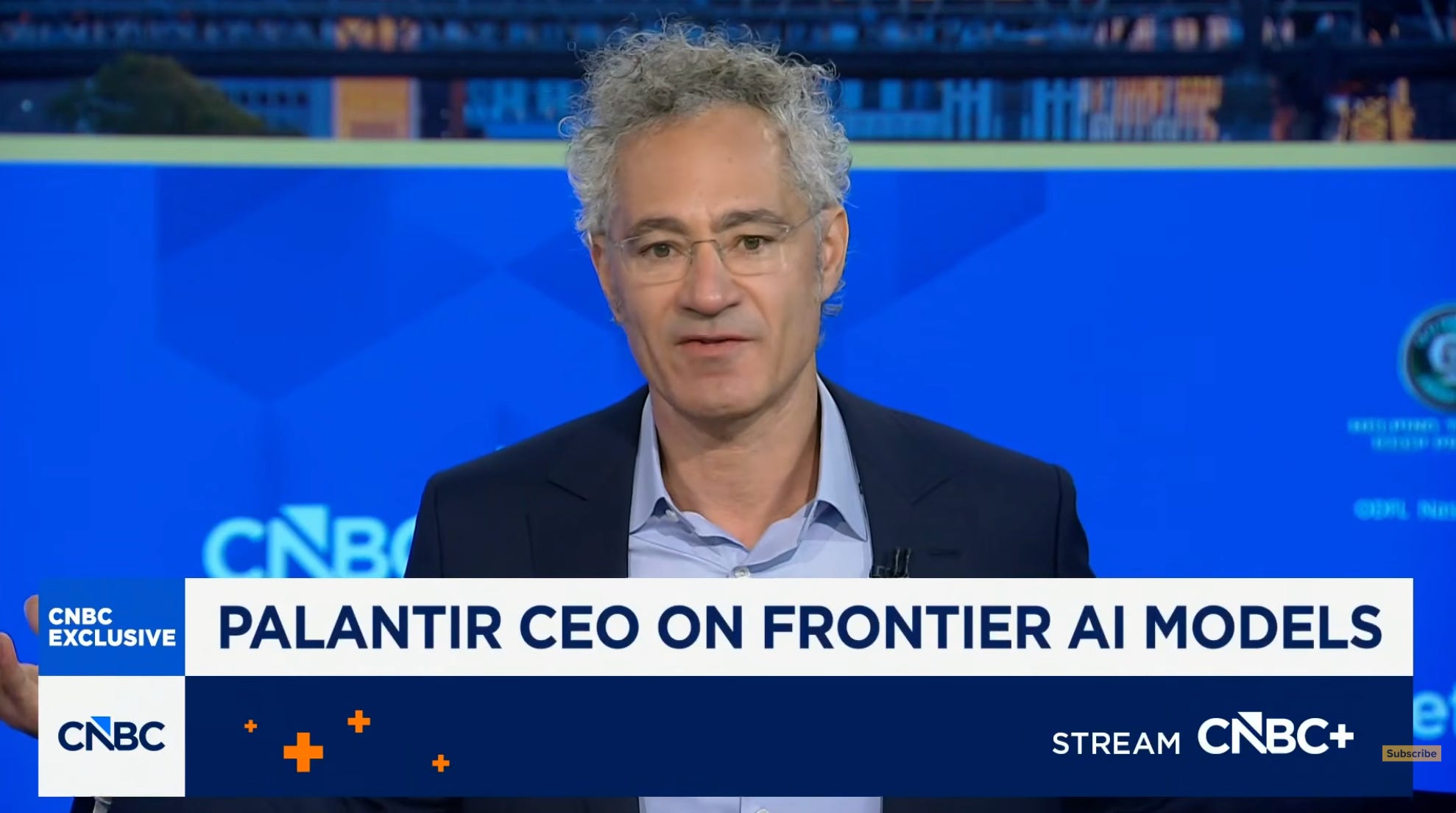
Last week, Alex Karp went on Squawk Box to discuss Palantir’s new partnership with Nvidia, going into why enterprises are upset with the frontier labs and emphasizing the criticality of open-source AI. He touches on a lot of the arguments in my memo, and so I thought worth sharing.
Short Bios
Alex Karp is the Cofounder and CEO of Palantir.
Summary, Full Bios, and Related Resources below paywall
Transcript
Andrew Ross Sorkin: Tell us about the Nvidia deal first.
Alex Karp: Because I have so much respect for Nvidia and Jensen Huang, I’m going to try to keep this more adult than I usually do. But the truth is, if you want to know how this came together from my perspective—there are a lot of technical issues: who controls the models, who controls the weights, who controls the value of your business? We’re sitting on critical infrastructure across America, Ukraine, and Israel. Everyone who uses LLMs on the battlefield runs on top of our ontology.
Our clients are just—to say they’re unhappy with the frontier labs is to say I’m welcome at the Berkeley faculty. There’s just a level of discomfort and loss of trust that really made it—
Andrew Ross Sorkin: Unpack that. What do you mean by that?
Alex Karp: When you’re using large language models—at this point, everyone technical realizes they’re a critical resource. To make them valuable in an enterprise, battlefield, regulated, or manufacturing context, you have to have what’s called an application layer. We have a thing called ontology that now everyone’s copying, but de facto, it takes a large language model and makes it safe, useful, and precise.
It’s safe because it doesn’t touch your own learning data. Safe because it prevents the large language model from caching your data and replicating your business. Safe because it doesn’t transfer your IP of how to fight—secret data, top-secret data, or in a clinical context. The general way these things were sold—and I’m not throwing shade at Sam and Dario, there’s nothing more fun than debating Dario in private—but something has gone completely wrong. The basic view among enterprises in this country is, “I’m going to chillax and waste my time with tokens, I’m going to get no value, and they’re going to get my IP.”
Andrew Ross Sorkin: Well, that sounds like shade, though.
Alex Karp: Okay.
Andrew Ross Sorkin: Not just shade, it sounds if you’re saying these—
Alex Karp: No, no, sorry. This is reporting. This is reporting that I’ve, against my own interest, literally called out. I’m profiting from this, right? The reality is you may not like us at my former school, Haverford, or at Berkeley, but enterprises in this country trust and love us, especially ones that are involved in critical infrastructure, both public and private.
We’re coming up to July 4th. I want for us and our friends across the globe to have the very best tech resources. The whole secret of Palantir is the forward-deployed model, the products that have been five years ahead. You’ve been with me for a long time. Everyone said FDEs were services. They said, “We don’t even know what an ontology is.” That’s the only thing people talk about now. The secret was we delivered the best things for the war fighters. Those war fighters have serious trust issues. It’s not just the war—vis-à-vis Frontier Labs.
Then you have my enterprises in the private sector who have the same issues. They ask, “Why would they get access to my data if they’re going to build my alpha? Why wouldn’t I control the weights?” That’s where you get this partnership. What aligns me with Nvidia, and I think is what custom technical customers want, which is control over their compute, their models, their data stack, and their alpha. They want to know they own the means of production; it’s not being transferred to someone else.
They’re not interested in some fake DeployCo that somehow is deploying tokens that transfers the alpha to a third party and the jig is up. We have to figure out a way where—our products are agnostic. We now sell a product to customers that allows you to switch from model to model, and we’re completely agnostic. We need to rebuild trust, and that trust will happen when everyone gets to ask and answer basic questions: Who owns the data? Where is it cached? Are the prompts secure? Is this being transferred to you? Are you being comp—okay, if it was so valuable, let’s say I can make you a billion dollars tomorrow. Wouldn’t I say, “I’ll make you a billion dollars and I want 30%?” Why are they charging for tokens if it’s so valuable?
Seema Mody: So then, Alex, if the key, from what I’m hearing you say, is a secure American-born open-source model, how quickly can your model compete with the frontier AI in terms of reasoning and agentic tasks.
Alex Karp: Well no, what I’m claiming, obviously slightly true but slightly self-centered, is it’s the model plus an application layer plus compute. It is really all three. In our jargon, the value—just look at our financials. The reason why everyone is chillaxing with bad financials and growth, while losing money, is that the client refuses to pay the true cost. The two places that actually make money—profit, free cash flow—are our application layer called ontology, and compute.
What I am not just claiming: we can take an open model and in the classified or non-classified context, get it to the point of a frontier model. But, a) you control the weights—so what is the true cost? Not just what you’re paying, but what you make minus what you lose, meaning the value of your business. We can get the frontier application to be exactly the same as a frontier model without the risk of transferring the alpha of your business to another. By the way, you could do this with a frontier closed model too.
But then the clients have to be able to ask and answer very basic questions: Are you keeping the data? Are you going to enter our business? In the classified context, when the Department of War goes to you and says, “I need this application,” do they get to control the weights to do it, or do you get to control the weights? Are we really going to outsource the battlefield of this country to the consensus view in Silicon Valley? That is effing insane!
And by the way, every single enterprise in this country, in private, a lot of them don’t want to speak in public because it gets outsourced to the neurodivergent crazy person that apparently is on drugs—the one thing I don’t do. So that’s my role. But I’m telling you, in this country, at every single enterprise I deal with, these people are livid. They’re like, “I am paying for tokens that create no value. These people are stealing the weights and alpha of my business. And they’re creating a wealth tax that does not help the poor.” It just punishes—it starts with the billionaires; every single person at this table is going to be paying a wealth tax—only to punish us.
The reason for it is because these models have been completely, irresponsibly oversold. The sell is: it’s dangerous for everyone, which is why I can give it to all your adversaries, but I can’t give it to the Department of War, or I can’t safely give it to an enterprise in this country without being certain that the alpha of that business could transfer to this model tomorrow, ie; I have no business, no job.
Becky Quick: You sound pretty angry. Is this Palantir or—
Alex Karp: No, this is the voice of American business that has being channeled through me. And I’m telling you, it is absolutely a problem for this country. Because we are on the cutting edge of every single AI technology. But if you’re going to triply oversell something, and—by the way, the enterprises are just tired of it.
Andrew Ross Sorkin: But my question—
Alex Karp: By the way—just a minute. I want everybody watching this to test what I’m saying, especially investors who think somehow this is working. Pick up the phone and call a CEO in private—not in public. Every single person here can do this. Call two or three and say, “Madman Karp is on TV saying we’re livid. I’m not going to quote you. You know I won’t quote you. We have a history.” And you’ll see, they’re twice as livid as me.
Andrew Ross Sorkin: So, if you’re right though, does that mean that we are living in some kind of terrible AI bubble and in a quarter or two or three quarters from now, we’re going to hear that big enterprises are canceling their subscriptions to these products, or that the buildout is going to slow because the math doesn’t add?
Alex Karp: No. This is the tragedy of it. The reality of compute plus ontology plus model is changing the course of history. Ask the Ukrainians. Ask the Israelis. Ask our Department of War. Ask the enterprises that are working. We do not have to oversell what we have. It’s all being built in this country. Essentially, except for the open models, which are a real thing coming from China, and Nvidia open models, which are world-class, it’s all being built here. We do not have to overhype it to the point where we’re going to have a wealth tax punishing—
Andrew Ross Sorkin: But if they’re charging the enterprise three times as much as they should be, and they have to pull back on that, that changes the math of all of this.
Alex Karp: Who’s the “they”?
Interviewer: The large language models, which, by the way, impacts your partner Nvidia.
Alex Karp: Okay, sorry. I’m talking about the “they” as the enterprises that power this country, as the most important thing. You’re talking about the “they” as Frontier Labs in Silicon Valley. That’s great. I’m focused on the enterprises of this country.
Becky Quick: Where do the hyperscalers fall on this?
Alex Karp: It depends what they’re selling. That’s very downstream from us. We’re completely agnostic. We prefer a world where there are more hyperscalers, where there are all sorts of new hyperscalers: Elon, Nvidia. We like that world. Why do we like that world? For the same reason when you go online and there are 50 kinds of coats, you get to pick the one you like.
But what is happening among the most technical players is they’re saying, “I want something I own. This is my business. I want to own the GPUs. I want to own my data. I want to own the model. I want to control the alpha.”
Seema Mody: So, is that creating more opportunity for Palantir? Are you already seeing the government cancel contracts with Anthropic and OpenAI and saying, “We want to work with Palantir?”
Alex Karp: I’m literally not here to talk about what’s going to happen to very important businesses of the country, except for, obviously, to some extent, mine. In my business, we have much more demand than we can supply. And by the way, I may be the crazy person who still only cares about free cash flow. We have more business than we can supply. If you just look at our financials, two years out, you can see $15, $18 billion in free cash flow.
Becky Quick: So are you frustrated by the stock’s performance over the last—over this year?
Alex Karp: You know what? I’ve been at this for 20 years. We’ve been at this—talking about this. When we first started talking, people were like, “Is this a services company? Is it worthless?” The markets are short-term, very fickle, and also, quite frankly, where I would throw some shade: what investors actually understand tech? They think because they’re very high IQ and they understand certain things—they understand what they’re using.
The fault of investors is typically: “I use it, therefore it’s valuable.” Yeah, when an enterprise uses it doing complicated manufacturing or pharmacological research, or putting a bomb on it, or bringing special forces people home safely, that’s very different from what you’re using—
Andrew Ross Sorkin: Do you think, if you’re a pharmaceutical company or you’re the government, should you not therefore be using Anthropic or OpenAI without your layer on top? Would you say that’s dangerous for them?
Alex Karp: First of all, honestly, the one thing that I am slightly frustrated about is that when OpenAI or Anthropic especially are talking about critical infrastructure, it only is being used in our product—my product. And there’s a reason for that. These things are very valuable. What they have done in building models is world historic.
And just so you see I’m not throwing shade, Dario is a literally historic figure. He came from behind, and he’s now number one. Almost no one in the world—I’ve been in business (whatever you want to call what I do) for a long time—I’ve never seen anything like this. The reality is, critical infrastructure does not run these models without an application layer. In almost all cases, and maybe it won’t be all cases someday, that application layer is our ontology. That’s a fact.
And there’s a reason for it. As you know, some people love me, some people hate me. They’re not buying it because of that; they’re buying because these things have to be made safe. And the “I’m going to trust you, you should trust me because I’ve never lied,” BS thing, just doesn’t cut it at this level. American enterprises are run by the shrewdest, most wily, intelligent people on the planet. If you think they’re going for that, you can go try to sell me—my parents still want me to get a job as a faculty member at Berkeley. Go try to get me a job at Berkeley. I’m very qualified—it’s not happening.
Seema Mody: Do you agree with the notion of the most robust, powerful AI models should be withheld from the public due to cybersecurity risks? From Anthropic and OpenAI?
Alex Karp: Look, you really have to—one of the things we’re trying to get the West to do is move away from like not like—these are very technical; what does the model do? Who is restricted? I would say, it is a loser to restrict something from the government because you don’t agree with how the government fights war, and then open it up to the world, including our adversaries. Go sell that to the American people, where they already don’t like you.
Seema Mody: You have a lot of data that you look at. Do you think China is getting better at AI? Is the gap narrowing?
Alex Karp: There are two relevant tech centers—two and a half: America, China, Israel. Those are the tech centers of the world. I spent half my life in Europe; I want Europe to be relevant. The reality is—and Sweden has a real tech scene. But the relevant tech centers—we have a peer-to-peer adversary in China. China has a lot of advantages, including, quite frankly, we have to find ways to make these models raise the standard of living for every American. Americans need to have a sense it’s not just the people at this table, the people watching this getting rich, and there are real issues there.
Then we have the far left and far right gone completely nuts. You would think that the greatest problem in the world, if you were on the far left, is somehow if things work, it’s evil and bad. By the way, I’ve been wholesale kicked out of my own party because I warned that this was going to happen on the left—and it is happening. Then you have, on the far right—it’s like on both sides, you think the biggest problem of our society is warlocks roaming the street building technology. Of course they can’t understand it.
They attack Palantir for the craziest things. China doesn’t have that problem. But it also doesn’t have the creativity, ingenuity, and deep tech creativity we have. But the reality is, it’s not a foregone conclusion that we win. The biggest problem in this country on these debates is we debate these things as if we don’t have adversaries. It’s not actually true. It’s binary: they will win, or we will win.
Andrew Ross Sorkin: I just want to pivot to a slightly different conversation but related. You have been a proponent and great supporter of Israel over the years. Great supporter. And right now, we have a ceasefire in the Middle East, which we hope holds. Having said that, there is a bit of space between where the US is now and where Netanyahu is on what is happening here and whether they will ultimately be protected. I’m curious, given that, and given also your relationship with the US government and the work you do there, how you think about that disconnect.
Alex Karp: Well look, this is so many things. I am the most publicly supportive CEO of Israel. And that’s true. I think Israel is on the side of good. In private, because I’m known there, to be fair, I’m probably also the most effective critic, saying, “Hey, I didn’t agree with this.” I’d be very happy to be more public about that, except I think not all—there are legitimate criticisms of Israel and every other country. Although, I would say, do you want a country that can sometimes be difficult as your partner, or do you want partners that have no tech scene as a partner?
In this world, having a fully adult, independent, aligned country that doesn’t always agree with us is much better than what we somehow have in Europe. We do not want that. Look, America and Israel will never be fully aligned—and that’s totally okay. My position is they are a very important partner, and we are proud to support them. And in private, you can bet your last dollar I call and complain about a lot of things.
Andrew Ross Sorkin: So what do you think of this MOU or whatever deal you think is on offer? And do you think that we are now in a better place than we were before in Iran, and vis-à-vis also what you think it means for Israel?
Alex Karp: I’m going to leave the Israeli thing for my talking to them in private, because I just don’t think—at this point, it’s very hard in public to talk about them because you just have people—look, there are legitimate criticisms of Israel. Half the people criticizing Israel just don’t believe it should exist, and that’s a fact. So I’m not going to play into their hands by saying things I say in private.
And America—America has to represent its own interests. Do I think Iran’s been degraded? Yes. Are there things that I don’t think are in the public space that would be comforting to people if they are? Yes. And I’ll leave it at that.
Andrew Ross Sorkin: Wow. Pretty great.
Seema Mody: Thank you.
Alex Karp: Thank you.
Andrew Ross Sorkin: Thank you. You don’t have to get up from the seat yet.
Alex Karp: You know, I just feel like I’m going to be kicked out of the room.
Seema Mody: No. Never. Wide-ranging conversation. We really appreciate your time.
Joe Kernen: No, not like your party. We want you to stay. Can you come back tomorrow?
Alex Karp: Yeah, I’ll come back. I really do appreciate you guys. You know, the thing I actually like about you guys the most, and I watch you, is that you actually, and it’s very hard to pull this off, you actually have have divergent opinions. And somehow you guys stay together.
Andrew Ross Sorkin: This is true.
Becky Quick: We’re still on camera.
Alex Karp: Oh yeah, well, great. That’s true. It’s honestly so boring—the other stuff. And again, I get kicked out of these rooms—even if I agreed with you, I would try to disagree with you. It’s more fun.
Andrew Ross Sorkin: Seema, thank you for bringing Alex here this morning. Thank you for your perspective on this. Alex, thank you. We appreciate it very much. Thanks.
Joe Kernen: People live in echo chambers. It’s bad.
Alex Karp: And they’re so offended by divergent opinions—it’s so crazy. And I’ll tell you—we’re off camera now?
Andrew Ross Sorkin: No, we’re still going.
[Unidentified Voice]: Let’s get off camera.
If you enjoyed this conversation, make sure to read The Structural Case for Open-Source AI.
Summary, Full Bios, and Related Resources below paywall.
Comments
Nothing yet. Say the first thing.
Sign in to join the conversation.