
*KG Note
I’m in London this week and will be in Paris (for Raise) next week. If you’re in either city and would like to try and grab a coffee/meal or go for a walk, please reach out (email; twitter).
Intro
More on this newsletter here.
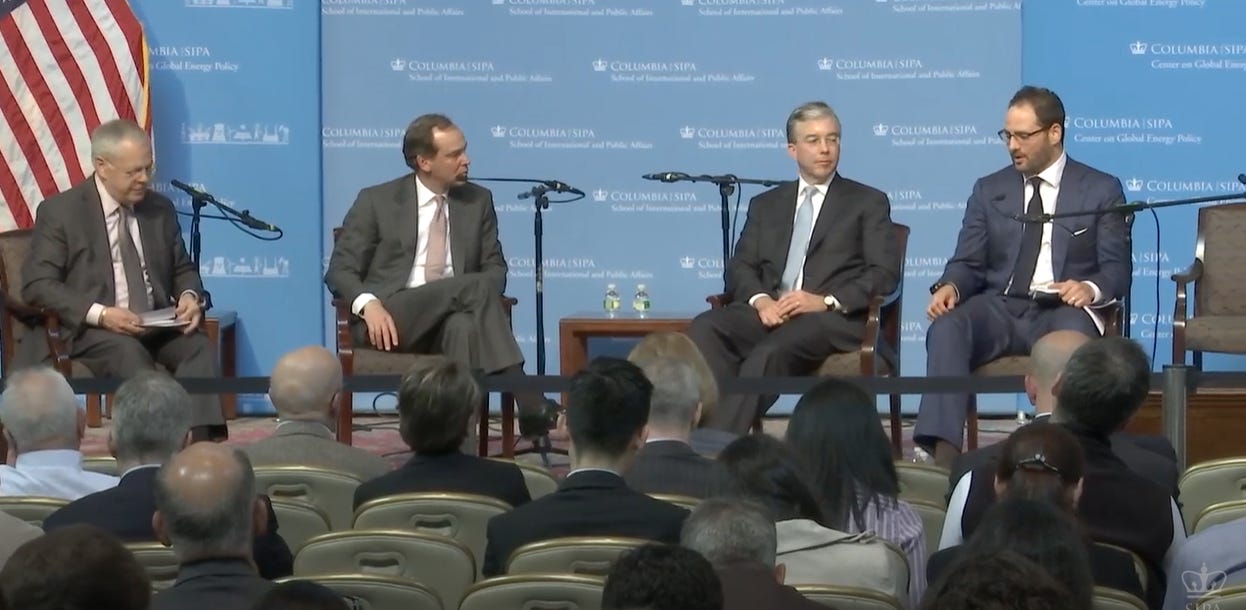
Today’s letter is the transcript of a 2015 panel with Peter, David, and Zach on Financing our Energy Future moderated by Ed Morse (Managing Director, Global Head of Commodities Research, Citi).
Short Bios
Peter Kagan is a Managing Director at Warburg Pincus, where he leads the firm’s energy team.
David Foley is a Sr. Managing Director & Global Head of Blackstone Energy Transition Partners.
Zach Schreiber is the Chairman and CEO of Point State Capital. Previously, he was a Managing Director with Stan Druckenmiller’s Duquesne Capital Management.
Summary, Full Bios, and Related Resources below paywall
A Letter a Day is a reader-supported publication. To receive new posts and support my work, consider becoming a free or paid subscriber.
Transcript
Ed Morse: Welcome to everyone. The title of this session is on Financing Our Energy Future. We're going to be talking about the money part of this business, just to set the stage a little bit, on the business, the amount of oil bought and sold, either internationally or within countries, or was in 2013, a $3tn business, rounded about $1tn of that was OPEC, and $2tn of it was the rest of the world. We're living in a substantially lower price environment, so this chunk of the world economy, at least in terms of the value of trading operations, is somewhat lower than it was in 2013. There are winners and losers, big time. And when you put the numbers out like that, in terms of flows, investment flows are also robust. In the beginning of 2014, our expectations were that there was going to be about $725bn invested globally in the upstream sector. Turned out to be a little lower than that: $525bn of that was not in the United States. About $200bn of it was for the US and Canada. That also turned out to be lower, and this year, a lot lower, a lot lower than that. So we're talking about large numbers, we're talking about financing new projects. And the future price really is going to be significantly determined by the flows of capital into the upstream sector, and who is going to be responsible for that financing, so that, more or less, is going to be the topic of our conversation for the next 40 minutes or so. And I'd like to start out with one question, and I'd like to ask each of our panelists, starting with Peter Kagan, and then going to David Foley, and finally to Zach Schreiber: We have been living in a kind of cheap money environment, a fast money environment--how much of your life and the investments that you are doing or seeing are significantly dependent upon cheap money? And how might your life change? And how might this sector change if we were to see the Fed raising rates sometime in the foreseeable future? So why don't I start with Peter, actually, since you're on my immediate left, and go through the other two.
Peter Kagan: Well, thanks, Ed. It's a good question. And let me start really just by thanking Jason and the Center for having us here. It's such a beautiful spring day, and to be on a campus like this, in a venue like this, is spectacular. And to talk about topics that are interesting and fun. So thank you for the opportunity. Low interest rates. Yeah, we're probably in a low interest rate environment. Potentially. I'm not an interest rate forecaster, but for a period of time. And clearly, the availability of capital is an input. But one of the things that's important to remember about the energy business is it's been a big consumer of capital for a really long time. It's not like all of a sudden we've started to deploy a lot of capital in the energy business. And if you look at it, and I think there's some data that goes back 50, 60 years, and look at returns on capital in this business, returns in the business, in particular when I say this I'm focused on exploration and production, returns on invested capital have actually been relatively consistent. That's despite lots and lots of volatility in the underlying commodity prices, and lots and lots of different interest rates environment. And so this is a business that needs to exist. It's a business that will continue to generate capital. And the terms upon which that capital gets priced and where it goes may vary at the margin in the interest rate environment, but I don't think you're going to see a fundamental shift in the amount of capital deployed based on sort of where interest rates are. I think it's a margin business. So obviously prices and costs are going to be big drivers of kind of capital deployment. And the thing about the business, and then I'll wrap up, is it's an amazingly technology-sensitive business. And I think nowhere more than North America have we seen the revolution and what that technology can do and unlock. But I think changes in technology and changes in sort of the macro environment and global growth trends are things that we watch. And I think interest rates matter, but I think you're going to continue to see capital flow to energy, kind of regardless, across the cycle.
David Foley: Ed, I'd say it's the impact is really disproportionate across the value chain. And so low interest rates, I think, have impacted and enabled midstream and infrastructure projects much more so than changed fundamentally the amount of activity going on on the upstream side. When you're building a fixed asset that's going to be in use for 20-40 years, and you've got long term contracts on it, whether it's a pipeline or storage terminal or an export facility, having a bit lower cost of debt really does make a huge difference, and it lowers the overall cost to parties who are contracting for that asset. So I think having had low interest rates now for a number of years has really enabled some of the infrastructure growth that has indirectly supported and enabled increased US production, and probably production around the world. But for the upstream side of it, it's a lot more volatile, and I think therefore it has historically been, and will continue to be, at least the bulk of it, equity financed. And you don't really know what your return is on equity until you sell it. And as Peter said, the returns in the sector have been uniform for a while. I think by uniform that they might be like uniform at not a great level, actually, because as oil prices quintupled, returns actually stayed flat to went slightly down. It'll be very interesting now to see what the industry does as the prices of the commodity are declined to see if they can improve productivity and cut costs quickly enough to maintain returns.
Ed Morse: Although, it's fair to say, the amount of capital that has gone into the business has changed significantly over time, and certainly in the last decade and a half, we're looking at, at least in nominal terms, the world as a whole, was less than the number going into the US at the moment.
David Foley: Well, we're not producing the lowest cost barrels first. So you may be with OPEC deciding they want some additional market share. Maybe that dynamic will change a little bit.
Ed Morse: Maybe we can come back to that in a bit. So, Zach Schreiber, what's your view on cost of capital in the businesses?
Zach Schreiber: I think cost of capital is something that sort of works its way into the price. Cost of capital is relatively uniform, and it's--so a low interest, so it sort of gets diluted. If you look at the US publicly traded EMP sector, about $260bn of debt, you move interest rates 25bps, when you look at that over the 4.4mn barrels, it's worth 40c per barrel. So interest rates, if it's 50bps, it's 80c/barrel. I think the price of the commodity is obviously a much more important driver than actually 50bps in interest rates. And the hemming and hawing that's going on in financial markets about whether the Fed is going to lift off in June, or whether they're going to lift off in September, or whether it's going to be September or January, when they really told you that whatever they do is going to be very, very moderate, and they're trying to sort of wean us from this liftoff date to sort of the shape of the liftoff curve, and they told us they'd rather be late than early, and they'd rather do it slowly, I think we're still in a very, very low interest rate environment for a long period of time. And when you look at the rest of the world, which has really followed our lead, with the ECB now engaged in quantitative easing, and the Bank of Japan engaged in quantitative easing, and when you look at what China is doing, they say it's not QE but you know, me think the lady doth protest too much--it looks a hell of a lot like QE to me. What that does is that keeps global interest rates low, and that sort of still will anchor, I think, the long end of the US yield curve, because there's only a certain amount of yield spread that the US is going to be allowed to have relative to bonds or other other types of sort of risk free G7 rates. So I think they're going to raise rates, I think we'll worry about it a little bit, but in terms of financing the energy industry, especially the upstream, it's not that big a deal, as long as it's relatively moderate. But I do agree with David's comments on differentiating the midstream versus the upstream and the multiples that will--that schmucks like us in the public markets will pay for midstream assets, and sort of, I call them, sort of bonds in drag, sort of repackaged equity streams that we make and look like bonds, so we can value them at a lower and lower cap rate. I think that those will be more sensitive to interest rates.
Ed Morse: So we're talking a little bit about the macro world, and as we were coming in, we kind of said that maybe it would be good to get out front early on in this conversation, what our price expectations are in oil and gas world. I don't remember a time when people I talked to have been as dramatically at different ends of the spectrum as they are now. I was watching from afar a week ago the IHS SiRA conference in Houston, there was a lot of bullish talk coming out of that conference, particularly by large oil companies. The $90 environment is the natural--$90-100 is the natural environment obviously in the Middle East at the time, where I was impressed by a couple of countries that were raising their production capacity in the face of everything, and they were about as bearish about the future as you can be. So just looking at the next two years, not about the indefinite future, starting with you David, and we'll do it the other way: How do you look at the back row price environment through this year and into next year?
David Foley: Sure, I think, in terms of how we look at it, we're probably, for the next 12 months now, a bit more cautious than price implied in the current forward curve, and by some of the sentiment that you referenced. Longer term, I'd say we're more bullish than the forward curve. Part of the reason for that is, as we sit up here, and I'm just kind of stunned at how quickly the sector went from absolute fear at the end of December to greed in like less than a couple of months--usually it takes a bit longer, sometimes several years, and it really turned quite quickly. And people are taking the money that the capital markets is--capital markets are largely the financing source now, not so much as we'd like it to be, not so much private equity at the moment, but public equity and public debt funding the liquidity shortfalls. And you have that plus a steeply sloped, positively sloped forward curve producer taking that money, hedging out future production, and they're doing what produced always do, which is they spend it, and they spend it on drilling. And so I don't think you'll get the kind of--recount has come down the US, but I think it'll start heading back up, and I don't think you'll get the kind of production cuts that people were expecting earlier. And if everyone at the industry conference is saying, Well, our costs are lower, and we're going to lower our cost per well, and we're going to make money at $50 oil, and we're going to keep increasing production, if they're all saying that, they may at least give it a shot if they have the money. And I think they'll find out later whether those wells are profitable. But I think the collective impact will be probably a little bit more oil production. And the big wild card, because I think we, we're sitting in the US, we're sitting here in New York, tend to have a too much of a focus, frankly, on US production. We think about US shale production is only 6-7% the global amount. It's not the marginal barrel. It just happens to be the one that you can turn on and off the quickest with capital markets that are driven by economic returns. It's not a state oil company. And so it's most rapid response, but it's kind of dwarfed, if you look at the top few countries in OPEC: Iraq, the ones that are maybe a little bit more precarious: Iraq, Libya, Venezuela, Nigeria, and then you add Russia on top of that, that's 20% of global production. I think if you could call any one of those right, you'd probably have a better shot at predicting oil prices than if you could predict US shale, where everyone knows to the day what the rig count is. So I think we're kind of looking in the $60s for the next couple of years, and then meaningfully higher later out, because it is--well, shale can go on and off pretty quick, the large projects, complex offshore projects in harsh environments, have a multi year lead time, and that's the part of the supply curve that just won't be there a few years from now when we need it. And I think that's what could drive, along with political unrest, which is always a huge wild card, people drive prices higher over the longer term.
Ed Morse: Thanks to David Foley. Now to Zach Schreiber. And if you wonder why I'm using their full name again, it's because you're not the only audience. You've got visibility, but we have people listening in. So what I'm doing, oddly enough, is for clarification for those listening in. So Zach.
Zach Schreiber: And specifically for those folks listening in, and out of deference to my lawyer's request, I'm not going to give you a specific price point, because I'm subject to different legal requirements since we actively trade the commodity than these folks are. But what I will say is the prices are going higher, and the reason why they're going higher is simple as there's a sort of golden law of commodities, which is that high prices cure high prices, and low prices cure low prices. We had prices very high a year ago, $100, $110 a barrel, that incentivized 1.6mn barrels a day of supply growth out of North America, right at the time when the market thought that the 3.5mn barrels a day of outages in the Middle East was going to last forever and probably get worse. Since then, we had prices go down to $42, double bottom there for WTI, Brent never sort of validated the double bottom, and sort of bottomed and kept going. And what have we seen since that period? Well, we've seen the capex in the US, which I know is only 8% of global supply, we've seen it go down 45%. We've seen global capex go down 30%+. I think I agree with David: Rigs are going to come back, but rigs are going to be need to be incentivized to come back. And right now the market is still in a supply reduction mode. Every morning it wakes up, it's killing supply, killing supply, killing supply. We dropped 30 rigs in total last week. We've taken the rig count down from 1,600 to, I think, 703, for oil directed rigs. So what I know is, is that the prices aren't going to start going down again until we've brought back rigs. We probably need to bring back 200, 250 rigs in the US. Now, if you look at sort of global supply, there's about 94mn barrels. There's the 9.5, 10 that we obsess about in the US. There's roughly 10 in Russia, and there's 30, 31 in OPEC. That's 50. Okay. Then there's what I call the Rodney Dangerfield barrels. There's 44mn barrels that get no respect, that no one talks about. Those barrels are declining approximately 3.2mn barrels per day, absent sufficient replenishment capex. They're being replenished basically until 2017, 2018, and after that, we're going to see massive decline rates in those barrels, at this environment. Those barrels come from projects that you would never sanction today. It's like looking at a marriage and saying, I would never marry that person. No one would sanction these barrels right now, and the capex has been cut. So effectively, now, the way we look at it, we think that, and I'll wrap it up real quick, that basically, we've moved from a call on OPEC world, in which OPEC was a swing producer, to a call on the US world, and that, given the capex reduction in the US, will be going from 9.5mn barrels/day to 8.9mn barrels/day by the end of the year, and there will be a certain momentum and inertia that will cause us to continue to decline until June. And that basically, we're going to need to restart the North American shale production that the world went from--and it's funny how different truths become assumed. The truth assumed $110/barrel was that the North American production is required to be 1.6mn barrels/day to balance the world. And the truth that was assumed to be written on high from God at $42/barrel was we don't need any production out of the US. Well, actually, like most truths, it lies somewhere in the middle. We probably need about 800,000 barrels/day of supply growth out of the US to sort of meet the call on the US, even with 500,000 barrels of Iranian crude coming back, if they get a deal, which isn't a guarantee. And even with a slight increase in Libya and so forth. So we think that you'll sort of--it's like what Judge Brandeis said, It's like pornography. You'll know it when you see it. But the price needs to go higher, we need to incentivize rigs, we need to see where the well cost deflation is, and what part of the curve gets incentivized. Basically, EOG is one of the most efficient producers in the US, they said they need 65 with 20% well cost deflation, and we think there's sort of a short to medium term period where the US is Atlas, where it's 4.5mn barrels/day of shale, with the entire world on its shoulders, and it needs to grow another 1-2mn barrels/day, more than it's currently growing, that will require a higher incentive price. And then we're going to come up to this medium term story that David mentioned, which is that 44mn barrels/day that aren't being replenished right now. The question really, for the market is, is, will it be a smooth hand off from incentivizing North America to the medium term story, or will we over incentivize America again and be choking on it before we have this medium term story? And with that, I'm gonna stop talking.
Ed Morse: I'll just comment before we turn it to Peter that I don't remember very many smooth hand offs.
Zach Schreiber: Yeah, I would agree with that. That's why I'm in business.
Peter Kagan: So, really good comments. And the disadvantage of speaking third is a lot of things get said. I'll try and add kind of two insights that build a little bit on what we've said. First, before I get there, remember, we're private equity investors, so our job for living style K capital, sort of with a three to eight year time frame. And so I'm not really good, like one year forecast. It's not what we do. I am allowed to, you know, kind of give a longer, longer term forecast, because by the time it happens, nobody will remember. But as we see, the world is very similar to my colleagues on the podium. We see a world that's slightly oversupplied today, to the tune of, you know, call it two to 3 million barrels, maybe a couple million barrels a day over supplied, and totally agree that we spend a lot of time talking about, you know, the swing, not the marginal barrel, which is here in North America, given the efficiency of our capital markets, which we've really seen take hold in the first quarter of this year. I think that what we would say is similar to my colleagues, we would see this market coming back into balance relatively quickly, like, you know, kind of end of this year into 2016 and I think where I might have a slightly different perspective is sort of, what does a balanced market mean when the world comes back into balance? What does that mean? And I guess here you might call me, well, I don't really know how you would label it, but I have more confidence in this industry to kind of find and extract more at reasonable economics. And so I guess while I agree that there's a big series of barrels, the Rodney Dangerfield barrels out there that are in steep decline and don't make sense today, we also see lots of room for innovation around the globe. We see lots of resource that we think the economics do work at 65 to 70, you know, dollars a barrel. And clearly, we think there's a lot within North America in a lower price environment that can work in that type of price, price range. But we actually think there's a fair amount around the globe of new project development. So are we in a, you know, 20, $40 World program? No. And do we think we need 80 to 100 No, as we look out three to five years, you know, something in that 65 to 75 feels about right? I don't know if that's a lot higher or not, to us. That's enough incentive to bring new projects online, and sort of enough to kind of keep the US. I actually really agree with Zach's numbers on sort of what the call on shale is. In order to balance the market about 800,000 barrels a day. The only other observation I would make is that we've never been in the energy business, and as far as I can tell, or having looked backwards at a time where we can be as capital efficient and as market focused in our ability to bring barrels on and off production. And that. Really is the big difference in sort of the unconventional North American Revolution and unconventional, you know, well, may cost eight to $15 million you know, to drill and to complete, and that can be brought online within a series of months. You can contrast that to major projects that used to take billions of dollars and take years and years, and that efficiency of capital, which we've seen come out of the market really quickly, and then in the first quarter, we are estimates $10 billion of public equity raised in the US for unconventional drilling that quickly can come back into the market is sort of a new phenomenon. And what does that mean for pricing? And I guess I would just pause it to think about we may be in a world where we see more short term volatility, right, where you see, you know, these spikes between 55 and 75 as the markets respond more quickly than they used to, but maybe around a tighter band.
Ed Morse: So bearing all that in mind, in the lower environment, the beginning of the year, there were, whether you go to private equity shops like yours, or look at big oil companies or medium sized oil companies, people are geared up for big consolidation in this business. People are geared up to spending more in order to take advantage of things to come yet, the level of consolidation year to date, whether a little bit maybe more noticeable in the service sector than in bn sector, but it's been kind of modest, other than one big shell BG deal. So Zach, starting with you. Zach, right, but starting with you, and then going around the way we've been rotating. What is your expectation of industry consolidation going forward and through the rest of the year?
Zach Schreiber: I don't have a strong view on industry consolidation. I don't know if the BG--Royal Dutch Shell deal is the tip of the iceberg. You know, I do know that specifically, that what that deal really means is that Royal Dutch Shell believes in Brazil is real. It means they believe that LNG is a real business. And it means and they, and they underwrote it at $70, $75 per barrel crude, effectively. Now what it might very well mean is companies are looking at the cost of developing new reserves and saying it's actually cheaper to get growth by buying it in the ground than it actually is in redeploying it, and it's certainly a lot less risky. So there's an interplay between the price--this is very reflexive, and I'm not trying to dodge the question, but if the price recovers very fast, then the window for consolidation will have closed very quickly. If I'm wrong on the price, then the low prices and the leverage will sort of have a bunch of arranged shotgun weddings and consolidation since--stipulate that--I think I'm right on the price. I don't think--I think there's going to be less shotgun weddings and less forced consolidation, although certain companies may still find it strategically appealing and accretive to sort of buy growth, then to do it through the drill bit. But I'm not hugely informed on it, and if I was, my lawyers wouldn't let me talk about it.
Ed Morse: I'm amazed your lawyers are letting you talk about as you have.
Zach Schreiber: Me too.
Ed Morse: Our lawyers let me talk about things that I published. So I can't speculate.
Zach Schreiber: Oh, if they're bad, you should see my wife.
Ed Morse: And let me, as we turn to you, Peter, expand it a little bit to the private equity world as well, and new money coming in. Much has been accumulated, the limited amount has been spent. But where do you see the combination of consolidation and opportunities for new investments in the seven months left in the year?
Peter Kagan: So this is what I like to talk about. We can get a little different point of view. And in part, I like this question around consolidation because I've been just dead wrong on this for years. So if I keep saying the same thing, eventually, maybe it'll come. And I do think you're going to see more industry consolidation. It comes back to a point that I think David made after my opening remarks, which I think was spot on as well, which is, this is a business that's earned kind of relatively stable industry average returns for very, very long time, returns on capital invested. And yet, we had five years of $80-100 oil, and you didn't see industry returns improve at all. And if you sit there and you're looking at a balance sheet of a major, a large national oil company, the types of assets that work in a $70 world or a $65 or $75 world are different than in a $100 world. And if you're along the Rodney Dangerfield barrels, you probably don't want to be there for the next 30 years. You probably want to begin to start thinking about what are the types of assets that work pretty well. So I'm leading into we think you're going to see more consolidation. I think that I feel a little bit not so over my skis in this answer because if you look back at the last time we had a major price downturn, and every time we really had a major price downturn, you begin to see major strategic transactions that create--whether it was BP-Amoco or Exxon Mobil, in the late 90s, 2000s, the last time we saw a big price drop, you saw major strategic activity. We think there's incentive for that to continue to happen in the current environment. So I do think you'll see consolidation. I don't think the Shell-BG deal was sort of a one off, isolated event. I think you will see more of it. But I've been saying that for a while, and I've been wrong. In terms of private equity, I think, let me--I'll answer it sort of at the--start with the macro. And David, we could--David and I could talk a long time, kind of micro-specifically where we see things. But I get asked the question about, Is there too much energy private equity today? And I think that I would start by saying the estimates that we've seen of private equity raised for energy is something in the order of $40bn, I don't know, I mean, it could be $30bn, could be--in that order of magnitude. But remember, private equity invests that over a long period of time. And so in any given year, if you assume most of those private equity funds have a three to four year average investment period, you're talking about the industry, in aggregate, investing $10bn. And you heard about--Ed started the session by talking about the scale of the industry, of it being, call it was going to be $720 but maybe it was only $520, it will be less this year. But when you stop and think about private equity impact in a scale of an industry that big, we continue to think there's going to be lots of interesting rooms, lots of interesting places to find really exceptional management teams who have a slightly different point of view, and hopefully can do one or two standard deviations better than those industry average returns, by pursuing a thesis. So we think it will--has been a good area for private equity, we think will continue to be an interesting area for private equity.
David Foley: I'd agree with Peter on that. I think the volatility in the industry, not just commodity prices, but also changing regulatory environment, changing--there's a lot of national strategic interest in hydrocarbon assets these days, which sometimes is a source of friction and precludes deals from happening sometimes, it enables it. Technological change. There's a lot of--that volatility in an industry that constantly requires capital to drill and replace reserves if that decline rate. Every year you've got to go out and find 4-5% just to produce the same amount. That's an incredible burden on producers, and they always need capital as a result. So that gives Peter and I enough opportunities, if we're disciplined about it, to--we don't have to do every deal that crosses our way. But be selective. Swing at one or two pitches a year and do okay. In terms of your broader question: so what we're going to do isn't going to change your league tables too much in terms of M&A. In downturns, the first thing you see is kind of no M&A. And I think that the--while there's--the US in particular is a very fragmented industry, it's one that's characterized by entrepreneurship, independence--one of the things it's enabled the US to fully capitalize, in a very quick manner, on innovations, technological innovations, and drill out shale. Saudi Arabia's got one national producer that's producing about as much as hundreds of producers in the US, and they have the benefit of lower cost reserves. We've got, I think, much higher cost reserves, but can move pretty nimbly and quickly and get down a cost curve. So I think that while there's a potential to consolidate, the major areas of friction are, if prices do come back up, the people who really should consolidate either won't have to, because they'll be able to raise money in the capital markets that will meet their liquidity needs, or their share price will inflate, as the public markets always looking forward to next year and the next, and that the premium that they need to get a deal done just won't be achieved. So that's so that's the first source of friction, I think, is if the expectation that things get better, they're going to wait it out. Second thing is, a lot of people that maybe need to change ownership of their assets the most don't have assets people want. And so at the moment, some of those guys are getting funded by the high yield market, I think. And I guess if your alternatives are loan money to the Swiss, and they'll probably pay you back, because they're Swiss, but you're going to have to pay them to take your money, or you can loan it to Mexico for 100 years in Euros and get 4.X%, loaning money to a Single B Independent Oil Company at 9% starts to look pretty good. And you won't really know until later whether or not they're earning a return on all those wells they're drilling. So that's what we see funding a lot of the near term liquidity needs in companies that would otherwise really it would be a change control transaction.
Ed Morse: Here's a question that came from either the audience or from somebody in Twitter-land--I don't know, I wasn't told. Might have been inspired by you, Zach. And the question is: we've just had this WTI rally. We've seen cost deflation on the service sector side, we see continuing innovation and productivity improvement on the production side. Is this taken it high enough to put the US on track to, once again, oversupply the world in 2016? And I guess we'll start going through the first order again. And Zach, you can have the last word. So Peter Kagan, start please.
Peter Kagan: Well, I'll try to be brief, because I think it mirrors my comment on the macro a little bit, which is that the answer is, we think you will begin to see a reinvigoration of domestic unconventional production, and domestic production capital back into production in a $60, $65 world with declining prices. And that will--you're going to continue to see production decline, and that, over time, that will again allow supply to begin to build. I would say that we think you need some of that supply to keep the market balanced, as I said. But I do think you--goes to my point of you are setting up a scenario with efficient capital, efficient producers who allocate capital, where you may find these kind of mini cycles that go on every one to two years. So I guess the answer is I agree with that.
David Foley: I don't think the US is going to oversupply the world, because the only thing that enabled that over the last couple of years was OPEC. I mean, markets do balance all the time, at a price, and you had a cartel that wasn't increasing its volumes, allowing the US to increase and still maintain a pretty high price. That plus some pretty scary political risk going on around the world that I think put a risk premium into it. But I think US producers will respond to whatever the market price is. So if they're over producing and prices fall, they'll cut back, just like they have. I think over the next decade, it'll be a bit more the low cost producers who should be at the left side of the supply curve who are going to make it up on volume--or they're going to try anyway. Because they're national oil companies, they're political regimes--in order to maintain their current political regimes and kind of keep their heads, will, if they're getting a lot less profit per barrel, they've got to produce more barrels, or at least they're going to try. So some of them will be successful at doing that, some of them won't. But I think if we get an oversupplied market, it'll be, I think, more likely due to some of those countries overcoming political adversity to actually bring their barrels to market.
Ed Morse: Do you want to rest your case?
Zach Schreiber: I don't think the price is yet high enough for us to oversupply the market. We're still cutting rigs. Again, I said we cut 31 rigs last week. And so what the market is realizing, I believe, is we were over supplied in the fourth quarter of last year, maybe a 1mn barrels/day. We were oversupplied in the first quarter of this year. We actually, when we were very bearish in the market, we thought the oversupply was going to be much larger than it was. We think the oversupply in the first quarter of this year was actually less than 750,000 barrels/day, maybe only 540,000 barrels/day. And what the market has realized is, with all this capex cut, that the market is going to be short probably--I don't think the market knows it yet, but we think the market will be short about 1mn barrels/day, by 2016 on a full year basis, and somewhere, through hook or crook, sort of a jump ball, and it's going to be likely the most flexible barrel will be in North America, and there will be parts of the shale curve that we thought were sort of marginal, that will be temporarily needed as a bridge, as we work through all the economics. And then all this well cost deflation, which we've seen, as we have to start calling back rigs, I would think the rate of change of that well cost deflation is going to go down. And the service guys might say back to the producers, Can I get back some of that price? Because my margins went from 5 -> 10 -> 0 to negative. So it's always--it's very procyclical. So, net-net, I'll think that North America is going to oversupply the global market when I see the rigs have come back and I hear from companies that they're not just hedging their existing production, they're calling on new rigs and new rigs and new rigs and going further and further from the sweet spots and the core of the core to drill barrels. So we're not there yet. We're not there yet.
Ed Morse: We're sticking with you for a second because somebody who must be a lot younger than you couldn't follow the Rodney Dangerfield metaphor, and wanted to know, What are these barrels? Again, no self respect. Where do they come from? Who produces them? And maybe we can all play with that a little bit.
Zach Schreiber: I believe Rodney Dangerfield said, I can't get any respect. And these are--I call them these barrels the Rodney Dangerfield barrels because we never talk about them. We talk about the 30 in OPEC, we talk about the 9.5 in North America, we obsess about the 4.5-5 of North American shale, sometimes we'll talk about the 10 in Russia, when there's sanctions with Ukraine or something like that, but we never talk about this 45mn barrels/day. So that's why I call them the Rodney Dangerfield barrels. And I agree with what David said, Let's focus on where the real barrels are. And there's some real barrels there. What was the second question?
Ed Morse: So you're talking about, just be specific, I gather you're talking about--what are they?
Zach Schreiber: Non-OPEC, non-North American production. So non-OPEC, non-North American production. Rest of World. 41-44mn barrels/day, depending on how you measure it.
Ed Morse: And if we--and this, we can all chime in on it--if we focus on the barrels that should get some respect, or that you have noted--and let me list some of them. So Saudi Arabia has the highest level of rig activity onshore and offshore that it has ever had, historically. The UAE and Kuwait are actively pursuing production expansions. And they've done it in the past, but they they say, No, no, no, we're we're really serious about it this time. We don't know what Iran could put back in the market, but at least the oil minister is walking around the world shouting, We can put 1mn barrels/day into the market, in short order. There are doubters, and there are some people who perk up. There is Iraq that nobody doubts having the resources. There's Mexico, nobody doubts having the resources. It's opening up for the first time, and clearly companies will be interested almost at any any fiscal regime. And I mean to ask this to all of us, as we look at the barrels that we should have some respect for, what are they pointing to in terms of incremental supply, call on shale notwithstanding. And maybe just reverse it, or Zach, if you want to continue your comment on the Rodney Dangerfield. Do that, and then we'll go to David.
Zach Schreiber: Based on our calculations, the world is going to need 500,000, going to 1mn barrels/day from Iran. It's going to need the several 100,000 to 1mn barrels/day that's coming out of--that Iraq is going to grow by. We're not sure there's going to be much growth out of Russia. It's 10mn barrels/day. It's actually interesting. If you would have taken a picture when crude was $45/barrel and when the dollar ruble was at 70, that was the most profitable moment for the Russian oil companies, because the way the fiscal regime works, basically, they get robbed by the government--I guess they get in line, it's a long line--they get robbed by the government above certain prices where the fiscal take rate is so much higher. So their profitability now, and their ability to invest, has now been squeezed by the higher prices, which go to the government. And their cost advantage has been eroded substantially by dollar ruble going from 70 to 50. Net-net, our view is just simply that the US is going to under produce its call by 1mn barrels/day by the end of this year, and by the end of next year, close to 2mn barrels/day. And that's with Iran coming back, and that's with Libya online. Interesting thing about Libya, I just had dinner with someone who spent like 30 years there, and when the rebels took over the fields, they sucked all the low hanging fruit for several months. And folks there think that those fields have sort of lost structural integrity, and maybe their ultimate EURS are now 50% of what they were because they've been de-pressured. There's a very fluid situation in Nigeria with a Muslim from the North now running the country. Time will tell what happens with the warlords in the Niger Delta, whether they can cut a deal. Ultimately, it should lead to more investment, a more stable regime, but in the short term, I think it has a lot of risk to it. So net-net--and I'll stop talking here, I can tell I'm losing you. But we think that the world needs to incentivize supply. And one point I would say is Saudis are the holder of the keys of spare capacity, and they are not investing in spare capacity right now. And they are basically tired of giving the market a free ride. And they're basically saying, Yeah, we haven't been compensated for this. When the prices got high, we got asked to cut for everyone. They're not investing in spare capacity. And right now, the global spare capacity, we think, is 1-1.5mn barrels/day. So the market probably needs some risk premium in it. It may need some risk premium in it to sort of keep the marginal shale in the US sort of warm and ready to respond. And maybe the risk--the sort of safety margin has moved from Saudi in the Middle East to North America. At least for the medium term.
David Foley: Can you clarify the question, because I'm trying to figure out what we haven't answered already.
Ed Morse: Yeah, the question is, if we're looking at--we started with getting respect and getting no respect, but if--just basically, the barrels that coming from countries that have significant reserve bases, are they going to be enough to to bridge the difference and to compensate for--is the call on OPEC, as it were, going to be fulfilled by OPEC for the first time in a couple of decades?
David Foley: I mean, just on on the economics and the fact that the barrels are in the ground, and they're very low cost to produce, I'd say eventually, yes, but the historical limit around that has been and will continue to be the above ground risk in these countries, the political risk in some cases, also, for those that don't have current access to water. The building infrastructure and pipelines, and then maintaining those pipelines as they keep getting blown up is an issue. But I think we've all seen the graphs of where the world's reserves are relative to production in the US is a little bit of an anomaly. There's almost a rounding error worth reserves, and yet we're producing the hell out of it. And countries in the Middle East have--and I'm excluding Canada and the oil sands--that's pretty high cost. And then also heavy oil in Venezuela. If you leave out the stuff that's not really economic, and you just look at low cost barrels that you know are there, it's in the Middle East, and they'll get produced eventually. Who's running the countries when they produce it, I think is debatable.
Peter Kagan: I think we've covered a lot of ground. The one thing I might just add on the kind of 44mn barrels that don't get any respect is, how do we think about the world a little bit? We would give respect to, What are the low cost barrels? So, where are there opportunities that can work in a $70-$75/barrel world. And there are some. And so offshore West Africa, which I thought David would surely mention is one of those spots where there are actually barrels and exploration that works at $70-75. I think we heard Shell's view on Brazil. And whether you look at Colombia, Venezuela, part of OPEC, but touched on. But throughout Latin America and Mexico, of course, are places where there's environments, hydrocarbon provinces where we can work and deliver economics in this price environment. There are certain environments that are really hard to work, and the North Sea is an example. And there are others around the globe that actually require, because of the cost structure of those areas, higher hydrocarbon price to make them work. So I think, How will the world differentiate its respect? It will be based on sort of where can you deliver supply on an economic basis in a $70-75 world.
David Foley: And think about why is the US done as much as it has with actually, not great resource? It's kind of in spite of the resource that we've done so well, and I think it's a sensibly regulated, not overly taxed, and independent, competitive environment among producers who eagerly adopt any new technology that will lower their cost, improve productivity. And that's enabled not just shale, but offshore Gulf of Mexico, great proven hydrocarbon producing province, doing well. $50 oil, still do well. And then you look at countries that have much, much more of a natural gift in terms of their resources, and they just haven't exploited it at all. And I think the key for the future will be if those countries can sensibly, safely develop those resources, share that wealth with the people in the country, so that people in countries feel like they've got some benefit from if they can do that, you'll have more oil come to market. And track record to date, it's not that great.
Ed Morse: We have three minutes left, and we have a whole bunch of questions not related to fossil fuels. So I think you know what we briefly can do before we end this is to look at the opportunities not in fossil fuels, but in other parts of the chain, whether it's in independent power, more particularly, what opportunities you see in cleaner resources, including renewables, wind and solar and battery power. And other than fossil fuels, where would you look, in what variety of areas to invest in, to think about putting other people's money?
Peter Kagan: Yeah, I think it's a good question. There's a lot of areas that we think a lot about, as we think about the future. We think that--
Ed Morse: And you're gonna have to be short, because we're now--because of my length of asking the question, we have one minute.
Peter Kagan: David's gonna have some good things to say, but we think you can see with the right incentive, solar and wind working, we kind of believe in the future of battery technologies, and we're spending some time thinking about whether it's grid scale storage or more mobile storage, what it is. And then really interesting question we're debating today, what's the impact of driverless cars and technology there on the demand side of the equation. So we see lots of ways that technology and renewables are going to continue to kind of impact this market. And as you think about sort of a longer term price, it's an important variable to think about.
David Foley: I think distributed solar can work pretty well. We're one of the largest solar developers in India, and one of the reasons it works is that the government there doesn't always work. And so getting base load, coal fired plants, plus transmission, everything else can take years, and getting local, solar is quick, and it's cost efficient, and makes a lot of sense. So we think in certain markets, solar makes a lot of sense. There's some incentives now in the US for residential solar applications, can relieve some grid constraints. Wind doesn't have the same kind of I think future in terms of continuing to improve its productivity. There are kind of physical limits, even now that we have gearless turbines, I think you do approach some kind of physical limits to the efficiency you can get with wind that perhaps solar still earlier on in improving its cost curve. We like transmission-related investments quite a bit. We're hoping to build a high voltage direct current line, 1,000 megawatts from Quebec down, actually, Lake Champlain and the Hudson into New York City. It'll connect renewable power from hydro and wind sources in Quebec with one of the highest cost markets that desperately needs renewable power, here in Manhattan. So we've got all the permits for that, including the Presidential permits. Hopefully that'll get started later this year. And part of it's just efficiency, because using existing resources more efficiently--we're not efficient at all. All the generation capacity around for peak demand, not balancing it out if Peter can find a commercial scale battery storage technology that works, we'll all want to buy it. When you think about how inefficient combustion engines are in your car, 60 something percent of it just goes into heat instead of making the wheels go around. There's a lot I think, that can be done in terms of demand management and energy efficiency that will allow us to still enjoy all the things that we've come to enjoy in a developed society without as much cost and without as much waste.
Ed Morse: Zach, 15 seconds.
Zach Schreiber: 15 seconds, I would say I agree with everything that Peter and David said. One thing I would add is, is the possibility of natural gas starting to sort of erode traditional gasoline or diesel in the automobile fleet. The economics for it have been very robust for a long period of time. The policy support in terms of building out--I think where the government should really play a role is really on the venture side, in terms of helping build the distribution network. Once you once you sort of put it on some of these major LTL routes with distribution, I think the OEMs would adjust, and so forth. So I would agree with all of that. I think some of that stuff is slightly longer term, potentially more relevant for the power generation stack. But in terms of discussion today around crude, I think, Watch natural gas and eventually its role in displacing transportation fuel.
Ed Morse: So thank you very much. Thanks, Zach Schreiber, David Foley, and Peter Kagan, and thanks for joining us in this discussion at the Columbia Center on Global Energy Policies focus on financing new energy. Thanks very much.
Summary, Full Bios, and Related Resources below paywall
Comments
Nothing yet. Say the first thing.
Sign in to join the conversation.