
In part 1 we considered the rising tide of ideological totalitarianism. Now we assign a name to it, the Machine, and further describe it.
We can think of ideological social collectives as the Machine, and this is good imagery for the form of totalitarianism we lapse into now.
In our ever more artificial and socialist and consumerist existence it’s easy to begin thinking the substituted social reality is all there is. This is especially true given the degree to which we live in the on-line world, but the separation was well underway before the 90’s when internet usage became ubiquitous. Denis Johnson portrayed this well in his 2011 novel Train Dreams, in which he has his protagonist show, by his contrasting life, our gradual loss of connection with the natural world over the course of the twentieth century.
To be clear, the point is not that all values evaporate, upon the demise of connection to natural order and its attendant truth- and moral-realism. This isn’t to say there is no right and wrong. It is to say, however, that we’ve come to think of right and wrong as a social product, and further, that its purpose is to facilitate emotional, therapeutic self care. You do you. Build your “boundaries” wherever you feel you must, no matter who it hurts. That’s the heart of the new ethos, and its practitioners somehow don’t see the dehumanizing zombification this necessarily entails.

This makes us ready grist for the Machine, the antichrist, the Beast of Revelation, the new totalitarianism. It begins with the spirit of negation, the impulse to transgression, the gnostic dissatisfaction with the world as we find it, priming us for ideological capture. It begins with release of the pre-revolution, deconstructive impulse described by Dostoevsky, and which we considered in part 1.
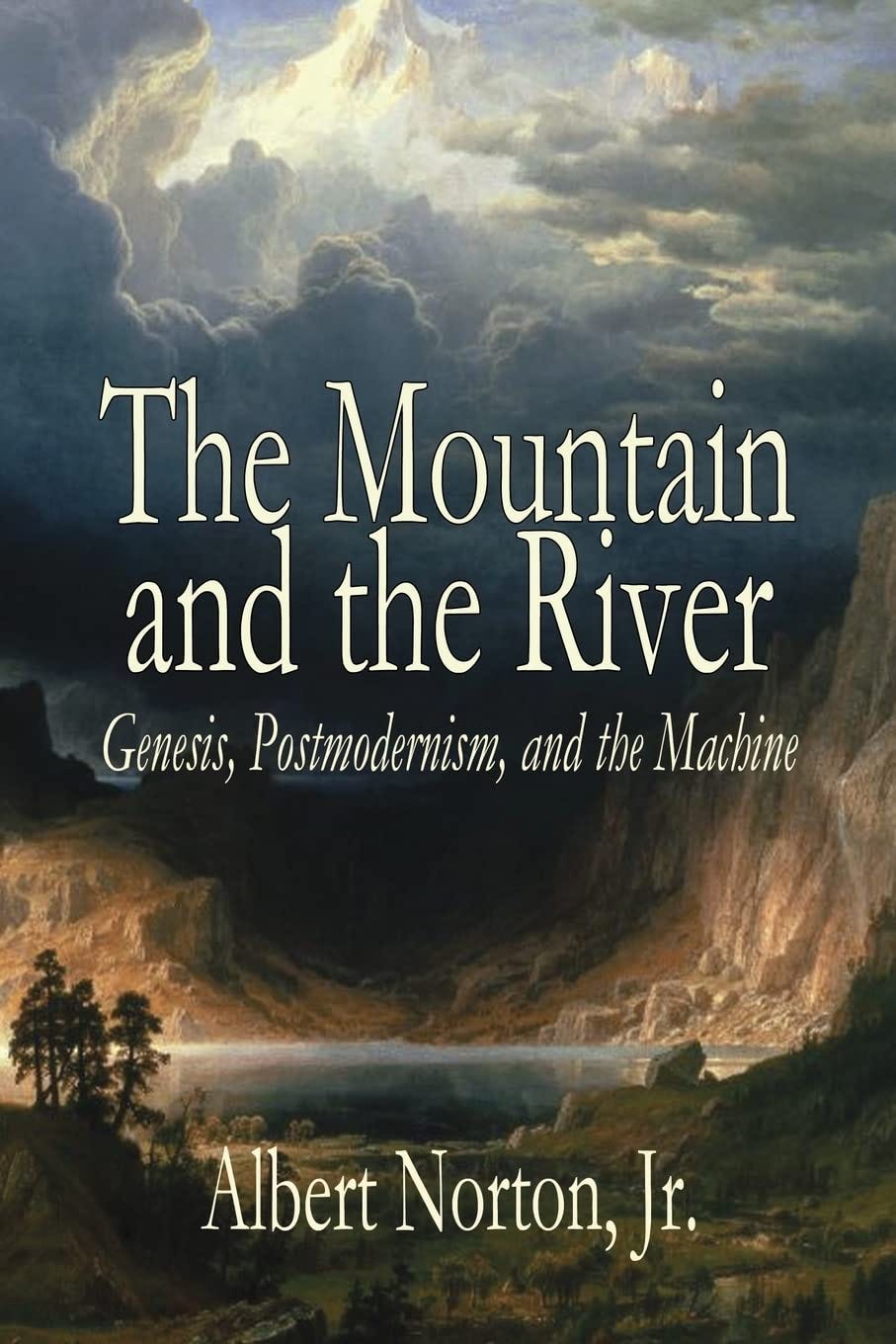
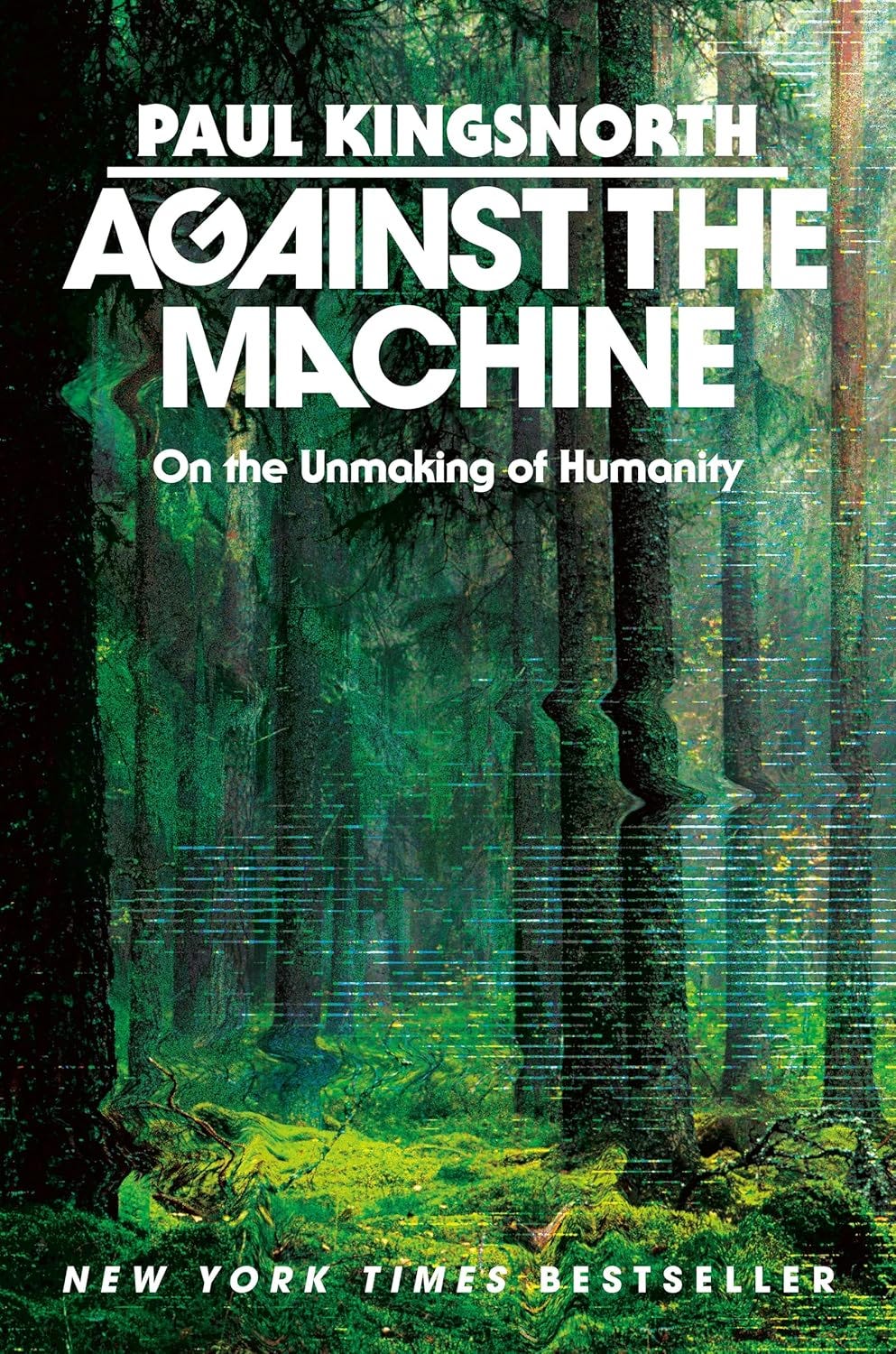
The pre-revolution disgruntlement delivers us to the Machine. Many have noted and commented on the Machine phenomenon, including me, in my 2023 book The Mountain and the River, subtitled Genesis, Postmodernism, and the Machine. Paul Kingsnorth laid out a compelling description in his book Against the Machine/On the Unmaking of Humanity, Thesis 2025, which I reviewed at newenglishreview.org for May, 2026. What follows is consideration of what “the Machine” is, and what it is doing to us, with particular consideration of Kingsnorth’s treatment.
Discussion of the Machine properly starts with an uneasy feeling that we are losing something essential, and when it’s gone we’ll no longer even feel its loss; we’ll be a different kind of being. Increasingly, we conceive ourselves as literal mechanisms within a larger social mechanism contained in a controlling social Narrative we fight over. For too much of any given day we live in an online simulacrum, artificiality overriding the touch of the natural world.
In large part this is the result of living in the ruins of a civilization that was once centered on moral realism. We now exist in a culture with no sacred order. This is a problem because we all worship something. “There is a throne at the heart of every culture,” as Kingsnorth puts it, and we can’t just dispense with some sense of the divine to sponsor a consistent other-centered moral authority. We are now all psychological man, and in our inward preoccupation are carried along by the current, indistinguishable in the flow that is the working of the Machine. The Machine is the sense of our place in the world following an uprooting from nature, culture, and God, leading us into a new “place” that is the mass of undifferentiated society.
One would be hard-pressed to refute the observation that we live in a new Weimar, an era of decline that will end with an excess of order to tame the chaos. Not that Nazism will follow—history does not repeat in such a predictable way—but some form of ideological capture will follow. The name given it here is “the Machine,” the form of which we can discern if we take care to examine it from different aspects so we can see how the various ideological threads come together into the sturdy rope that constrains us. The Machine is a form of re-imposing order, a giving over of oneself to a new occupier of the culture’s throne.
The Machine does not subject us to a top-down authority, like bolshevism or Maoism, but rather seductively induces acquiescence, beginning with the separation from the natural world and the moral realism it implies. We’re softened by fear that naturally results from the banishment of any sense of universality in values and disvalues, one element of the liquid modernity that now sweeps us along. It is a psychological dissolution of the sense of self, an unwitting ceding of agency to the collective.
Our heavily commodified culture separates us from nature and our food and our manufactures and from the sources of products shipped through complicated trade pathways to be served up to we in our principal functions of consumption and production, elevated to highest purpose on the assumption that the chief organizing principal of society is pursuit of the greatest pleasure with the least effort. All other drivers of human effort are extracted over time, dissolved in the acid bath of immediate, personal, desire, for things, property, comfort. The soulless Machine is a manifestation of our reduction to mere desiring beings, liberating us for that one object.
Kingsnorth writes “The Machine is . . . a tendency within us, made concrete by power and circumstance, which coalesces in a huge agglomeration of power, control, and ambition.” That tendency manifests in algorithm-making and -following, but also in the relentless making of literal machines, a constant evolution of technological innovation and change in mechanized processes to extend the range of our power.
The simplest machine, say a lever, expands man’s power. And we use a form of that word, “leverage,” to denote ever-expanding mechanical power to enhance our efforts, and in non-mechanical exercises of power, too. Our mechanical and social tools are intended to leverage our efforts, and they do, but at the same time they have a limiting effect, reducing the scope of our agency to participation in the Machine.
We have become progressively more distant from the natural world. As technologies advance, we become ever more dependent on them for even the smallest tasks, and come to be ever more distant from the natural world which produces the essentials for life. The critical understanding that all living things are interdependent, and that the health of the planet requires that interdependence, is eroded in a Machine-like conception of our place here, and a Machine-like conception of the natural world itself. The ideology is full deference to Science, without questioning whether its advances correspond to advances in human flourishing. The worship of Science in place of God means an attempted throwing-over of all limits.
As we become more and more interconnected technologically, and habituated to it, it becomes ever more possible to centrally control territory, population, and political sovereignty. Our sense of place diminishes and our instinct to collectivism expands. The Machine gobbles up our sense of community, so it becomes ever more abstract. The result is a vague connection to humanity, instead of people. This is the essence of globalism, which is both cause and effect of political socialism. Technology feeds statist control at the national level, except to the extent the nation cedes control to one-world globalism, increasingly ideologically aligned, as with the EU, NATO, international NGO’s, and so on.
Urbanization combined with technological advances in transportation and information technologies has brought a sameness to our culture, globally. All big cities are the same, and they’re the same because they readily borrow what seems fresh and new from other cultures. New York is London is Paris. And at the same time, a sameness devolves upon sub-urban and rural areas, denuded of a distinctive culture unto themselves. We’re all citizens of the world, which means we’re citizens of nowhere.
The ideology of open-society globalism serves the god of consumerism by facilitating free trade of goods and services with minimal barriers of culture, language, territorial sovereignty, technological limitations, and the limitations of nature without technological alteration. We are expected to bow to whatever serves commercial interests to the exclusion of all other human values.
The Machine is a product of tendencies in human nature sieved through postmodern ideologies that create in us a sense of alienation from the natural world and from each other. And of course technological innovation, so reflexively part of our mind-set that with each new gadget we don’t stop to think whether it makes life better, or us better people to be living it.
The Machine constrains in capillary regulation about minutiae, that invisibly governs the smallest of actions that would otherwise be undertaken in the exercise of individual initiative. We learn deference to the Machine this way. We know that any independent thought we have, or any act of initiative, is likely the subject of some legal regulation, or potentially outside that which is acceptable under the prevailing social Narrative. This can’t help but inhibit the exercise of our individual agency, so we effectively cede it to the Machine.
We might think of this ceding of agency as “colonization,” as Kingsnorth does. Incremental regulation from on high collectively reduces the home to a dormitory. With each small assault the home is reduced to a house; the family to a collection of co-inhabitants. The net effect is to eradicate not just the home, but the family.
Self-creation through expressive individual “identity” occurs in tandem with the consumerism the Machine fosters. The virtue of selfless giving to family and community is replaced with the utter selfishness of the therapeutic, and this takes our focus away from self-sufficiency, rendering us ever more dependent on the Machine for any remaining sense of self.
We must understand that the purpose of the Machine is ideological capture, making us individually more like little machines doing their expected part within a larger machine. Tools no longer serve human beings; instead human beings become tools themselves, to serve the inhuman, larger Machine.
Comments
Nothing yet. Say the first thing.
Sign in to join the conversation.