
I hope here to present a summary of The Machine, and what it consists in. I’ll need to do it in two parts, however. In this first part I discuss the provenance of the ideological totalitarianism that brings it about, and in the second part I fill in the sketch of what this Machine looks like.
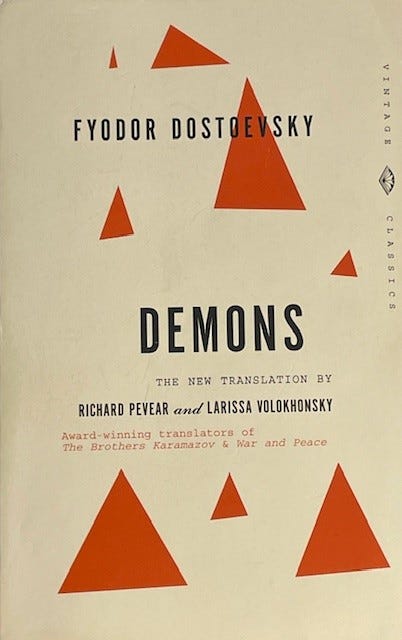
In November my article What Dostoevsky Tells Us About Totalitarianism was published, and it seems like I continue to see references to Dostoevsky’s book Demons (a/k/a The Possessed) popping up everywhere. It helps to explain the felt sense of being subsumed into ever-increasing state control; an uneasy sense that totalitarianism is on the rise.
We’re no strangers to this sort of thing, unfortunately. In the last century, Nazism, communism, Maoism, and variants of them have grown organically in foreign soils missing some cultural or political or religious mitigator of illiberalism. The liberal West was spared then, but now there is a growing sense that the disease has spread to our door. Something has gone missing from our body politic, and now the threat of totalitarianism is real. Some something drives well-meaning human beings away from natural relations with one’s fellows and community, and into reflexive deference to the positivism of “scientific” social management.
What is this impulse? Why does it arise again and again to enslave, until it finally crests in a wave of evil, leaving the people who were just trying to live their lives struggling in the flotsam of the all-sweeping wave’s backwash?
Totalitarianism is a product of ideology. Ideology is not just a cohering set of ideas, but rather a system that requires first rejecting the natural order. The natural order can be thought of as the world in the condition we receive it; that is, a world with at least the following elements. One, the logos: the implicit rationality of the universe, and our minds able to apprehend it, which inescapably means that truth and falsity also are real and extant in the world, not projected onto it by us. Two: moral realism implied by the logos but evident also in the conscience and in religious revelation. Three: the tragic sense, our awareness of our own moral failures, the reality of justice, and our own mortality. Four, the givenness of the natural world, with its limitations on us.
Thus, ideologies begin with a rejection of the natural order, the world-as-it-is. Ideologies are inherently hostile to the religious perspective, because the goal is to overcome the tragic sense in our own power, not to learn to live with it mitigated by appeal to a power beyond ourselves.
“Totalitarianism” is a reasonably all-encompassing word for variants of ideological socialism displacing individual agency. It’s sufficiently broad to avoid niggling cavil about its protean forms, and the distraction of disputed but insignificant details about the ways the monster has grown and devours, in the history of the last two centuries.
Totalitarian regimes have included Nazism, Soviet communism, Maoism, and others. But we must be careful not to suppose that the historical instances of totalitarianism exhaust the possibilities. The rising dismal tide may take a superficially dissimilar form, which is why we should approach the topic of totalitarianism and its origins with a broader sweep of understanding, as is attempted here. Sure, Maoism is/was totalitarian, but what makes it so?
Let the word “totalitarianism” be sufficiently broad, then, for our purposes, provided we first distinguish it from “authoritarianism.” Authoritarianism means dictatorial domination and control. Under it, there is no mistaking the heavy hand of the autocratic regime. It imposes a blanket of unfreedom, more uncomfortable for some than others, but restrictive for all, a felt repression.
Totalitarianism, by contrast, means insidious inducement to conformity. It is not felt as repression; instead compliance occurs from the inside out, so to speak. The project of totalitarian regimes is to induce ideological conformity. The subjects of a totalitarian regime are slavering to comply with the state ideology, rather than grumbling in dissent.
History is messy, however, and so are the various strains of ideology that make totalitarian mind-control possible. These categories are not experienced in exclusivity. Authoritarianism and totalitarianism may coincide, or totalitarianism may follow upon authoritarianism.
The common denominator for ideological totalitarian regimes is rejection of the world-as-it-is. This means a desire to destroy what is, in order to recreate anew. The thought must be that if we can install just the right man-made social system, we can overcome the tragic sense that attends us in this life.
To get to this system—that is, a positivist man-made system, as envisioned by August Comte, invariably ideological—we must first deconstruct the world as we have received it. The world we encounter has problems. The utopian ideological impulse is to overcome those problems. Mankind is perfectible on our own terms, the thinking goes.
This is a spirit of negation; of deconstruction rather than construction. It begins with angst about the fallen nature of the world. I resist being required to meet its expectations of me. It is too full of hypocrisies and social disharmony and class presumptuousness and all the other unavoidable manifestations of innate, profound human inequality. And so arises a sense that it all must be swept away.
The desire to transgress, to negate, is a fundamental psychological drive. Perhaps in everyone, to a degree, but in certain types of people, revolutionaries, it overrides any vision of what the world ought to be. Even more significantly, it overrides any vision of what I ought to be. The revolution is not about reducing evil in myself and in my small corner. It is a top-down endeavor.
The spirit of negation is in one sense independent of the ideological impulse. This desire to sweep away is not stage one to an articulable utopian goal. Rather, it stands alone, in the beginning. The utopian vision does not precede the spirit of negation, but follows. That is to say, the role of revolutionaries is transgression and deconstruction, leaving rebuilding on ideological lines to others. The wrecking crew can do its work without real concern for what happens next.
Fyodr Dostoevsky helps us understand this spirit of negation. How it exploits the ideological impulse, and how the ideological impulse in turn exploits the impulse to tear down. Revolution occurs once pre-revolution sets the stage. In Demons we see the incipient characteristics of this pre-revolution stage. He begins with a fictional small town in Russia in the 1860’s. Russia has slowly been modernizing, and the serfs have only recently been freed from the land. Political and legal reform toward a more egalitarian society has begun, but too slowly for the nihilistic pre-revolutionaries.
We see in Demons, as we see in the West today, a key signal of coming nihilistic revolution: a breakdown in what we might refer to as filial piety, the natural loyalty a child has to his parents, not just in childhood, but into adulthood thereafter. This is a curious phenomenon, to those who haven’t experienced it in their own lives. Outside of pre-revolution cultures, there has always been the natural cycle of parents caring for children and then adult children caring for aged parents. There have always been exceptions, of course, but this has been so much the normal course that we consider deviation from this pattern unnatural.
We can likewise see the spirit of negation in the breakdown of natural male and female relations. The breakdown of the family in the West has been much documented and commented upon, but for our purposes we should note how it deviates from natural order. If a man or woman cannot count on their mate’s loyalty, are there any social relations at all that are close, confidential, reliable, and not attenuated by all of society? Likewise for a child, with the specter of divorce always in the background, how can he or she not feel atomized and alone, even before being launched into the socially hostile world to fend for himself or herself? Even the category of male or female is called into question, in this brave new world that opposes natural limits.
We seem to be losing the ability to see the natural world for what it is. The natural order is a form of authority. Imposition of order on the natural world is obviously authoritative, and this implies an Author. We tend to think we can reject God and reject the moral realism He sponsors and maintains in hierarchy, like Christmas tree lights removed from the tree to be piled up in an undifferentiated, tangled mess on the floor.
And yet, clearly there is a form of authority behind the way the world really is, and really is bounded, so that we don’t get to make it up as we go along. Without much thought, upon rejecting divine injunction we default to another source of authority. We imagine the social collective and its dictates as the replacement source of values hierarchy.
We’ll look at that more closely in part 2, please stay tuned.
Comments
Nothing yet. Say the first thing.
Sign in to join the conversation.