
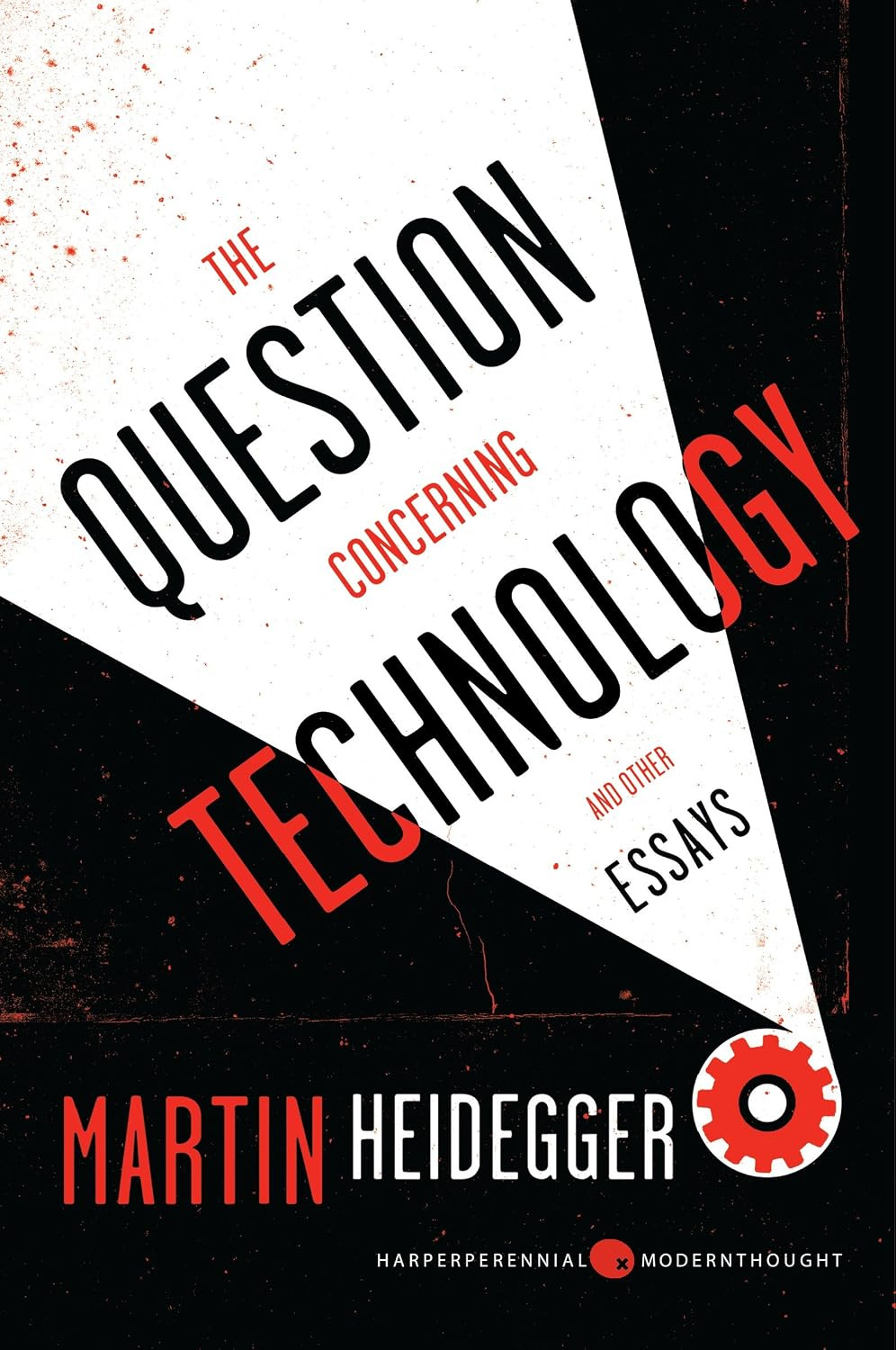
Martin Heidegger wrote an essay published in 1954, titled (in English translation) The Question Concerning Technology,[1] based on content of lectures he had given a few years earlier. An English translation was first published in 1977. In his essay, Heidegger addressed the essence of technology, on the way to explaining what he considered a corruption of its essence in the postmodern era.[2] So, what follows concerning Heidegger can be divided into two sections, the first having to do with what technology is, and the second to what we have become, in our relation to it.
Philosophers quibble over whether Heidegger was an existentialist or not, and he apparently eschewed the term in favor of something like “ontologist,” but certainly he was concerned with the essence and nature of existence. With regard to technology, he first separates technology in the form of the mechanisms we produce, from that which makes technology, technology: its essence. His metaphysical analysis turns on causation.
He begins with the traditional Aristotelian four causes: material, formal, efficient, and final. But, he invites re-examining the relations among these causes, stressing that they don’t merely coincide, as if we have one rope of four strands and simply pull the strands apart in order to consider what a rope is. Rather, the final cause precipitates the coinciding of the causes, binding them and impelling them forward together. We might think of the final cause, or purpose, as a spirit permeating the coming together of the first three: matter, form, and temporality. This way of analyzing cause is important because it personalizes the causation in the case of technology. Human craft from nature is relational.
Man’s crafting from nature involves a “bringing-forth” from material, and this bringing-forth occurs through a process of revealing, as with the famous quote attributed to Michaelangelo: “I saw the angel in the marble and carved until I set him free.” Heidegger likens this to the ancient Greeks’ personalizing of truth as aletheia, which imagines truth not as a raw fact out there in the universe disconnected from humanity’s pursuit of it, but rather as a product of its relationship to us: accessible to us but as yet unrevealed, and discovered by us in the process of our clearing away that which is not truth, to reveal truth for what it is.
“Technology is no mere means,”[3] therefore. The idea of “revealing” and of “bringing-forth” engender a reconsideration of the very word “technology.” It is derived from the Greek technē, which is not just making practical things, but includes fine art and products of mind. It therefore also encompasses poiēsis, creative formation. Not just swords, but poetry, too. Poiēsis suggests a gentle summoning; a beckoning; a coaxing-forth. It thus invokes a relational mythos element, in addition to the necessary logos of attention-directed striving. Though this conception may apply well to the traditional craftsman or artist, Heidegger notes that “it simply does not fit modern machine-powered technology.”[4]
This is precisely the problem, the “question concerning technology” to which he is addressed. With that understanding, we can make the turn Heidegger has led us to, toward the new and negative aspects of technology in this postmodern age.
We should consider the times in which Heidegger lectured and wrote on this subject. World War II ended in 1945. Anyone alive and conscious of the devastation of those conflicts could not help but be conscious also of the role of advancing technology in it. There were atom bombs deployed against Japan by the United States, of course, but also war from the air played a new and major role, as with the US and UK bombing raids, most shockingly observed in Dresden. The Germans developed advanced tank technology, and the UK lived daily under the threat not only of bombing, but possible deployment of V1 and V2 rockets. The blitzkrieg tactics of the Germans were also a sort of technology, properly understood. Fast communications, not just audacity, enabled their skirting of the Maginot line, to take France in 1940. The war vastly accelerated and made frighteningly visible the product of industrial technology. It is fair to say that the world was a very different place, technologically, after the war. This technological quantum leap no doubt disturbed the nature-loving Heidegger, notwithstanding its exploitation by the Nazi party, with which he was affiliated.
So for Heidegger, the essence of modern technology was different from that which obtained previously. It still amounts to a revealing, but diminished or gone is the calling-forth of poiēsis, to be replaced with a “challenging” of the natural world, a more antagonistic relation of extraction and exploitation to obtain the most yield at the least cost. To visualize, we might consider the pre-war traditional family farm in which natural processes were employed to rejuvenate soil and reproduce livestock in an ongoing, living, organic way. And then contrast that to modern-day industrial farming, involving thousands of acres of monoculture, the soil regarded as a fertilizer-injected medium rather than a living thing unto itself to be continuously cared-for in a give-and-take mutually nurturing relationship. As with Ernst Jünger’s glass bees, extracting nectar but not reciprocating with pollination.
Recall that for Heidegger the essence of technology is relational, meaning that it is not machinery itself nor machine-like processes, but rather inheres in humanity’s relation to it. And so the place to find the change in its essence is in the human stance as against the natural world. The result of the “challenging” relation to the natural world is to view nature not merely as a living thing unto itself, but as a natural resource for our creation of what Heidegger called (translated) “standing reserve.” The idea, he felt, was that we no longer interact with nature in a way that leaves it unscarred, but we look upon nature as a way to store up energy for ourselves, to fill our warehouses, so to speak, against continuous future need. Heidegger called this (again, translated) “enframing.” In our mental vision we enframe the natural world as standing reserve.
This enframing is not just a new way of thinking about our relationship to the natural world. It changes us fundamentally; indeed for Heidegger it means a “destining” to a less-free future. It is less free because it means we have denied to ourselves the creative self-will that inheres in poiēsis, the summoning or coaxing or “bringing-forth” in love as the way to engage in our makings. We become reduced to animals engaged in “ordering” upon our standing reserve. We do not dance with nature; we conquer it. “We murder to dissect,” as in William Wordsworth’s poem.[5]
Thus, we dig coal at an industrial scale and alter the landscape; we dam the Rhine (Heidegger’s example) for hydroelectric power production, permanently altering the river to extract power. We build machines in order to build other machines that will interact with other machines, to which human efforts are mere appurtenances. Science proceeds not just to discover and build new technology, but sophisticated technology becomes necessary to the further scientific advance. We no longer live in a natural environment, but in a technology environment. Imagine looking out the window of an airplane. You’re passively transported by this huge machine that is dependent on technological extraction of fuel, and you look out on man-made construction, landing on an engineered sealing of the ground, guided by advanced communication technology in an intricate air traffic control system.
We can come to think of other humans as a form of standing reserve, and in this way become mechanized ourselves; that is, as we interact with machines and engage machine-like algorithmic thinking, we come more to resemble machines. And as we do we operate socially more like machines, just as cars going to and from work during rush hour look like bees headed out to do their waggles and foraging, returning to the hive with the groceries, just to do it all again the next day, day after day amen. We look to others to operate in a machine-like way, and we are dependent on them in the way we used to be dependent directly on nature. And we can easily cross a line that makes us exploitative with respect to other people, the question being what we can get from them; how to make them a part of our standing reserve. How can I soften and make subtle my instrumental usage of them, so I can get the most out of them?
Just as Heidegger suggested we look at the natural flow of the Rhine and its environs as having a stand-alone existence to be respected, such that we might step in it to fish or drink or ford without extracting from it in a way that alters its fundamental nature, so in human relations we ought to look at our neighbors as having equal dignity to ourselves, giving voluntarily without expecting or requiring anything in return, except by honest trade, and when we engage in commerce with them or employ them or work for them, we do not diminish them or consider them to have lesser dignity.
But in the Machine age, we may see others the way post-moderns see the Rhine: as a resource to be exploited, to build standing reserve for ourselves, as when we interact with co-employees in a way calculated to ensure their loyalty in the corporate jostle, or to get the most work out of them for the least pay. Or, let it be said, outsource exploitation to the Machine of inflexible work rules and regulations, a systemic rather than personal extraction, in which we shrug our shoulders and nod to the dictates of the Machine of which we are helplessly but a part.
Our world is more technological than it is natural. It’s ever harder to “touch grass.” All of this creates in us a habit of mind in which we regard nature as mere resource to use for our benefit. We may embark on conserving natural resources, which sounds like a good thing, but the very way we describe that undertaking reveals the new attitude: nature as resource. We might enjoy being in what we think of as nature, but even to get there is an outing to another kind of place. It is no longer our real environment. We live in technology, not in nature. One can only imagine the dim view Heidegger would take of our thoroughly on-line existence.
But. To be fair to Heidegger on this subject, and to ourselves, there is hope. The corrupted essence of technology does not forever change who and what we are fundamentally. Heidegger quotes a poem by Friedrich Hölderlin:[6]
“But where danger is, grows
The saving power also.”
And the same poet says to us:
“. . . poetically dwells man upon this earth.”
“The poetical thoroughly pervades every art,” writes Heidegger, “every revealing of coming to presence into the beautiful.”[7] It’s still there, this hunger for mystery, and perhaps for the Divine, in all of our relation to the work of our hands.
[1] Martin Heidegger, The Question Concerning Technology, Harper Perennial Modern Thought, 2013 (hereafter “QT”)
[2] His references to the time frame involved would be translated to something like “modernity” or “late modernity,” and his concern was with “modern technology,” but I have consistently placed “postmodernism” and the postmodern era as commencing at approximately the turn to the twentieth century, before Heidegger’s time. The name given to the relevant time period is not of the essence of Heidegger’s inquiry.
[3] QT p. 12.
[4] QT p. 13.
[5] The Tables Turned, 1798.
[6] Patmos, 1803.
[7] QT p. 34.
Comments
Nothing yet. Say the first thing.
Sign in to join the conversation.