
I’ve been reading (and writing) quite a bit on the ideological trajectory in the post-Christian postmodern age. I’m convinced that the old left/right political dichotomy is oversimplified and out of date. You probably know it arose from the seating arrangement of the French National Assembly following the revolution of 1789 and the decade or so following.
Translated to twentieth-century Western “democracies,” until recently left and right roughly corresponded to the degree to which we accepted socialism as a corruption of individual freedom. In the United States, for example, at mid-twentieth century Republicans and Democrats were much more closely aligned on foundational principles, compared to now. Back then, the right stood for greater preservation of individual liberty vis-à-vis the state; the left stood for greater government intervention.
Now, the right gropes for some return to individual freedom, but is hampered by the postmodern withering of moral realism, which makes a common ethic—necessary to a polity with individual freedom—increasingly impossible. The left gropes for it knows not what, a vague utopia that will culminate somehow in a socialism of the heart that rests on an impossible universal brotherhood.
I’ve been engaged in the last few months in trying to pull together the disparate strands of the postmodern trend to Machine unfreedom. Today I want to examine one piece of it, the twentieth-century managerialism that installs the elite, or “officer class,” now driving the train off a cliff.
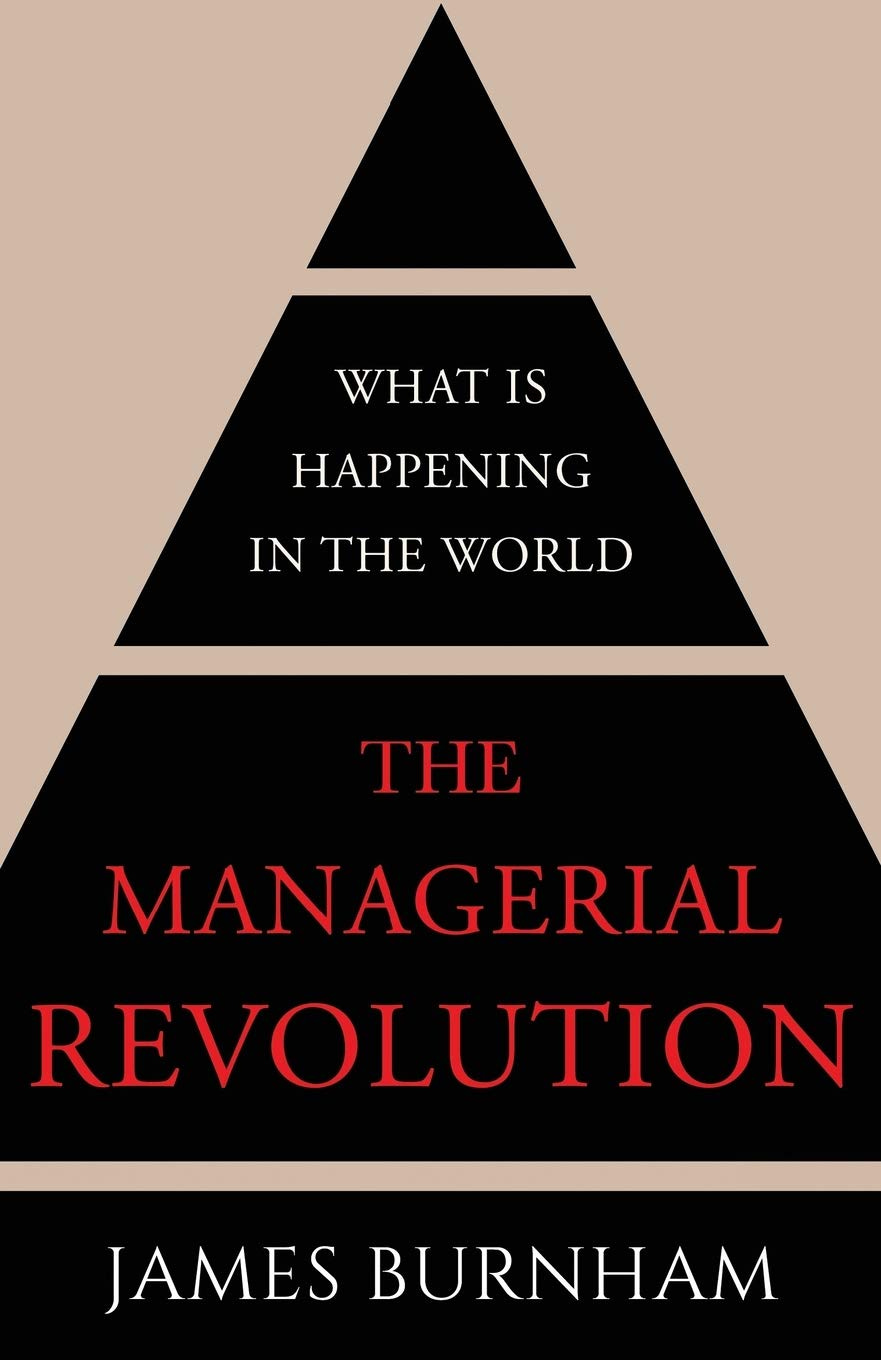
James Burnham warned of the consequences of the rise of a managerial class in his 1941 The Managerial Revolution.[1] His observations were profound and prescient, for the larger trend if not the details. He observed the growth of a new ruling class, those who managed but did not necessarily own the means of production. He concluded that this was a departure from capitalism, but not (in his view) in the direction of socialism. Rather, he observed a sort of hybrid, which he called “managerialism,” a locution that remains in common usage, often with some adjustments to Burnham’s original thesis.
Managerialism had the effect of disbursing power from monied tycoons to a new officer class. This class now most heavily influences the zeitgeist, evolving social mores which, with the decline of a common moral code rooted in religion, became the fluid social stand-in for the unchanging moral realism formerly sponsored in religion.
Managerialism is a theory—and reality—of economic organization, but it contributes to the advance of ideological Machine unfreedom, chiefly by introducing a mechanism of interchangeability in personnel of large machine-like organizations. The organization is conceived as a machine itself, and the managers are interchangeable parts, so to speak, available to be plugged in to any kind of large organization.
This interchangeability, and detachment from subject-matter expertise (other than expertise in management itself) would be called by Jacques Ellul plasticity,[2] suggesting mobility and a willing atomization in service to an organization-first mentality, managers functioning as swivel-points to reduce friction within and among large organizations, like a ball bearing in a mechanical device. The manager class enables growth of an organization beyond the natural limits of leadership by owners or those knowledgeable in the subject-matter of the enterprise.
To illustrate, imagine a large commercial enterprise of the nineteenth century. Perhaps a railroad, an example true to history. New ways of doing things in business are necessary, as compared to the small closely-held entities that formerly predominated. The capital required for such an undertaking is unlikely to come from one tycoon source. New ways of seeding the industrial enterprise are needed. Stockholders are the new owners, for such an entity, but those stockholders are manifestly not the direct operators of the enterprise. The operators will be managers. The managers are not the steel-forgers or engine operators, but rather the army of professionals who interact with government and the public; who account for finances through multiple jurisdictions; who maneuver through new government regulation; who work out logistical details, and so on.
Importantly, this manager class can be plucked from the railroad environment and deposited in some other enterprise, with little re-tooling, because most of its efforts for the railroad were not necessarily specific to railroads. Often, that other enterprise has been the government, because along with the late-nineteenth century meta-surge in the size of commercial enterprises, there was a surge also in the administrative arm of government to regulate. The administrative state grew concomitantly with the growth of big business.[3] The officer class moves freely between them, because its contribution is to the Machine of big: big business and big government, working increasingly in symbiosis, rather than in a tension of competing interests.
Now, decades on from Burnham’s observations, the line between public and private interests is blurred nearly out of existence. And so the coercive power of the state is for the most part unmitigated by liberal principles extant at the founding which would check government power. Public/private partnerships of various kinds are the order of the day. Managerialism can hardly be called capitalism, but neither is it a full-on socialism, as it retains some residual tensions between the domains of public and private. The Machine-like quality of this evolved social structure rests with the managers, the college-educated white-collar workers in their millions who share not only the ethos of managerialism itself, but a loose moral philosophy that is relativistic, consumerist, therapeutic, and self-reinforcing.
[1] Lume Books 2021 (first published in 1941).
[2] The Technological Society, p. 51 (first published in 1954, and in English 1964).
[3] To zoom in a moment, consider the Supreme Court decision in Trump et. al. v. Slaughter, decided just days ago (June 29, 2026). The news reports this as an expansion of Executive branch power, but more importantly it is a diminution of Deep State power, that of administrative agencies that have become effectively an unaccountable fourth branch of government. At least the Executive branch is accountable to the vote and to the legislative and judicial branches. The rise of the administrative state is part of the legacy of managerialism.
Comments
Nothing yet. Say the first thing.
Sign in to join the conversation.