
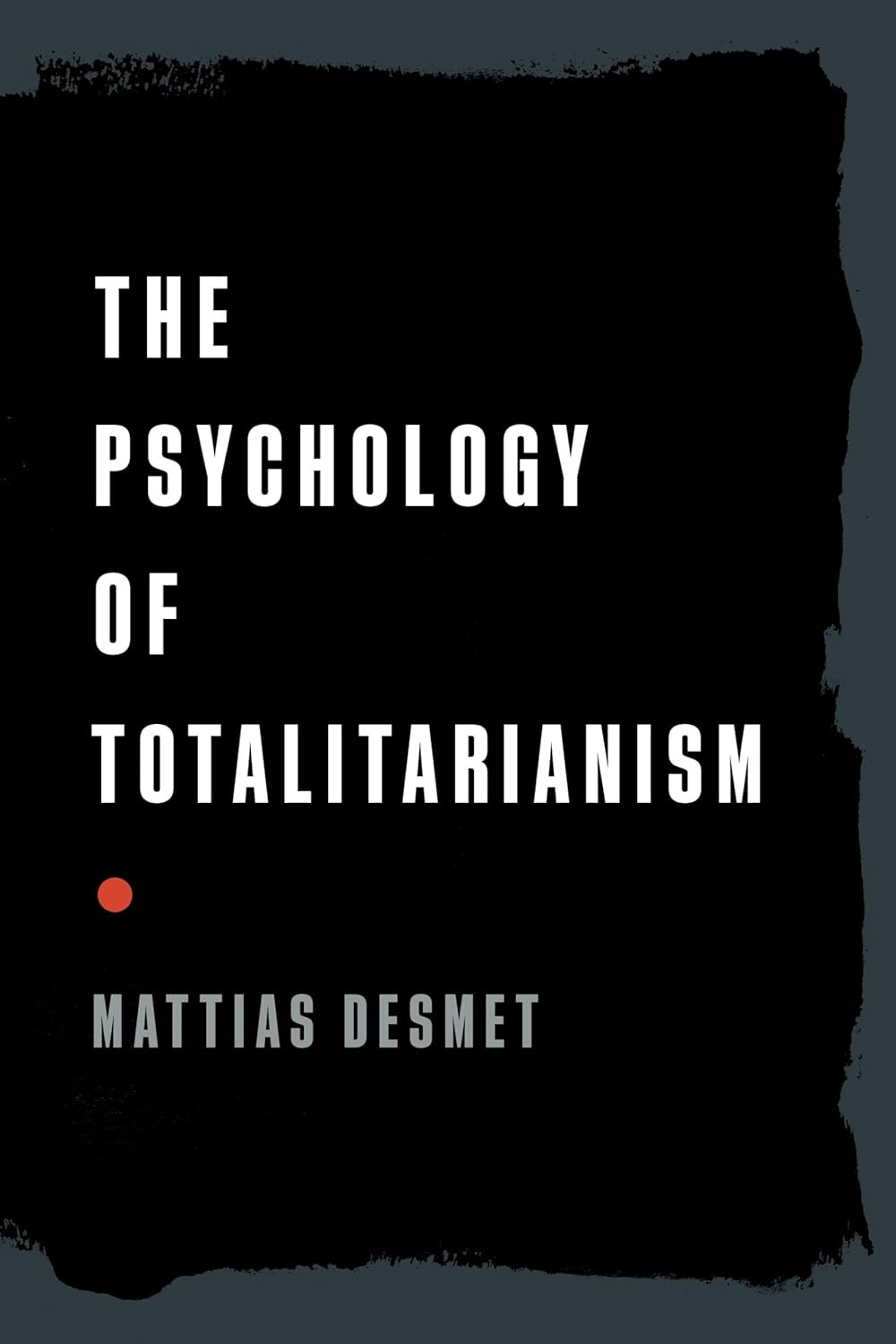
The first thing to note about this book is the year of its publication: 2022. What was going on then? We were at the height of a surge in state control, owing to widespread overreaction to covid. Mattias Desmet’s observations accordingly are heavy on the state of exception it wrought, but the principles he elucidated apply more broadly, and we should continue to be concerned for the next state of exception, and the one after that. The trend-line toward totalitarianism has not gone away.
A state of exception is a circumstance that seems to warrant a temporary suspension of our freedom. One would never close borders and order people off the streets and impose crippling commercial restrictions absent some huge catastrophe, like covid was presented to be. We supposedly live in freedom, absent a state of exception to freedom, but the problem is that we unnecessarily permit states of exception, one after the other, each one stretching us a little farther in the direction of totalitarianism.
Human-induced climate change was a state of exception, until it became laughably unsustainable. The 9/11 attack brought on a state of exception with far-reaching consequences to freedom. Woke culture raised our susceptibility to states of exception to a whole new level, so that suddenly conservative heterosexual white men were so dangerous they must be cordoned off from polite society, allowed back in only upon groveling in shame, and then only contingently. Violent race riots even in the midst of what was considered a pandemic must be not only tolerated, but encouraged, because somehow this will cure us of racism.
Early in his book, Desmet points out that exploitation of states of exception are not merely projects of governments seeking to expand their power. Demands for ever greater exercises of power by the government now emerge from the population itself. It is a psychological response to ambient fear, in the face of which we willingly hand over our freedom.
Desmet distinguishes dictatorships from totalitarianism. A dictatorship relies on a climate of fear generated in the population. Totalitarianism, on the other hand, “has its roots in the insidious psychological process of mass formation,” which he defines as “a kind of group hypnosis that destroys individuals’ ethical self-awareness and robs them of them of their ability to think critically.”
These are people, he says, who lose the capacity to separate fact from fiction; truth from falsity. Why? The answer must lie in the underlying disease of this postmodern era: the rejection of logos realism and its sponsorship in the Divine. This failing is unprecedented in the history of the world; what makes totalitarianism inevitable on the currently dominant metaphysics. Desmet may have had something like this in the back of his mind because he points to the limitations of scientistic materialism in describing our susceptibility to fear.
On individual subjective psychology the author’s explanations are a little less convincing, relying as they do on questionable Freudian precepts. In most of our forays into psychology, we don’t really explain, but rather only describe. The psychology practitioner’s bible is the DSM-5, but it is only a classification tool: one long set of descriptions that help us structure psychological understanding, but don’t really explain anything.
Basically, Desmet’s approach boils down to this: we want rules so we know how to please others because we want to belong. So we demand rules, which means we welcome authority. He goes into more (Freudian) detail, of course, but it wears thin. Freud tried to tell us what is in the unknowable subconscious.
The social psychology is more convincing, perhaps because we can better observe the motivations of large groups of people, than we can an individual’s subconscious. Desmet fleshes out the idea of mass formation starting with the systematization and “iron cage” of society. Our managerial technocracy means opinion is shaped not by a charismatic leader, but by routine and rules and regulations, supervised by dull, plodding bureaucrats. Ideology can take hold not because it presents a true picture of the world, but because it creates a social bond. Once inside the made-up rules of the ideological system, a desire to conform takes over and we bend individual interests toward those of the collective.
Desmet relies heavily on Hannah Arendt, especially in her 1951 The Origins of Totalitarianism, and her emphasis on technocratic automatism and social isolation. A mechanistic ideology (as all positivist systems are) leads to anxiety and loss of meaning and isolation, which leads to mass formation and a delusion of connectedness, which leads to a totalitarian state system. The totalitarian state breaks down social bonds, leaving us desperate to re-bond any way we can, so we bond through the auspices of the state, an unnatural simulacrum of human connection.
The thesis lands on its feet with its emphasis on Enlightenment hyper-rationalism and its insistence that there is more mystery to reality than we think. Citing Arendt, Desmet observes that “ultimately totalitarianism is the symptom of a naïve belief in the omnipotence of human rationality.” That naïve belief is what gets us to totalitarianism. It’s not even necessary to identify the specific ideology that gets us there: communism, Nazism, open-society managerial socialism, or something else. What matters is mechanization of human beings, and the mounting states of exception that push us, in fear, to prefer Narrative to truth.
Comments
Nothing yet. Say the first thing.
Sign in to join the conversation.