
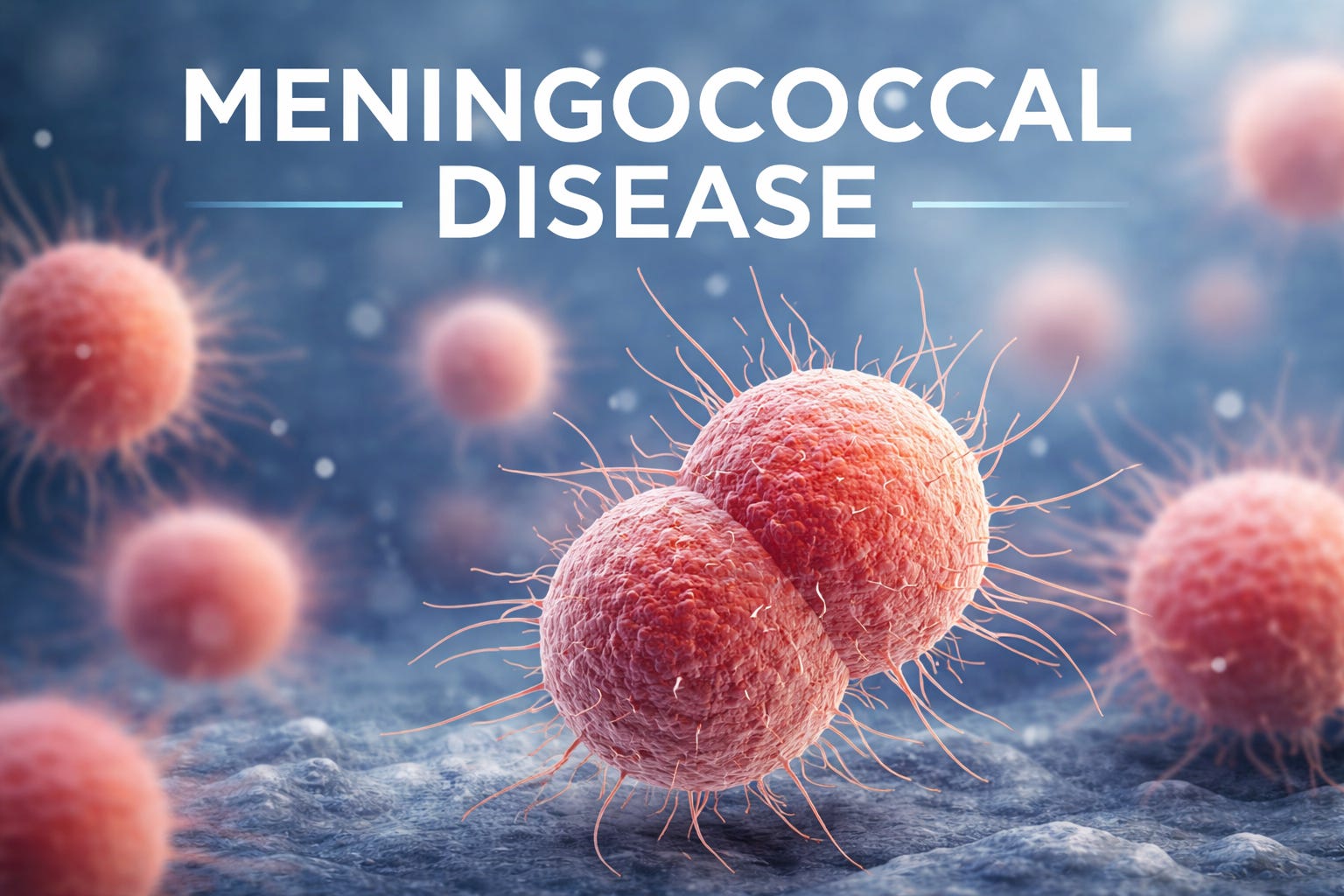
The UK news is full of reports of an outbreak of infection with the bacteria Neisseria meningitidis, more commonly known as Meningococcus. Due to the severity of the infection, this has understandably been the source of intense interest and anxiety among the public. But what is Meningococcus, and what has happened in this outbreak?
Neisseria meningitidis was first discovered by an Austrian bacteriologist in 1887, in the cerebrospinal fluid of patients suffering from meningitis. Indeed, the bacteria is most famous for causing meningitis (infection around the brain), but can also cause bacteraemia (infection in the blood stream, also known as “septicaemia”). Bacteraemia is responsible for the classic sign of the non-blanching rash - the famous rash which does not disappear when pressure with glass is applied. When these appear as spots they are known as petechiae, and when they grow and coalesce into a patch like a bruise they are called purpura. Very severe purpura can lead to skin and tissue breakdown in the hands and feet, which in some cases can require amputation.
Notably, meningitis alone will not cause this rash. Despite the glass test being considered a test for meningitis, it is more accurate to think of it as a test for meningococcal bacteraemia.
Both infection around the brain or in the blood can lead to sepsis - an overwhelming immune response to infection which can be life threatening. The reason this infection is so dangerous is the speed with which sepsis develops. Children in particular can go from looking relatively well to having life threatening symptoms in minutes to hours.
Despite the severity of infection, the bacteria itself is extremely easy to kill. A single dose of antibiotics is usually enough to almost completely sterilise the blood or cerebrospinal fluid. A treatment course for uncomplicated bacterial meningitis with Meningococcus is only five days long - compared to 14 days for Group B Streptococcus or 21 days for E coli.
Thankfully, invasive meningococcal disease is extremely rare in the UK. During 2024/2025, there were only 378 total cases in England and around 30 deaths. Around 1/3 of all cases were in children <15yrs. Those aged 15 - 25yrs made up around 25% of cases. This rarity is largely thanks to the success of vaccination.
As of March 19th, there have been 15 confirmed cases and 12 suspected cases of invasive Meningococcal disease linked to the outbreak (this will be a combination of meningitis and bacteraemia). There have sadly been two deaths. The cases have occurred in the county of Kent in South East England, all linked to the city of Canterbury. Almost all the cases were linked to the same university, and the majority linked to attendance of a particular nightclub over a three day period.
There is no good explanation for why such an intense outbreak has occurred, but this is not an unknown phenomenon. My own university (Southampton) experienced an outbreak of MenC in 1997, with 6 students affected and three deaths. Most cases were linked to a shared nightclub attendance. A similar outbreak occurred in Wales the year before. More recently, the university of Surrey experienced a cluster of three cases in 2017. The current outbreak has been notable for a much higher number of cases, which remains unexplained. It is conceivable that pandemic restrictions reduced mixing and subsequent carriage rates, temporarily reducing immunity. This is reflected in the temporary drop in cases during 2020/21, but why an outbreak would only occur now is unclear and this remains speculative.
Despite high rates of carriage, the bacteria is not thought to be highly transmissible. Normally, only “kissing contacts” are thought to be at risk following cases of invasive disease and offered prophylaxis, and it is unclear why sporadic outbreaks occur in different settings such as universities, or nurseries.
The current outbreak is considered to have been contained, with the response of the UKHSA having been to offer prophylactic antibiotics to any attendees of the nightclub during the affected period, and close contacts of any of the known cases. In addition, students at the affected university at the relevant campus or who attended the nightclub during the relevant period are also now being offered a vaccine against the specific serogroup of Meningococcus indicated in the outbreak - MenB.
The current UK vaccine schedule does include vaccination against MenB, but only for infants This was introduced in 2015. Teenagers received a different meningococcal vaccine, which is against serogroups ACWY.
The reasons for this difference in infant and adolescent vaccination are all to do with carriage.
Meningococcus is a normal commensal bacteria in the mouth and throat, carried by around 10% - 35% of people, with the highest rates in older teenagers/young adults. This makes them the main reservoir for Meningococcal transmission. The MenACWY vaccine is extremely effective, not just at preventing severe illness, but also preventing carriage. This means that vaccinating teenagers protects the entire population, as it halts the main route of transmission of these serogroups. The reason we no longer need to vaccinate infants against MenC (previously the most common cause of invasive Meningococcal disease) is because we have effectively eliminated carriage of this serogroup by vaccinating teenagers.
Alas, the same is not true of MenB. Whilst the MenACWY vaccine effectively targets the polysaccharide capsule surrounding the bacteria, we cannot do this for MenB. Its capsular polysaccharide too closely resembles human neural tissue, risks causing the body to attack itself and appears relatively un-immunogenic in pre-clinical models.
The other antigens available to target are highly diverse, meaning that several have had to be combined to try and get the best possible coverage, but still leaves some strains uncovered. Disappointingly, the vaccine also fails to prevent transmission of carriage among young adults, as demonstrated in RCTs. This means vaccinating teenagers has not been cost effective, as invasive disease is very rare and there are no benefits to others from vaccinating them. Protection from the vaccine is also relatively short lived, so future adolescents who were vaccinated as infants will have relatively little protection by the time they attend university.
The current outbreak is likely to provoke strong feelings amongst some about the need to vaccinate teenagers against MenB. The JCVI (who determine the recommendations) operate on strict criteria for cost effectiveness. It remains to be seen whether the most up-to-date epidemiology and modelling would tip this over into being a good decision based on these criteria, but it seems unlikely a single outbreak would have much impact.
Thanks for reading The Munro Report! This post is public so feel free to share it.
Neisseria meningitidis is a bacteria which can cause life threatening infection around the brain or in the blood, leading to sepsis. It has cause an outbreak in at least 20 university students in South East England, with a some deaths. The outbreak is caused by the MenB serogroup, which infants are vaccinated against, but adolescents are not. This is because the vaccine does not prevent carriage; unlike the MenACWY vaccine currently offered. It is unclear if there is a case for offering routine vaccination to adolescents in the future.
No posts
Comments
Nothing yet. Say the first thing.
Sign in to join the conversation.