

Until recently, most parents had never heard of Respiratory Syncytial Virus (RSV). This is remarkable, given it is the major winter scourge of child health. Whilst influenza, rightly, has a reputation for causing pressure on health services, RSV actually poses a much larger burden in paediatrics. Entire ward bays are dedicated to babies and young children with RSV infection every winter. This usually presents as the syndrome known as “bronchiolitis”, characterised by difficulty breathing, wheezing and crackles on the lungs, and difficulty feeding. It is the most common reason for children to need hospitalisation in the UK and high income countries. It costs the UK economy around £80 million per year. There is no treatment, and the management is just supporting babies whilst their immune systems fends off the invader.
Despite the revolution in child health brought about by vaccination in the last 25 years, RSV remained the major pathogen for healthy children for which we had no protection.
That has now changed.
Why didn’t we have vaccines for RSV?
Due to it’s significance, RSV has long been a target for vaccination. Some of the earliest efforts were made in 1966 and were made from formalin inactivated RSV viruses - a relatively common technique.
However, this is where we ran into problems. In the trials of these vaccines, far from protecting infants against RSV infection, it looked as though the vaccines seemed to somehow make infections worse. Sadly, two children who received these early vaccines died and many more were hospitalised with severe infection. This is one of the earliest examples of something called vaccine associated enhanced respiratory disease (VAERD), where the reaction to vaccination creates an aberrant immune response when infection is next encountered, resulting in much more severe disease. It was later noted that the formalin inactivated vaccines only generated antibodies to the F protein (the most immunogenic antigen) in its post fusion form - the way it looks after binding to cells. It was theorised that targeting only the pre-fusion version might avert VAERD, and all therapeutics have been targeted at the pre-fusion F protein (RSVpreF) ever since.
This major setback caused a lot of anxiety about producing vaccines for young children, delaying progress in the field for a long time. This is why we’ve had no options for protecting otherwise healthy children - until now. Remarkably, in the past two years we have gained two novel methods of protection.
Thanks for reading The Munro Report! Subscribe to make sure you don’t miss out on any new posts.
Monoclonal antibodies
Vaccines work by showing your immune system a portion, or weakened version of a pathogen, training it to make antibodies itself. But there is an alternative approach. If you know precisely what portion of a pathogen is best to target, you can externally manufacture antibodies against it and then administer them to people directly. These are called monoclonal antibodies. They usually don’t last long, and are expensive to manufacture - but they work. A version of this for RSV called palivizumab already existed, but it only worked for 1 month at a time. This meant only babies with profound susceptibility to RSV were eligible, and needed monthly injections during winter to stay protected.
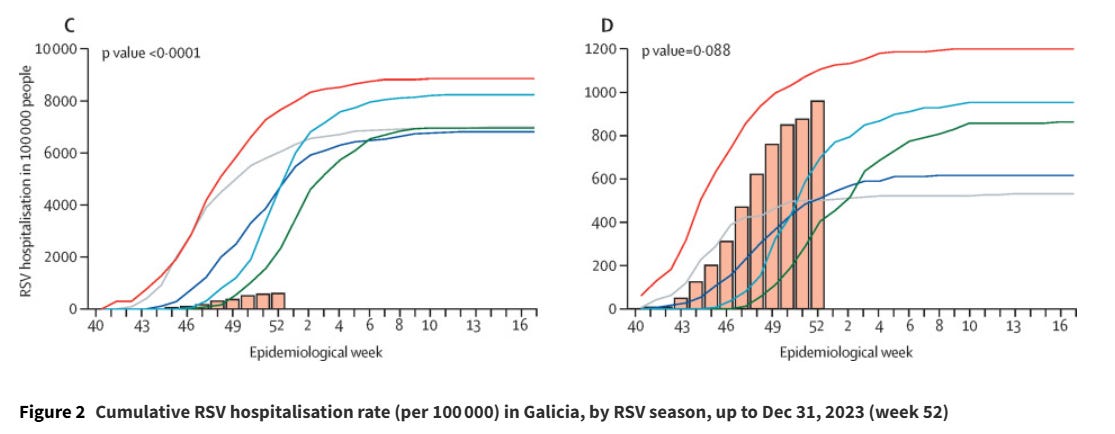
More recently, a long acting monclonal antibody called nirsevimab came along. It provided amazing results in phase III trials, then in the pivotal HARMONIE clinical trial was shown to reduce RSV hospitalisation by 80% over the first RSV season, and remarkably, reduced all cause respiratory hospitalisations in babies by half. It lasts for a whole RSV season (at least), suitable for all babies to get protected from RSV.
It was implemented very early after licensure in some areas, including Galicia in Spain, where very high uptake by babies resulted in dramatic falls in hospital admissions from RSV over the following season. This is the first real “game changer”, in paediatrics for decades. But it doesn’t end there.
Maternal vaccination
The issues encountered by RSV vaccination in infants seemed to be restricted to babies who hadn’t seen RSV before. If you already had an existing immune profile to RSV, vaccination seemed to just enhance your existing response rather than resulting in an aberrant one. This has led to much faster development of excellent vaccines for the elderly, and for pregnant mums.
Maternal vaccination is ingenious. Newborn babies obviously have no existing adaptive immune profile - they’ve never encountered any pathogens of their own. To help protect them, their mothers antibodies (specifically IgG) are actively transferred to babies across the placenta during the third trimester. This gives babies pretty good antibody protection for the first three to six months of life. By boosting maternal antibody levels to pathogens which are particularly dangerous to newborns, you can enhance the newborns protection by giving them more of their mum’s antibodies. We already do this for pertussis and flu - now we can do it for RSV too.
Phase III clinical trials showed impressive protection for babies whose mothers were vaccinated against RSV during pregnancy at levels which look very similar to those provided by immunisation with nirsevimab (the trials are different in many ways which preclude direct comparison - but they are in the same ball-park). This is now the main form of protection offered in the UK, with monoclonal antibodies only offered to very high risk infants (who would previously have received palivizumab).
Both monoclonal antibodies and maternal vaccination work in a similar way - by providing babies with antibodies they didn’t make themselves to give them effective, but temporary protection during the period where they are most vulnerable.
What about infant vaccination?
Whilst temporary protection is much better than nothing, there remains a desire to give infants vaccination which could provide long term protection - enabling them to produce an enduring response to RSV for all future encounters, and not just for the few months where they are highest risk. Whilst the spectre of VAERD loomed over RSV vaccination, extensive efforts have been made to try and understand the mechanisms by which it happened. Several safeguards were put in place to eliminate any candidates at the pre-clinical stage which looked like they might induce it.1
Vaccine trials commenced with several candidates, including those made by the novel mRNA platforms which were so successful for COVID-19. But sadly, things did not go entirely as planned.
At the very early stages of clinical trials for mRNA RSV vaccines, a small imbalance in severe RSV infections were noticed in the vaccination groups compared to the placebo arms (but fortunately no deaths). The trials were immediately halted and a meeting of drug regulators was convened on December 12th 2024. Despite the vaccine passing all the pre-clinical tests put in place to ensure the vaccines didn’t result in VAERD, it looks possible it may have happened anyway. The good news is that all the safety checks put in place to catch it early at the clinical phase worked extremely well.
The outcome of the meeting was that all clinical trials for RSV vaccines in children under two years old, or under five years old with no evidence of prior RSV exposure were put on-hold (with the exception of live, attenuated vaccines).2 Further scientific work will be needed to provide additional reassurances for study of future vaccine candidates, and robust safety plans in place to detect any possible incidences of VAERD.
What next?
There are promising candidates for RSV vaccination for children - most notably, a nasal spray of a live, attenuated RSV virus. This would be similar to the current nasal influenza vaccine used for children aged two and older (known as Fluenz in the UK and Flumist in the US). The vaccine brings the added benefit of involving no needles, making it more acceptable for children and their parents alike. Many of us are eagerly awaiting to hear progress on the further information needed by the FDA to move forwards with clinical trials.
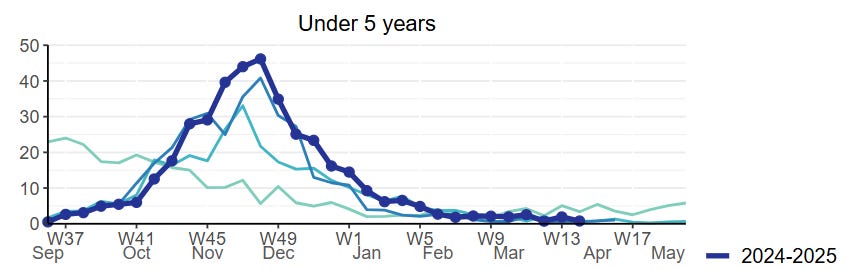
In the meantime, we are fortunate to have two alternatives to protect infants during their most vulnerable stages in life - passive immunisation with monoclonal antibodies or maternal vaccination. The key for these interventions will be in ensuring uptake. The UK managed a pretty miserable 55% uptake of maternal vaccination during it’s first year, and it was given to pregnant mothers too late to have any impact on the first RSV season (much to the frustration of paediatricians around the country). Hopefully this year we will begin to see an impact - although this will only be as good as the uptake we manage to achieve.
This is no small task in an era where the worlds main superpower has an avowed anti-vaxxer in charge of it’s health service, and who has filled their own vaccine advisory board with other anti-vaxxers. The public have never received such a barrage of confusing, and downright false information regarding vaccines from the people they are meant to be able to trust. It is more important than ever that professionals in the UK step up to provide the English speaking world with clear, open, and trustworthy communications about vaccination to improve public confidence.
Thanks for reading The Munro Report! This post is public so feel free to share it.
Summary
RSV is a major cause of respiratory morbidity in young infants. Until recently, we had no way to protect babies. Now we are able to provide them with maternal vaccination or monoclonal antibodies to keep them safe during their most vulnerable periods. Health professionals must focus on improving confidence and trust in the provision of these therapies to help keep babies safe. Infant vaccination remains someway in the distance due to recent setbacks in potential VAERD, but promising candidates remain.
We’ve come a very long way in infant protection from RSV - but there is further we can go still.
For those who are more scientifically minded, the pre-clinical immunology criteria for this include:
ability to induce anti-RSV neutralising Ab (nAb) responses;
avoid induction of non-nAbs and have a relatively low anti-RSV-F IgG binding to nAb ratio
avoid induction of strong Th2-type CD4+ T-cell responses (e.g., IL-4, IL-5 and IL-3 and/or mucus production)
should not provoke alveolitis after a valid, live RSV challenge.
Comments
Nothing yet. Say the first thing.
Sign in to join the conversation.