
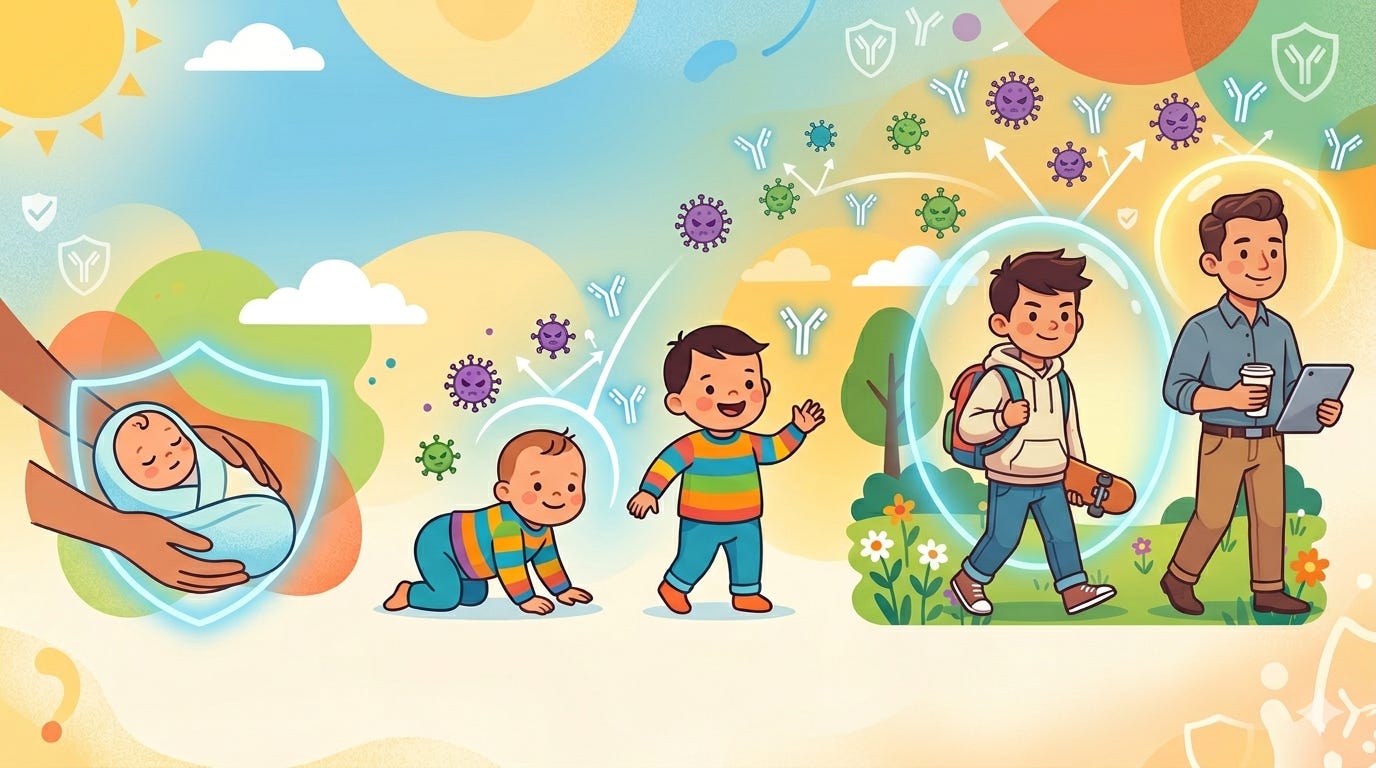
All parents will be familiar with the endless onslaught of childhood illnesses once your child enters their first educational environment - be that nursery, pre-school, or school. There seems to be much confusion as to the significance of getting - or not getting - these infections. Post pandemic, the world seems to have been split into two camps; those who wish to stop their children getting these infections at all, and those who think “the sooner the better”.
As with many things, the reality is more complex.
It’s important to note that infections with most common endemic pathogens is inevitable - and for most of them, will be experienced multiple times over the life course. For some, such as rhinovirus and some of the human coronaviruses, this may even be multiple times per year. Immunity that prevents infection is short lived, either due to modest immune responses or the virus frequently changing it’s appearance to circumvent existing immunity.
One thing that is true for these bugs - it is almost always much better to get them for the first time as a young child, and probably better to get them multiple times.
This is because the immune system is set up differently in children compared to adults. There is a qualitative difference that is designed to reflect what is happening at these life stages. Children’s immune systems are programmed in preparation to encounter pathogens for the first time. Children produce a much more pronounced immediate innate immune response - the part of the immune system which recognises general patterns and is not pathogen specific - and rapid onset of inflammation. This buys time for their adaptive immune system - the part which learns to recognise specific pathogens and deploy a highly targeted and effective response - to kick into action, and mainly to be ready for when that pathogen is encountered in future.
After the first encounter, multiple exposures allow the adaptive immune system to hone and refine its response to the pathogen. This is why for most people, by the time we are adults, the same viruses which cause fevers and debilitating symptoms in young children bounce off us with often no symptoms at all.
The most obvious recent example of this phenomenon was COVID-19. Children experienced by far the mildest form of illness from the SARS-CoV-2 virus. It was in almost every respect indistinguishable from other benign respiratory viruses. For adults however, prior to vaccination it carried a remarkable rate of hospitalisation and risk of death when compared to counterparts like influenza. We were fortunate to develop vaccines for adults to use, but by the time today’s children are adults, they will have been exposed to SARS-CoV-2 so many times that it will be a trivial infection for their immune system to deal with, much like the other human coronaviruses.
There are other interesting examples. Influenza is a nasty virus. We know it now as being particularly severe for young children compared to adults - but that is only because the adult population have all been exposed multiple times and generated an impressive immune repertoire. Prior to the advent of global travel, there are accounts of influenza being introduced for the first time to small cohorts of isolated populations to dramatic effect - with mortality rates up to 20% or higher among adults in Samoa during the 1918 influenza pandemic.
Measles was similar. Prior to vaccination it was known as an illness of childhood, and even for children it was a very nasty disease. However, it was far better to have caught it as a child than as an adult. When measles was introduced into small, immune naïve populations of adults it absolutely ravaged them. In the 1850’s measles tore through Hawaii and killed ~20% of the population.
In this sense, childhood is not simply a vulnerable period, but a training phase.
For many endemic respiratory viruses and common childhood infections, this training happens early and repeatedly. By adulthood, most people carry a layered history of exposures that shapes how their immune system responds to future threats. This is why truly “novel” infections are relatively rare in adults, and when they do occur, they can be disproportionately severe.
This is where things become a little complicated. Whilst it is almost always better to get these infectionsp during childhood, the first year of life is particularly vulnerable. A good example of this is RSV, the virus which causes bronchiolitis and is the most common cause of hospitalisation of infants in the modern era. RSV exposure is ubiquitous in early life, with 90% of children having caught it by the age of two. However, evidence suggests that the severity of infection for RSV is much more strongly determined by the age at infection than whether you have been infected before. This is a good example of where being a little bit older provides better protection than having existing immunity.
Whilst the first year of life is relatively vulnerable, the period which is most exposed is the neonatal period - the first four to eight weeks of life. This is not necessarily just due to the set up of the immune system, but the developing respiratory and gastrointestinal systems which are less resilient to the onset of infection and inflammation. The protection provided by mothers during this period is absolutely key.
Since the newborn has none of their own adaptive immunity - having not yet encountered any pathogens for themselves, they are entirely reliant on immunity transferred to them from their mother. During the third trimester of pregnancy, the placenta actively transfers maternal immunoglobulins (antibodies) to the infant (more specifically immunoglobulin G, or IgG). This gives surprisingly good protection for the following three to six months. The difference between having this or not can be profound. Varicella (chicken pox) caught by a newborn in the postnatal period whose mum has transferred anti-varicella IgG to them is likely to experience a very mild illness. However, varicella caught by a newborn with no maternal IgG protection is at risk of life threatening infection and needs urgent medical treatment.
Outside of the neonatal period, and particularly past 9-12 months of age, the timings of these first infections does not matter too much. The infections are almost all unavoidable, and it will not make a huge difference to the child at which point they first start catching them.
A new study from Germany has examined this in some detail. The findings were that, as you would expect, entering nursery significantly increased the number of infections at this point in life compared to not going to nursery. Reassuringly however, this didn’t seem to significantly increase the total number of illness episodes. The increase at an early age seemed almost completely offset by a decrease at the older ages when other children would be entering preschool or school.
This is essentially shifting the burden earlier without any significant effect on the total burden of infections.
This also didn’t seem to make a significant difference to healthcare utilisation overall - simply shifting the time period during which this is utilised.
It may seem silly to say it - but given a lot of confusion on this topic it’s good to be clear.
It is not good for your children, or you, to get infections.
In an ideal world, we would enable children to avoid these pathogens altogether. However, for many endemic viruses this is impossible and so we have to deal with the reality we live in. If we consider it is inevitable that these infections will occur, and all other things being equal, it is simply better to encounter them for the first time in early life. When it becomes possible to avoid the infection completely - for example, by vaccinating against chicken pox or measles - this will always be the preferred option.
There is also no evidence that countering multiple infections during childhood “boosts” the immune system in any general sense, or helps it to function appropriately. The theory parallel to this it the “hygiene hypothesis”, which is more to do with encountering normal, harmless commensal organisms, of the sort that live peacefully on your skin or within your gut. A lack of diversity among these is theorised to increase the risk of allergy or immune dysregulation, as your immune system is not adequately set up to differentiate friend from foe. According to this theory, playing in the dirt would be considered beneficial. Not so for catching influenza and RSV.
There are a huge array of ubiquitous childhood infections that must be encountered at some point. Children are uniquely designed to meet these organisms for the first time, and having multiple encounters during childhood leads to these infections being mild or trivial in adulthood. Many of these infections can be more severe during the first few months of life, but are usually less severe once over 6 - 12 months of age. It doesn’t seem to matter whether these infections are encountered earlier, during nursery, or later during school periods. The total burden seems to be the same, only shifted earlier or later.
No posts
Comments
Nothing yet. Say the first thing.
Sign in to join the conversation.