
I have always wanted to learn a new language. It’s the new possibilities that come with a new language. If I had learned Spanish, I could go biking in Latin America. If I knew French, I could carry a flirty conversation beyond ‘bonjour’. I would vibe better to Bollywood tunes if I learned Punjabi.
Whenever I expressed my interest in learning one of these languages, the most common advice I got was to learn it before it was too late. This belief is held by most people, and it may hold you back from learning a new language if you are past the ideal age.
With this piece, I want to examine what contributes to one’s linguistic capabilities. What makes us learn a language faster? For that, we will explore an interesting dataset from the official ‘State Examination of Dutch as a second language’. This data reports one’s Speaking scores and Lexicon scores, which is one’s ability to understand written words. The people in this dataset are from all around the world and want to learn Dutch (the target language)
I will be looking at the performance of Individuals from around the world across their education levels, number of languages already known, first language, and age at arrival in the Netherlands (this variable is a proxy for the age when they were first exposed to Dutch).
Instead of comparing average scores as is, we will be looking at percentiles of the speaking and lexicon scores. Percentiles give us real performance characteristics, unlike averages. Consider a 100-point exam; a 10-point increase from 50 to 60 isn’t as remarkable as a 10-point increase from 85 to 95. So, measuring progress using averages can be misleading and one-dimensional. Percentiles account for this by considering the entire distribution of scores
The age hypothesis
Age at arrival (in the netherlands) is a proxy for what age you were exposed to the target language. Children are indeed able to learn faster due to their dynamic neurology. Read more: https://www.brown.edu/news/2022-11-15/children-learning. To test the age hypothesis, I have compared exam scores against age group.
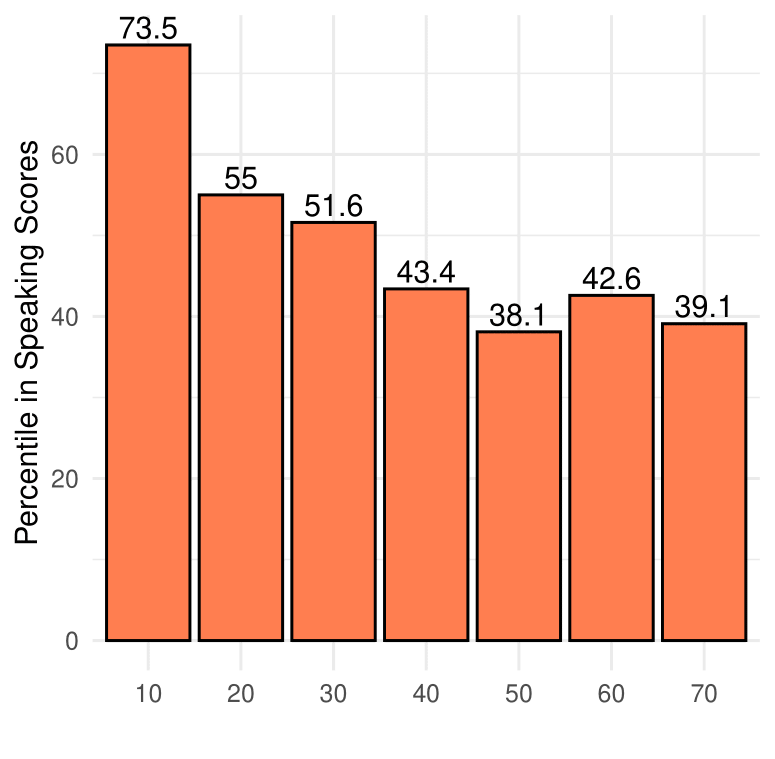
In this dataset, children in the 0-10 category did have much better speaking score percentiles than any other age category. In fact, the percentiles drop as the age category matures.
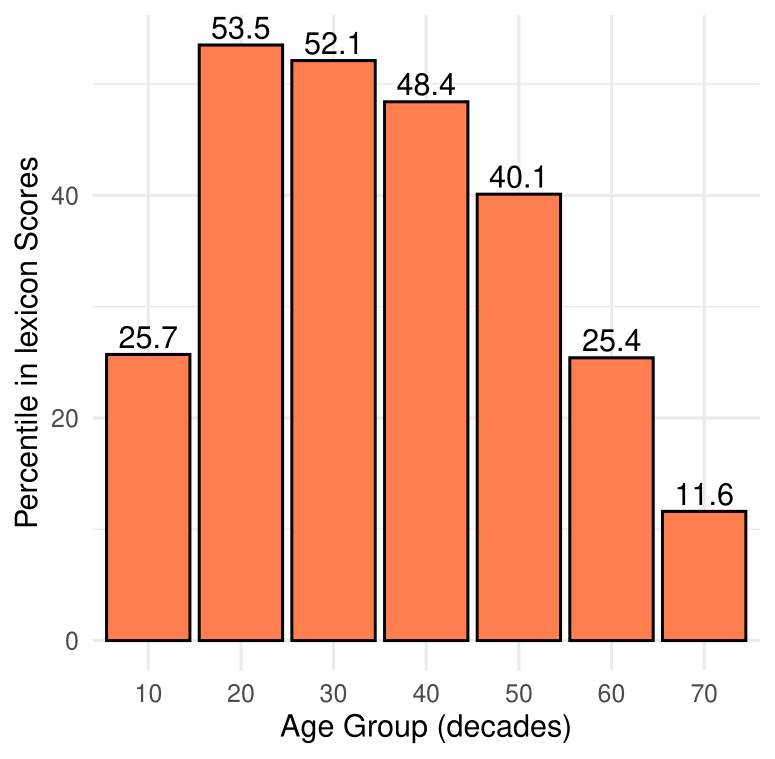
However, we see a different pattern for lexicon scores. The age category which performs the best in speaking tests is the 2nd worst performing in lexicon scores. The age groups 10-20 and 20-30 get the highest scores. This asymmetry may be due to the difficulty in learning the written word. Learning to write is more challenging than learning to speak.
The first language hypothesis
Naturally, if your first language is similar to the target language, your learning will be much easier. This is because the semantics of both languages will be similar. The grammatical structure will be more comprehensible. If the languages are derived and evolved from the same root language, the vocabulary will likely be similar.
To test this hypothesis, I clubbed languages most similar to Dutch in a group, put the rest in another group and compared the scores.
The languages most similar to Dutch are: Afrikaans, German, Danish, Swedish, English & Indonesian
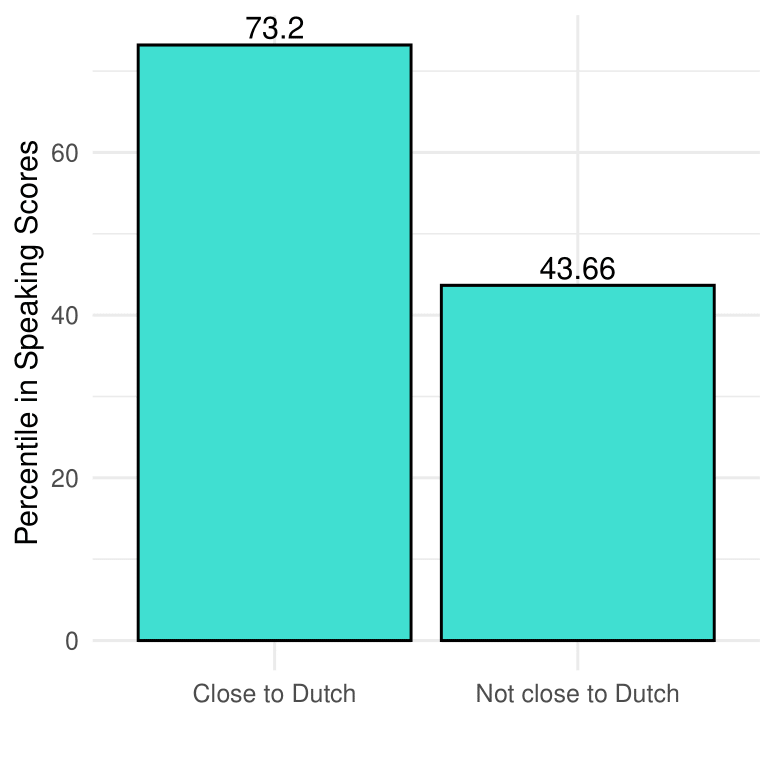
It is, in fact, true that if your first language is close to your target language, you will climb up 30 percentiles in the speaking scores of the target language.
Know someone who is learning a new language? Go ahead and send it to them!
The monolingual hypothesis
Being monolingual means that you can read and write in only one language. This limits your learning abilities as it increases communication friction with other people. It also signals that you have not been exposed to different cultures, so you will have a lot of catching up to do while learning a new language.
In the data, being monolingual decreases your percentile in the speaking scores by 10 units. However, the difference is much less for lexicon scores (3 percentile lower).
The education hypothesis
When you have more years of formal education, you will likely have learned things sequentially with easy access to tutors. You will also be exposed to different cultures in a public school, increasing your ability to learn a new language. High education also correlates with wealth, so you will likely have better access to resources that help you learn languages.
In this dataset, there are 4 levels of education:
1st level: 1-5 years of schooling
2nd level: 6-10 years of schooling
3rd level: 11-15 years of schooling
4th level: 16 or more years of schooling
Given the rationale above, as the education levels of the learner increase, the speaking scores in the target language would too.
But I found an interesting deviation from the trend. This hypothesis is only true if you go from level 1 to level 2. After level 2, if you get more educated, the scores decrease.
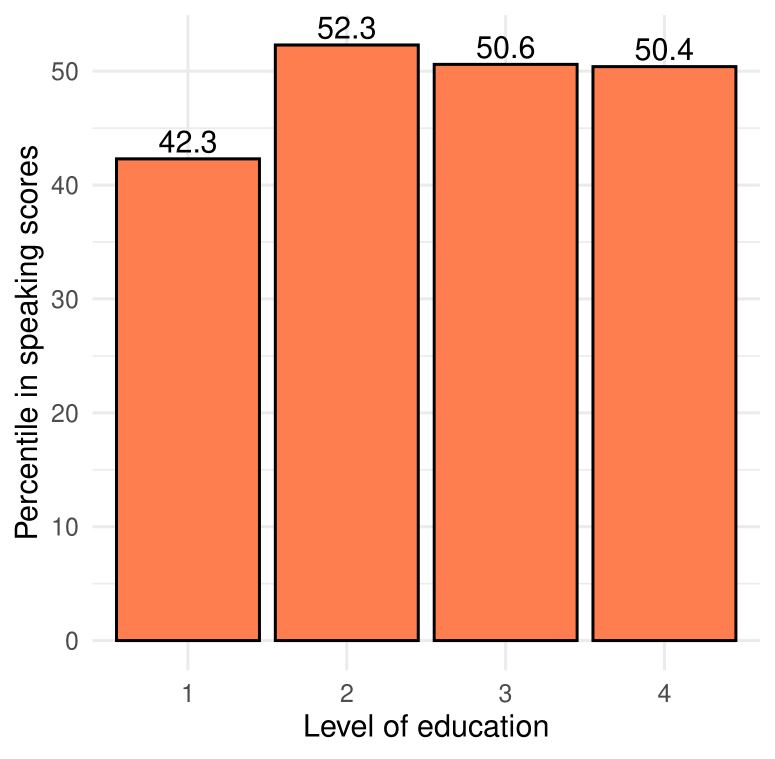
This result completely confounded me! After all, better education should translate to better learning abilities.
The missing piece lies in the monolingual hypothesis. People who are educated in the 3rd and 4th levels are more likely to be monolingual than the ones on the 1st and 2nd levels.
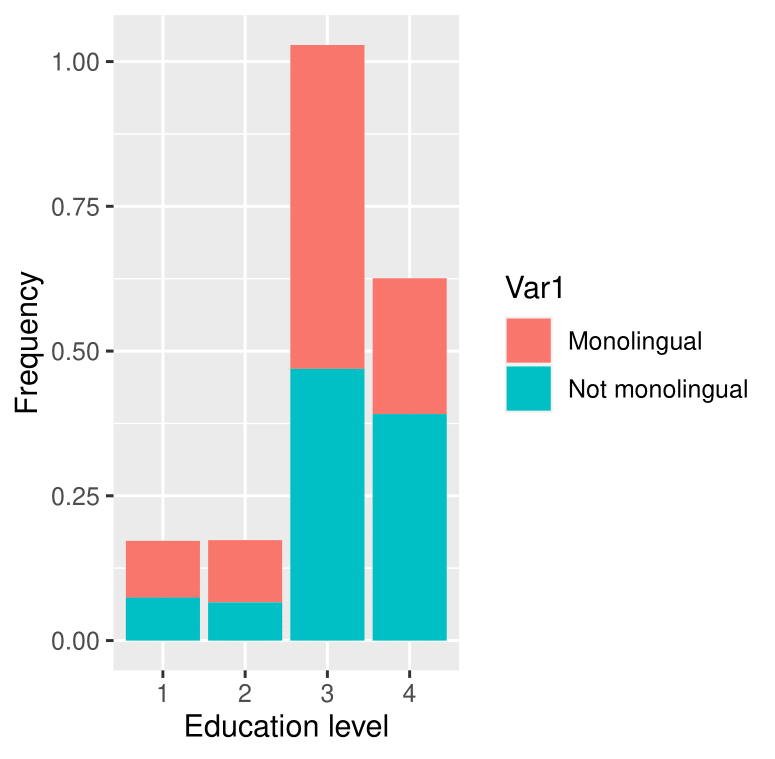
This might be because high-income countries with high education levels tend to be in the global north. In these regions, English is the dominant tongue. So, there isn’t really any necessity to learn a new language.
This analysis is mainly descriptive and does not establish causality. So, get back to Duolingo and let that streak thrive!
If you liked the visualisations and the analysis, please consider subscribing!
Comments
Nothing yet. Say the first thing.
Sign in to join the conversation.