
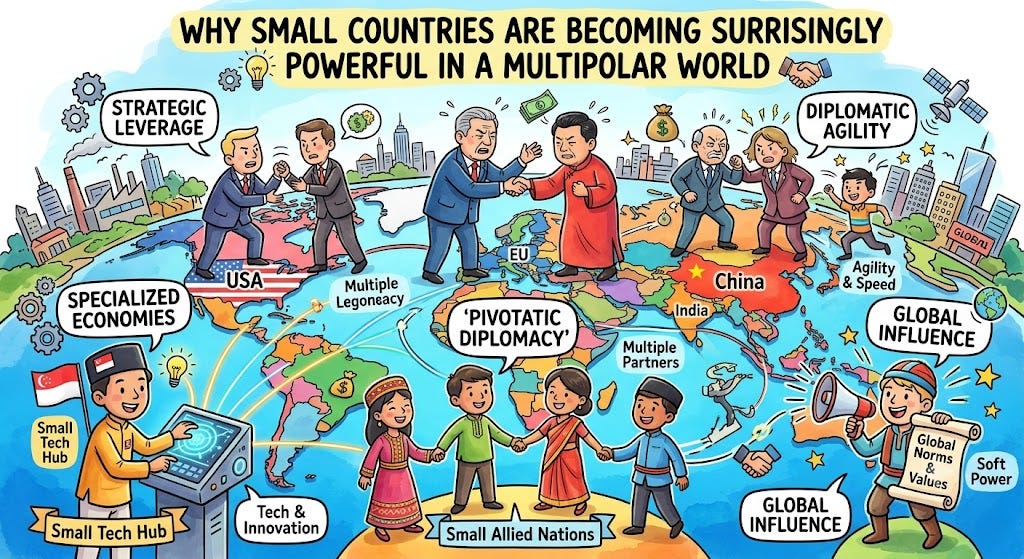
Djibouti is a country of roughly a million people, wedged onto a strip of Horn of Africa coastline you’d struggle to find on an unlabeled map. It currently hosts active military bases from the United States, China, France, Japan, Italy, and Saudi Arabia - rival and allied powers alike, within a few miles of each other, all paying rent to the same small government. Djibouti takes a 20% cut of what it charges those militaries for the privilege and funnels it straight into a sovereign wealth fund it’s explicitly trying to double within a decade. That’s not a country caught helplessly between great powers. That’s a country that figured out it’s sitting on the one asset none of those great powers can build for themselves - a specific stretch of coastline at the mouth of the Red Sea - and started billing everyone who needs it, simultaneously, without ever having to choose a side.
That’s the pattern I think explains why small and mid-sized states are having a genuinely disproportionate moment right now, and it isn’t a fluke of any one region. During the Cold War, and for a good stretch of the unipolar decades after it, being small mostly meant being told to pick a patron and stay picked - Cuba orbits Moscow, most of Latin America orbits Washington, and your leverage as a small state was basically whatever your patron decided to grant you in exchange for loyalty. A world with one dominant power, or two clearly competing ones, doesn’t have much room for a small country to extract value from being wanted by both sides, because usually only one side is seriously bidding.
A genuinely multipolar world without a clear center changes that math completely, because now there are multiple powers who each need you more than they need each other to lose you to a rival. The Belfer Center’s own list of the world’s current middle powers - Brazil, Egypt, India, Indonesia, Kazakhstan, Nigeria, Pakistan, Saudi Arabia, Singapore, South Africa, Turkey, the UAE, Vietnam - reads less like a ranking of raw strength and more like a list of countries that have each found a specific axis on which the big powers are competing to court them rather than push them around.
Qatar is probably the cleanest example of turning that dynamic into actual leverage rather than just surviving inside it. A country of under three million people has become the indispensable back channel for negotiations the great powers themselves can’t run directly - mediating ceasefire talks, hosting political offices for groups that Washington won’t formally engage but needs someone to talk to anyway, all while hosting a major US military base and maintaining serious commercial ties with China at the same time. Qatar didn’t get that role from military strength or population. It got it by making itself useful to every side simultaneously, in a way that would actually cost each of those sides something real if Qatar stopped being available to play that role.
Singapore runs a quieter version of the same hedge: US naval and air assets rotate through Changi, while Singapore remains deeply integrated into China’s Belt and Road infrastructure lending and trade networks. Neither relationship is a secret, neither side seriously demands Singapore drop the other, and Singapore’s actual strategy is to make itself valuable enough to both that neither one can afford to force the choice. That only works, notably, in a world where no single power is dominant enough to make that demand and have it stick - which is precisely the world we’re currently in.
Capital is its own version of this leverage, and it doesn’t require geography at all. Norway’s sovereign wealth fund sits at roughly $2.2 trillion - larger than the entire GDP of Spain - accumulated by a country of about 5.5 million people that simply saved its oil revenue for decades instead of spending it. That fund gives Norway a genuine seat at tables its population size would never earn it on its own, because money moving at that scale gets courted by everyone regardless of the flag flying over the country that controls it. Djibouti is explicitly trying to build a smaller version of exactly that same asset, using base-lease revenue instead of oil, which tells you the model is now something small states actively study and copy rather than stumble into by accident.
None of this makes small states powerful in the way a large military or a large economy is powerful - Djibouti can’t project force, Qatar can’t out-produce a major economy, and any of these countries could, in theory, still get steamrolled if a great power decided the cost was worth it. What’s actually changed is that the cost of steamrolling a useful small state has gone up, because in a genuinely multipolar world, mistreating the mediator, the base host, or the capital pool doesn’t just cost you that one relationship - it costs you standing with every other power watching how you treat the small states that all of you currently need something from. That’s a fundamentally different position than the Cold War client-state model, and I think it’s the real story sitting underneath most of the individual headlines about any one of these countries: smallness stopped being pure vulnerability the moment more than one great power needed something only the small state could offer.
No posts
Comments
Nothing yet. Say the first thing.
Sign in to join the conversation.