
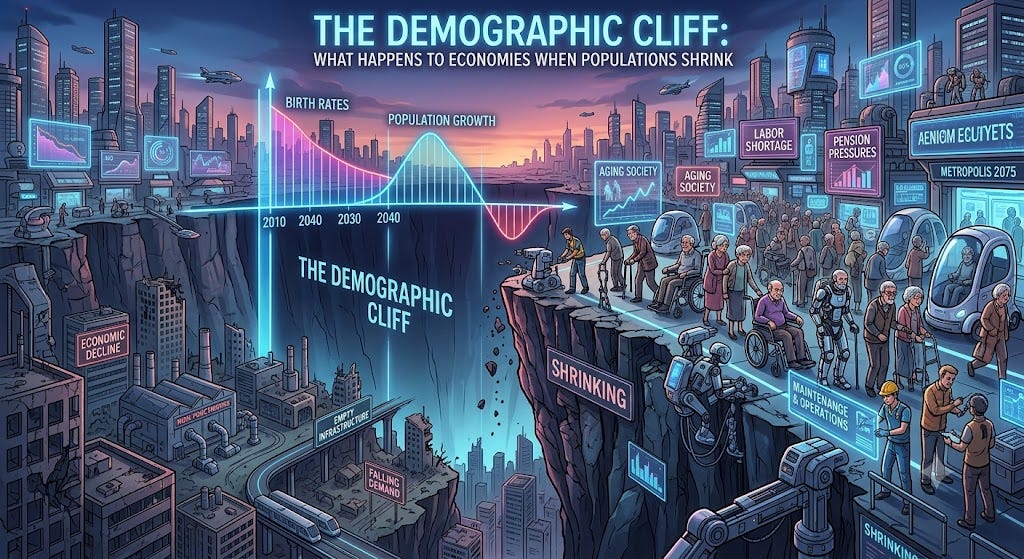
South Korea’s active-duty military has shrunk by 20% over the past six years, and it isn’t because of policy, budget cuts, or a change in strategic doctrine. It’s because the pool of 20-year-old men eligible for mandatory conscription is running out, having already fallen by more than 130,000 over the past decade. Current projections put active-duty troop strength at roughly 290,000 by 2030, 260,000 by 2035, and as low as 150,000 by 2040 - a country with an actively hostile, nuclear-armed neighbor directly across a heavily militarized border, watching its ability to field a defensive force erode for reasons that have nothing to do with any enemy action. That’s the demographic cliff stopped being an abstraction. It’s a country’s hard power shrinking on a fixed, entirely predictable timeline that nobody can negotiate, legislate, or bomb their way out of.
The fertility numbers behind that military math are almost hard to believe until you sit with them. South Korea’s total fertility rate fell from 0.78 births per woman in 2022 to around 0.65 in 2025, with some projections putting it as low as 0.59 this year - meaning the average South Korean woman is having well under one child, in a country where two would be required just to hold the population steady. The country’s total population is projected to fall from roughly 51.75 million to about 36.22 million, a level not seen since 1977. South Korea officially became a “super-aged” society in December 2024, and by some estimates the country’s total workforce could roughly halve over the next four decades. This isn’t a forecast contingent on some policy failure. Everyone who will turn 20 in the year 2045 has, definitionally, already been born or not been born. The size of that cohort is already locked in, arithmetically, today.
Japan is a few decades further down the same road, which makes it the closest thing to a preview available. Its population, sitting at roughly 126 million now, is projected to fall to about 104 million by 2050 and to a genuinely startling 72 million by the end of the century, with annual population drops already exceeding 800,000 people in recent years - functionally, an entire mid-sized city disappearing from the country every year, without a single person leaving. China, despite decades of assuming its scale made it immune to this kind of math, is now losing something like 3 million people a year on net, and demographers increasingly describe the decline as close to irreversible, meaning even a dramatic policy reversal today wouldn’t meaningfully change the trajectory for a generation, because the smaller cohort of women now in their childbearing years is itself the legacy of decisions made decades ago.
What I find most instructive is watching Japan try to actually solve this in real time, because both of its major responses are running into the same wall from different directions, and neither is remotely closing the gap. On immigration, a 2019 law opened guest-worker visas across fourteen sectors, healthcare among them, and roughly 60,000 healthcare visas were issued in the first year. That sounds significant until you set it against the actual scale of Japan’s eldercare labor shortfall, against which 60,000 workers is a rounding error. On automation, Japan has spent years pushing robotics into elder care specifically to sidestep the immigration question entirely - and the research on how that’s actually gone is genuinely counterintuitive: rather than simply replacing human caregivers, the robots have in practice increased the total number of tasks human staff have to manage, deskilled parts of the caregiving job in ways that made it less attractive to skilled workers, and raised overall costs, all while the actual labor shortage persisted underneath the shiny pilot programs. Two of the most technologically and administratively sophisticated interventions available to a wealthy, well-governed state, deployed for years, and neither has come close to solving the underlying arithmetic problem.
I think that’s the part of this story that deserves more attention than it gets: there is currently no demonstrated policy lever, anywhere, that reverses a fertility collapse of this scale once it’s underway. Cash incentives, expanded parental leave, subsidized childcare, immigration, robotics - countries have tried versions of all of them, and the honest read of the results is that they slow the decline at the margins at best, not reverse it. That’s a genuinely uncomfortable thing to say plainly, because it implies these countries aren’t dealing with a solvable policy problem so much as managing an already-locked-in demographic transition, and the actual, harder political conversation - how do you restructure a pension system, a military, an eldercare system, and an entire economic growth model around a permanently smaller and older population - is the one most governments are still avoiding in favor of announcing the next round of baby bonuses that the data already says won’t move the number enough to matter.
Comments
Nothing yet. Say the first thing.
Sign in to join the conversation.