
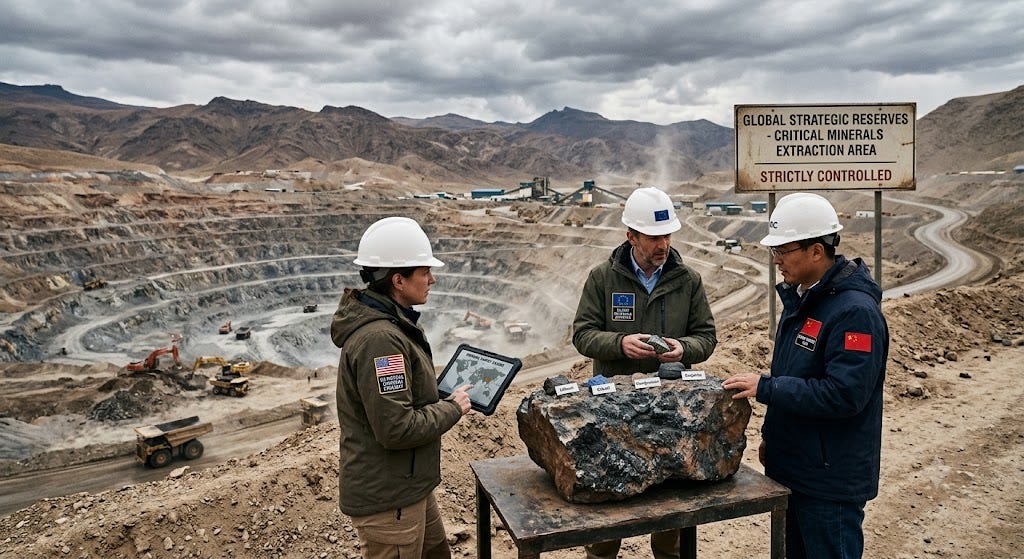
On January 1 of this year, a new layer of Chinese export controls on rare earths and related materials took effect, and within months, prices for some of the affected materials had risen sixfold. European firms trying to secure export licenses were getting approved at a rate below 25%. By May, exports of yttrium, dysprosium, and terbium - unglamorous names that happen to sit inside your phone, your car, your wind turbine, and a meaningful share of modern weapons systems - were running roughly 50% below where they sat before the controls began. No ships were sunk. No borders were crossed. And yet this is, functionally, an arms race, fought with export licenses and mineral stockpiles instead of missiles, and I think it’s the most consequential geopolitical story most people aren’t actually following in real time, because it’s boring in exactly the way that makes it easy to ignore.
The reason China can do this at all is a distinction that gets flattened in most coverage: China doesn’t actually hold most of the world’s rare earth reserves. It holds something like 35% of them. What it holds instead is roughly 90% of global rare earth processing capacity - the far less glamorous, far more capital-intensive, far harder-to-replicate step of turning raw ore into usable refined material. It’s the same story with tungsten, where China controls about 80% of supply, and antimony, where it’s closer to 60%. The lesson embedded in those numbers is one Western industrial policy spent decades ignoring: whoever controls the refining chokepoint controls the resource, regardless of where the dirt actually came out of the ground. You can mine cobalt in a dozen countries. If only one country can turn it into something usable at scale, that country holds the leverage, full stop.
What makes this genuinely feel like an arms race rather than an ordinary trade dispute is how explicitly both sides are now treating it as a matter of national security rather than commerce. The current restrictions are technically paused under a truce struck in October 2025 - but that truce is set to lapse again around October of this year, which means there’s an actual clock running on whether this whole cycle repeats, and everyone involved knows the date on the calendar. That’s not how ordinary supply and demand disputes work. That’s how arms control agreements work, complete with an expiration date both sides are quietly preparing for in advance.
And prepare is exactly what Washington has started doing, in a way that represents a genuinely striking reversal of decades of stated American economic philosophy. The Pentagon has committed roughly $2 billion specifically to rebuilding a national defense mineral stockpile - buying up to $500 million in cobalt, about $245 million in antimony, roughly $100 million in tantalum, tens of millions more in scandium - essentially reconstructing the kind of strategic materials reserve that fell out of fashion once the Cold War ended and “just buy it on the global market” became the default assumption of nearly every Western economy. A broader federal initiative, reportedly nicknamed Project Vault, is targeting more than fifty minerals for accelerated domestic mining, processing, and even deep-sea extraction. MP Materials, which operates the only active rare earth mine currently running in the US, is now effectively a Pentagon-backed national champion, building out magnet manufacturing with direct federal investment behind it.
I think the honest way to describe what’s happening is that the United States, in order to compete with a state-directed rival on state-directed terms, is quietly becoming considerably more state-directed itself - picking specific companies, guaranteeing specific purchases, subsidizing specific facilities, all in the name of resilience rather than efficiency. That’s not a criticism, exactly; it might be the correct response to the actual situation. But it’s worth naming plainly, because it represents a real abandonment of the free-market assumptions that shaped American industrial policy for the previous several decades, driven entirely by the discovery that pure market efficiency and national security turned out to be pointing in opposite directions on this specific set of materials.
The part I find most underappreciated in all of this is just how deep the current dependency runs on the other side of the ledger. More than 80% of European companies reportedly still depend on Chinese supply chains for critical minerals, and building genuinely independent alternative supply chains is estimated to take 20 to 30 years - not because the ore isn’t out there somewhere else in the world, but because building refining capacity at the scale China built it over the past two decades is an industrial undertaking on the scale of building an entire new energy grid, and nobody skips that queue with a subsidy check alone, however large. Which means whatever happens when this October’s truce deadline arrives, the leverage imbalance underneath it isn’t disappearing on any timeline shorter than a generation. Stockpiles and new mines buy time and reduce specific vulnerabilities. They don’t undo two decades of processing infrastructure built somewhere else, and I don’t think most of the coverage treating this as a story that gets “resolved” by a single trade deal or a single new mine has actually reckoned with how long that particular clock really runs.
Comments
Nothing yet. Say the first thing.
Sign in to join the conversation.