
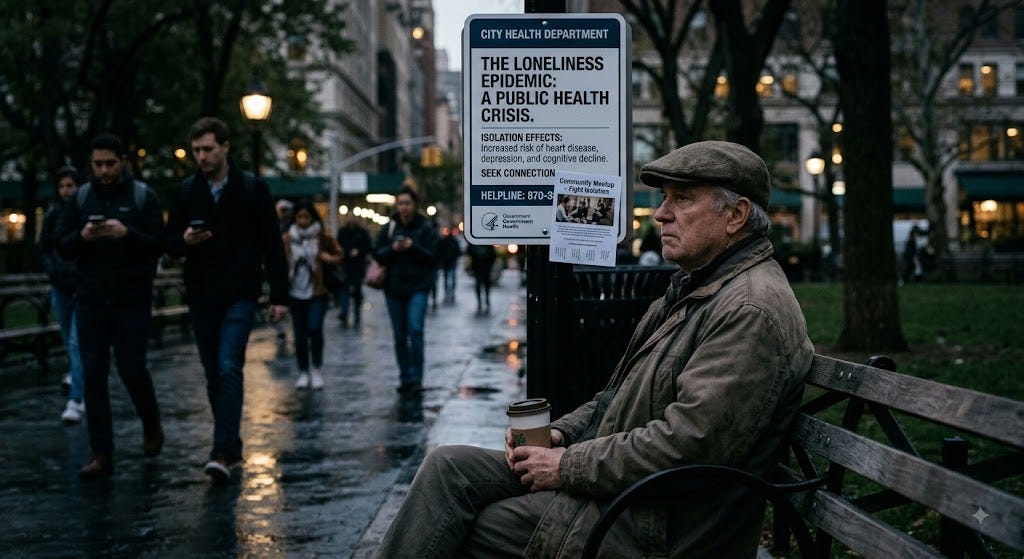
The single sentence that turned loneliness from a private sadness into a formal public health category is worth reading slowly: lacking social connection carries a mortality risk comparable to smoking up to 15 cigarettes a day, and a bigger one than obesity or physical inactivity. That’s not a metaphor a wellness newsletter came up with. It’s the actual framing the US Surgeon General used in a formal 2023 advisory, and it’s backed by a pooled analysis of 70 prospective studies finding that social isolation raises mortality risk by 26%, loneliness by another 26%, and simply living alone by 32% — each one independent of the other known risk factors researchers controlled for. Once loneliness produces numbers that sit next to smoking and obesity on the same mortality chart, it stops being a soft, sentimental topic and starts being a category public health systems are structurally required to take as seriously as anything else on that list.
The scale underneath that framing is what actually justifies calling it a crisis rather than just a sad statistic. The World Health Organization’s own 2025 accounting put persistent loneliness at roughly one in six people worldwide, linking it to something like 100 deaths every hour globally - well over 800,000 deaths a year, from a cause that doesn’t show up on a single death certificate anywhere, because loneliness kills through the diseases it accelerates rather than directly. In the US specifically, roughly half of adults now report measurable loneliness, and the generational shift is the detail I find most genuinely alarming: 17% of Americans currently report having zero close friends, compared to just 1% in 1990. That’s not a story about elderly widowers losing a spouse, which is the image loneliness research used to conjure. That’s a wholesale restructuring of how an entire population relates to other people, happening across age groups, over roughly one generation.
What I think is genuinely new here isn’t the loneliness itself - humans have presumably always experienced isolation - it’s the institutional machinery now being built to treat it as a category requiring the same infrastructure as any other major public health threat. The UK appointed the world’s first Minister for Loneliness back in 2018, a decision that read as slightly whimsical at the time and looks, in retrospect, like an early and correct call. Japan followed in 2021 and has since passed dedicated legislation, the Loneliness Countermeasures Act, giving the office actual legal and budgetary teeth rather than just a title. The World Health Organization convened its first-ever Commission on Social Connection, running from 2024 through this year, explicitly modeled on the kind of global coordinated response usually reserved for infectious disease or tobacco control. That’s the actual marker of a public health crisis in the modern bureaucratic sense: not just bad statistics, but the emergence of dedicated ministries, formal advisories, and international commissions organized specifically around the problem, which loneliness now has in a way it simply didn’t a decade ago.
The economics turn out to matter more than I expected going into this, mostly because they’re the language that moves budgets in a way mortality statistics alone often don’t. Loneliness and isolation are estimated to cost the US economy roughly $400 billion a year, and in Spain the figure works out to around 1.2% of the entire national GDP. Projected forward, the global economic cost of loneliness is estimated to reach $1.5 trillion by 2030, driven by a combination of direct healthcare spending, lost workplace productivity, and the broader social fragmentation that compounds on itself once a critical mass of a population stops maintaining the relationships that used to catch people before they fell too far. Public health crises get funded once they’re expensive in a way finance ministries can put a number on, and loneliness has now cleared that bar in a way it hadn’t even five years ago.
What strikes me most, though, is how far ahead the diagnosis is running compared to any actual treatment. Public health has multiple, well-tested playbooks for reducing smoking rates or improving diets, built up over decades of trial and error at population scale - taxation, labeling, cessation programs, school curricula, entire categories of intervention refined against real outcome data. Loneliness has almost none of that yet. The interventions currently being piloted globally are still early and largely unproven at scale: community connection programs, “social prescribing” where doctors refer patients to group activities instead of medication, loneliness screening folded into routine healthcare visits. Promising directions, all of them, and I don’t think any of them are wrong to try. But they’re nowhere near the maturity of the interventions available for other conditions carrying comparable mortality risk, which means we’ve arrived at the uncomfortable moment of knowing, with real epidemiological confidence, exactly how dangerous this is, well before we’ve figured out what actually works to fix it at the scale the numbers demand.
Comments
Nothing yet. Say the first thing.
Sign in to join the conversation.