
Bryan Johnson reportedly spends around $2 million a year on his anti-aging protocol - a full-time clinical team, continuous biomarker monitoring, quarterly MRIs, chef-prepared meals engineered down to the gram. By some outside estimates, a person willing to spend $5,000 to $20,000 over a season can capture roughly 80% of what that $2 million actually delivers. Sit with that ratio for a second, because I think it’s the single most useful number in the entire longevity conversation: the last 20% of Bryan Johnson’s protocol costs somewhere between 100 and 400 times more than the first 80%. That’s not a story about longevity science. That’s a story about diminishing returns, dressed up as a story about immortality.
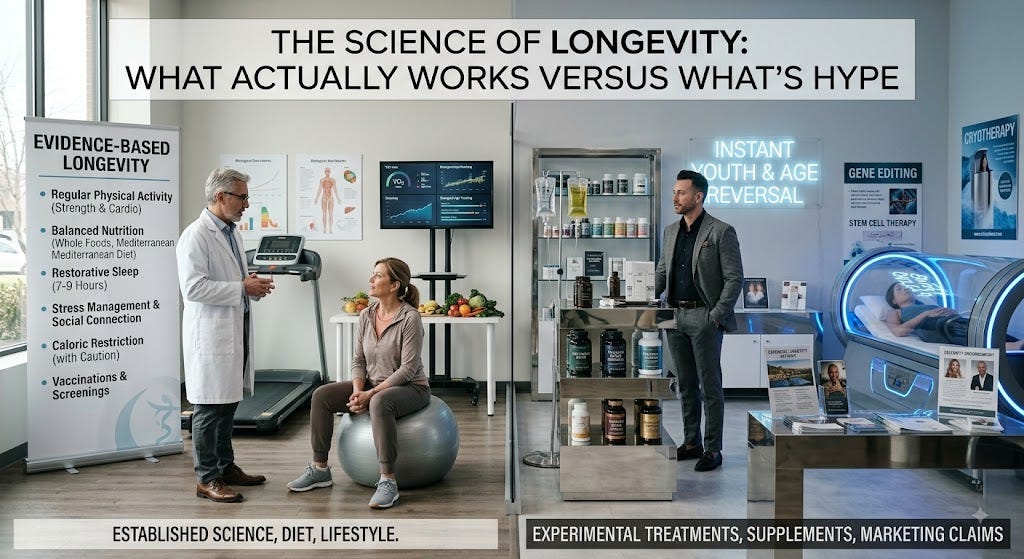
I want to sort this field into three tiers, because I think that’s the only way to talk about it honestly, and almost nothing in the online longevity conversation actually does the sorting for you before selling you something.
The first tier is boring, cheap, and has the strongest human evidence of anything discussed here, which is exactly why it gets the least attention relative to how much it actually matters. Cardiorespiratory fitness is about as close to a settled finding as this field has: a 2022 analysis in the British Journal of Sports Medicine found that each one-unit increase in a standard fitness measure called METs was associated with roughly a 13% reduction in all-cause mortality. Not a supplement. Not a biomarker panel. Just being measurably more fit than you currently are, at any starting point, tracks with a real, replicated, large-scale reduction in dying. Resistance training and adequate sleep sit in the same tier - unglamorous, essentially free, and backed by decades of the kind of large observational and interventional evidence that a single celebrity’s personal protocol will never generate no matter how many biomarkers get tracked.
The second tier is where the actually interesting scientific uncertainty lives, and it’s frustratingly split down the middle. Metformin, the decades-old diabetes drug, has more human trial evidence behind it than most of the trendier options - data associating its use with reduced all-cause mortality from cancer and cardiovascular disease, the two biggest aging-related killers. But whether it genuinely extends lifespan in people who don’t have diabetes, versus simply treating conditions that would otherwise shorten it, remains genuinely unresolved; the trial designed to answer that question directly is still working through the years it needs to produce a real answer. Rapamycin is the mirror image: extraordinarily consistent evidence of lifespan extension - reliably above 10% - across worms, flies, and mice, which is about as strong as preclinical biology gets. But chronic use in humans carries real, documented risks, including recurrent infections and elevated cholesterol, and the human safety trials specifically designed to test it in otherwise healthy older adults are only now reporting their first results. Both drugs are legitimate, serious scientific bets. Neither one is a settled human-lifespan intervention yet, and anyone telling you otherwise is several years ahead of what the actual trial data supports.
The third tier is where the marketing budget most dramatically outpaces the evidence base, and NAD+ precursors are the clearest example. There is real research showing modest improvements in physical performance measures - grip strength, gait speed - in some older adult trials. There is a vastly larger industry selling these compounds as broad anti-aging nutraceuticals based on a much thinner evidentiary foundation than the marketing implies, riding on genuinely interesting cellular biology that hasn’t yet translated into the sweeping human outcomes being sold alongside it. Epigenetic clocks, the biological-age tests increasingly used to justify entire protocols, sit in the same tier for a related reason: their accuracy and what they actually measure are still genuinely debated inside the field that invented them, which makes using one person’s before-and-after clock reading as proof a $2 million-a-year regimen works a fairly weak form of evidence, no matter how compelling the chart looks. A sample size of one, run by someone financially and reputationally invested in the outcome, using a measurement tool whose validity is still an open scientific question, is not a result. It’s a very expensive anecdote.
What I take from sorting it this way is that the actual, defensible longevity stack available to almost anyone looks nothing like what gets the engagement online. It’s exercise, consistently, at a real intensity, for years. It’s sleep, protected like it matters, because it does. It’s not smoking, keeping weight in a healthy range, and getting genuinely boring, well-established preventive care instead of a quarterly full-body MRI scan whose downstream anxiety and false-positive rate most of its enthusiastic proponents never mention. The drugs might matter enormously in another decade, once the human trials currently running finish running. The supplements and the biological-age tests, on the current evidence, are mostly buying a feeling of control over a process that, so far, still yields most of its actual returns to the same handful of unglamorous habits it always has.
No posts
Comments
Nothing yet. Say the first thing.
Sign in to join the conversation.