
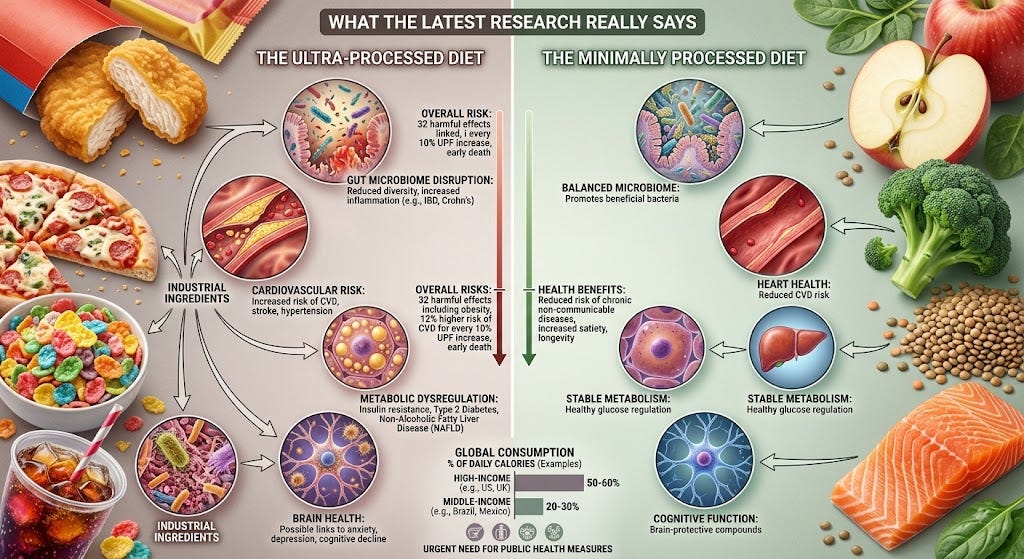
The single study most of the ultra-processed food alarm actually rests on involved twenty adults, two weeks, and a hospital ward. Researchers at the NIH’s Clinical Center put volunteers on an ultra-processed diet for two weeks and an unprocessed diet for another two, each carefully matched for calories, sugar, fat, fiber, and macronutrients on paper, then let people eat as much as they wanted. On the ultra-processed diet, people ate roughly 500 more calories a day and gained weight. On the unprocessed diet, on the same nominal nutrition profile, they lost weight. People also physically ate the ultra-processed food faster - about 17 calories a minute faster - fast enough, the researchers suggested, that the body’s own fullness signals couldn’t keep pace with intake before the meal was already over. That’s a genuinely well-designed, causal, inpatient trial, published in a serious journal, and it’s the closest thing this entire field has to a smoking gun. It’s also n=20, two weeks per condition, which is a very small, very short foundation for the scale of policy now being built on top of it.
Here’s where the more recent research actually complicates the tidy version of the story rather than confirming it further, which I think matters more than most coverage lets on. A newer crossover trial took the same basic design - swap people between processing levels, watch what happens - but this time matched both diets to standard dietary guidelines rather than just matching them to each other’s raw macros. The result: people lost weight and improved metabolic markers on both the minimally processed diet and the ultra-processed one, as long as each version actually followed sound nutritional guidelines. That’s a genuinely important wrinkle. It suggests “ultra-processed” as a category might be doing less causal work on its own than the term implies, and that a food’s actual nutrient composition - fiber, protein, energy density, added sugar - may be carrying more of the real effect than the processing label attached to it.
The classification system underneath all of this turns out to be shakier than the confident headlines suggest, too. NOVA, the four-tier system that sorts food into “ultra-processed” versus everything else, was built by nutrition researchers roughly fifteen years ago and has become the default framework nearly every subsequent study uses. But inter-rater reliability testing - different trained evaluators independently categorizing the same foods - has found real disagreement in practice: one French study found only 55% consistency between evaluators on what actually counts as ultra-processed, while a separate US analysis found better but still imperfect agreement, around 88%. When trained nutrition scientists can’t consistently agree on which bucket a given food belongs in, building sweeping public health claims on comparisons across that bucket gets shakier than the confidence of the coverage usually lets on. Group four of the NOVA system in particular is enormous and wildly heterogeneous — it lumps a mass-produced snack cake in with a store-bought whole-grain bread and a protein bar formulated by a sports nutritionist, on the theory that shared manufacturing process matters more than wildly different nutrient profiles, which is exactly the assumption the newer trial data is starting to push back against.
None of that means the original alarm was wrong, to be clear - I don’t think it was. Something in the Hall study’s ultra-processed arm drove people to eat 500 more calories a day without noticing, and that’s a real, replicated-enough-to-take-seriously phenomenon regardless of exactly which mechanism turns out to be doing the work. What’s genuinely unresolved is whether “processing” itself is the active ingredient, or whether processing is mostly just a reliable marker for a cluster of other properties - low fiber, high energy density, engineered palatability, fast eating speed - that could in principle be present or absent independent of how industrially a food was made. That’s not a pedantic distinction. It’s the difference between “avoid anything processed” and “pay attention to fiber, energy density, and how fast a food lets you eat it,” which point toward very different diets and very different regulatory approaches.
And regulation is where this is heading regardless of how settled the underlying science actually is. The FDA opened a formal public comment process in mid-2025 specifically to develop a uniform legal definition of ultra-processed food, and the newest federal dietary guidelines now explicitly discourage highly processed foods, added sugars, and artificial additives as a matter of official policy. As of earlier this year, no agency had actually finalized a binding definition or rule - turning any of this into enforceable regulation still requires either formal rulemaking or new legislation, neither of which has happened yet. Which means the government is currently racing to build a legal category around a scientific classification that trained researchers themselves can’t reliably agree on in roughly half to one-tenth of cases, based substantially on one small, short, genuinely excellent but genuinely narrow inpatient trial. I think the honest takeaway is unglamorous, same as most of this space: pay real attention to fiber, protein, and how easy a food is to eat quickly and mindlessly, rather than sorting your pantry strictly by processing category - because the research increasingly suggests that’s closer to what’s actually driving the effect than the word “processed” ever was on its own.
Comments
Nothing yet. Say the first thing.
Sign in to join the conversation.