
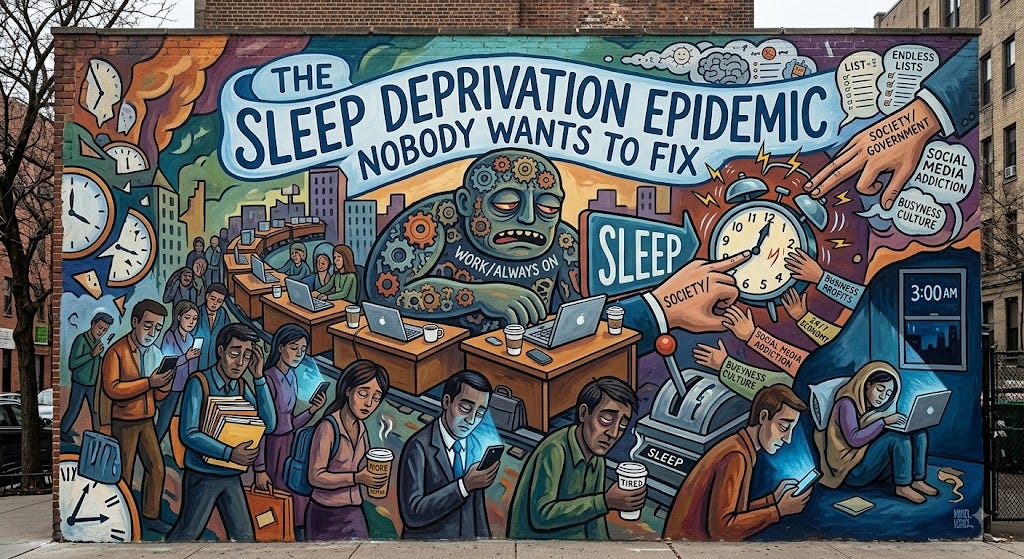
The average American adult is now sleeping about 7.13 hours a night, according to a Yale-led analysis of nearly 92,000 national health survey respondents - technically inside the recommended 7-to-9 hour range, but sitting right on the bottom edge of it, which is a bit like saying your car is technically still running on the fumes light. A separate federal data brief released this April found 30.5% of US adults report short sleep duration on a typical day. This isn’t a niche problem affecting insomniacs and new parents. It’s something like a third of the adult population, running persistently under-slept, as a stable and apparently tolerated feature of how the country functions rather than an emergency anyone’s treating as one.
The economic numbers are the part I find genuinely strange to sit with, because they’re large enough that you’d expect them to move policy on their own, and they mostly haven’t. Insufficient sleep is estimated to cost the US economy up to $411 billion a year in lost productivity alone. Widen that lens across five industrialized economies and the combined figure climbs to roughly $680 billion annually, driven by sick days, reduced output, and higher healthcare spending. Canada’s version of the same math puts its national cost at up to $21.4 billion a year, or about 1.35% of the entire country’s GDP. For comparison, that’s the kind of number that triggers immediate legislative action when it shows up attached to almost any other cause - a specific disease, a specific industrial hazard, a specific piece of infrastructure. Attached to “people aren’t sleeping enough,” it mostly just sits in reports.
I think the honest reason nobody’s fixing this at scale is that the actual causes are baked into things society has decided are non-negotiable, and no single actor has both the incentive and the authority to change any of them. Work culture treats early starts and long hours as a proxy for seriousness, regardless of what it does to the people producing the work. School schedules get built around bus logistics, teacher contracts, and after-school sports far more than around adolescent sleep biology, even though the biology here is unusually well understood and unusually ignored. And screens sit in nearly every bedroom in the country, actively fighting the exact circadian signals that are supposed to tell a body it’s time to wind down. None of these are mysteries. All of them are structurally difficult to change precisely because changing any one of them means some other institution - an employer, a school district, a tech company - has to absorb a cost or an inconvenience that sleep deprivation currently offloads onto individuals instead.
School start times are the clearest place to watch this play out, because it’s the one part of the problem with genuinely strong evidence and at least one real policy intervention already tested at scale. Teenagers experience a well-documented biological shift in their circadian rhythm that makes early waking genuinely harder for them, not just less convenient - which means a 7:30 a.m. first bell isn’t asking teenagers to be more disciplined, it’s asking an entire age group to override actual physiology on a five-day-a-week basis for years. A Swiss high school that let students choose flexible start times found they overwhelmingly picked later ones, slept about 45 minutes more per school night on average, and showed measurable improvements in well-being and academic performance as a result. California passed an actual law in 2022 requiring public high schools to start no earlier than 8:30 a.m. and middle schools no earlier than 8 a.m. - a real, binding, statewide mandate built directly on this evidence. And virtually nowhere else in the country has followed, years later, despite the evidence being just as available to every other state legislature as it was to California’s.
That gap, more than any single statistic, is what makes me think “nobody wants to fix it” is a more accurate description than “nobody knows how.” We have a state-level case study proving the intervention works, sitting right next to a well-quantified national cost running into the hundreds of billions of dollars, and the response almost everywhere outside one state has been silence rather than replication. I don’t think that’s because policymakers doubt the science. I think it’s because fixing it requires someone with real institutional power - a school board rearranging bus routes and after-school schedules, an employer rethinking what “committed” looks like, a legislature willing to spend political capital on something that reads as a lifestyle issue rather than a crisis to absorb a real, immediate cost in exchange for a diffuse, population-level benefit that mostly shows up in numbers too abstract to feel urgent. Until that changes, the $680 billion keeps compounding quietly, one under-slept year at a time, treated less like an emergency and more like the weather.
No posts
Comments
Nothing yet. Say the first thing.
Sign in to join the conversation.