
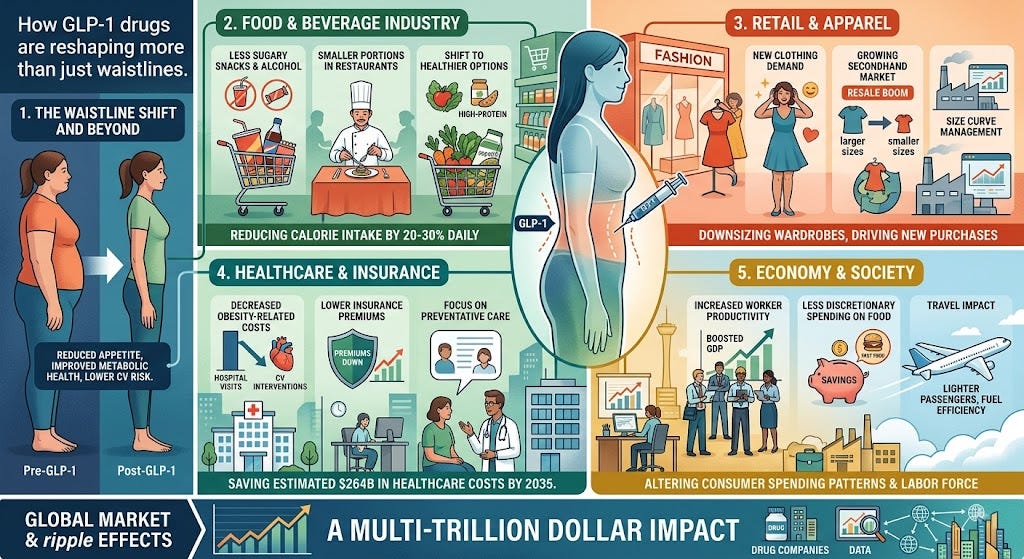
About 18% of American adults are currently on a GLP-1 medication, up from roughly 14% just a year earlier, with projections putting total US users at around 25 million by the end of the decade, up from about 10 million now. Eli Lilly’s tirzepatide is on track to become the best-selling drug on Earth this year, north of $45 billion in global sales, edging out Novo Nordisk’s semaglutide family at a mere $39.5 billion. Those numbers alone would make this one of the biggest pharmaceutical stories in a generation. What makes it genuinely bigger than that is how many industries and disease categories that have nothing obviously to do with each other are now visibly bending around a class of drug originally approved to manage blood sugar in diabetics.
Start with what these drugs are doing to what people actually buy, because the food industry has been running its own real-time experiment on tens of millions of people for a few years now, and the early data is more specific than “people eat less.” Users of GLP-1 drugs report eating roughly 55% more fruits and vegetables and drinking about 65% fewer sugary beverages. Frozen food has taken the single largest hit of any packaged-food category, with dollar spending down about three points over a user’s first year on the medication, while chips, cookies, soda, ice cream, and candy are all seeing meaningfully lower volumes. That’s not a story about people simply eating less of everything proportionally. It’s a story about appetite itself getting restructured - less compulsive snacking and hyper-palatable food, more of the food you’d choose if your cravings weren’t doing quite so much of the deciding for you.
Alcohol is where the effect looks even sharper. Roughly one in five GLP-1 users reports drinking less since starting the medication, and one industry analysis estimates the drugs could shave something like 2.5% off cumulative US alcohol consumption by 2035 - a genuinely significant dent in a mature, heavily marketed industry, driven entirely by a diabetes and obesity drug nobody designed with beer sales in mind. Some reporting on heavy users finds consumption dropping by well over half. And it’s not simply less drinking across the board - users report shifting toward fewer, more premium drinks rather than uniformly cutting every category, which tells you this isn’t blunt appetite suppression so much as a genuine dampening of the compulsive, reach-for-another-one impulse specifically.
That same mechanism - quieting a compulsive reward-seeking loop rather than just suppressing hunger - is what’s making addiction researchers genuinely excited, carefully. A study of more than 600,000 veterans with type 2 diabetes found GLP-1 use was associated with a lower risk of substance use disorders across essentially every major drug class, along with fewer overdoses and related hospitalizations. None of that has translated into an FDA approval for treating addiction directly yet, and the researchers themselves are careful to call the evidence preliminary rather than settled. But a drug developed for blood sugar control showing up as a plausible addiction intervention, independent of any weight-loss effect, is the kind of finding that reshapes how an entire field thinks about the underlying biology of craving itself.
The cardiovascular, kidney, and brain data extend the story even further from the original weight-loss headline. A large trial found semaglutide meaningfully reduced kidney complications in patients with both type 2 diabetes and chronic kidney disease, with benefits that showed up independent of how much weight patients actually lost - meaning the drug appears to be doing something protective at the organ level beyond simply making people lighter. Separate research has linked GLP-1 use to slower cognitive decline and reduced brain shrinkage in early Alzheimer’s studies, and a much larger analysis of nearly 2.5 million patient records found people prescribed GLP-1s had a lower relative risk of developing dementia compared to those on other diabetes medications. Nobody set out to build an Alzheimer’s drug. They may have built one anyway, as a side effect of a side effect.
None of this is arriving without real costs, and I think the two most serious ones are getting less attention than the upside. Patients losing more than 15% of body weight on high-dose GLP-1 treatment see an average lean muscle mass decline of 10 to 15%, with older adults and anyone starting from low muscle mass at meaningfully higher risk - a real tradeoff that combining the drug with protein intake and resistance training appears to meaningfully offset, but only for patients who actually get that guidance, which not everyone prescribing these drugs at scale is consistently providing. And the supply side has its own mess: the FDA moved this year to permanently close the compounding loophole that let non-brand-name versions of these drugs reach patients faster and cheaper, after receiving more than 455 adverse event reports tied to compounded semaglutide and over 320 tied to compounded tirzepatide. That’s the regulatory system racing to catch up with a market that scaled faster than the safety infrastructure meant to govern it - which is, in miniature, the story of this entire drug class. The science keeps finding new systems in the body these drugs touch faster than the healthcare system, the food industry, or the regulators tracking them can fully absorb what that means.
No posts
Comments
Nothing yet. Say the first thing.
Sign in to join the conversation.