
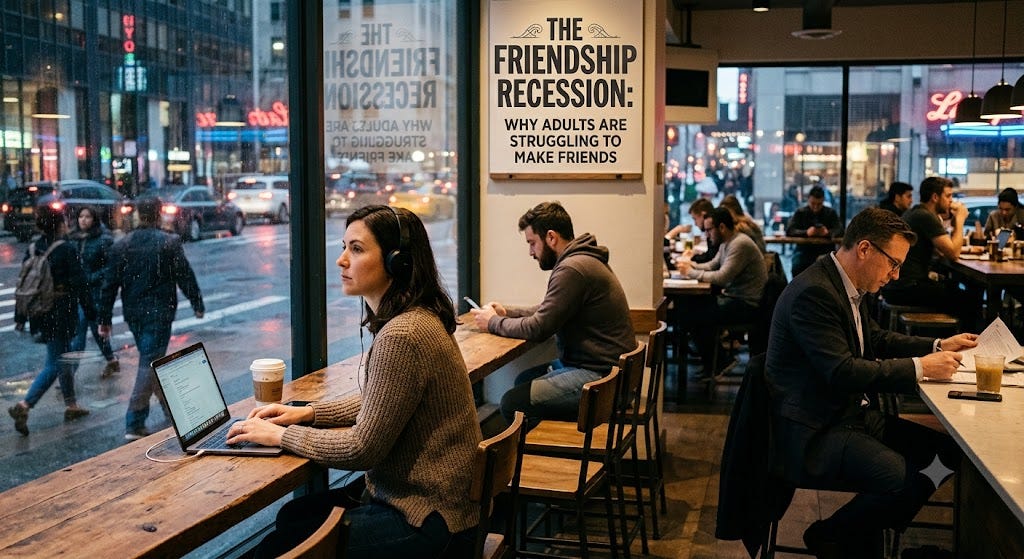
A University of Kansas researcher named Jeffrey Hall put an actual number on something that used to be pure folk wisdom: it takes roughly 50 hours together to turn a stranger into a casual friend, another 40 or so - 90 hours total - to become an actual friend, and more than 200 hours before someone earns the label “close friend.” That’s not a vague estimate. It came from surveying people who’d recently moved to a new city and asking them to clock the actual hours spent with someone they’d met there, then mapping those hours against how close the relationship had become. Once you have that number, the modern adult friendship shortage stops looking like a mystery and starts looking like simple arithmetic that most adults are structurally set up to fail.
Here’s the arithmetic: a typical working adult, managing a job, a household, and often a family, has something like 5 to 10 discretionary hours a week actually available to spend with a new acquaintance - and that’s a generous estimate, assuming no other obligations eat into it. At that rate, reaching the 200-hour close-friend threshold takes somewhere between five months and nearly a year of consistent, dedicated time with one specific person, assuming you don’t miss a week and don’t split that time across the other new people you’d also need to meet to build any kind of real social circle. Compare that to a college dorm, where proximity alone hands you dozens of hours a week with the same small group of people without either of you scheduling anything. The friendship recession isn’t really a story about people forgetting how to connect. It’s a story about adult life quietly removing the raw material - unstructured, repeated, chosen time - that friendship formation has always actually run on.
The word “chosen” in that sentence matters more than it sounds like it should, because Hall’s research found something that undercuts a comforting assumption most working adults make without examining it: hours spent together because a job or a class requires it count for meaningfully less than hours people actively decide to spend together. Sitting near a coworker eight hours a day doesn’t accumulate toward closeness the way a chosen dinner or a chosen hike does, even if the raw hour totals look similar on paper. And digital interaction - texting, liking posts, the entire daily rhythm of staying “in touch” through a phone - contributes close to zero toward actually building the relationship. You can spend real time on a friendship in the sense of minutes elapsed, and still not be spending time on it in the sense that actually moves someone from acquaintance to close friend, which is precisely the trap a huge amount of modern digitally-mediated adult social life is quietly falling into.
The statistics on where this has actually landed the country are stark enough to read like a typo the first time you see them. The share of Americans reporting zero close friends climbed from 3% in 1990 to 12% more recently, and then kept climbing - up to 17% between 2021 and 2024 alone, a jump in just a few years. The average number of close friends per person fell from 2.94 to 2.23. And the decline has hit men in a specifically brutal, gendered way: the share of men reporting six or more close friends was cut roughly in half since 1990, from 55% down to 27%, while the share of men with zero close friends jumped fivefold, from 3% to 15%. One in five unmarried, unpartnered American men currently reports having no close friends at all - meaning an entire category of men have effectively lost the two traditional channels, a partner and a friend group, simultaneously. Only 21% of men say they got emotional support from a friend in the past week, against 41% of women, which tells you this isn’t just about raw friend counts. It’s about whether the friendships that do exist are actually doing the emotional work friendships are supposed to do.
What used to backstop all of this arithmetic, quietly, was what sociologists call third places - the bowling league, the church group, the regular bar, the workplace with enough stability that colleagues turned into something more over years of overlapping hours. Those venues didn’t require anyone to deliberately schedule friendship; they just generated the repeated, chosen-enough contact that accumulated toward the 200-hour threshold as a side effect of showing up. As those institutions have thinned out - replaced by remote work, higher household mobility, and leisure time increasingly spent on individual screens rather than shared spaces - adults lost the machinery that used to generate close friendships almost automatically, without leaving behind any replacement mechanism that produces the same kind of unstructured, recurring, chosen time. Which means the honest, unglamorous fix isn’t a better app or a cleverer social strategy. It’s blocking out actual, repeated, chosen hours with the same handful of people, month after month, in a culture that currently makes that specific behavior harder to sustain than at almost any point on record.
No posts
Comments
Nothing yet. Say the first thing.
Sign in to join the conversation.