
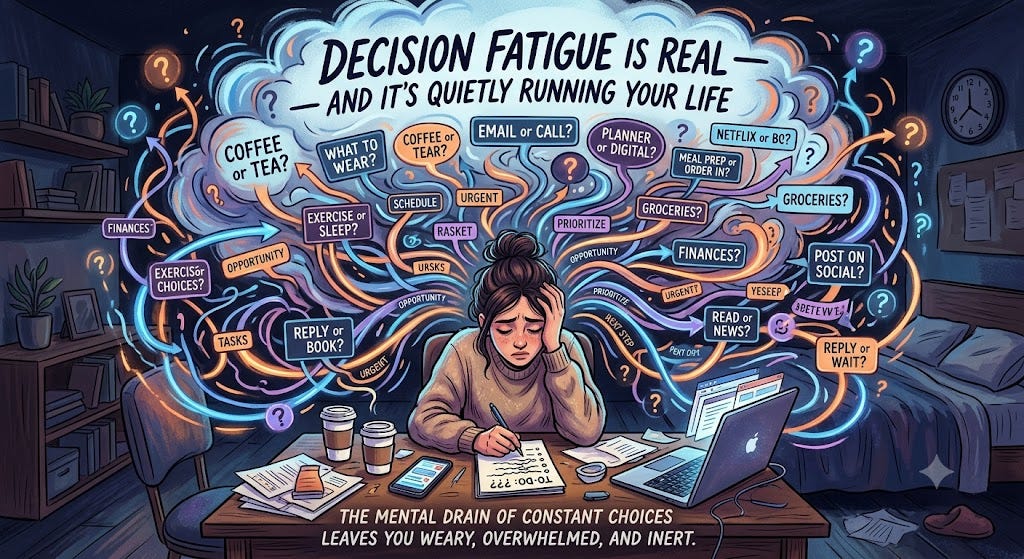
The single most famous piece of evidence for decision fatigue is a study of Israeli parole judges, and it’s worth stating the actual finding before getting to the part almost nobody mentions afterward. Researchers tracking real parole hearings found that the odds of a prisoner getting a favorable ruling started around 65% at the beginning of a judge’s session, decayed steadily toward almost zero as the session wore on, and then snapped straight back up to roughly 65% right after the judge took a food break. It’s a genuinely striking pattern, it got covered everywhere, and it became the go-to real-world proof that willpower and judgment run on some kind of depletable fuel tank that empties over the course of a day.
Here’s the part that gets left out of most retellings: that same study has since been re-examined, and the explanation researchers now consider more likely isn’t judicial hunger at all. It’s case ordering and scheduling - the pattern is consistent with easier or more clear-cut cases getting slotted toward the end of a docket, or with more complex, unresolved cases piling up earlier in a session. The actual statistical pattern in the data - outcomes getting worse for defendants across a session, then resetting after a break - appears to be real. The specific causal story everyone repeated about it, that the judges’ willpower was running out like a phone battery, is now considered considerably shakier than the headline implied.
That gap between “the pattern is real” and “the explanation was wrong” turns out to describe the entire field, not just one study. The broader theory behind decision fatigue, called ego depletion - the idea that self-control draws from a single, finite psychological resource that gets used up with each act of willpower, the same way a muscle tires from repeated lifting - went through a brutal reckoning in 2016, when 23 independent labs ran a coordinated, pre-registered replication involving 2,141 participants. The effect size they found was 0.04. Statistically indistinguishable from nothing. A theory that had shaped decades of self-help advice, corporate scheduling wisdom, and a small industry of productivity books turned out to rest on a foundation that couldn’t survive a well-designed group of researchers actually trying to reproduce it.
So is decision fatigue real or isn’t it? The honest answer, and I think it’s a more useful one than either the original hype or the debunking headlines that followed it, is that the phenomenon and the mechanism are two different claims, and only one of them collapsed. The observation that a long sequence of decisions degrades the quality of the decisions that follow is still a robust, practically significant finding across plenty of well-designed research. What’s been seriously undermined is the specific story about why - that it’s a finite resource literally draining like fuel, identical regardless of what the decisions are about or how much you care about them.
The theory that’s replaced it is, I think, genuinely more useful precisely because it’s less mechanical. Researchers now generally frame what looks like depletion as a shift in motivation and attention rather than a resource running dry - your brain isn’t running out of willpower units, it’s recalculating, in real time, whether the task in front of you is still worth the effort relative to whatever else you could be doing instead. One well-designed set of experiments testing this directly found that the objective value of an alternative activity didn’t automatically produce more fatigue on its own - but people who personally valued the alternative more reported getting more fatigued while working and less fatigued while relaxing, exactly what you’d expect if fatigue tracks a live cost-benefit calculation rather than a fixed tank slowly running to empty.
What I take from sitting with both halves of this is that decision fatigue absolutely is running your life quietly in the background - just not through the mechanism the popular version describes. The famous trick of always wearing the same outfit or eating the same lunch every day probably doesn’t work by “conserving willpower units” the way it’s usually explained. It works by removing low-value competing decisions that would otherwise pull your brain’s constant, ongoing cost-benefit calculation away from the thing that actually matters that day. The practical advice ends up looking almost identical either way - make your most important decisions early, reduce the number of trivial ones competing for attention, protect your best hours for what actually counts - which might be the most reassuring thing about this whole story. The mechanism researchers believed in for years turned out to be wrong. The advice built on top of it mostly still holds, just for a quieter, less dramatic reason than a battery running down.
No posts
Comments
Nothing yet. Say the first thing.
Sign in to join the conversation.