
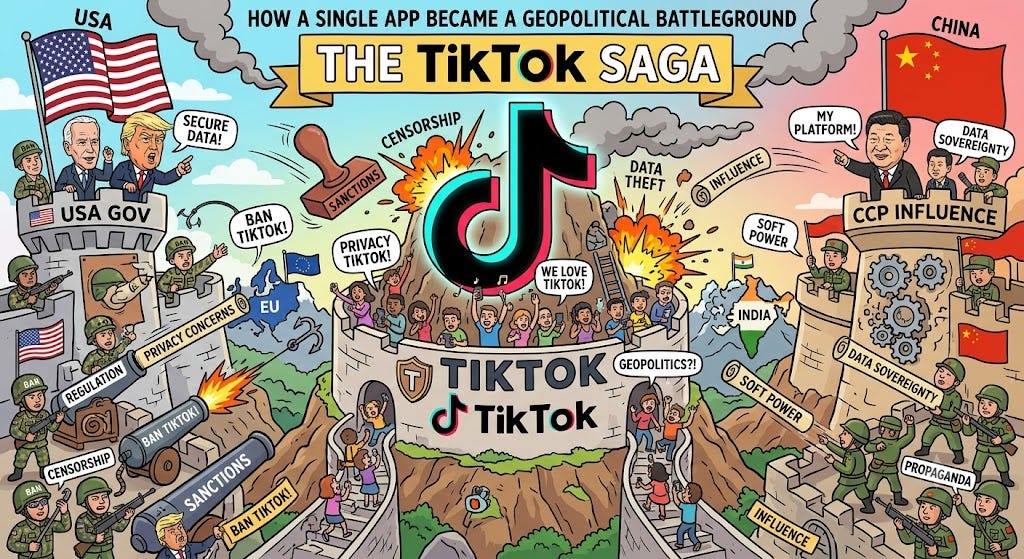
On January 22 of this year, a joint venture called TikTok USDS LLC was formally established, closing out a fight that had, by that point, involved an act of Congress, a Supreme Court ruling, at least one brief nationwide shutdown of the app, and a deal reportedly valued around $14 billion. Oracle, Silver Lake, and the Abu Dhabi state investment vehicle MGX collectively took 45% of the new US entity. ByteDance, the original Chinese parent, was pushed down to just under 20%. The rest went to other non-Chinese investors, all arranged specifically so the joint venture could be legally described as “majority-owned and controlled by United States persons” - the exact phrase the underlying 2024 law required before TikTok could keep operating in America at all. A dance app that mostly exists to show teenagers other teenagers dancing needed a Supreme Court case and a sovereign wealth fund to keep running. That sentence alone tells you something has genuinely changed about what a consumer app is allowed to be in 2026.
I think the useful way to understand how a video app got here is to notice that the actual national security worry was never really about the videos. It was about two things sitting underneath them: whether a company ultimately subject to Chinese law could be compelled to hand over the data of roughly 170 million American users, and whether the recommendation algorithm - the actual engine deciding what a huge fraction of a generation sees every day - could be quietly steered by a foreign government to shape what an entire country pays attention to. Both concerns are real, structurally, regardless of whether anyone can point to a specific instance of either one actually happening. That distinction between “this could theoretically be weaponized” and “this has been proven to be weaponized” sat at the center of the entire fight, and it’s still sitting there, mostly unresolved, even after the deal closed.
Here’s the detail I think undercuts how cleanly this story gets told as “resolved”: the new US joint venture isn’t building its own recommendation algorithm from scratch. It’s licensing a copy of ByteDance’s existing algorithm, then retraining it “from the ground up” under Oracle’s oversight. That’s a meaningfully different thing than replacing the technology, and it’s exactly the gap Senator Ed Markey has been publicly pressing on since the deal closed - sending letters to both TikTok’s new US entity and Oracle questioning whether the arrangement actually satisfies the guardrails Congress wrote into law, or just relabels the same underlying system under new corporate ownership. His specific, pointed question - whether a source code review can meaningfully detect algorithmic manipulation baked into a system this complex - is one nobody involved in the deal has given a fully satisfying public answer to. You can restructure who owns the company. Verifying that you’ve actually severed the technical dependency is a different, much harder problem, and four months after the ink dried, a sitting US senator was still saying publicly that Americans don’t have enough information to know whether that problem got solved or just renamed.
What strikes me most, stepping back from the specific mechanics, is how completely unremarkable it’s become for a consumer app’s ownership structure to require this level of state involvement. A decade ago, the idea that the US government would force the sale of a social media platform, that the deal would need to survive a constitutional challenge at the Supreme Court, and that a Gulf state’s sovereign fund would end up as a meaningful equity holder in the outcome - all of that would have read as a wild hypothetical. Now it’s simply what happened, covered with roughly the same tone as any other large corporate restructuring, because the previous several years of trade wars, chip export controls, and critical mineral fights had already normalized treating major technology platforms as instruments of state power rather than just products. TikTok didn’t create that shift. It arrived at the exact moment that shift had already happened, which is why an app about lip-syncing and cooking videos ended up as possibly the single most litigated, most legislated, most diplomatically fraught piece of software in recent American history.
I don’t think this is the last time this exact fight happens, either - it’s the template now. Any platform with enough scale, enough data, and enough algorithmic influence over public attention is going to face some version of this question going forward, regardless of what it’s actually built to do on the surface. The TikTok deal didn’t settle the underlying tension between global platforms and national security concerns. It just produced the first fully worked example of how that tension gets resolved when a government actually decides to force the issue - through ownership restructuring, through partial technology transfer, through a settlement that satisfies the letter of a law while leaving open, serious questions about whether it satisfies the actual concern the law was written to address. The next platform this happens to, and there will be one, gets to start from this playbook instead of inventing the process from scratch. That’s the real legacy of the fight, more than any specific clause in the ownership agreement.
Comments
Nothing yet. Say the first thing.
Sign in to join the conversation.