
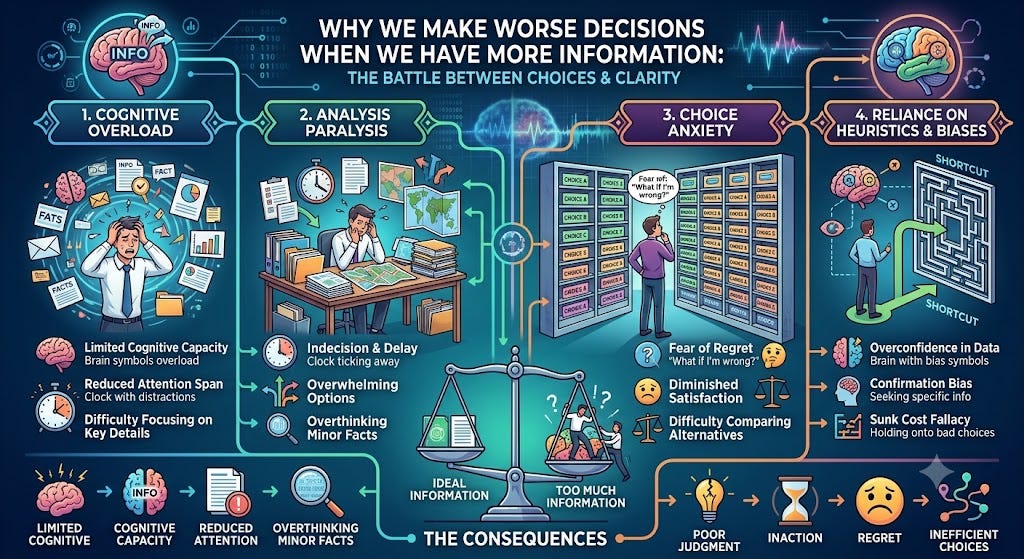
The most famous study in this entire field is also, it turns out, considerably shakier than the version everyone quotes. In 2000, researchers set up a jam tasting table in a grocery store: sometimes stocked with 6 varieties, sometimes with 24. The smaller display converted 30% of tasters into buyers. The larger one converted just 3% - a tenfold collapse, purely from adding more options. That result became one of the most cited findings in behavioral psychology, spawned a bestselling book about the paradox of choice, and turned “fewer options is better” into one of those facts everyone just knows. Then, a decade later, a researcher named Benjamin Scheibehenne ran a meta-analysis pooling 50 separate replication attempts of the same basic effect. The average result across all fifty studies: roughly zero. No overload effect, on average, at all.
I think that gap is more interesting than either headline on its own, because it’s not actually a case of one study being right and the other being wrong. It’s a case of a real effect getting mistaken for a universal law. Scheibehenne’s own analysis found that choice overload shows up reliably under specific conditions: when the options are hard to tell apart, when the stakes feel meaningfully high, and when the person choosing doesn’t have real expertise in the domain. Take away any one of those three ingredients and the effect tends to shrink toward nothing or even reverse. More jam flavors doesn’t overwhelm a sommelier the way it overwhelms someone who just wants toast. That’s a very different, much more useful finding than “more information is always bad” - it tells you exactly when to expect the problem and, more importantly, when you shouldn’t.
The retirement savings data makes the mechanism concrete in a way that actually costs people real money. Research on 401(k) enrollment found that plans offering just two investment funds saw participation rates around 75%, while plans offering more than 50 funds saw participation drop into the low 60s. The relationship holds at a granular level too: each additional fund option was associated with participation dropping by roughly 0.15 to 0.2 percentage points, and every ten extra funds cost the plan another 1.5 to 2 points of enrollment. Nobody sat down and rationally decided that more investment choice made saving for retirement less appealing. People just... didn’t enroll, at a measurably higher rate, the more choices sat in front of them - a decision about their own financial future, genuinely high-stakes, made by people with limited domain expertise in fund selection. That’s precisely the combination Scheibehenne’s analysis flags as the danger zone, and the cost shows up as thousands of real people quietly opting out of saving money rather than picking through fifty comparable-looking funds.
A more recent line of research puts a number on the broader pattern: one 2023 study found information overload reduced decision quality by roughly 20% through what researchers call choice paralysis - not people making a different decision, but people making a measurably worse one, or failing to decide at all and defaulting to inaction. And a 2025 review of decision fatigue specifically among healthcare professionals found significant effects in nearly half the studies that quantitatively tested for it, across diagnostic decisions, test ordering, and prescribing choices - meaning the person reviewing your test results at 4 p.m. after a full day of comparable, high-stakes, expertise-demanding decisions may genuinely be working with degraded judgment purely as a function of decision volume, regardless of how skilled or well-rested they are in the morning.
What I find myself doing differently after actually sitting with this research is being much more specific about when I trust my own instinct that “I just need more information before deciding.” That instinct is usually right when I actually have relevant expertise and the options in front of me are genuinely different from each other - more information sharpens a real distinction I’m equipped to evaluate. It’s usually a trap when the options are essentially comparable, the stakes feel large enough to make me anxious, and I don’t actually know the domain well enough to tell the choices apart on the merits - which describes an enormous share of modern decisions, from health insurance plans to streaming subscriptions to, not coincidentally, retirement funds. In those situations, more research isn’t sharpening my judgment. It’s just adding comparable-looking noise to a decision I was never well-equipped to optimize in the first place, and the honest move is picking a reasonable option and moving on rather than mistaking more tabs open in the browser for more clarity in the choice.
No posts
Comments
Nothing yet. Say the first thing.
Sign in to join the conversation.